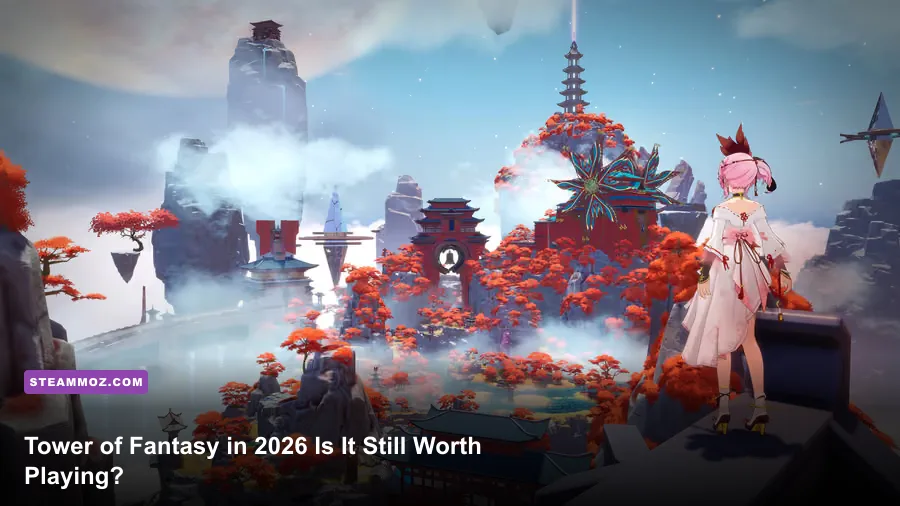
Yes, Tower of Fantasy is still worth playing in 2026—but only if you want a combat-first, anime-styled live-service RPG and can tolerate gacha upkeep. Its open world is less exciting than it was at launch, the story remains uneven, and late-game power depends heavily on keeping up with limited weapons. Yet the free exploration, aerial movement, shared-world events, and flexible three-weapon combat still give it an identity that most mobile RPGs never develop. New players can have a great time without spending money, provided they choose one element, ignore collector impulses, and treat the game as a long-term hobby rather than a traditional single-player RPG.
This is an honest retrospective rather than a launch-era victory lap. Tower of Fantasy has matured since its 2022 release, but maturity has brought both quality-of-life improvements and more intimidating layers of currencies, matrices, advancements, weekly modes, and banner schedules. The question in 2026 isn't whether the game has content. It absolutely does. The real question is whether that content respects the way you want to play.
What Tower of Fantasy Still Does Better Than Its Rivals

The hook still works: you sprint, glide, climb, grapple, surf, and teleport across a science-fantasy world while swapping weapons in real time. Aesperia's Astra, Banges, Navia, and Crown regions feel like the game's most approachable starting point, while Vera's cyberpunk Mirroria and Domain 9 provide more verticality and stranger visual design. Innars adds underwater traversal, and Domain 9 pushes the aerial exploration idea with its floating architecture and futuristic landmarks.
The world isn't as densely reactive as a premium open-world RPG. Many camps are cleared once, environmental puzzles repeat their logic, and dialogue can swing from genuinely moving to aggressively over-written. Still, movement creates a satisfying rhythm. The Jetpack, Omnium Handcannon, grappling tools, and region-specific traversal devices let you reach places that would be inaccessible in a slower action RPG. Exploration also pays out with Black Nucleus, Gold Nucleus, upgrade materials, scenic points, chests, and currency for pulls.
The other enduring strength is weapon swapping. You equip three weapons, each with its own normal attacks, skill, discharge ability, elemental resonance, and shatter or charge profile. You aren't simply changing characters; you're changing the shape of the fight. A shield-breaking weapon can open a boss, a damage weapon can capitalize on the window, and a support weapon can provide healing, buffs, or crowd control. That structure makes even familiar enemies more interesting than they would be in a conventional cooldown-based RPG.
| System | Why It Still Works | Where It Falls Short |
|---|---|---|
| Open-world movement | Fast climbing, gliding, grappling, and region tools make traversal lively. | Older zones can feel empty after the exploration rewards are collected. |
| Three-weapon combat | Swapping creates real rotations instead of passive character collecting. | Meta teams can make off-element weapons feel dramatically weaker. |
| Co-op activities | World bosses and Joint Operations are easy to enter and naturally social. | Matchmaking quality and player damage vary wildly. |
| Story and regions | Vera and Domain 9 deliver memorable visual identities. | Writing, pacing, and quest direction remain inconsistent. |
If you're arriving from another demanding PC game, check our ELEX performance fixes for the same practical approach to stutter, drivers, and frame pacing. Tower of Fantasy benefits from that mindset: smooth traversal matters more than a handful of extra shadows.
How Good Is the Combat and Progression in 2026?
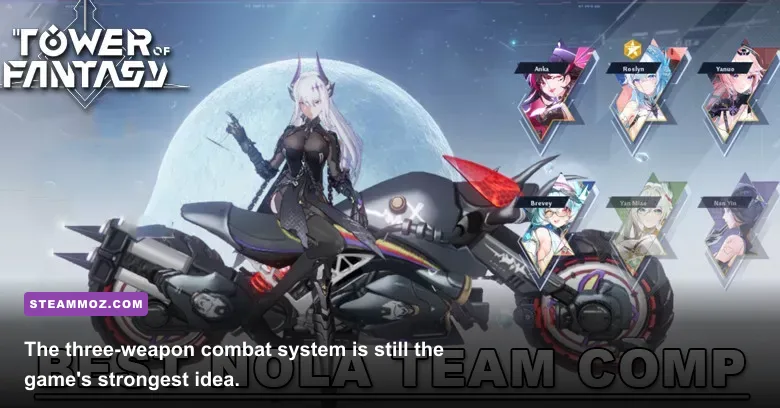
Combat remains the reason to stay. Every weapon has a role beyond its damage number. Roslyn's Frost weapon, Glistening Moon, rewards close-range pressure and precise timing. Nola's Flaming Revolver brings flexible Flame and altered-style utility depending on how you build her. Nan Yin's Lost Art is valuable for altered teams because it contributes off-field pressure and helps maintain a rotation while another weapon occupies the active slot. Brevey's Unity supports Volt-focused setups and gives newer players a forgiving route into healing and damage utility.
These weapons are not interchangeable. The combat model tracks weapon charge and shatter, so a team with three spectacular damage weapons can still struggle against a boss shield. When a boss begins a shield phase, use your highest-shatter option, watch for the break animation, then trigger a discharge from the weapon you want to activate. If you simply mash normal attacks, you'll lose the game's biggest damage windows.
Builds are generally organized around Frost, Flame, Volt, Physical, Altered, or a support role. Elemental resonance rewards specialization, while rainbow teams can be more comfortable for story content but less efficient in competitive modes. Matrix sets add another layer: four-piece sets are powerful, but a fully advanced weapon with mediocre matrices often performs better than an under-advanced weapon wearing a perfect set.
| Team Direction | Core Weapons | Priority | Best Use |
|---|---|---|---|
| Frost | Glistening Moon, Lost Art, a Frost support or shatter weapon | Weapon advancements, Frost attack, charge management | Boss damage and sustained field rotations |
| Flame | Flaming Revolver with a current Flame DPS and shield breaker | Flame attack, burn or discharge timing | Open-world damage and burst phases |
| Volt | Unity with a Volt DPS and utility slot | Volt attack, survivability, skill uptime | Fast rotations and comfortable co-op play |
| Altered | Lost Art plus an altered-focused damage core | Rotation consistency and matrix quality | Flexible teams for experienced players |
| Support | Healing or buff weapon alongside a shatter option | Healing effectiveness, resistance, discharge timing | Joint Operations and raid groups |
Progression is generous at the start and much harsher at the ceiling. Story rewards, events, exploration, achievements, and weekly activities can fund a solid account. The trap is spreading resources across every element. Don't advance three new weapons just because their banners look attractive. Pick one main damage line, keep one dependable shatter weapon, and reserve the third slot for support or a future character who actually improves your rotation.
What new players should prioritize
Finish the main story until the major regions and systems unlock, then spend stamina on the highest available Joint Operation tier rather than farming random low-level materials. Save Dark Crystals for limited banners, not cosmetic impulse purchases. Use the in-game trial stages to test a weapon's movement and skill feel before committing resources. The pity system and Flame Gold can help targeted pulls, but missed planning still hurts: banner currency eventually converts, while the weapon itself does not magically return when you need it.
Is the Gacha Fair Enough for a Free Player?

“Free-to-play friendly” needs a qualifier. Tower of Fantasy is generous enough to let a patient player build a functional team, but it is not generous enough to let a free player collect every limited character, weapon, and matrix set. Those are completely different promises.
The game gives you several routes to Dark Crystals and pull currency: exploration, achievements, events, story progress, weekly activities, and routine account rewards. A disciplined player who skips banners can guarantee important targets more reliably than a casual collector expects. The problem begins when you chase advancements. An A0 limited weapon can be usable, but A1, A3, or A6 improvements may dramatically change comfort, damage, cooldown behavior, or team utility. The gap is especially visible in bygone-style challenge content and leaderboards.
That creates a sensible 2026 rule: stop at A0 unless an advancement clearly fixes a problem your team has. Spend on a weapon first, then consider matrices only after your core roster works. Limited matrices can be excellent, but standard or farmable alternatives are usually good enough for story, exploration, and ordinary co-op. Never borrow currency from your next guaranteed banner because a trial stage made a character look spectacular for five minutes.
| Player Type | Recommended Spending Rule | Expected Experience |
|---|---|---|
| Strict free player | Save for one element and stop most limited weapons at A0. | Strong story and co-op account, weaker leaderboard performance. |
| Low spender | Use monthly value packs and target one or two teams. | Comfortable endgame progression with fewer painful skips. |
| Collector | Budget for characters, advancements, and matrices every cycle. | Broad roster, but expensive and difficult to sustain long-term. |
| Competitive player | Track banners, advancements, matrices, and damage testing closely. | Best performance, highest time and financial pressure. |
The official Tower of Fantasy website and official news feed are worth checking before every pull. Event shops, login campaigns, and rerun schedules can change the value of a banner overnight.
What Is There to Do After the Main Story?
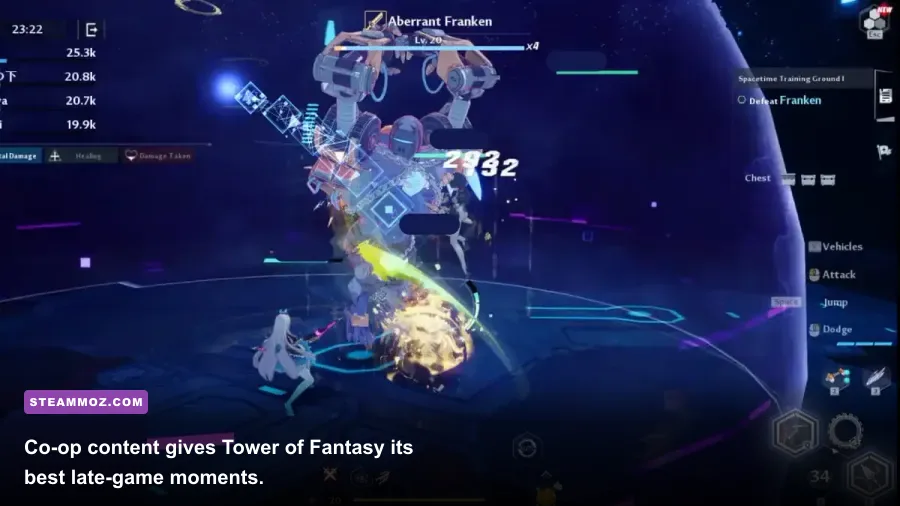
Endgame is where your answer depends most on your habits. If you enjoy routine optimization, Tower of Fantasy offers plenty: Joint Operations, Frontier Clash, Void Abyss, Origin of War, bygone-style solo challenges, world bosses, weekly tasks, event maps, and region exploration. Group activities are particularly good when the matchmaking lands you with players who understand roles. A shield-breaker who times a discharge correctly can save a run, while a support player can cover mistakes that would wipe a damage-only party.
The downside is repetition. Daily and weekly chores can feel like account maintenance, especially when you log in to spend vitality, claim rewards, clear a short event stage, and leave. Some modes also expose the game's power creep. A returning player may understand every mechanic and still hit a wall because their old weapon no longer fits current enemy resistances, advancement expectations, or damage checks.
Don't treat every activity as mandatory. For a healthy routine, complete the weekly currency sources first, farm materials for your active team second, and only touch leaderboards if you genuinely enjoy testing rotations. Exploration is still the best low-pressure content because it gives you a reason to revisit each region without demanding perfect gear.
Players who love hunting secrets may also enjoy our guide to secret locations and hidden rewards. That same approach works here: don't sprint through every map marker. Scenic points, puzzle routes, and tucked-away chests make the world feel better when you discover them naturally.
How Does Tower of Fantasy Perform on PC and Mobile?
Performance has improved, but Tower of Fantasy remains a demanding open-world client. Busy hubs, world bosses, water effects, dense foliage, and large multiplayer events can hammer both GPU and CPU. A locked 60 fps is a better target than chasing maximum texture quality. On a mid-range gaming PC, lowering shadows, vegetation density, reflections, and volumetric effects usually produces a larger gain than reducing texture quality.
On mobile, heat and battery drain are the real enemies. Start at 30 fps with medium or low effects, then increase resolution only if the device stays cool after fifteen minutes in a crowded area. A stable 30 fps feels better than an unstable 60 that throttles into stutter. On PC, use an SSD, close overlays, update graphics drivers, and let shaders finish compiling before judging traversal performance.
| Setting | Recommended Value | FPS Impact | Visual Trade-Off |
|---|---|---|---|
| Frame rate | 60 fps on PC; 30 fps on weaker mobile hardware | High stability benefit | Lower cap feels smoother than constant drops. |
| Shadows | Medium | High | Less contact shadow detail, major gain in hubs. |
| Vegetation density | Medium or Low | Medium to high | Fewer plants and distant environmental details. |
| Reflections | Low or Medium | Medium | Water and polished surfaces look less vivid. |
| Volumetric effects | Low | Medium | Reduced fog, bloom, and atmospheric lighting. |
| Texture quality | High if VRAM allows | Low to medium | Keep this high before sacrificing shadows. |
| Motion blur | Off | Small | Sharper camera movement and combat readability. |
For broader troubleshooting habits, our crashing and low-FPS fixes cover the usual Windows checks, while our FPS settings breakdown explains why shadows and volumetrics are often the first cuts. Those principles apply cleanly here.
Who Should Play Tower of Fantasy in 2026?
Play it if you want a free anime action RPG where movement matters, combat rotations have genuine texture, and co-op is always close at hand. It is also a strong choice if you like experimenting with teams rather than committing to one permanent class. A player who enjoys checking banner calendars, building one element carefully, and slowly clearing new regions can get hundreds of hours without paying.
Skip it if you want a finished narrative with a clean ending, a purely cosmetic monetization model, or a level playing field in every endgame mode. You should also skip it if daily chores and limited-time banners make you anxious. Tower of Fantasy is built around return visits. That can feel like a welcoming living world—or a second job—depending on your tolerance for schedules.
New players should install through the official Steam page if PC convenience matters, but check account-linking instructions before committing to a platform. Make sure your progress is connected correctly, because discovering that your preferred device is using a separate account is a uniquely miserable way to begin a live-service game.
The Final Verdict
Tower of Fantasy is no longer the must-see open-world challenger it appeared to be at launch, but that doesn't make it irrelevant. In 2026, it is a more specialized recommendation: a stylish, mechanically ambitious free-to-play RPG with excellent movement, enjoyable weapon swapping, memorable regions such as Mirroria and Domain 9, and an endgame that rewards commitment. Its weakest points—story pacing, repetition, power creep, and gacha pressure—are impossible to ignore.
My verdict is 7/10 for new players and 6/10 for returning players. New players receive a mountain of content, generous early resources, and several ways to build a viable account. Returning players face the more frustrating job of understanding which older weapons still fit current teams and which currencies, systems, and events they missed. That gap matters.
So, is Tower of Fantasy still worth playing in 2026? Yes, but play it on your terms. Pick one element. Save before pulling. Keep your settings sensible. Enjoy the world instead of treating every weekly mode like a mandatory exam. If you can do that, Tower of Fantasy still has enough speed, style, and combat personality to earn a place in your rotation.