If CITYCONOMY: Service for your City hooked you with garbage trucks, public transport, road maintenance, and the messy reality of keeping citizens happy, the best games like it in 2026 are Workers & Resources: Soviet Republic, Cities: Skylines II, Anno 1800, SimCity 4 Deluxe, and Citystate II. Workers & Resources is the closest match for hands-on service management, while Cities: Skylines II is the best all-round city sandbox.
CITYCONOMY has a narrower focus than most famous city builders. You aren't simply drawing zones and watching towers rise. You’re operating the systems that make a city function: collecting waste, maintaining roads, moving residents, and balancing a municipal budget. That makes the right alternative depend on what you enjoyed most. Want service vehicles and supply chains? Pick Workers & Resources. Want traffic and public transport at huge scale? Choose Cities: Skylines II. Want citizens whose needs drive an entire economy? Anno 1800 is the heavyweight.
The best CITYCONOMY alternatives ranked
Here’s the short version before we get into the mechanics. The rankings weigh service depth, traffic simulation, economic pressure, learning curve, and how satisfying it feels to fix a city that is actively falling apart.
| Game | Tier | Best For | Main Difference From CITYCONOMY |
|---|---|---|---|
| Workers & Resources: Soviet Republic | S-Tier | Hardcore services and logistics | Every utility connects to a detailed production economy |
| Cities: Skylines II | S-Tier | Traffic, zoning, and transport | Much larger sandbox with deeper road simulation |
| Anno 1800 | A-Tier | Citizen needs and supply chains | Island production chains replace modern city services |
| SimCity 4 Deluxe | A-Tier | Classic zoning and regional planning | Older presentation but remarkably sharp simulation rules |
| Citystate II | B-Tier | Politics and social management | Ideology and factions matter more than vehicle operations |

🎮 CITYCONOMY: Service for your City
Looking to experience this game? Grab your digital key directly on our store for $4.99.
View on Steammoz Store →Workers & Resources is the closest match
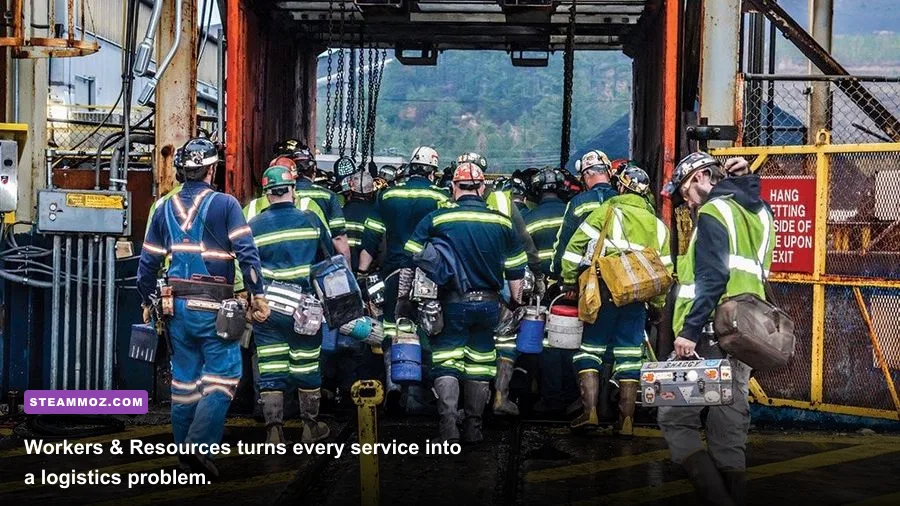
Workers & Resources: Soviet Republic on Steam is the recommendation for players who want CITYCONOMY’s service loop pushed to a wonderfully ruthless extreme. Its realistic mode makes utilities, fuel, labor, storage, and transport physical problems rather than abstract budget sliders.
Start with the basics: a water well, a treatment plant, a pumping station, power connections, and a distribution network. A service building that exists on the map but lacks workers or a working vehicle fleet does nothing. The same principle applies to garbage collection. You need waste containers, collection vehicles, transfer stations, and a final destination. Miss one link and trash piles up while your city’s productivity drops.
The real magic is the transport layer. A coal power plant needs coal delivered by truck, conveyor, or rail. Trucks need fuel. Fuel needs to reach a gas station. Citizens need buses to reach workplaces, and workers standing at a bus stop are not contributing until they arrive. That chain creates the same satisfying “I fixed the city” moments CITYCONOMY aims for, only with more spreadsheets and harsher failure states.
How to avoid an early collapse
Begin with a modest settlement near a customs house. Import electricity and construction materials at first instead of building every industry immediately. Place a bus stop within walking distance of homes and workplaces, then run one short route before expanding. Keep a reserve of cash for fuel and emergency imports. The game’s biggest beginner trap is building a huge industrial district before you have enough workers, trucks, or power to operate it.
Its downside is obvious: the learning curve is steep. If you want a relaxed city painter, this is not it. If you want every service decision to have consequences, it’s the strongest CITYCONOMY alternative available.
Cities: Skylines II wins the traffic battle
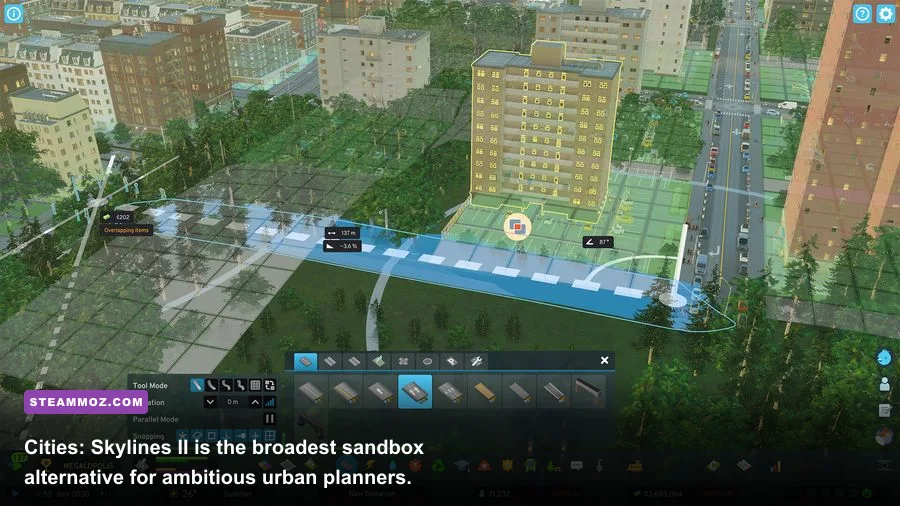
Cities: Skylines II is the better choice when your favorite CITYCONOMY moments involve buses, road layouts, congestion, and watching a city transform from a rural junction into a functioning metropolis. Its simulation tracks citizens through daily activities, while traffic lanes, parking, public transport, garbage, electricity, water, and sewage all interact.
The critical difference is scale. You can separate local streets from collectors and arterial roads, then use buses, trams, subway lines, trains, and intercity connections to keep commuter traffic out of residential neighborhoods. A four-lane road is not automatically better. Adding lanes often creates faster inflow into a bottleneck. A dedicated bus lane, a roundabout, or a second route across town can solve more traffic than widening every street.
For a stable early layout, zone low-density housing behind local roads, connect those roads to a collector, and keep industrial traffic away from residential intersections. Place elementary schools within walking distance, then add a bus route once the city spreads. Watch the Traffic Routes overlay instead of guessing. If one intersection is red while the surrounding roads are green, fix that junction rather than rebuilding the whole district.
Performance still matters in 2026. Large populations and heavy simulation loads can reduce frame rates even when your graphics card is comfortable. Use a 30 or 60 fps target, lower volumetrics and depth of field first, and avoid confusing visual stutter with simulation slowdown. Steamoz’s guide to maximum FPS settings covers the same performance-first thinking, while the PC fixes guide is useful if your broader library is also behaving badly.
| Setting | Recommended Value | FPS Impact | Visual Trade-Off |
|---|---|---|---|
| Depth of Field | Off | Low to medium gain | Less cinematic blur |
| Volumetrics | Low | Medium gain | Less fog and atmospheric lighting |
| Level of Detail | Medium | Medium gain | Buildings simplify sooner at distance |
| Shadow Quality | Medium | Medium gain | Less detailed shadows |
| Texture Quality | High if VRAM allows | Low impact | Keep sharper building surfaces |
Anno 1800 makes every citizen need matter
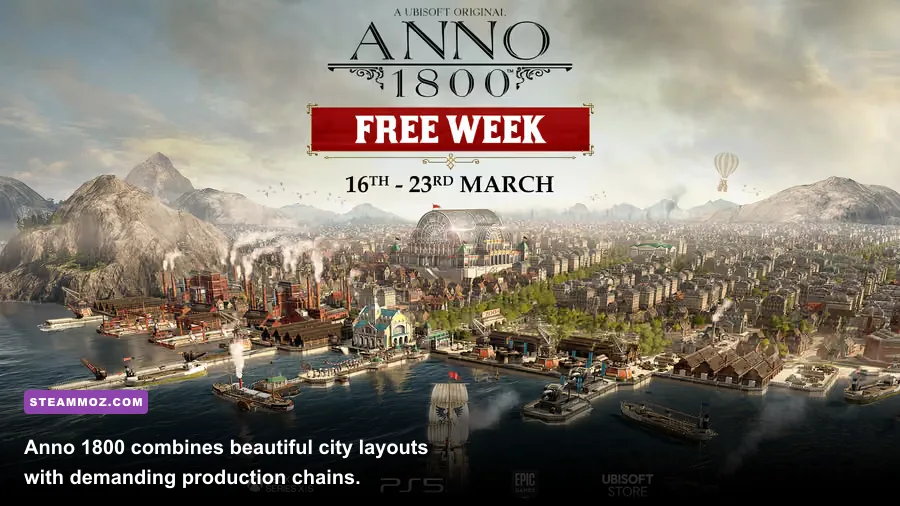
Anno 1800 is not a modern municipal simulator, but it scratches the same management itch with more elegant production chains. Instead of optimizing garbage trucks and road crews, you satisfy escalating population tiers. Farmers need fish and work clothes; Workers add sausages and bread; Artisans demand soap, school access, canned food, and more advanced goods.
The important lesson is that expansion creates obligations. Upgrade too many residences at once and you can suddenly need coal, steel beams, canned food, or sewing machines that your current island cannot produce. The best players upgrade in controlled blocks, checking supply percentages and warehouse stock before moving to the next tier.
Place production buildings near warehouses to reduce transport time, but don’t pack every factory into the capital. Pollution lowers the appeal of nearby homes, so create dedicated industrial districts and connect them with harbor routes or commuter piers. Fire stations, police coverage, and public buildings also reward compact planning. Anno’s city satisfaction system is less granular than CITYCONOMY’s service vehicles, but its economy is deeper and its visual feedback is superb.
Try it if you enjoy the feeling of a city growing faster than its infrastructure can handle. Skip it if you specifically want to drive a garbage truck or micromanage modern roads.
SimCity 4 still understands urban pressure
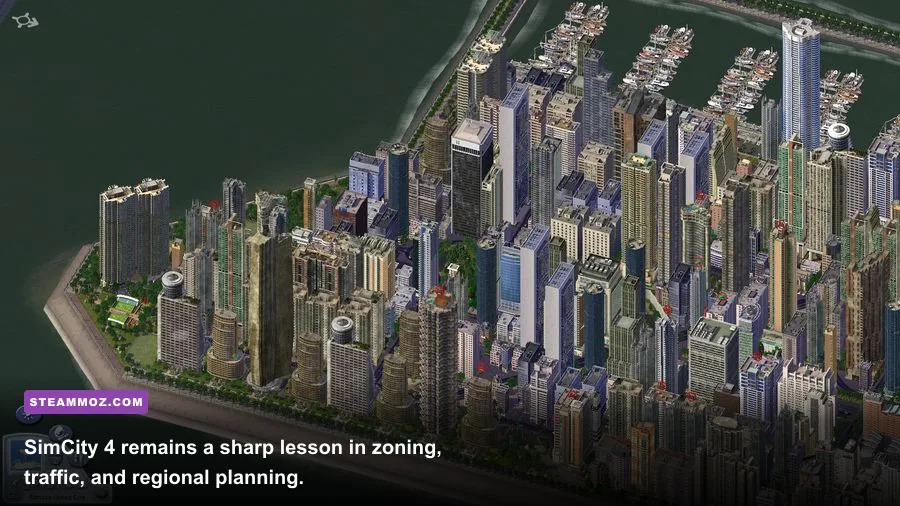
SimCity 4 Deluxe looks ancient beside newer builders, but its regional structure and demand simulation remain excellent. The game separates residential, commercial, and industrial demand into the famous RCI system. Your job is not to build whatever looks attractive; it’s to provide the jobs, education, transport, utilities, and land value that make the next development possible.
Its strongest feature is the region. One city can specialize in dirty industry, another in offices, and a third in high-value residential development. Neighbor deals let cities share power, water, garbage capacity, and commuters. That makes service planning feel genuinely regional rather than trapped inside one map.
Traffic is less physically detailed than in Cities: Skylines II, but road hierarchy still matters. Use streets for local access, roads for neighborhood collectors, and avenues for major movement. Keep heavy industry near rail and highways. A coal plant placed beside expensive homes may solve your power shortage while quietly destroying land value and demand.
SimCity 4 also benefits from its mature mod scene, although you should install gradually and keep backups. The vanilla game is the cleanest way to learn its rules. For more classic PC recommendations, Steamoz’s 2026 classic-games feature is a worthwhile detour.
Citystate II is the wildcard pick
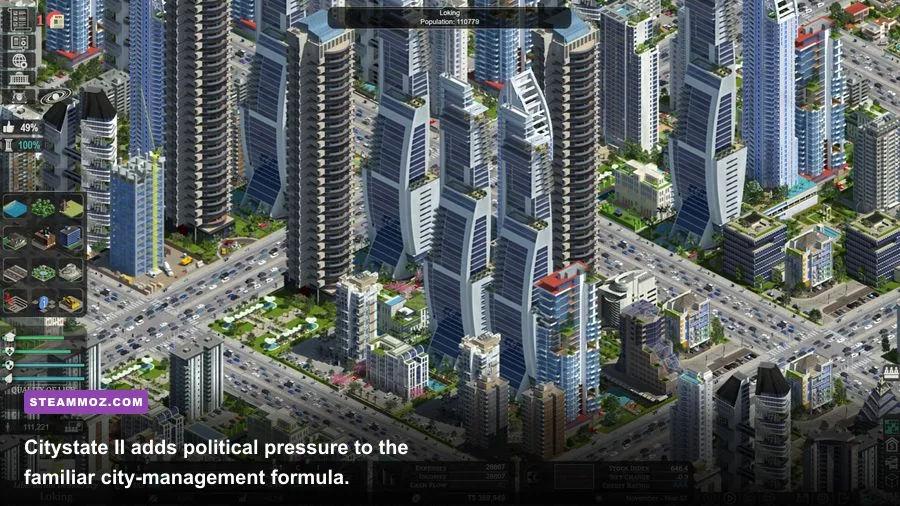
Citystate II belongs on this list because it asks a question CITYCONOMY mostly leaves in the background: who actually supports your policies? You develop a city while managing political factions, laws, public opinion, taxation, immigration, and social tensions. The city is not only a machine of roads and services; it’s a political argument that can turn against you.
Its systems are more abstract than Workers & Resources. You won’t get the same granular truck routing or production-chain engineering. Instead, your decisions push ideological groups toward approval or revolt. Expanding welfare can protect lower-income residents while damaging your budget. Restricting immigration may please one faction and hurt labor availability. High taxes can fund services but reduce growth and private investment.
Choose Citystate II when you want consequences beyond traffic jams. It’s especially good after you’ve exhausted the familiar “zone, connect utilities, wait for growth” loop. The interface takes time to read, and its presentation is less immediately polished than Anno 1800, but the political layer gives it a personality few city builders match.
Which game should you play first?
Pick Workers & Resources if you want the closest mechanical follow-up to CITYCONOMY and don’t mind failure. Pick Cities: Skylines II if roads, traffic, zoning, and public transport are your priority. Choose Anno 1800 for a gorgeous economy built around citizen needs, or SimCity 4 for classic regional planning that still rewards careful thinking. Citystate II is the left-field choice for players who want ideology and public opinion to shape the skyline.
| Your CITYCONOMY Priority | Best Game | First System To Learn | Difficulty |
|---|---|---|---|
| Waste, utilities, and service logistics | Workers & Resources | Imports, workers, and distribution | Very High |
| Roads, buses, and congestion | Cities: Skylines II | Road hierarchy and transit routes | Medium |
| Citizen needs and economic chains | Anno 1800 | Production ratios and warehouse access | Medium |
| Zoning and regional growth | SimCity 4 Deluxe | RCI demand and neighbor deals | Medium |
| Politics and public approval | Citystate II | Faction demands and tax policy | Medium-High |
The smartest 2026 route is to start with Cities: Skylines II for a familiar modern interface, then move to Workers & Resources when you want the simulation to stop forgiving mistakes. If you prefer a calmer but deeper economic rhythm, Anno 1800 is the standout. CITYCONOMY’s appeal is that it makes everyday city services feel important; these games take that same idea and build entire worlds around it.
For more focused strategy guides, check Steamoz’s hidden-rewards guide and the gear tier list. They’re different genres, but both reward the same habit that makes city builders click: understand the system before you expand it.