The best weapons in Holy Potatoes! A Weapon Shop?! are not one fixed list of legendary names. The game’s weapon output depends on weapon family, material quality, crafter skill, workshop upgrades, and the hero’s request. For a reliable ranking, prioritize high-quality Swords for general-purpose orders, Bows when speed and ranged demand matter, Staves for magic-focused heroes, and Guns when you can afford the slower, more specialized production curve. A mediocre weapon built at the wrong time can hurt your shop more than a lower-tier weapon that perfectly matches an active quest.
This distinction matters because Holy Potatoes! A Weapon Shop?! is a shop-management RPG, not a conventional loot game with a permanent best-in-slot sword. You run a fantasy forge, recruit and train potato workers, research blueprints, gather resources, and supply heroes before they head into danger. The strongest strategy is therefore a ranking of weapon families and production situations rather than a fake list of fixed unique items. This guide breaks down that ranking, explains the stats that actually move an order forward, and shows how to turn your workshop into a dependable equipment pipeline.
How this weapon tier list actually works
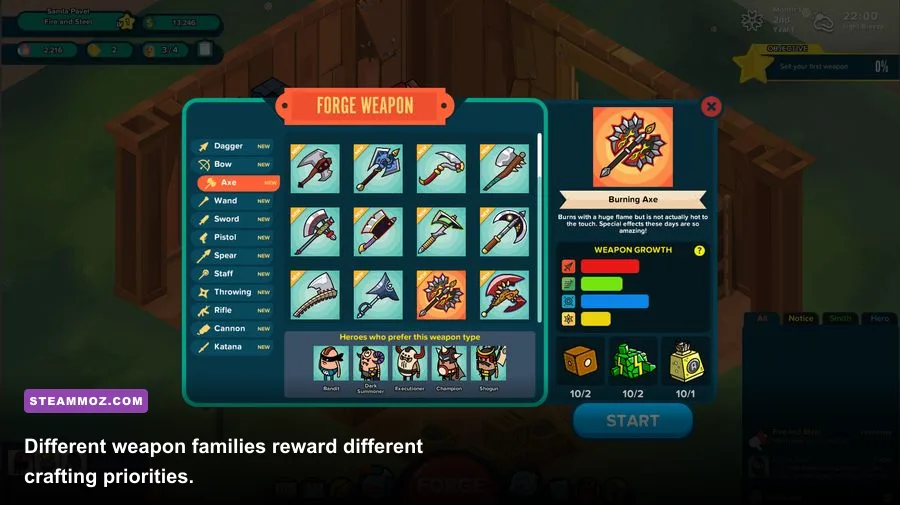
The tier ratings below judge each weapon family by five practical questions: how often it appears in useful requests, how flexible it is across hero types, how expensive it is to produce, how quickly your shop can deliver it, and how safely it scales into later chapters. The rating is about shop performance, not just the largest number shown on a finished item.
There is no single permanently correct weapon because orders are contextual. A powerful Staff is worthless if your active hero wants a Bow and the quest timer is already running. Likewise, a Gun may look attractive because of its specialist identity, but rushing that production line before your materials and workers are ready can leave the rest of the store under-equipped.
| Weapon family | Tier | Best use | Main drawback |
|---|---|---|---|
| Sword | S-Tier | General orders, dependable early progression, flexible stock | Can become expensive when pushed to top quality |
| Bow | A-Tier | Fast ranged orders and speed-focused heroes | Less forgiving when the requested stat is missed |
| Staff | A-Tier | Magic-oriented requests and specialized hero builds | Needs the right materials and crafter profile |
| Gun | B-Tier | Specialist late-game orders and high-value requests | Slower, more demanding production curve |
Think of this as a priority chart. S-Tier means “build this whenever the shop can support it,” not “ignore every other weapon.” A-Tier weapons become excellent when a quest or customer specifically rewards their profile. B-Tier means the item has a place, but you should not let it consume your best resources before the workshop is stable.
For more management-game decision making, the resource discipline in our Heart of the Machine beginner build guide is a useful comparison: early efficiency beats glamorous upgrades that arrive too soon.

🎮 Holy Potatoes! A Weapon Shop?!
Looking to experience this game? Grab your digital key directly on our store for $0.99.
View on Steammoz Store →S-Tier: Swords are the safest all-round investment
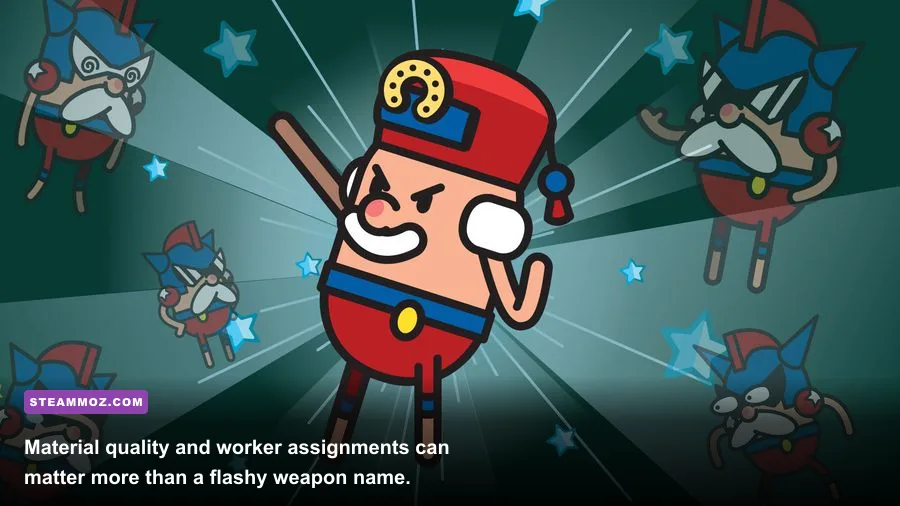
Swords take the top spot because they are the most forgiving foundation for a growing shop. They are straightforward to understand, useful for a broad spread of hero requests, and usually easier to keep in production than highly specialized equipment. If you only have enough material for one serious crafting queue, the Sword line is the safest place to spend it.
Why Swords dominate the early and middle game
The main advantage is flexibility. A Sword order can keep your workshop earning while you wait for better materials, unlock additional blueprints, or train a weaker worker. You can also use swords to test which worker combinations produce the quality and stat profile your current customers want without committing your entire inventory to a narrow weapon type.
That doesn’t mean you should mass-produce the cheapest sword forever. Low-quality stock may satisfy a basic order, but it leaves money and reputation on the table once customers begin asking for stronger equipment. Watch the requested quality and attributes, then assign your strongest sword-oriented crafter to the job that has the highest payoff or the tightest deadline.
The best Sword production pattern
Keep one dependable Sword blueprint available for routine orders, and reserve premium materials for requests that clearly pay for the jump in quality. Don’t burn rare components simply to create a weapon that sits on the shelf. A finished item only helps when it matches demand, so your production queue should follow active orders rather than personal attachment to a favorite design.
Swords are also excellent for stabilizing the shop after an expensive upgrade. If your cash is low, use a reliable Sword order to rebuild income before experimenting with more demanding Guns or high-end Staves. That steady rhythm is less exciting than gambling on a huge sale, but it keeps your workshop alive.
| Sword situation | Priority | Recommended action | Why it works |
|---|---|---|---|
| Early basic request | High | Use a trained generalist and common materials | Fast completion without damaging reserves |
| High-quality customer order | Very high | Assign the best Sword crafter and premium components | Improves payoff on a guaranteed sale |
| No active Sword demand | Low | Pause production instead of filling storage | Prevents cash being trapped in unsold stock |
| Shop recovering financially | High | Return to dependable Sword orders | Creates a safer income baseline |
A-Tier: Bows reward speed, timing, and clean orders
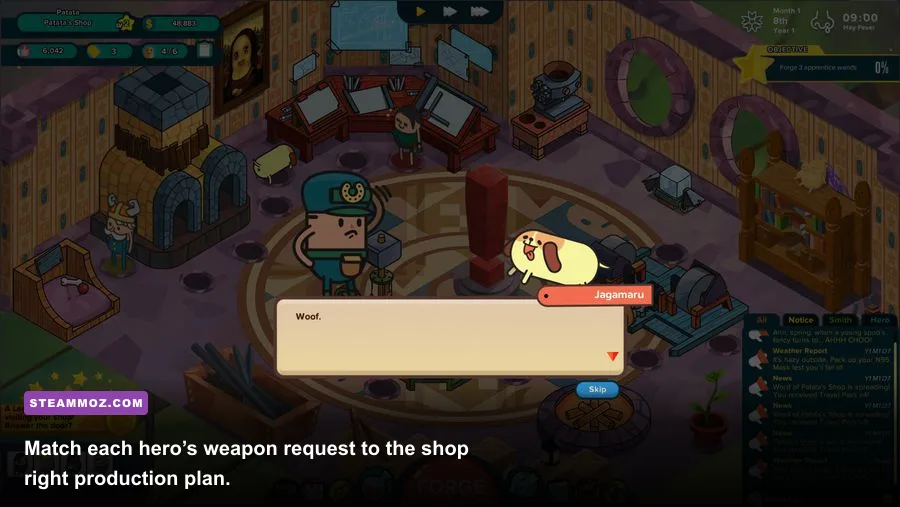
Bows sit just below S-Tier because they are excellent when the request lines up with them, but less universal than Swords. Their biggest practical value is production tempo. When a Bow order asks for a clear quality or stat target, a well-assigned crafter can turn it around quickly and keep your customer queue moving.
That speed becomes especially useful when several heroes are waiting on equipment at once. A Bow can prevent one slow, complicated order from clogging the workshop while you handle another request. This is where many new players lose momentum: they chase maximum quality on every item, let a queue stall, and miss easier revenue opportunities that would have funded the next upgrade.
How to get the most from Bows
Use Bows as a precision tool. Check the request before selecting the crafter, then look for the worker whose strengths best match the desired result. A fast completion is valuable, but not if it misses the customer’s required quality or attribute. The right Bow is the one that clears the order cleanly, not necessarily the one with the highest theoretical ceiling.
Keep a modest Bow pipeline available when the game starts presenting more ranged heroes. Don’t overstock them early, though. Storage space and materials are limited, and a shelf full of unsold Bows is just money wearing a wooden frame.
Players who enjoy optimizing action-game equipment can apply the same “match the tool to the situation” mindset to our Ghostrunner weapon ranking, although Holy Potatoes replaces reflexes with production planning.
A-Tier: Staves shine when the request is specific
Staves are another A-Tier family, and their ceiling can feel higher than their ranking suggests. The problem is consistency. Staves are at their best when you have a magic-focused request, the necessary blueprint, and a crafter who can reliably reach the target. Without those ingredients, they can become an expensive detour.
The important lesson is to stop treating every weapon as a generic damage stick. Staff requests usually reward a more deliberate production decision. Read the hero’s requirements, inspect the quality threshold, and compare the expected sale against the materials you would spend. If the order is valuable and your workshop can hit it, Staves are absolutely worth prioritizing. If not, return to the Sword line and build your economy first.
When a Staff outranks a Sword
A Staff should jump ahead of a Sword when three conditions are true: the order is active, the customer’s requested profile matches your available materials, and the assigned worker has enough skill to produce a dependable result. This is the kind of conditional strength that defines A-Tier equipment.
Research also matters here. New blueprints can expand your options, but every unlock competes with workshop upgrades and worker development. Don’t research a Staff simply because it appears interesting. Research it when it answers a demand problem or unlocks a profitable order type you can actually fulfill.
That same balance between abilities and practical utility appears in our guide to GRIS abilities that still matter: the strongest option is often the one that fits the immediate challenge, not the flashiest one on paper.
B-Tier: Guns are powerful, but don’t rush the production line
Guns rank B-Tier for most of a normal playthrough because their value is tied to specialization and timing. They can be the right answer for a lucrative late request, but they are a poor first answer to a struggling shop. Their production demands make mistakes more painful, especially when rare materials or your best worker are tied up for too long.
Once your workshop has stronger workers, better blueprints, and a reliable stream of resources, Guns become much more attractive. At that point, you can absorb a longer crafting cycle and still fulfill routine Sword, Bow, and Staff orders. Before then, a Gun project can create a nasty chain reaction: one delayed item blocks a worker, the next order expires, and your cash flow drops just when you need it for an upgrade.
When Guns deserve priority
Build a Gun when the request pays enough to justify the resource commitment, the deadline gives you room, and the item’s requested profile fits your available crafter. If any of those pieces are missing, wait. A Gun is not automatically better because it looks like an advanced weapon.
Use the same rule for rare materials. If a material can improve several guaranteed orders, don’t spend it on a speculative Gun sitting in storage. Inventory is not a trophy cabinet; it’s your production budget.
Weapon quality, materials, and worker assignments
The tier of a weapon family is only half the story. A low-quality S-Tier Sword can lose to a well-made A-Tier Bow if the Bow perfectly satisfies an urgent request. Three systems decide whether a weapon is genuinely good: the quality of the recipe and materials, the worker assigned to craft it, and the timing of the order.
Start with workers. Your best crafter should handle the highest-value order they can complete reliably, not automatically every premium weapon. A specialist wasted on a basic request is an opportunity cost. At the same time, assigning an inexperienced worker to a demanding Gun or Staff order can produce a result that fails the customer’s requirements and wastes the materials anyway.
Next, compare the material cost with the reward. Better components can raise the final quality, but the improvement only matters if it crosses a meaningful customer threshold or increases the sale enough to justify itself. Common materials are perfectly fine for routine orders. Save rarer resources for requests that explicitly reward excellence.
| Production decision | Best choice | Common mistake | Practical fix |
|---|---|---|---|
| High-value urgent order | Best matching worker and strong materials | Using a generalist to save a small amount | Protect the guaranteed payout |
| Routine low-tier order | Reliable worker and common components | Spending rare materials | Keep premium stock for demanding requests |
| Experimental weapon | Test only when the queue has spare capacity | Blocking every other order | Protect workshop throughput first |
| New blueprint | Unlock when it answers real demand | Researching without an income plan | Pair research with a profitable order path |
The best upgrade order for a stronger shop
Weapon ranking means little if your workshop cannot produce consistently. Early upgrades should improve throughput and reliability before you chase the highest possible item quality. More production capacity, better workers, and useful research create a compounding advantage: every successful order gives you more money and flexibility for the next one.
Recruit workers whose strengths cover different weapon families instead of stacking a narrow roster. A shop staffed entirely for one weapon type may produce impressive items, but it will struggle whenever customer demand shifts. Cross-training is valuable because it lets you respond to an unexpected order without abandoning your main production line.
Keep an eye on fatigue and task assignment as the shop grows. A tired or poorly matched worker can turn a safe order into a gamble. The game rewards active supervision, so revisit the workshop whenever a valuable request appears rather than letting the queue run unattended for long stretches.
For PC players dealing with technical problems in other demanding Steam releases, our guides to Ghost Recon Breakpoint crashes and Hunt: Showdown performance fixes cover a different kind of optimization. Here, the bottleneck is usually your production plan.
Common tier-list mistakes that cost you money
Chasing the highest quality on every order: Quality is valuable, but an expensive overbuilt item can be worse than a fast, correctly targeted sale. Read the reward and requirement first.
Stockpiling weapons “just in case”: Stored equipment ties up materials and cash. Build for visible demand unless you have a clear reason to maintain a small emergency reserve.
Ignoring deadlines: A technically superior weapon that arrives too late is a failed business decision. Prioritize completion when the request window is tight.
Unlocking every blueprint immediately: New options are exciting, but research without supporting workers or resources spreads your shop thin. Build a foundation before expanding the menu.
Ranking weapons without considering heroes: The customer’s requested weapon family and quality target should always outrank a generic tier label. The best weapon is the one that clears the current order profitably.
Final ranking and the winning shop mindset
For most players, the practical order is Sword first, Bow and Staff next, Gun last. Swords provide the safest baseline and deserve S-Tier status because they keep the shop flexible. Bows are excellent for quick ranged demand, while Staves deliver strong returns when your magic-focused orders and worker skills line up. Guns can be extremely worthwhile, but they should usually wait until the workshop has enough capacity and financial breathing room.
Check the current requests before every major crafting decision. Assign workers based on the required result, not habit. Spend premium materials only when the reward or quality threshold justifies them. Most importantly, treat the tier list as a decision tool rather than a rigid rulebook. Holy Potatoes! A Weapon Shop?! is at its best when you react to demand, build around your staff, and turn a modest order into a smooth production chain.
You can find the game on the official Steam store page, while the developer’s Daylight Studios website provides information about the studio and its games. For broader series details, check the publisher’s official HandyGames site.