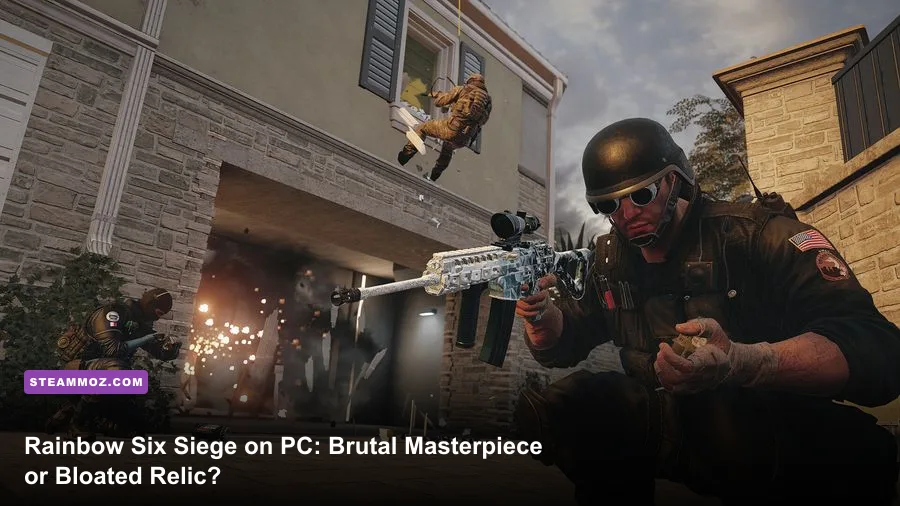
If you want the direct, unvarnished verdict: yes, Rainbow Six Siege on Steam is still entirely worth playing on PC, but only if you are looking for an uncompromising, high-stress tactical shooter that rewards map knowledge and game sense over raw twitch reflexes. There is still nothing quite like it on the market. Valve has Counter-Strike 2 and Riot has Valorant, but neither provides the heart-stopping verticality, real-time spatial dismantling, and gadget-driven mind games that define Siege. That said, jumping in today means navigating an intimidating mountain of legacy mechanics, a roster bloated past 70 operators, and a controversial Ranked 2.0 system that tests your patience as much as your crosshair placement.
Gunplay and Destruction: The Mechanics No Other Shooter Can Clone
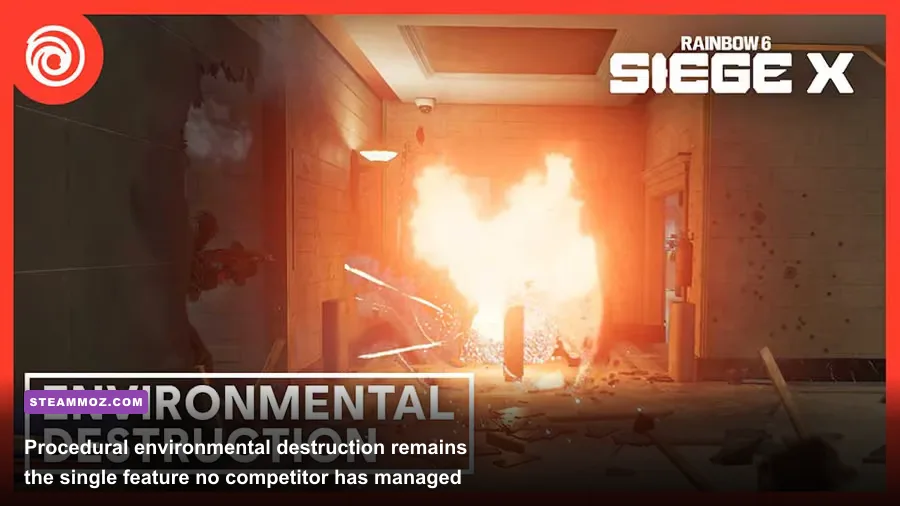
The foundational core of Siege has not lost an ounce of its luster. While competing tactical shooters lock you into symmetrical corridors with static geometry, Siege treats every map like a modular puzzle box made of drywall, wood studs, and reinforced steel. The procedural destruction engine remains unrivaled. You do not just check corners; you punch punch-holes through cubicle walls to create pixel-peeks, use Buck’s Skeleton Key to strip wooden ceilings from below, or blast murder-holes through bathroom floors to deny default plant spots on the bomb site underneath.
That mechanical freedom creates unmatched tactical depth, but it also establishes the highest environmental barrier to entry in modern multiplayer gaming. Gunplay is anchored around the lethal one-shot headshot mechanic (1x HS kill). Regardless of whether you fire Ash’s R4-C, Bandit’s MP7, or a suppressed P9 sidearm, a single bullet to the skull drops an enemy instantly. This mechanic keeps round outcomes razor-thin; even if you are down in a 1v4 clutch situation, superior positioning, sound discipline, and disciplined reticle height allow you to pull off miraculous round swings.
Ubisoft has spent recent seasons reining in the runaway 'run-and-gun' swing-or-be-swung meta that plagued the game around Year 7 and Year 8. The developers overhauled optic options—largely retiring universal 1.5x zoom crutches in favor of clearly distinguished 1x reflex/holo sights and magnified telescopic scopes assigned strictly by operator balance—while introducing heavier movement penalties for fully kitted defenders. If you've been grinding other arcade shooters where aggressive slides reign supreme, Siege’s measured, heavy movement will feel like walking through wet cement at first. But when you execute an orchestrated push—flashes blinding anchors, an EMP disabling electronics, and a hard-breach opening sightlines into the objective—the rush is unmatched. For players seeking that deliberate pacing, exploring different weapon classes and handling traits reveals how much deliberate mechanical tuning separates tactical masterclasses from standard arcade shooting galleries.
The Operator Roster: Tactical Depth vs. Information Overload
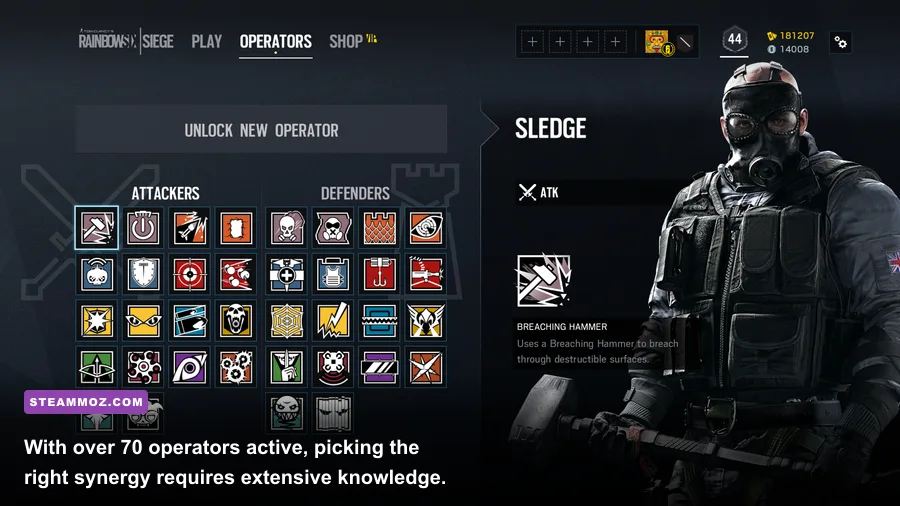
When Siege launched, its twenty "Pathfinder" operators filled simple, binary roles: Thermite melted reinforced walls, Thatcher disabled electronics, and Mute jammed signals. Today, the operator select screen looks like an encyclopedic military catalog. With more than 70 operators split across Attack and Defense, the sheer volume of gadgets, secondary utility interactions, and passive synergies can cause genuine cognitive overload.
Recent additions have dramatically warped the tactical meta. Operators like Azami turned site setup on its head with Kiba Barriers—bulletproof, expanding chemical foam that creates synthetic cover, closes destroyed walls, and constructs completely custom angles out of thin air. Fenrir brought panic-inducing dread with his F-NATT mines, blinding attackers in a smoky haze of hallucinogenic fear toxin. Meanwhile, utility-denial defenders like Tubarão freeze gadgets and gadgets-in-progress, stalling hard breaches with chilled liquid nitrogen, while attackers counter with Deimos, a ruthless hunter who reveals an enemy's exact live location at the cost of pinging himself.
This design escalation means you cannot simply master two or three characters and expect to cruise. You must understand hard-counter chains: running an IQ or Twitch to spot hidden electronics, packing impact EMPs to bail out your hard breacher when Thatcher is banned, or utilizing Solis to punish attackers scrolling through their observation drones. The roster variety keeps matches endlessly dynamic, though it undeniably punishes casual drop-in players who don't follow patch notes religiously.
| Operator | Side | Primary Role | Signature Gadget | Meta Tier & Strategic Value |
|---|---|---|---|---|
| Azami | Defender | Architect / Anchor | Kiba Barrier (Solidifying Foam) | S-Tier: Completely rewires site defense; constructs bulletproof cover and plugs breaches. |
| Fenrir | Defender | Trapper / Crowd Control | F-NATT Dread Mine | S-Tier: Highly contested ban; severely limits attacker vision and controls chokepoints. |
| Ace | Attacker | Hard Breach / Fragger | SELMA Aqua Breacher | S-Tier: The most versatile wall-opener in the game; armed with the devastating AK-12. |
| Dokkaebi | Attacker | Intel Denial / Roam Clear | Logic Bomb Phone Hack | A-Tier: Forces defenders to turn off ringing phones, generating free audio intel. |
| Tubarão | Defender | Breach Denial / Stall | Zoto Canister (Cryo Freeze) | A-Tier: Temporarily freezes exothermic charges, electronics, and slows attacker pushes. |
| Deimos | Attacker | Roamer Hunt / Duelist | DeathMARK Tracker Micro-Drones | B-Tier: Devastating in coordinated stacks; risky in solo play due to mutual location reveal. |
Ranked 2.0 and Competitive Integrity: The Real State of Matchmaking
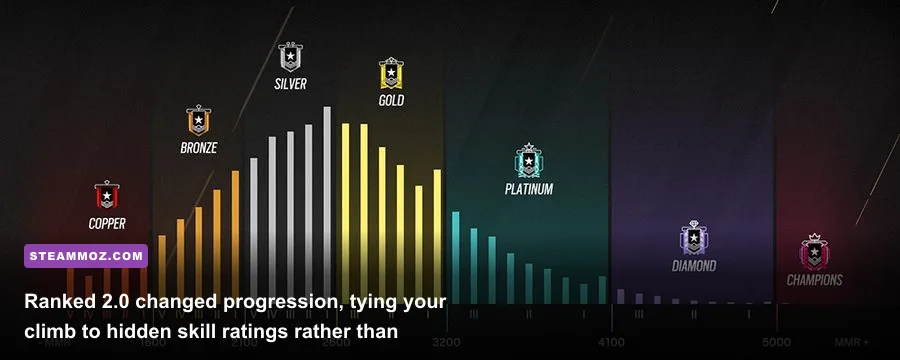
If there is one aspect of modern Siege that continues to ignite furious community debate, it is the competitive infrastructure. The introduction of Ranked 2.0 fundamentally reshaped how the game evaluates and rewards skill. In the classic system, your visual rank was directly pegged to your MMR; if you won your ten placement matches with flying colors, you immediately landed in Gold or Platinum. Ranked 2.0 tossed placement matches entirely, forcing every player to start the season at Copper V and grind upward.
Under the hood, your matchmaking is not dictated by your visual badge (Copper, Silver, Emerald, or Champion). Instead, it matches you against players sharing your "hidden skill rating." If the backend algorithm thinks you play like a high-Emerald veteran, you will face Emerald-caliber players while you are technically sitting in Bronze. The system compensates by granting you massive Rank Point (RP) gains (often +80 to +110 per victory) and minimal losses until your visual rank catches up to your hidden skill. While this guarantees steady seasonal progression and eliminates early-season ladder anxiety, it often leaves solo-queue warriors feeling bewildered when they spot Diamond weapon charms on players in their visual Gold lobbies. You can inspect player stats and track hidden MMR trajectories directly via the R6 Tracker database to better understand who you're actually sharing servers with.
Beyond the progression philosophy, competitive integrity remains a perpetual arms race. Ubisoft has bolstered its defenses with the proprietary QB architecture alongside BattlEye and implemented MouseTrap to punish input-spoofers on consoles. On PC, blatant spin-botters are caught swiftly, but subtle recoil scripters and wallhackers still slip through the cracks during peak season launches. If you play solo, communication can be a coin toss between silence and unfiltered lobby toxicity. However, if you recruit a reliable 3-to-5-stack through community Discord servers, Siege transforms into the most exhilarating tactical team sport on PC. Dealing with competitive pressure and latency feels very familiar to anyone fine-tuning their setup for fighting games, as detailed in our guide on competitive PC specs and low input latency.
Performance, Hardware Demands, and the Siege Engine
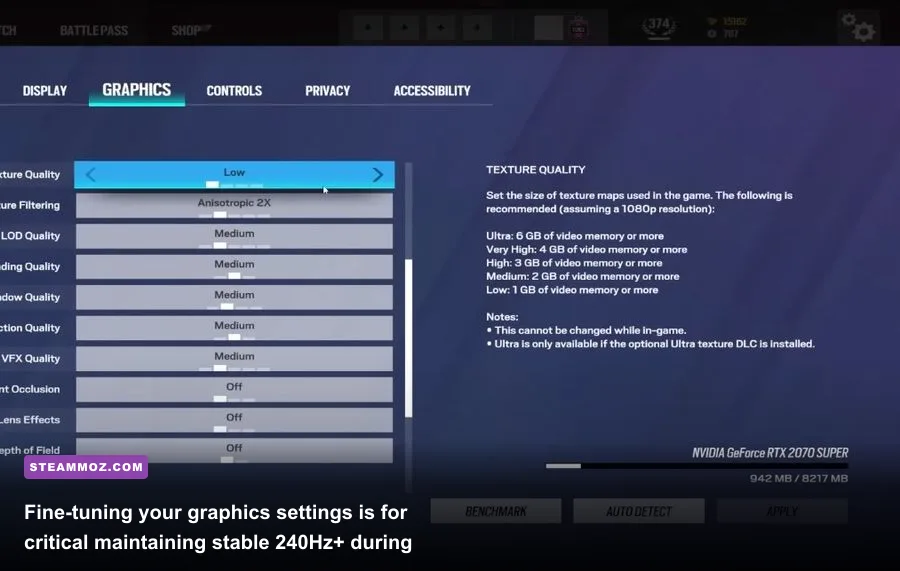
From a purely technical perspective, Siege is an engineering marvel that has aged remarkably well. Built on an upgraded version of Ubisoft's proprietary AnvilNext engine, the game runs smoothly across a vast spectrum of hardware. Whether you are running an aging GTX 1660 Super or a cutting-edge RTX 4080 Super, achieving high, stable framerates is remarkably accessible—provided you understand which settings actually impact your competitive clarity.
Ubisoft officially transitioned its graphics rendering pipeline to DirectX 12, phasing out the legacy Vulkan implementation that many PC veterans leaned on for years. While the DX12 backend initially brought minor stuttering on older CPUs, recent engine optimizations have stabilized frametime pacing. The game fully supports NVIDIA Reflex and low-latency rendering, pushing input delay down to single-digit milliseconds on competitive displays. In a game where holding a pixel-thin doorway gap determines whether you live or die, maintaining locked 144Hz, 240Hz, or 360Hz refresh rates provides an undeniable tactical edge.
To extract maximum clarity without introducing visual noise, you must strip away graphical clutter. Volumetric lighting and ambient occlusion might make the bank lobby look moody and cinematic, but they actively obscure enemy silhouette contrasts in shadowed corners. If you've ever dealt with sudden engine frame drops or stutters in demanding games, troubleshooting them follows similar principles to our PC fixes that stop crashes and rescue framerates. Below is the battle-tested competitive graphics configuration used by high-tier ranked and pro-circuit players to maximize framerates and target clarity.
| Graphics Setting | Competitive Value | FPS Performance Impact | Tactical / Visual Advantage |
|---|---|---|---|
| Overall Quality / Resolution | Native 1080p / 1440p (100% Render Scale) | Baseline | Never use sub-sampling; pixelated edges ruin target identification at 30+ meters. |
| Texture Quality | Medium or High | Negligible (VRAM Dependent) | Keeps operator uniforms and weapon sights sharp without muddying textures. |
| Texture Filtering | Anisotropic 16x | Minimal (~1-2%) | Clarifies angled surfaces, floor breaches, and murder-holes at oblique angles. |
| LOD (Level of Detail) Quality | Ultra | Low (~3%) | CRITICAL: Prevents distant operator models and barricades from de-rendering into low-poly meshes. |
| Shading Quality | Low | Moderate (~6-8%) | Eliminates unnecessary lighting shaders that darken rooms and hide defenders. |
| Shadow Quality | Medium | Moderate (~5%) | Renders dynamic player shadows without wasting GPU power on soft environmental shading. |
| Ambient Occlusion | Off | High (~8-12%) | Removes dark contact shadows around corners, making hiding operators stick out cleanly. |
| Lens Effects & Bloom | Off | Low (~2%) | Removes blinding optical glare when peering through exterior windows into the sunlight. |
Stripping away post-processing fluff like Motion Blur and Depth of Field is mandatory. For players who love extracting every last frame out of their rig, the tuning logic matches what we recommend in our breakdown of settings for maximum FPS in modern open-world shooters. Set your Field of View (FOV) between 84 and 90; this widens your peripheral vision to catch flanking roamers without turning your center screen into an unreadable fisheye lens.
The Siege Marketplace and Monetization: Skin Trading Revolution
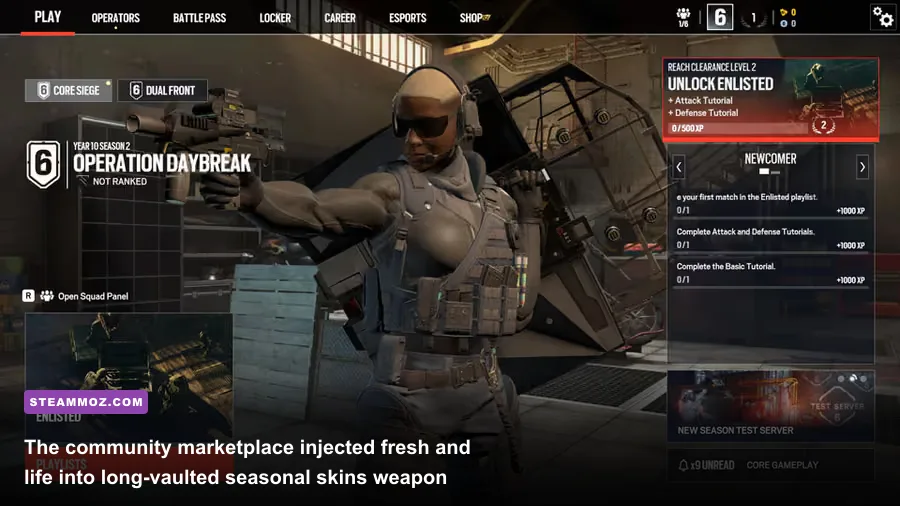
Monetization in live-service titles is frequently a point of irritation, but Siege introduced a system that genuinely rewarded its veteran community: the Siege Marketplace. Accessible through an official web portal, this peer-to-peer trading hub allows players to buy and sell weapon skins, headgears, uniform sets, and universal attachments using R6 Credits—the game's premium currency.
This single addition completely transformed cosmetic collection. Ultra-rare historical items—such as the coveted Glacier weapon skin from Year 1 Pro League packs, vintage Dust Line seasonal camos, or long-vaulted seasonal universal skins—command massive value on the open market. Players who sat on inventories packed with alpha pack drops from 2016 suddenly found themselves sitting on tens of thousands of R6 Credits. This economy allows savvy traders to fund their seasonal Battle Passes, Elite Skins, and event bundles without ever having to swipe a real-world credit card again.
Naturally, Ubisoft still maintains traditional monetization vectors: a tiered seasonal Battle Pass, paid Elite Sets containing retro character models and victory animations, and the optional "R6 Membership" monthly subscription. While the subscription service was met with fierce backlash from the hardcore player base when first unveiled, the core game remains mechanically fair. Every gameplay-relevant asset—operators, standard attachments, and base weapons—is earnable purely through Renown accumulated by playing matches. There are zero pay-to-win stat boosts, and cosmetic visibility has been improved thanks to rim-lighting options that prevent camouflaged skins (like the notorious Ember Rise uniforms) from blending into dark walls.
The New Player Experience: Can a Beginner Actually Survive Today?

We cannot discuss modern Siege without addressing the towering elephant in the room: onboarding. For years, Siege had the most merciless new player experience in gaming. You bought the client, finished a handful of offline "Situations," hopped into Casual, and immediately got wallbanged through three reinforced walls by a level 300 player who heard you step on a shard of broken glass two rooms over.
To Ubisoft’s credit, they have poured serious development hours into revamping new player tools. The updated Map Training mode allows you to explore complex layouts like Clubhouse, Oregon, Consulate, and Nighthaven Labs with clear pathfinding guides. You can run Target Drill, clearing rooms populated by aggressive dummy targets to memorize common anchor angles and pre-fire spots. The Shooting Range is now one of the most comprehensive in the genre, featuring damage charts, distance sliders, target speed controls, and full recoil spray-wall testing. You can keep tabs on upcoming onboarding adjustments and seasonal roadmaps directly through Ubisoft's official Rainbow Six site.
Yet despite these additions, no simulation can prepare you for the raw psychological pressure of live 5v5 bomb defusal. The map knowledge requirement is immense. You do not just need to know the floor plan; you need to know which walls connect to which hallways, where default drone cams sit outside the building, which hatches lead into basement objectives, and where the common vertical angles sit. If you run into technical hitches or frametime micro-stutters during these tense firefights, applying optimization habits from our guide on settings for higher and smoother framerates ensures hardware issues don't compound your learning curve.
The Final Verdict: Who Should Play It?
Rainbow Six Siege is not a casual drop-in shooter you boot up for twenty minutes of mindless entertainment while chatting with friends over music. It demands your full attention, a good pair of stereo headphones, clear microphone communication, and an appetite for cerebral problem-solving. If you are burned out on hero shooters that lean entirely on ability spam, or tactical shooters that limit your tactical creativity to throwing smoke grenades down identical corridors, Siege remains an absolute masterpiece of competitive tension.
It is brutal, occasionally frustrating, and unapologetically complex. But when your five-man stack coordinates a flawless basement execute with four seconds left on the round timer, planting the defuser amidst smoke and gunfire while holding off a frantic defender retake, there is no shooter on PC that delivers a higher adrenaline rush. More than a decade into its reign, Siege has earned its scars—and it still wears the tactical crown.