
The ten best Mysteria Ecclesiae tips are simple: arrive prepared, keep multiple saves, treat the monastery like a social stealth puzzle, and investigate before drawing steel. Bring clean clothes, a reliable weapon, bandages, nourishment, and a few alchemical staples. The DLC’s monastery investigation punishes rushed choices more than weak combat stats, while careful questioning, reading, and scouting open safer routes through its most tense quests.

🎮 Get Kingdom Come: Deliverance II
Ready to dive in? Grab your copy today for just $23.99.
Check Offer1. Start Mysteria Ecclesiae with a properly prepared Henry

Don’t begin the DLC with Henry exhausted, filthy, drunk, or overloaded with loot. Before travelling to the monastery around Sedletz, sleep until your energy is comfortably above 80, eat a filling meal, repair your equipment, and wash at a bathhouse. Charisma checks are influenced by appearance, while poor nourishment and fatigue can make combat and skill checks noticeably less forgiving.
Pack at least 10 bandages, a Marigold Decoction, a Lazarus potion if you have one, and a few Savior Schnapps for manual saves. A clean gambeson or light mail is better than arriving in muddy plate if you expect to question people. Keep your total weight below the capacity limit, too: encumbrance drains stamina and turns a perfectly manageable sword exchange into a panic spiral.
If your main save is still early in the campaign, you can sharpen Henry first with the advice in our starting-build guide. The principle carries over: establish a dependable core before chasing specialist perks.
🎮 Kingdom Come: Deliverance II Mysteria Ecclesiae
Looking to experience this game? Grab your digital key directly on our store for $9.09.
View on Steammoz Store →2. Make a manual save before every major conversation

Mysteria Ecclesiae is built around information, suspicion, and decisions that may not announce their consequences immediately. Autosaves are useful, but they won’t protect every branch. Create a manual save before entering the monastery, before accusing anyone, and before presenting evidence connected to the illness investigation.
Use the three-save rhythm: a travelling save outside the area, a conversation save before a major interview, and a working save after completing an objective. That gives you room to test a speech check without replaying an hour of searching. Savior Schnapps works in a pinch, but don’t burn your entire supply simply because a dialogue option looks ominous.
Read the wording of Henry’s responses. A line that sounds politely inquisitive can still be an accusation, and an aggressive answer may close cooperation with a witness. When the game lets you leave a conversation and investigate first, take that exit. Knowledge is often the hidden stat behind the best outcome.
3. Treat the monastery as a social-stealth dungeon

The monastery is not just another combat arena. It’s a restricted workplace, a network of routines, and a place where being seen in the wrong corridor matters. Watch who enters the infirmary, which doors are guarded, and when residents move between prayer, meals, work, and sleep. A short observation period can reveal more than a failed Speech check.
Carry two clothing sets. Your public outfit should be clean and respectable, with strong Charisma. Your private outfit should be quiet, light, and inexpensive enough that losing it won’t hurt. Remove noisy spurs and heavy plate before sneaking. Keep a torch ready outside, but don’t wave it around while trying to remain unnoticed.
Use crouch-walking only when it buys you something. Slow movement drains patience and can leave you exposed if an NPC turns around. In many situations, waiting behind cover, following a worker through an unlocked route, or returning during a less crowded hour is safer than forcing a lockpick attempt.
4. Build your investigation around reading and note-taking
Search desks, shelves, chests, and bodies only when the situation allows it. Books and written records can provide the context needed for later dialogue, but reading also consumes time and can place Henry somewhere he shouldn’t be. If a document looks important, read it immediately, then save before confronting the person it implicates.
Keep a small real-world note of names, symptoms, locations, and contradictions. Mysteria Ecclesiae asks you to connect clues rather than simply follow a glowing marker. If two witnesses describe the same event differently, don’t automatically assume the more confident speaker is right. Compare their timing, access, and motive.
Investigation perks such as First Aid and other skill-specific dialogue options are valuable here because they let Henry interpret evidence instead of merely collecting it. If your build leans toward Speech, pair persuasion with actual information. A high Speech score can open a door, but the right clue is what tells you which door matters.
5. Use alchemy as preparation, not emergency button-mashing
Alchemy is one of the best ways to make the expansion easier without overlevelling Henry. Before entering the monastery, brew or buy Marigold Decoctions for healing, Embrocation for recovering from injuries, and Fever Tonic or other relevant remedies when the investigation points toward illness. Keep ingredients in your saddlebags and use a nearby alchemy bench when you have a safe window.
Marigold Decoction is especially useful because it restores health over time, allowing you to retreat after a fight instead of spending expensive food or sleeping through the day. Lazarus is stronger but should be reserved for serious injuries or a difficult quest sequence. Remember that potion effects and hunger management are separate problems: a healing potion won’t fix an exhausted Henry.
Don’t brew blindly from memory. The alchemy interface rewards accurate water, herb, boiling, and grinding steps, and mistakes waste ingredients. If your alchemy skill is low, buy a few finished potions rather than gambling rare components. The same measured preparation philosophy helps in other RPGs too; Steamoz’s new-player survival tips make a similar case for stocking tools before trouble starts.
6. Choose a compact combat loadout for monastery interiors
Tight corridors favor a shield, one-handed sword, or mace over a long weapon that needs room to work. A mace is excellent against heavily armoured opponents because blunt damage remains dependable when a slash keeps bouncing off plate. A sword gives you better reach and flexible cuts against lightly armoured targets. Don’t carry every weapon you own; spare weight makes stamina management worse.
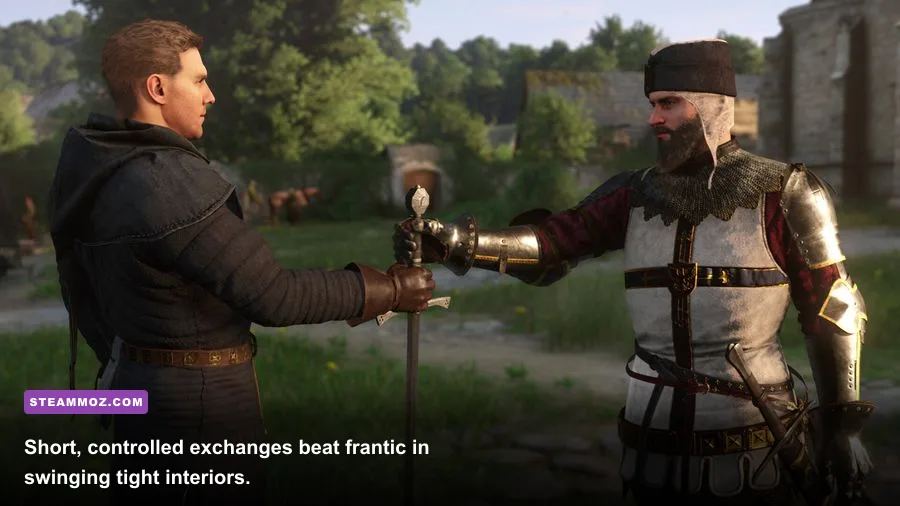
Open fights with a controlled block, not a wild combo. Watch the opponent’s shoulder and weapon line, perfect-block when the attack arrives, then answer with one or two strikes before resetting your guard. Master Strikes are especially valuable because they punish predictable attacks without draining as much stamina as repeated offensive chains. If several enemies surround you, move toward a doorway so only one or two can attack at once.
Feints are worth using against cautious human enemies, but they’re not magic. Change the attack direction late, force a reaction, and stop if your stamina is collapsing. A tired Henry blocks badly and takes more damage. For a broader look at performance-minded loadout thinking, see our weapon loadout breakdown.
| Situation | Best preparation | Why it works | Main mistake |
|---|---|---|---|
| Questioning witnesses | Clean clothes, high Charisma, recent bath | Improves the chance of social cooperation | Arriving bloody or muddy |
| Stealth search | Light clothing, lockpicks, night timing | Reduces noise and unwanted attention | Wearing full plate indoors |
| Armoured fight | Mace, shield, bandages, Marigold Decoction | Reliable blunt damage and safer defense | Spamming attacks into guard |
| Long investigation | Savior Schnapps, food, torch, spare outfit | Protects progress and handles changing conditions | Relying only on autosaves |
7. Don’t rush sickness-related objectives
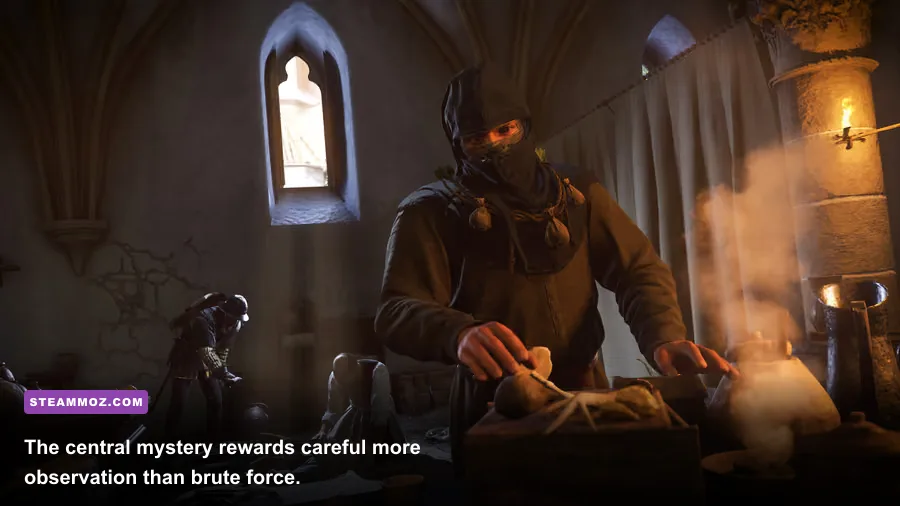
The central mystery is designed to make you suspicious, but suspicion is not proof. Examine symptoms, speak to everyone connected to the infirmary, and revisit locations after new information changes what you can notice. If the game offers a treatment, test, or observation step, complete it before blaming a person.
Timing matters. A quest marker can tell you where to go without telling you when to go. Some objectives are easier during daylight, while others become possible once the monastery quiets down. Sleep or wait in a safe place rather than sprinting into a restricted zone at the worst possible hour.
8. Manage crime, trespassing, and reputation carefully
Stealing a key item may seem harmless if nobody catches Henry, but monastery reputation can affect later conversations. Close doors behind you, avoid taking containers that aren’t essential, and don’t linger after an NPC raises an alarm. If you are discovered, leaving the area is often better than escalating into a murder investigation.
When a guard stops you, stay calm. A Speech response may work if Henry is clean and the offence is minor; trying to intimidate someone while wearing stolen clothing is asking for trouble. If you must enter illegally, scout the exit first. A successful infiltration is only successful if Henry can leave without a dozen armed men chasing him.
9. Spend perks for reliability, not flashy damage
New players often chase the biggest-looking damage perk, but Mysteria Ecclesiae rewards consistency. Prioritise stamina, durability, maintenance, Speech, Alchemy, and First Aid before niche bonuses that only trigger in ideal conditions. A weapon that stays repaired and a Henry who can recover between encounters will outperform a theoretically stronger build that constantly fights at half stamina.
Save a perk point if you’re unsure. The expansion’s mix of dialogue, stealth, and combat makes a balanced character more useful than a pure duelist. Strength helps with heavier equipment and melee damage, Agility supports weapon handling and movement, Vitality improves endurance, and Speech gives you more ways to resolve problems without bloodshed.
10. Tune performance before entering the busiest areas
Dense monastery interiors can stress both CPU and GPU systems because of NPC routines, lighting, shadows, and streaming. On PC, use the official Kingdom Come: Deliverance II Steam page as your hardware baseline, then adjust settings around a stable frame rate rather than chasing every ultra preset.
Start with textures at High if your VRAM allows it, lower shadows and volumetric effects first, and use upscaling only when native resolution cannot maintain your target. A locked 60 fps makes perfect blocks and stealth camera corrections feel far more dependable than an unstable 80 that drops during combat. Steamoz’s smooth-FPS settings advice explains the same priority: stabilise frame pacing before cosmetic upgrades.
| Setting | Recommended starting value | Performance impact | Visual trade-off |
|---|---|---|---|
| Textures | High, if VRAM permits | Low to medium | Keep character and cloth detail |
| Shadows | Medium | High | Less definition in dark courtyards |
| Volumetric effects | Medium or Low | High | Reduced fog and light shafts |
| View distance | High | Medium to high | Lower distant geometry detail if reduced |
| Upscaling | Quality mode | Medium benefit | Slight softness at long range |
For official background on the studio and its design approach, visit Warhorse Studios, and check the publisher’s Kingdom Come: Deliverance II page for current DLC and support information.
Most importantly, let Mysteria Ecclesiae breathe. Save before risks, listen longer than you talk, keep Henry presentable, and use the monastery’s schedule against it. The expansion becomes dramatically less frustrating once you stop treating every objective as a race to the next marker—and start treating it like an investigation that can be won before the first sword leaves its scabbard.