
The short answer is that Ken Follett’s The Pillars of the Earth has no weapons, armor, combat stats, loot rarity, or equipment screen. It’s a story-driven point-and-click adventure from Daedalic Entertainment, adapted from Ken Follett’s historical novel. Searching for an S-tier sword or the best gear setup will send you down the wrong path: the meaningful “equipment” in this game is your evidence, dialogue choices, relationships, and timing.
That distinction matters because several search results and automated gaming pages incorrectly treat The Pillars of the Earth like an RPG. It isn’t one. There are no damage values to compare, no character builds to optimize, and no boss encounters that reward a stronger weapon. What you can optimize is your route through the story, your attention to interactive objects, and the consequences attached to decisions made by Philip, Jack, and Aliena.
There Is No Weapon System to Rank

Daedalic’s adaptation is built around exploration, conversation, observation, and narrative choice. You control characters across the medieval English setting of Kingsbridge, inspect scenes, collect information, and select responses that can alter relationships or later events. The game follows the novel’s broad structure through three books rather than a conventional campaign of combat zones and gear checks.
That means familiar RPG terms simply don’t apply. A weapon does not have a base attack value, a critical-hit chance, an upgrade path, or a durability meter here. A tool appearing in a scene is generally a story object or a contextual interaction, not a permanent item you can equip. If a character picks something up, examines it, or uses it, the purpose is usually to unlock an observation, solve a scene, or advance the narrative.
| RPG Feature | The Pillars of the Earth | What Actually Matters |
|---|---|---|
| Weapons | Not available | Objects used in contextual story interactions |
| Armor | Not available | Character identity and narrative circumstances |
| Damage or stats | Not available | Dialogue outcomes and scene progression |
| Loot rarity | Not available | Finding the correct hotspot or clue |
| Skill tree | Not available | Player judgment during conversations |
| Inventory loadout | Not available | Context-sensitive items and observations |
So the accurate weapon tier list is refreshingly brief: there is no tier list. That isn’t a missing feature or a technical limitation; it’s the design. The game is closer to a playable historical drama than to a weapon-focused action game.
🎮 Ken Follett's The Pillars of the Earth
Looking to experience this game? Grab your digital key directly on our store for $1.99.
View on Steammoz Store →The Real “Equipment” Tier List
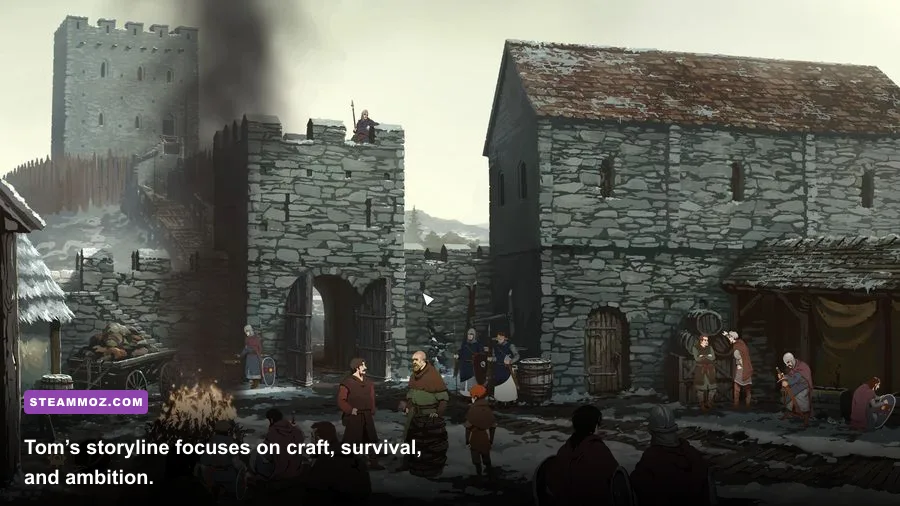
If you still want a ranking, the useful version ranks the tools and habits that help you finish scenes cleanly. These aren’t equippable items. They’re the practical resources you carry as a player. The strongest one is careful observation, because many interactions are gated by examining the environment before speaking to the right person.
| Tier | Resource or Habit | Why It Ranks Here | Best Use |
|---|---|---|---|
| S-Tier | Thorough scene inspection | Reveals hotspots, clues, and optional context | Every new location |
| S-Tier | Dialogue attention | Choices can influence relationships and later scenes | Conversations with major characters |
| A-Tier | Character perspective | Different protagonists expose different story angles | Switching between narrative threads |
| A-Tier | Save management | Protects against choices you want to reconsider | Before major conversations |
| B-Tier | Optional observations | Adds lore and characterization but rarely acts like loot | Replay and completionist runs |
| C-Tier | Rushing objectives | Gets scenes moving but can hide the best writing | Only on a repeat playthrough |
“Save management” deserves a small warning. This isn’t a combat game where a failed encounter costs you resources, but choices can carry narrative consequences. Keeping a manual save before an important conversation is the closest thing to carrying a backup weapon. It lets you explore a different response without replaying an entire chapter.
Players coming from games such as Dropsy’s unconventional item design may recognize the joke here: the most powerful equipment is often not equipment at all. In The Pillars of the Earth, attention is the stat that pays off.
What to Prioritize as Philip, Jack, and Aliena

The playable cast gives the adventure its variety. Philip’s chapters are tied closely to Kingsbridge’s priory and its political pressures. Jack’s storyline leans into art, building, family, and his connection to Tom Builder’s world. Aliena’s path is more directly shaped by upheaval, survival, and the harsh social realities surrounding her.
None of them has a combat role. Don’t approach Philip as a support class, Jack as a crafting class, or Aliena as a rogue. Their differences are narrative and contextual. A scene may give one character access to an observation or conversation that another protagonist could never reach, but you aren’t assembling a party or distributing gear.
Philip’s strongest advantage is patience
Philip’s sections reward players who listen closely and consider the wider consequences of a response. The priory isn’t a quest hub full of vendors; it’s a pressure cooker of faith, authority, resources, and personality. Examine the environment, speak with available characters, and avoid assuming that the most aggressive answer is the most productive one.
Jack benefits from curiosity
Jack’s scenes are especially good at making spaces feel like puzzles without turning them into traditional inventory puzzles. Look for visual details, inspect unusual objects, and follow the logic of the location. His connection to construction and artistic work is represented through story interactions, not a hammer with +5 building efficiency.
Aliena rewards caution
Aliena’s story carries some of the game’s most difficult emotional choices. Treat conversations as consequential even when the interface doesn’t flash a warning. If you’re chasing the “best” outcome, remember that the game is adapting a novel about compromise and political violence, not offering a morality meter with a perfect ending.
How Progression Actually Works
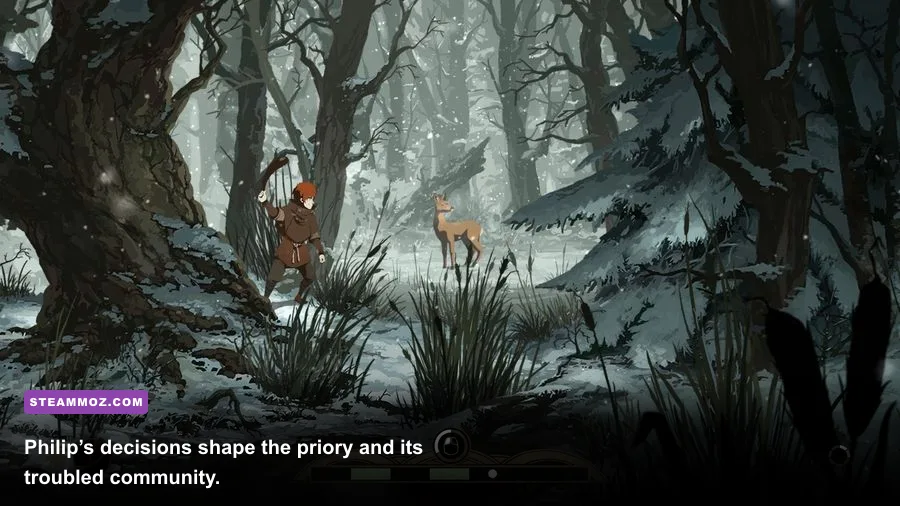
The game’s progression is chapter-based and story-led. You advance by completing conversations, examining points of interest, using contextual objects, and triggering the next sequence. There is no experience bar, no character level, and no equipment score that determines whether a scene is available.
The smartest route through a new area is simple but easy to ignore:
- Scan the entire scene. Move the cursor across the environment and inspect every highlighted point before committing to the main conversation.
- Talk to everyone available. Minor exchanges can establish context for a later choice or reveal the emotional stakes of the scene.
- Use objects after learning the context. A prop can make more sense after a character comments on it, so don’t assume the first available interaction is the correct order.
- Save before major decisions. This is particularly useful if you want to compare dialogue branches without replaying large sections.
- Revisit locations when the story permits. New scenes and observations can appear after a chapter event changes the situation.
This is also why guides claiming to list “best equipment locations” are misleading. A location may contain an important object, but that object is part of a scene’s solution rather than a collectible weapon or permanent upgrade.
If you’re used to a game with real gear optimization, Steamoz’s starter-build coverage for Dungeons 3 shows the kind of progression system where rankings make sense. The Pillars of the Earth belongs to a completely different lane.
Best Settings for a Smooth Story Experience
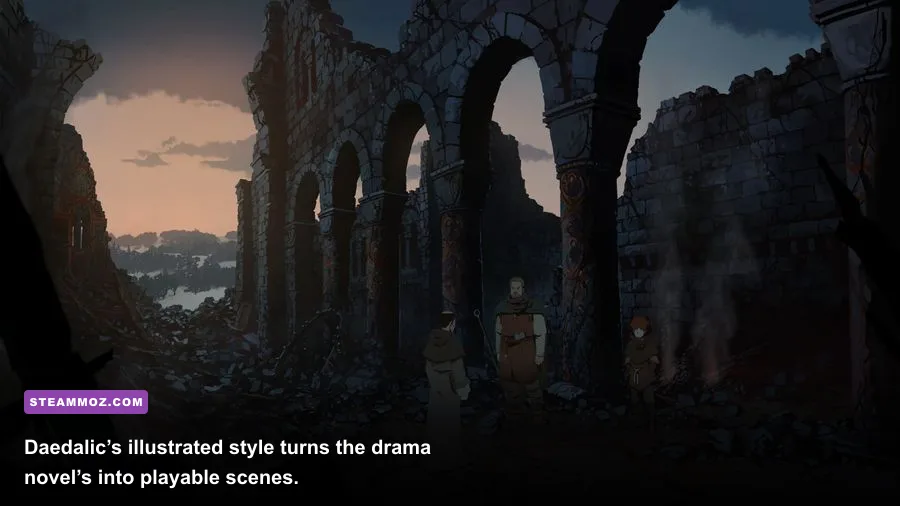
There’s no competitive frame-rate target to chase, but stable performance still helps a heavily illustrated adventure feel polished. The Steam version is not a demanding modern action game. A modest gaming PC should handle it comfortably, while newer systems can prioritize resolution and clean presentation.
| Setting or Priority | Recommended Choice | Reason | When to Change It |
|---|---|---|---|
| Resolution | Native monitor resolution | Keeps illustrated backgrounds sharp | Lower only if the system struggles |
| Display mode | Borderless or fullscreen | Reduces desktop switching friction | Use fullscreen for troubleshooting |
| Frame rate | Stable 60 FPS where available | Makes panning and transitions feel smooth | Cap lower on older hardware |
| V-Sync | On if tearing appears | Useful during camera movement | Disable if input feels delayed |
| Background apps | Close overlays and recording tools | Reduces stutter and compatibility issues | Especially on older PCs |
For general PC troubleshooting, our guides to stutters and low FPS and crashes on PC cover broader fixes, but don’t apply RPG-style optimization logic to this title. You won’t gain a stronger “build” by changing texture quality.
Verdict on the Best “Equipment”
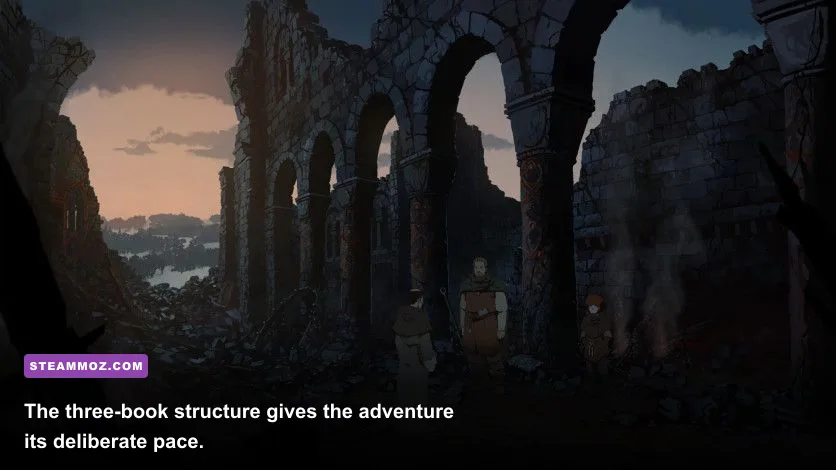
Ken Follett’s The Pillars of the Earth cannot honestly support a conventional weapon tier list. Its design has no swords, bows, armor sets, damage numbers, or upgrade materials to rank. The best equipment is metaphorical: a careful eye, a willingness to inspect every scene, and enough patience to let the characters finish speaking.
That answer may disappoint players looking for an optimized loadout, but it’s good news for anyone shopping for a narrative adventure. The game’s appeal is in how it turns the novel’s conflicts into interactive decisions. Philip, Jack, and Aliena don’t become stronger because you found rare loot; they become more compelling because you understand what each choice costs.
For the accurate product details, platform information, and community feedback, check the official Steam page. Daedalic’s developer game page provides the clearest overview of the adaptation, while Ken Follett’s official book page is the right place to compare the game’s source material with the original novel.
Final ranking: S-tier observation, S-tier dialogue awareness, A-tier manual saves, A-tier exploration, and absolutely no weapon category. If a guide promises a legendary axe hidden somewhere in Kingsbridge, it’s selling you a game that doesn’t exist.