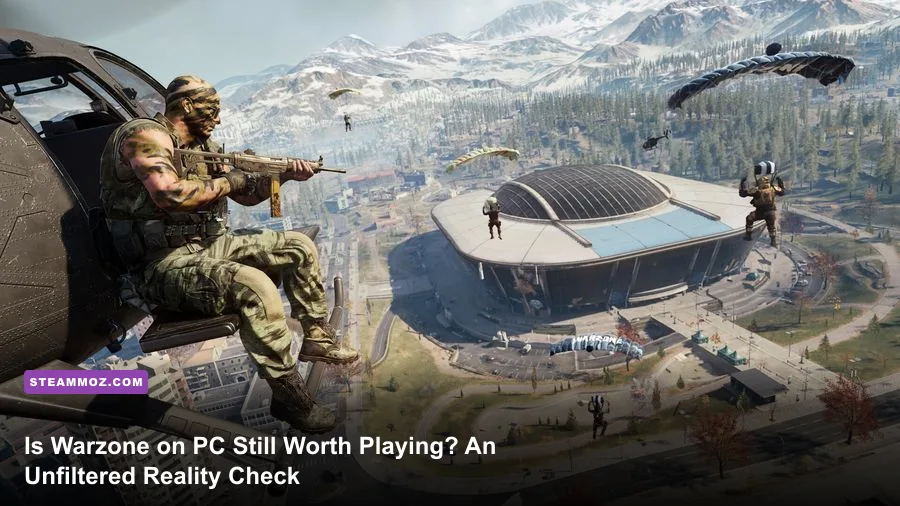
If you're wondering whether Call of Duty: Warzone is worth the staggering 180GB bite out of your NVMe SSD right now, here is the unvarnished bottom line: Warzone remains the mechanically slickest, most aggressive arcade battle royale on the PC platform, but it demands an exhausting toll in hardware maintenance, storage bloat, and competitive sweat equity. If you have a dedicated squad running high-refresh gaming rigs, the breakneck rush of landing squad wipes with pristine omnimovement is still unmatched by rivals like Apex Legends or PUBG. However, if you're a casual solo mouse-and-keyboard player hoping for relaxed weekend drops without navigating shader stutters, hyper-tuned rotational aim assist, and aggressive Engagement-Optimized Matchmaking (EOMM), the game will run you ragged.
Omnimovement and Gunplay: The Mechanical Peak of Battle Royales
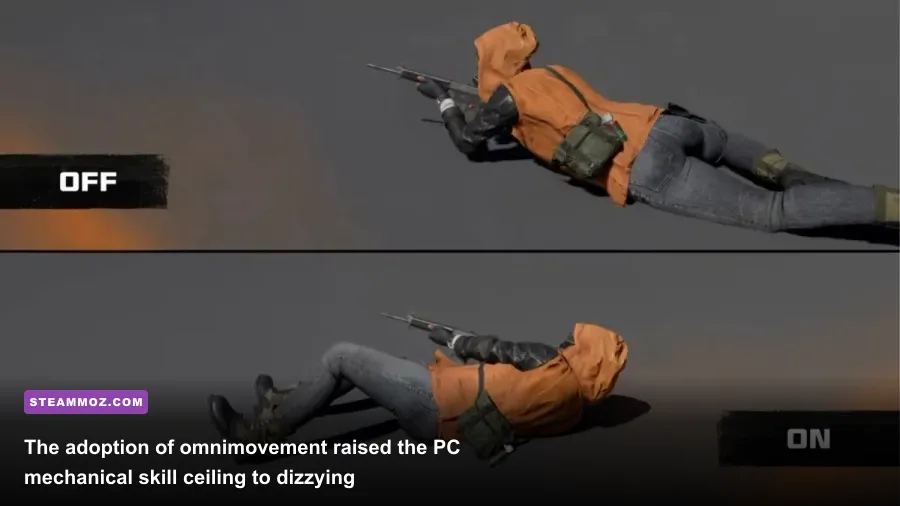
No shooter on the market feels quite like modern Warzone when your movement clicks. The full rollout of omnimovement—allowing sprint, slide, and dive actions in any lateral or reverse direction without breaking your camera velocity—fundamentally transformed gunfights into high-speed ballet. Where previous iterations rewarded methodical corner-holding and passive pre-aiming, the current sandbox heavily favors kinetic aggression. Breaking enemy camera angles via reverse slides around doorways or diving through second-story windows while tracking targets mid-air delivers pure adrenaline that competing battle royales simply do not replicate.
Weapon handling across the board is tighter, snappier, and noticeably more responsive than the sluggish, heavy-handed gunplay of the early Modern Warfare II era. The baseline close-quarters Time-to-Kill (TTK) sits in a balanced pocket around 620ms to 680ms for meta submachine guns like the Superi 46 and Jackal PDW, giving targeted players a razor-thin window to react, snap back, or break line of sight using smoke grenades. Weapon visual recoil—long a massive complaint among mouse purists on PC—has been dialed back to favor predictable, learnable recoil patterns rather than blinding visual muzzle smoke and erratic reticle bounce.
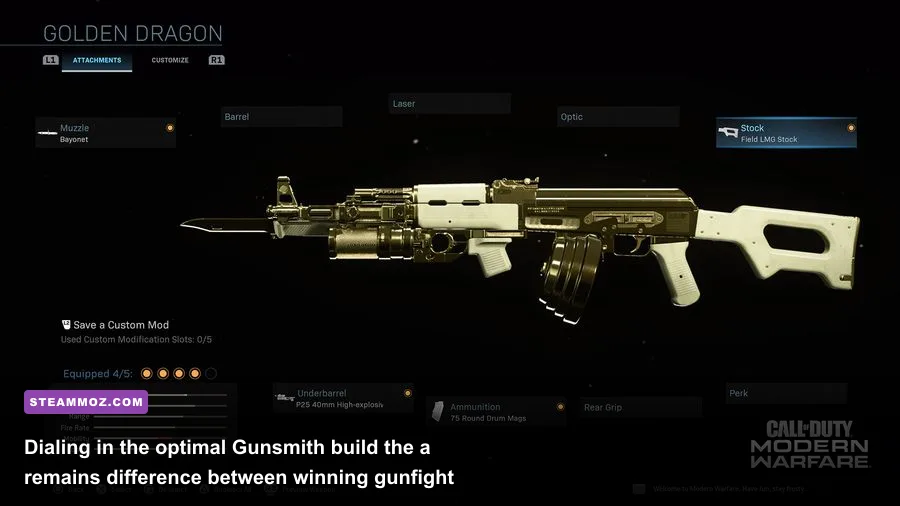
The Gunsmith system has also shed much of its agonizing bloat. Gone are the days when slapping a suppressor on your barrel tanked your Aim-Down-Sight (ADS) speed into unplayable territory. Tuning attachments now delivers tangible, readable statistical tradeoffs. You can build out an assault rifle like the DTIR 30-06 for pinpoint laser accuracy at 70 meters without turning your handling into that of a concrete block. For gunplay purists who value deep mechanical feedback, weapon mastery feels deeply satisfying on the Call of Duty on Steam client.
The Technical Toll: Storage Bloat, Shader Caching, and Engine Overhead
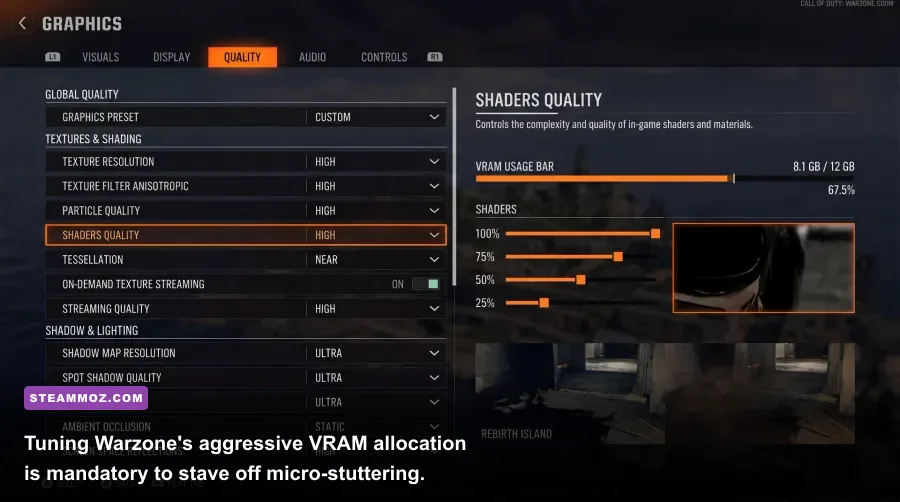
Yet, for all its kinetic brilliance, Warzone's technical footprint on PC remains an exercise in frustration. The centralized "Call of Duty HQ" launcher launcher structure continues to be an clunky, unintuitive mess. Booting the game frequently subjects players to sudden "Update Requires Restart" prompts, followed by long minutes of shader compilation passes that pin multi-core processors at 100% utilization. If you fail to let those shaders compile completely before jumping into a drop, your first three matches will be plagued by gut-wrenching frame drops and hitching.
System resource allocation requires constant vigilance. The proprietary engine loves to monopolize system RAM and push GPU VRAM usage right up against the hardware ceiling, triggering nasty memory leaks during marathon gaming sessions. If you regularly battle frame stuttering or random desktop crashes in complex PC titles, tackling engine bottlenecks with proven strategies like PC fixes that stop crashes and rescue your FPS will feel intensely familiar here. Much like dialing in modern action releases, running Warzone at competitive framerates requires ditching ultra presets in favor of an esports-tuned configuration.
| Graphics Setting | Competitive Recommendation | FPS Gain Impact | Tactical Visual Benefit |
|---|---|---|---|
| Upscaling / Sharpening | FidelityFX CAS (Strength: 75-85) | Moderate (5-8%) | Exceptional edge clarity across distant foliage |
| Volumetric Quality | Low | High (10-14%) | Removes dense volumetric haze inside buildings |
| Spot Cache | High / Ultra | Neutral (Requires 16GB+ RAM) | Prevents micro-stutters when firing muzzle flashes |
| Particle Lighting | Low | Moderate (6-9%) | Prevents frame tanking during cluster strikes |
| Screen Space Reflections | Off | High (8-12%) | Eliminates blinding light bounces off wet pavement |
Just as players must aggressively optimize demanding titles using settings for maximum FPS, Warzone demands that you prioritize frame pacing above raw eye candy. You cannot rely solely on raw GPU horsepower; single-core CPU clock speeds and low-latency system memory are the true arbiters of whether you maintain a steady 165+ FPS inside dense suburban points of interest. If you want to dive deeper into stabilizing erratic frame spikes, studying troubleshooting blueprints like fine-tuned settings for higher FPS will help you tame frame-time variances.
The State of Ricochet Anti-Cheat and the Competitive Ranked Ladder
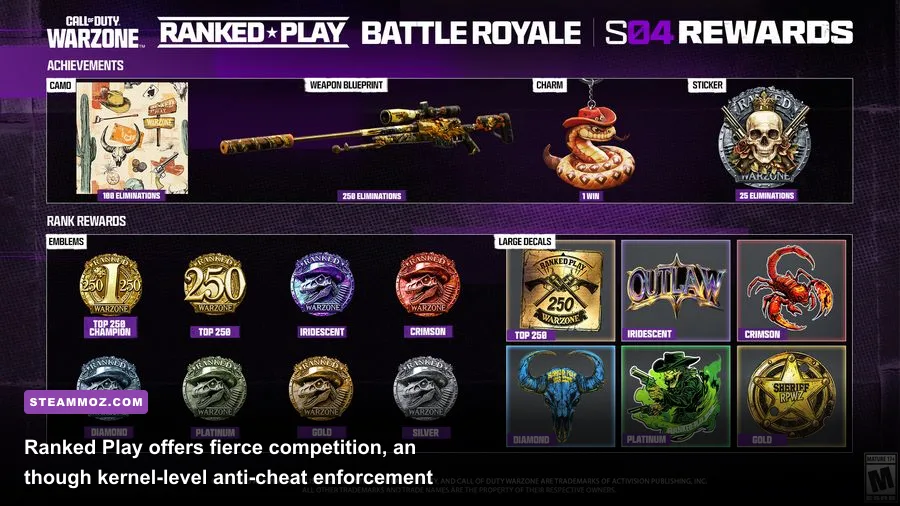
Warzone’s competitive integrity lives and dies by its security measures, and the ongoing tug-of-war between the proprietary Ricochet anti-cheat and underground cheat developers remains as contentious as ever. Operating via a kernel-level driver, Ricochet has largely eliminated the flagrant, comical cheat suites of yesteryear—such as flying vehicles or instant-map aimbots spinning at lightspeed. You can read up on their technical countermeasure milestones via Activision's Ricochet anti-cheat reports.
However, the modern battle space has evolved toward far subtler, stealthier exploits. High-tier lobbies and Diamond-to-Iridescent Ranked Play matches are perpetually haunted by players utilizing hardware-level DMA (Direct Memory Access) cards, zero-recoil scripts, and soft-aim wallhacks that skirt standard behavioral detection algorithms. For legitimate high-skill players, reaching Crimson or Top 250 rank often feels less like an evaluation of pure game sense and more like navigating a minefield of suspect player tracking through walls.
Simultaneously, the input debate on PC has reached a permanent stalemate. Rotational Aim Assist (RAA) remains heavily favored in close-quarters skirmishes inside buildings. While mouse-and-keyboard snipers still dominate extreme-range engagements across rolling hills, an average controller player leveraging crosshair-centering algorithms will win nine out of ten 5-meter SMG spray-downs against a skilled mouse aimer. If you refuse to pick up a gamepad, your tactical positioning on PC must be flawless to compensate for the controller's software-assisted tracking advantage.
Map Rotation Fatigue: Urzikstan, Resurgence, and the Nostalgia Trap
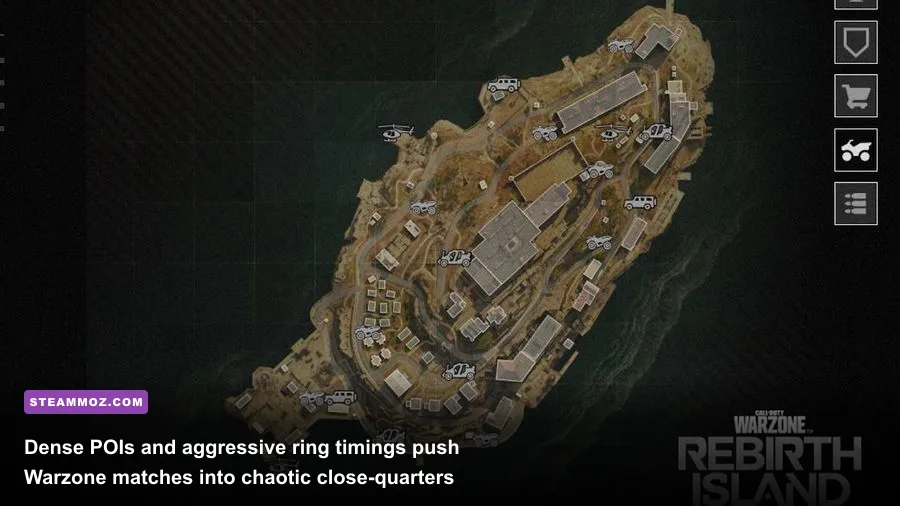
Warzone's map design has taken a hard pivot toward high-density combat zones. While large-map Battle Royale on Urzikstan remains an option for traditionalists who love long-term macro rotations, the player base overwhelmingly gravitates toward Resurgence modes on compact maps like Rebirth Island, Fortune’s Keep, and Area 99. The speed of the match cycle has completely reshaped player expectations: players drop, engage instantly, die, redeploy, and chain kills in rapid succession without the slow, calculated mid-games that defined the original Verdansk experience.
This relentless focus on high-octane Resurgence has made Warzone an adrenaline machine, but it comes at the expense of strategic variety. Matches blur together into constant third-party firefights where survival relies entirely on lightning-fast re-plating, smoke-grenade spam, and close-quarters SMG dominance. If your rig suffers from thermal throttling during these prolonged, explosive indoor skirmishes, investigating solutions like fixes for sudden crashes and low frame rates will keep your system from falling apart under the load.
| Weapon Class & Name | Optimal Combat Range | Theoretical TTK (Chest) | Playstyle Synergy |
|---|---|---|---|
| Superi 46 (SMG) | 0 to 14 meters | 610 ms | Hyper-aggressive slide-canceling, building clearing |
| DTIR 30-06 (Battle Rifle) | 25 to 65 meters | 640 ms | Holding power positions, punishing rooftop rotations |
| Kar98k (Marksman Rifle) | 40 to 90 meters | Single-shot Headshot Down | Aggressive entry-fragging, fast-peeking sightlines |
| SVA 545 (Assault Rifle) | 15 to 45 meters | 660 ms (Burst Fire) | Versatile squad support, exceptional recoil stability |
Even with shifting balance passes, knowing what your hardware can actually handle when rendering these intricate environments is crucial. Before downloading 180GB of map assets, checking whether your processor and graphics card align with modern baseline demands—similar to reviewing a guide on PC specs and hardware performance limits—can save you hours of troubleshooting unplayable performance bottlenecks.
The Verdict: Who Should Still Keep Warzone on Their SSD?
Warzone on PC remains a polarizing triumph of mechanical design tethered to an exhausting live-service ecosystem. It isn't a relaxed after-work hangout game; it is an unforgiving, sweat-drenched arena where millisecond decisions, audio positioning, and hardware optimization directly dictate your survival. If you have an organized trio or quad running modern PC builds, the tactical rush of pulling off a final-circle victory on the official Call of Duty Warzone portal is an unmatched thrill that no other free-to-play battle royale can currently duplicate.
On the flip side, if you are a solo mouse-and-keyboard enthusiast who gets frustrated by bloated launchers, frequent massive title updates, aggressive skill-based matchmaking lobbies, and controller close-range supremacy, keeping Warzone installed will feel like a second job. It remains the undisputed king of fast-paced arcade battle royales, but you need to walk into its lobbies with clear eyes about the hardware overhead and competitive sweat it demands from you every single match.