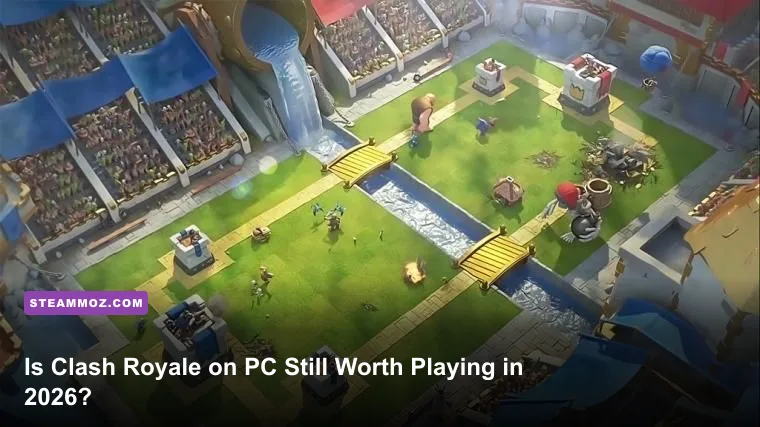
Yes, Clash Royale on PC is still worth playing in 2026—but only if you want a brutally competitive five-minute strategy game, not a relaxed free-to-play experience. The core loop remains excellent: build an eight-card deck, manage a maximum of 10 Elixir, defend efficiently, then convert surviving troops into a counterpush. On a monitor with a stable frame rate, the game is crisp, fast, and easier to read than on a phone. The catch is progression. Level gaps, card Evolutions, Champions, seasonal systems, and monetization make the long-term climb far less friendly than the brilliant battles suggest.
That split is the whole retrospective. Clash Royale is still one of the best examples of real-time decision-making in gaming, but it isn't automatically a good recommendation for every PC player. If you're willing to treat it like a competitive hobby, learn matchups, and ignore the pressure to buy your way up the ladder, there's a remarkable game here. If you want a fair, complete PC release with a clean progression path, you'll find better options.
What Clash Royale on PC actually offers in 2026

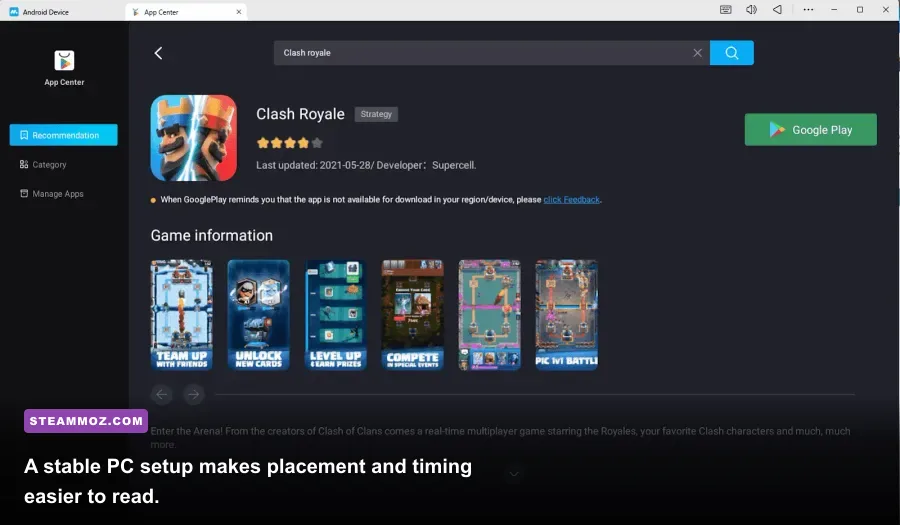
Clash Royale was designed for touchscreens, so “playing on PC” needs a small qualification. Supercell's official desktop options and availability can vary by region and account setup; many players still use an Android emulator, while some supported PC installations provide a more direct route. Before installing anything, check the current official Clash Royale page and the game's Steam catalog. Clash Royale does not function like a conventional Steam game with a native mouse-first interface.
That said, a PC screen is a genuine advantage for clarity. The arena is divided into two lanes by the river, and small details decide trades: whether a troop crosses the bridge before a defensive building locks on, whether a Tornado pulls a unit into King Tower range, or whether a Skeleton placed one tile away buys enough time for a tower to fire again. A 1080p display makes those interactions easier to inspect, although mouse placement can feel less natural than tapping once you start playing fast cycle decks.
| PC setup | Best advantage | Main drawback | Verdict |
|---|---|---|---|
| Official supported desktop route | Cleaner installation and account handling | Availability may depend on region and current support | Best when available |
| Android emulator | Large display, stable controls, easy recording | Input feel, emulator overhead, policy concerns | Practical but verify current rules |
| Phone or tablet | Fast touch placement and portability | Smaller battlefield and battery drain | Still the most natural format |
The battles are still Clash Royale's killer feature
The reason people keep returning is not nostalgia. It is the extraordinary density of decisions packed into a standard battle. Elixir regenerates continuously, each player can hold up to 10, and the opening three-minute clock forces you to choose between revealing a win condition and preserving a response. At the two-minute mark, standard battles enter Double Elixir, dramatically accelerating the pace. Overtime rules and event formats can differ, so read the mode rules rather than assuming every match follows the same clock.
Good play starts with positive Elixir trades. A four-Elixir Fireball that damages a five-Elixir Musketeer plus a three-Elixir support troop is a clear gain, but the real value is positional: the spell may also push units into tower range or remove the defender protecting a win condition. Likewise, a one-Elixir Skeletons card can distract a Prince long enough for a Crown Tower to land several shots. These aren't abstract advantages. Towers deal repeated damage while troops retarget, and one extra attack often determines whether a counterpush reaches the bridge.
The best decks also have a defined win condition. Hog Rider pressures the building immediately and works naturally with cheap cycle cards. Royal Giant attacks from range and becomes far more threatening when a Fisherman or Hunter controls the defensive response. Graveyard converts a surviving tank into unpredictable tower pressure, while Miner can chip a tower, tank for ranged troops, or snipe a key support unit. A deck that merely contains strong cards usually loses to a deck whose cards solve a specific tactical problem.
| Archetype | Typical win condition | What it rewards | Where it struggles |
|---|---|---|---|
| Hog cycle | Hog Rider | Fast rotation, precise defense, constant pressure | Heavy buildings and disciplined Tornado users |
| Royal Giant control | Royal Giant | Counterpushes and ranged support | Strong swarm pressure and bad starting hands |
| Log bait | Goblin Barrel | Tracking small spells and forcing awkward answers | Multiple cheap counters and spell-heavy decks |
| Graveyard control | Graveyard | Defensive patience and tank timing | Poison, Valkyrie, and clean splash defense |
| Bridge spam | Battle Ram or Ram Rider | Punishing passive play and split pressure | Reliable buildings and swarm distractions |
Why the 2026 progression grind is harder to defend
Clash Royale's biggest problem is no longer whether the matches are fun. They are. The problem is how much collection progress sits between a new player and a genuinely competitive account. Card levels affect hit points and damage, so an underleveled deck can lose interactions that would be automatic at equal levels. A Fireball that leaves a unit alive, a tower that falls one hit short, or a Mini P.E.K.K.A. that fails to finish a tank can turn a strategically correct defense into a loss.
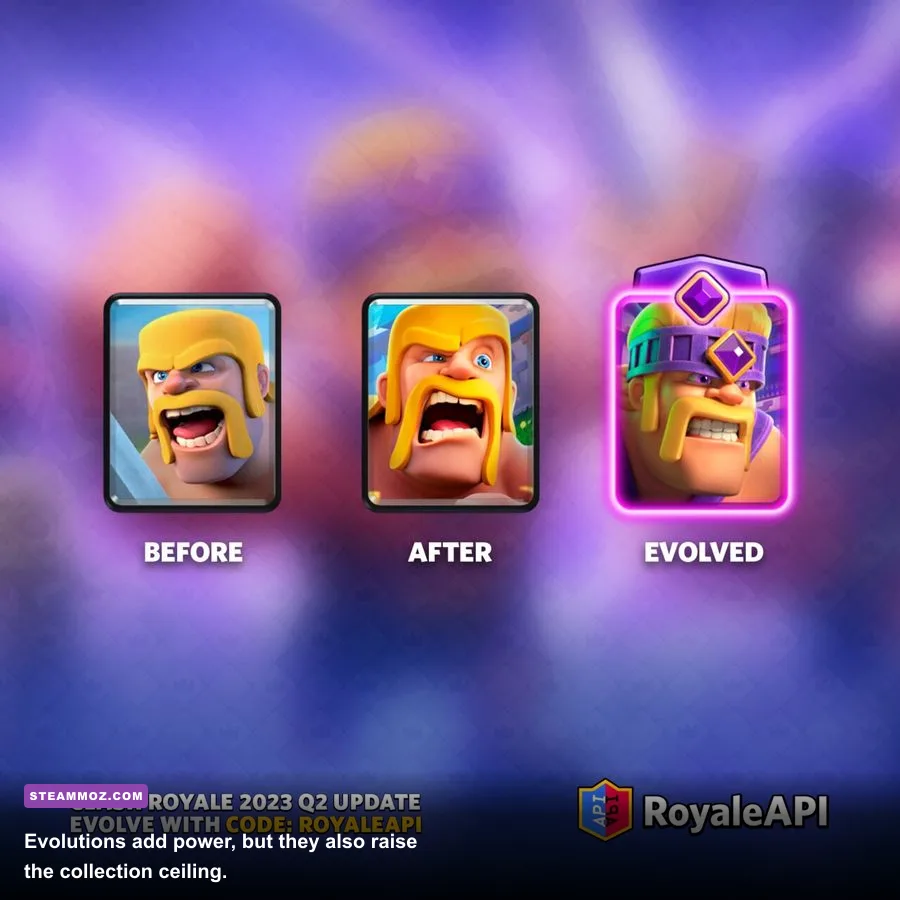
Evolutions add another layer. Cards such as Knight, Firecracker, Royal Giant, Skeletons, and other rotating options can gain a special upgraded form after the required cycle count. The exact rotation and available slots have changed across updates, but the design issue remains: an Evolution is not just another card level. It changes what the opponent must respect. An evolved Royal Giant can demand a different defensive sequence, while evolved Skeletons can multiply pressure if the opponent wastes a small spell.
Champions bring powerful abilities into the same eight-card deck. Archer Queen's Cloaking ability hides her and boosts her attack, Golden Knight can dash through targets, and Mighty Miner switches lanes while changing his damage profile. Those mechanics are satisfying when both players have access to the same tools. They feel much worse when a new account faces a fully developed collection without enough resources to experiment.
That makes the free-to-play experience uneven. You can absolutely reach respectable arenas without spending, but competitive flexibility arrives slowly. The smartest approach is to choose one archetype, upgrade only its core cards, and avoid scattering Gold across every interesting card in your collection. If you want a broader look at managing progression systems in strategy games, Steamoz's fast leveling and gold farming guide for Empires of the Undergrowth covers the same resource-discipline mindset from a different angle.
PC performance, controls, and the fair-play question
Clash Royale is lightweight compared with a modern 3D PC game. You don't need a gaming GPU, but you do need consistency. A dropped frame during a bridge engagement can make a late Skeleton placement miss its distraction window, and emulator stutter can produce the same practical effect as lag. Use a wired connection or strong 5 GHz Wi-Fi, close background capture tools, and cap performance to a stable rate rather than chasing an unstable maximum.
| Setting or factor | Recommended choice | Performance impact | Why it matters |
|---|---|---|---|
| Display resolution | 1080p | Low | Sharp enough to read placements without unnecessary scaling |
| Frame-rate target | Stable 60 FPS where supported | Low to moderate | Consistency matters more than peak numbers |
| Emulator resolution scale | 100% native scale | Moderate | Avoids blurry UI and extra rendering overhead |
| Background recording | Disable while climbing | Moderate on weaker PCs | Reduces spikes during crowded pushes |
| Network connection | Ethernet or reliable 5 GHz Wi-Fi | None | Limits jitter and delayed card deployment |
There is also a competitive etiquette issue. Before committing to an emulator, review Supercell's Terms of Service and current support guidance. Don't use macros, scripts, automation, modified clients, or anything that turns a timing game into a botting contest. A larger display and ordinary input method are one thing; automation is another.
For troubleshooting general PC stutter and crashes, our guides to ELEX PC crash and FPS fixes and EscapeVR performance problems offer useful Windows-level checks. They won't fix a server-side connection issue, but updating drivers, disabling overlays, and checking background load are still sensible first steps.
How to play smarter instead of simply playing more
The fastest way to improve is to stop treating every card as an emergency. Track your opponent's counters and cycle. If they spend their only reliable answer to your Goblin Barrel, the next Barrel becomes more valuable than the first. If their building is out of rotation, a Hog Rider can be played immediately rather than waiting for a perfect push. Strong players aren't just counting Elixir; they're counting access.
Use the first minute to gather information
Don't unload a full push at zero information. A safe split of Skeletons, a lone Ice Spirit, or a backline support card can reveal the opponent's archetype without risking your tower. Note their small spell, building, tank killer, and win condition. Once you know those four pieces, your attacks become tests: force the counter, punish its absence, and avoid giving their spell value against multiple troops.
Defend in the center whenever possible
Buildings such as Cannon, Tesla, Bomb Tower, and Inferno Tower gain value when placed to pull units toward the middle. That activates both Crown Towers, shortens the distance your defenders travel, and creates crossfire. Against a Hog Rider, a correctly timed Cannon can prevent all but one hit; against a Giant, central placement buys time for ranged damage. Placement is matchup-specific, so practice the tile positions in friendly battles rather than relying on vague “place it in the middle” advice.
Save spells for value, not comfort
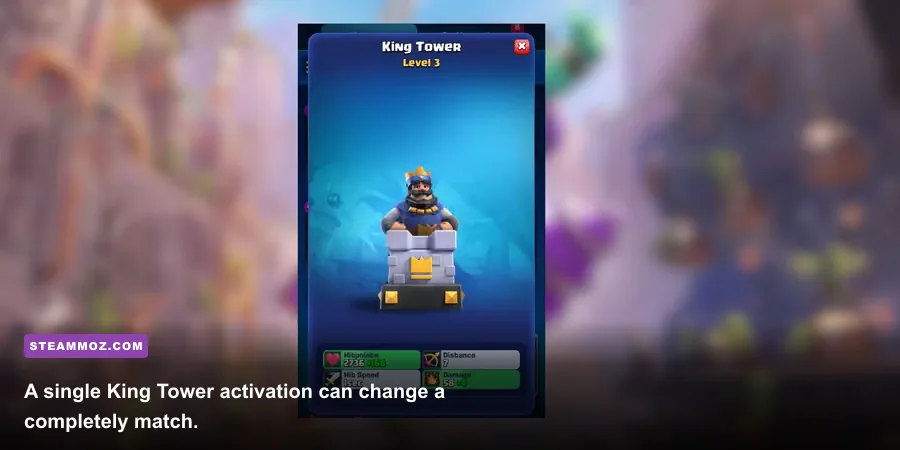
Fireball is strongest when it hits a tower and multiple medium-health troops, but waiting too long can be just as bad as wasting it. Log should often answer Goblin Barrel, Princess, or a swarm, while Arrows cover wider formations and air units. Tornado is uniquely valuable because it can activate the King Tower against cards including Goblin Barrel, Hog Rider, and Balloon when the timing and position are correct. That activation is a long-term advantage, not merely a single defensive trick.
Know when to stop attacking
At one tower's worth of damage, a reckless second push can throw away a winning game. Defend, cycle to your spell, and force the opponent to cross the bridge. In Double Elixir, players often overcommit because the screen fills with troops and the match feels explosive. The calm response is usually better: identify the highest-damage threat, protect your tower, then counterpush with whatever survived.
So, should you play Clash Royale on PC in 2026?
Play it if you enjoy short competitive matches, matchup knowledge, and the satisfaction of turning a one-Elixir defensive trick into a tower-taking counterattack. The game still has a spectacular skill ceiling. A strong player can win through placement, timing, cycle tracking, and spell discipline even when the collection system makes that climb uncomfortable. On PC, the larger view is particularly good for learning interactions and reviewing replays.
Skip it if you dislike live-service pressure, rotating balance changes, or the feeling that your favorite deck is incomplete until several cards and Evolutions are upgraded. The free-to-play model is playable, but “playable” isn't the same as frictionless. Competitive modes can expose level differences, and building multiple top-end decks takes patience or spending. That was already a concern years ago; by 2026, the expanding card systems make it more visible.
| Player type | Recommendation | Reason |
|---|---|---|
| Returning veteran | Yes, with a fresh account audit | Your old deck may need new Evolutions, Champions, or current-meta replacements |
| Competitive strategy fan | Yes | Excellent decision density and a deep matchup ecosystem |
| Casual PC player | Maybe | Great short sessions, but progression pressure can become tiring |
| Strict free-to-play collector | With reservations | Focus on one deck and expect a slow path to broad collection parity |
| Player seeking a native Steam game | No | PC availability and input support may not match a traditional desktop release |
My honest verdict is a qualified recommendation: Clash Royale is still worth playing on PC in 2026 for the battles, not for the grind. Keep your expectations narrow, pick one deck, learn every interaction inside it, and treat purchases as optional rather than necessary. The moment you stop chasing every card and start studying why a defense works, the game becomes sharp again. The towers, bridges, and 10-Elixir decisions still deliver. The progression system is the part you'll need to manage.
For more PC-focused gaming advice, Steamoz also covers performance tuning in Far Cry 6 and resource-efficient builds in our beginner build guide. Neither replaces Clash Royale's particular brand of pressure, but both reinforce the same rule: a smart setup helps, while understanding the game wins matches.