
Gearshifters gets much easier once you stop treating it like a conventional twin-stick shooter. Your vehicle is both your character and your health bar, so the winning formula is constant movement, controlled weapon use, smart route selection, and upgrades that solve your immediate weakness. These 10 tips will help new players survive longer runs, earn more credits, and reach the tougher encounters without wasting valuable gear.
Gearshifters comes from Red Phantom Games and blends vehicle combat with roguelite progression. You steer with one input, aim weapons independently, and make route decisions between fights. That combination creates its own rhythm: drift out of danger, keep your weapon arc useful, collect resources only when the road is safe, then spend your earnings on a build that complements the vehicle you’re driving.
1. Learn the split between driving and aiming
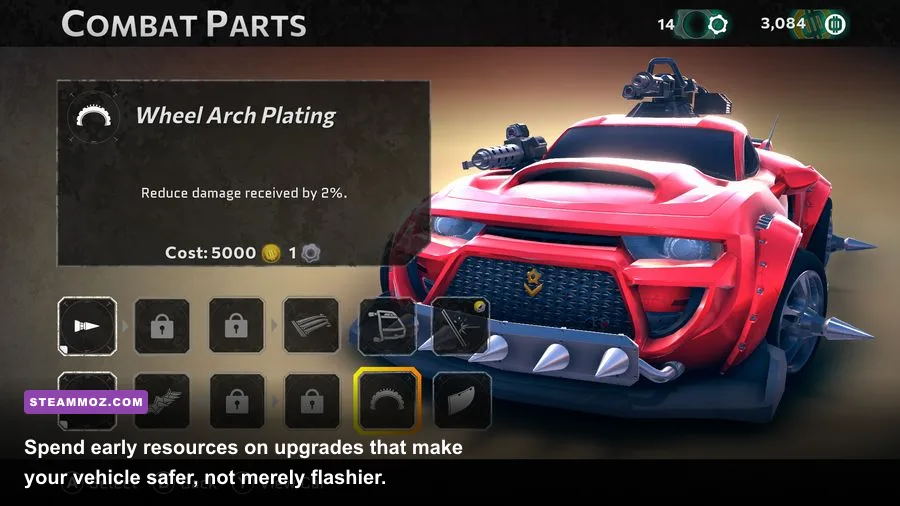
The first hour is mostly about rewiring your hands. Your movement direction and firing direction do not need to match. That means you can drive past an enemy while aiming backward, circle a heavy target while keeping your guns trained on its weak side, or retreat while continuing to apply damage.
Don’t hold the movement stick in one direction for an entire encounter. Short steering corrections are safer than huge swings because they keep the vehicle’s hitbox predictable. Against groups, travel around the edge of the arena rather than cutting through the middle. This gives you more reaction time when projectiles begin arriving from both sides.
Use the practice of “drive, fire, reset.” Drive into a favorable lane, fire long enough to finish a target, then reset your position before collecting drops. New players often reverse into danger because they focus on the crosshair. Keep checking the vehicle, not just the enemy you’re attacking.

🎮 Gearshifters
Looking to experience this game? Grab your digital key directly on our store for $6.24.
View on Steammoz Store →2. Treat every weapon slot as a job
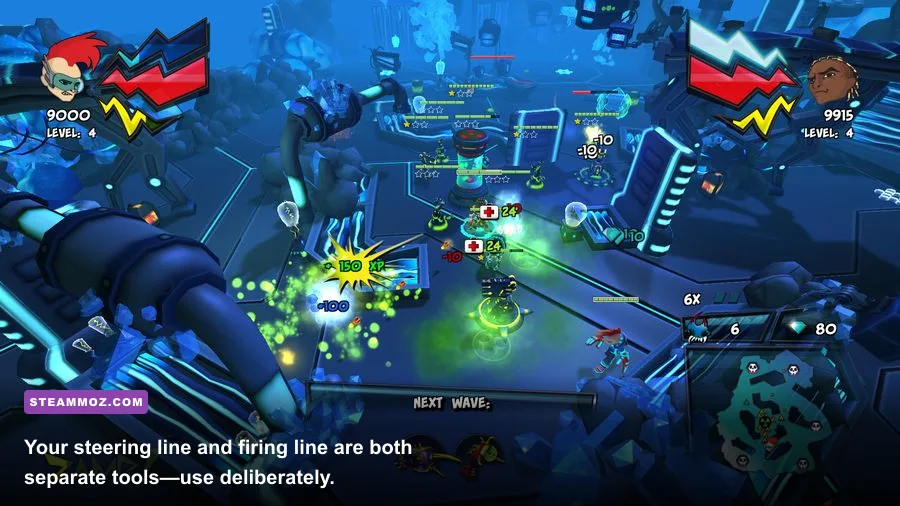
Gearshifters’ weapons are most useful when they cover different combat problems. Rapid-fire guns handle ordinary enemies and exposed weak points. Shotgun-style weapons deliver brutal close-range damage but demand better positioning. Explosive weapons are excellent for clustered targets, while long-range precision weapons let you remove dangerous units before they flood the road.
Don’t build around raw damage alone. Ask what each weapon contributes to the run. A powerful single-target weapon paired with reliable crowd control is usually safer than stacking two slow weapons that both struggle when enemies surround you. Likewise, a short-range weapon becomes much better when your vehicle has an upgrade that improves survivability during close passes.
| Weapon Role | Best Target | Main Risk | Useful Pairing |
|---|---|---|---|
| Rapid-fire gun | Light enemies and weak points | Low burst against armored targets | Explosives or a heavy secondary |
| Shotgun | Close groups and large targets | Requires dangerous positioning | Mobility or defensive gear |
| Explosive weapon | Clusters and chokepoints | Slow firing rhythm | Rapid-fire weapon |
| Precision weapon | Turrets and elite enemies | Misses are expensive | Crowd-control equipment |
Upgrade a weapon you can consistently use rather than chasing a theoretical perfect loadout. If a gun forces you to stop steering or stare at one target for too long, its displayed damage won’t matter when the road fills with projectiles.
3. Spend credits on survival before luxury damage

Credits are easy to waste because the upgrade screen constantly presents tempting damage increases. Early in a run, durability, repair value, cooldown improvements, and ammunition efficiency usually produce more real progress than a small damage bump. A dead vehicle cannot benefit from excellent DPS.
Your first purchases should answer three questions. Can you survive one mistake? Can you clear ordinary enemies before they surround you? Can your main weapon keep firing through a long encounter? If the answer to the first question is no, buy defensive help. If the second is no, improve your most reliable damage source. Only then should you chase specialized bonuses.
Watch for upgrades that multiply each other. A faster-firing weapon gets more value from ammunition or heat-management improvements. A close-range build benefits from mobility and damage reduction. A precision setup wants cooldown reduction and anything that buys time to line up shots. Random upgrades are still useful, but a coherent pair often beats three unrelated bonuses.
| Upgrade Priority | When to Buy It | Why It Matters | Common Mistake |
|---|---|---|---|
| Durability or repairs | After taking repeated chip damage | Extends the run immediately | Ignoring defense for a tiny DPS increase |
| Primary weapon improvement | When normal fights feel slow | Shortens exposure to enemy fire | Upgrading a weapon you rarely aim well |
| Cooldown or ammo support | When downtime causes danger | Keeps damage consistent | Buying it before fixing survivability |
| Specialist damage | Once the core build works | Improves elite and boss pressure | Building for bosses while losing to mobs |
4. Choose routes for information, not greed
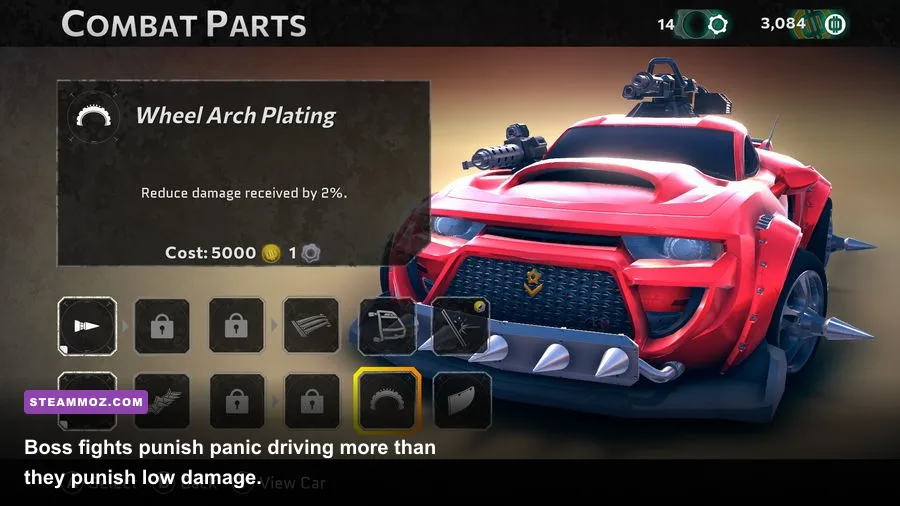
Branching missions are a risk calculation. The reward shown on a route matters, but so does your current vehicle condition, ammunition situation, and ability to handle the encounter type. A high-value route is a bad choice if you arrive with one repair away from failure.
Use ordinary combat missions to test a new weapon combination. Save more dangerous encounters for runs where your build already has a clear identity. If you’ve built around close-range damage, avoid taking a route packed with open spaces and long-range enemies. If your weapons need time to recharge, don’t stack missions that repeatedly spawn large groups.
Route decisions also affect your learning. When you lose, remember whether the problem was the mission itself or the decision that led to it. That distinction matters. You might not need a stronger vehicle; you might simply need to stop entering elite fights while damaged.
For a similar player-first approach to route planning and resource management, Steamoz’s Generation Zero survival tips and Laxius Force III run-saving advice are worth a look.
5. Read enemy attacks before reacting
Most deaths in Gearshifters happen because players react to the projectile instead of the enemy telegraph. Watch the firing unit first. Turrets, ramming enemies, and heavier attackers usually reveal their intent through an animation or aiming pause. The moment you recognize that cue, begin moving; don’t wait until the projectile is already beside the vehicle.
Move laterally when possible. Straight-line driving is predictable, especially against enemies that lead their shots. A gentle curve can make an entire volley miss while keeping your weapons pointed at the target. Against ramming enemies, don’t panic-turn toward them. Let them commit, then cross behind their path and attack while they recover.
Large encounters become manageable when you remove threats in order. Prioritize anything that limits your movement, then long-range attackers, then durable enemies. A slow enemy with high health is less dangerous than a small unit that forces you into a bad lane.
6. Don’t collect drops during active danger
Loot is bait when the arena is still hostile. Credits and equipment are valuable, but driving across open ground to grab them can cost more health than the reward is worth. Clear the immediate firing lane first, then collect drops during a short lull.
Use the vehicle’s momentum to make collection safer. Approach from the side, grab the item, and continue moving rather than stopping directly on top of it. If multiple pickups are spread across the road, take the ones that require the smallest change of direction. The “best” drop is useless if it pushes you into an enemy formation.
7. Use abilities to create escape windows
Defensive and utility abilities are not emergency buttons you should save forever. Their best use is creating a clean window to reposition, reload, or finish a dangerous elite. Trigger one before the vehicle becomes trapped, not after enemies have already surrounded you.
Offensive abilities work best when several threats overlap. Don’t spend a screen-clearing tool on the last weak enemy in a wave. Save it for the moment when a heavy target arrives behind a group of smaller units. That timing turns an ability from extra damage into a complete change in the shape of the fight.
8. Build around one primary damage plan
A run becomes much more reliable when your upgrades support one plan. A sustained-fire build wants firing speed, uptime, and safe distance. A burst build wants critical opportunities, cooldown support, and enough mobility to disengage. A close-range build needs durability because its damage comes with exposure.
Don’t split upgrades equally between every weapon. Choose a primary weapon by the middle of the run and let the other slot cover its weakness. This makes your damage predictable, which is far more useful than having several weapons that are individually decent but collectively awkward.
9. Tune performance for readable combat
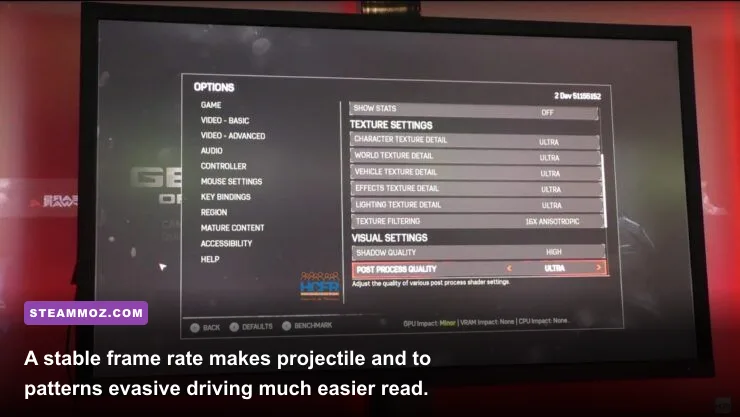
Gearshifters is fast enough that inconsistent frame pacing can make driving feel slippery. Start with a stable frame rate rather than maximum visual quality. If your PC struggles during large enemy waves, lower shadows and effects quality before reducing resolution. Those settings commonly create the biggest performance swings while having less impact on readability.
| Setting | Recommended Starting Value | Performance Impact | Visual Trade-Off |
|---|---|---|---|
| Resolution | Native monitor resolution | High if reduced | Lower values look softer |
| Shadows | Medium | Medium to high | Less environmental depth |
| Effects quality | Medium | Medium during heavy fights | Less dramatic explosions |
| VSync | Off if input feels delayed | Minimal FPS change | Possible tearing |
| Motion blur | Off | Small performance gain | Cleaner projectile tracking |
Lock the game to a frame rate your system can actually hold. A steady 60 FPS is preferable to a fluctuating 100 FPS that collapses whenever the screen fills with effects. Steamoz’s higher-FPS settings guide covers the same stability-first mindset.
10. Treat every failed run as a scouting mission
Gearshifters’ progression clicks when you stop measuring success only by how far you travelled. A failed run can still teach you which weapon pairing collapses under pressure, which route type drains your repairs, and which enemy telegraph you’re missing.
Before starting again, identify one change—not five. Use a different route, prioritize repairs earlier, or replace one weapon that creates too much downtime. Changing everything at once makes it impossible to tell what worked. Small, deliberate adjustments turn repeated failures into useful data.
For official information, check the Gearshifters Steam page, the Red Phantom Games website, and the publisher’s Numskull Games site. If you’re troubleshooting another demanding PC title, Steamoz’s guides to crashes and low FPS and strong starting builds offer useful comparisons.
The biggest Gearshifters upgrade is learning to stay calm while moving. Keep the vehicle in a safe lane, aim independently, spend credits to fix your real weakness, and leave dangerous loot behind when the road is hot. Once those habits become automatic, the game’s brutal early runs start feeling less like luck and more like control.