New to Generation Zero: Alpine Unrest? Survive Himfjäll by treating every encounter like a noisy stealth puzzle: scout first, destroy sensors and weapons before armor, carry an assault rifle plus an anti-armor option, and never fight without a retreat route. These ten practical tips cover the DLC’s island exploration, machine behavior, loot economy, skills, equipment, and co-op mistakes that routinely wipe fresh characters.
Check the Alpine Unrest Steam page for the DLC’s official listing, and remember that the expansion assumes you already understand Generation Zero’s basic shooting and inventory systems. You can also compare its open-world survival rhythm with our guide to Hunt: Showdown’s hidden rewards.
1. Scout Himfjäll before you start a fight

Himfjäll rewards patience. The island’s snowy sightlines make machines easy to spot, but they also leave you exposed for a surprisingly long time. Before entering a settlement, crouch behind terrain and use binoculars to tag every visible target. Marking is not cosmetic: it gives you a clean read on whether a group contains a Runner, Hunter, Tank, or a troublesome Seeker that can summon attention.
Look for red canisters, fuel cells, glowing components, and weapon mounts. Those are usually better targets than the machine’s central body. A machine with half its health remaining but no missile pod is often less dangerous than a pristine machine whose weapon systems are intact. Save a manual game state at a safehouse before pushing into a dense area; safehouses also give you a dependable fast-travel anchor when the island goes loud.
🎮 Generation Zero - Alpine Unrest
Looking to experience this game? Grab your digital key directly on our store for $3.19.
View on Steammoz Store →2. Learn the machine weak points, not just their health bars

Tip 1: Remove sensors first
Seekers and Hunters can turn a quiet approach into a full island-wide problem. Their sensors and spotlights make stealth much harder, so open with controlled rifle fire if you have a clear angle. The AG4 is excellent here because its automatic fire lets you correct aim quickly without the sluggish handling of a heavier rifle.
Tip 2: Break weapons before armor
Hunters become far more manageable when you destroy the shoulder-mounted weapons, while Tanks should lose their rocket launcher or machine gun before you commit to a prolonged exchange. Use armor-piercing ammunition on components when possible, then switch to soft-point ammunition against exposed internals. The exact damage varies with weapon quality and enemy class, but the principle stays consistent: component damage changes the fight faster than body shots.
Tip 3: Don’t stand in front of a Runner
Runners are not harmless starter enemies. Their pounce closes distance quickly, and packs can stagger-lock a new player. Backpedal toward a doorway, vehicle, or staircase rather than open snow. A shotgun blast at close range or a short automatic burst into the fuel cell can stop one quickly. If you hear the charge but lose visual contact, move sideways instead of simply sprinting backward.
| Machine | Priority target | Best response | Common mistake |
|---|---|---|---|
| Seeker | Sensor and signal equipment | Kill immediately with a rifle | Ignoring it while fighting heavier machines |
| Runner | Fuel cell or leg joints | Shotgun, SMG, or close rifle burst | Fighting in open ground |
| Hunter | Shoulder weapons and fuel tank | Use cover and dismantle components | Trading shots in the open |
| Tank | Rocket pod, machine gun, sensors | Long-range anti-armor attacks | Wasting pistol ammunition on its front armor |
3. Build a loadout for three different distances
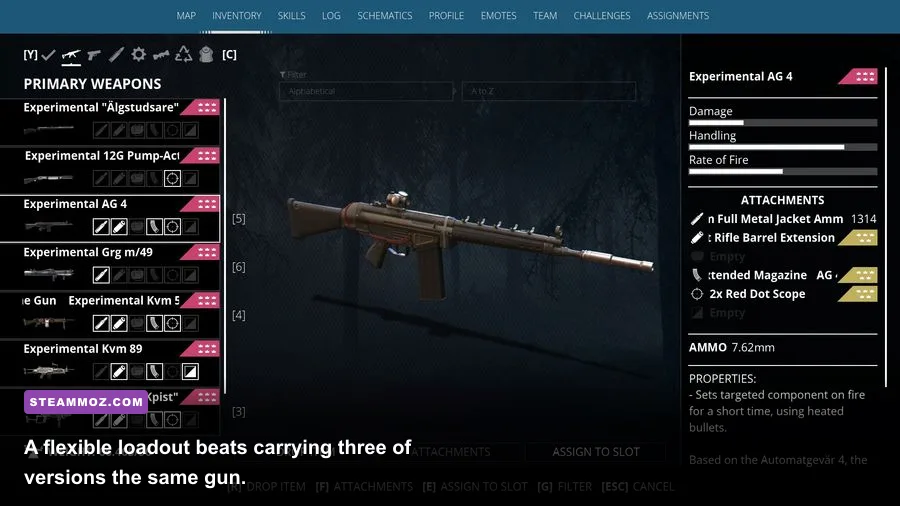
New players often carry their favorite gun, a second favorite gun, and ammunition that fits neither. Alpine Unrest is much easier with complementary ranges. A practical early loadout is the AG4 or AI-76 for medium-range precision, the Kpist for close-range panic control, and the Pansarvärnsgevär m/42 or Granatgevär m/49 for armored targets. The m/42 is especially useful when you have a safe firing lane; the m/49 is better when several machines are clustered or hiding behind cover.
Keep a shotgun as your close-range alternative if your inventory provides one, but don’t carry four heavy weapons. Weight affects how much ammunition, medical equipment, and throwables you can bring. A weapon with a three-crown rating is not automatically better than a lower-rated gun you can control. Prioritize a reliable optic, extended magazine, and ammunition economy before chasing perfect rarity.
| Slot | Recommended choice | Why it works | Reserve ammunition |
|---|---|---|---|
| Primary | AG4 or AI-76 | Flexible medium-range damage | At least 180 rounds |
| Secondary | Kpist or shotgun | Fast response against Runners | 60–100 rounds or shells |
| Anti-armor | Pansarvärnsgevär m/42 | Accurate component damage | 10–20 rounds |
| Utility | EMP grenades and flares | Creates openings and distractions | Two or more of each |
Weapon and ammunition management matters more than raw damage. If your backpack is full, dismantle low-level attachments and duplicate guns rather than abandoning medical kits. For another perspective on smooth PC combat performance, see Steamoz’s stutter-free FPS settings guide.
4. Spend early skill points on survival and information
Generation Zero’s skill tree tempts you with flashy combat upgrades, but Alpine Unrest punishes blind movement more than it punishes modest damage. Early points in Scavenger and Resourceful improve the value of every building you search, while Inquisitive helps you identify useful objects and interactable clues. Lockpick is worthwhile once you’re regularly finding locked containers, but it should not come before the skills that improve your day-to-day supply flow.
For a solo character, Hacker and Remote Hacking can create excellent openings by turning a machine against its group, though the ability has a cooldown and is not a replacement for a weapon. Spotter is a strong co-op investment because tagged targets give the whole team better information. On the combat side, Marksman suits rifle users, while Grenadier becomes more valuable after you have a steady supply of explosives.
Don’t spread points across every branch. Pick one information or support path and one damage path. A solo rifle character can prioritize Scavenger, Inquisitive, Spotter, Marksman, and Hacker; a co-op player carrying heavy weapons can lean into Resourceful, Engineer, Grenadier, and machine-gun skills. Resetting your plan later is possible, but early points should solve the problems you face every minute.
5. Use stealth, sound, and equipment as one system
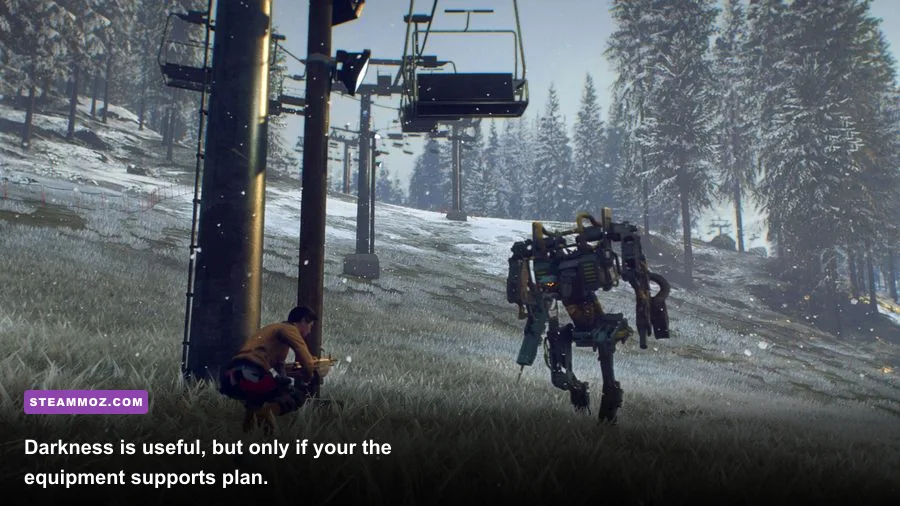
Crouching reduces your profile, but it doesn’t make you invisible. A machine that has line of sight, hears repeated gunfire, or receives a signal from a Seeker can still find you. Fire one short burst, relocate, and break line of sight behind a building or rock. Suppressors help, but they don’t erase the consequences of shooting at close range.
Flares are more than distractions. Throw one away from your intended route, wait for machines to face it, then slip around the opposite side. EMP grenades are ideal for creating a damage window against a dangerous machine: disable the target, sprint to a flank, and hit exposed components while it is temporarily helpless. Adrenaline shots are best saved for recoveries in co-op or risky revives, not used casually after every small hit.
Fireworks and other noise-making equipment can split a patrol, while smoke gives you a chance to revive or cross a dangerous gap. Carry different tools rather than stacking one type. The best equipment is the item that changes enemy behavior, not the item with the biggest explosion.
6. Fight from buildings, not from the middle of snow
Himfjäll’s cabins, hotels, bunkers, and service buildings are defensive resources. Before firing, identify two exits and check whether a staircase or doorway can funnel Runners. Interior walls can block some attacks, but don’t assume every structure is safe: explosions, windows, and collapsing cover can still expose you.
Use corners to bait a Hunter into a predictable approach, fire at a component, then retreat through the second exit. Never reload in the same doorway where you fired your last burst. Machines track the location of repeated shots, and a Tank’s projectile can punish that habit instantly. Vehicles are useful cover only when you know whether the machine can fire over or around them; they’re not guaranteed fortresses.
7. Treat loot routes like a survival economy
Search garages, military buildings, emergency supply points, and isolated homes even when the immediate objective is elsewhere. Ammunition, medkits, grenades, attachments, and clothing bonuses add up. Check weapon containers twice: one item may be visible while another sits behind a door or on a shelf.
Keep a sensible reserve before beginning a story mission: roughly 100 rifle rounds, 50 close-range rounds, several healing items, and at least one anti-armor option. If you’re below that threshold, roam nearby buildings instead of forcing the objective. Use safehouses to fast-travel between supply areas, but remember that fast travel can reset your sense of direction; reopen the map and identify your next fallback before leaving.
8. Make co-op roles explicit before the shooting starts
Four players emptying four magazines into the same armor plate is not teamwork. Assign one player to scouting and tagging, one to anti-armor fire, one to crowd control, and one to revives or support. Call out the target component—“left rocket pod,” “sensor,” or “rear fuel cell”—rather than vaguely shouting a machine’s name.
Keep revive attempts staggered. If one player is down in open snow, another should create an EMP or flare distraction while the third watches the approach. Don’t rush to revive someone beside an active Tank. Retreat, heal, and reset the encounter if necessary; the game rewards survival far more than dramatic last stands.
9. Tune performance before you blame your aim
Generation Zero’s large outdoor scenes can stress a PC more than enclosed interiors. Start with a stable frame-rate target rather than maximum visual quality. Lower volumetric effects, shadows, and foliage first if snowy terrain causes stutter. Keep textures higher when VRAM allows, because they usually provide a better visual return than expensive shadow settings.
| Setting | Recommended starting value | Performance impact | Visual trade-off |
|---|---|---|---|
| Resolution scale | 100% | High | Lower only when GPU-limited |
| Shadows | Medium | Medium to high | Less contact detail in snow and interiors |
| Volumetric effects | Medium or Low | Medium | Reduced fog and light shafts |
| Foliage distance | Medium | Medium | Shorter vegetation draw distance |
| Textures | High if VRAM permits | Low to medium | Keep machine and building detail |
| Motion blur | Off | Small | Clearer tracking during fast turns |
Use an FPS cap that your system can hold consistently—60 is better than an unstable 90 for precise component shots. If you’re troubleshooting broader PC performance, Steamoz’s max-FPS settings breakdown covers the same useful principle: stable frame pacing beats a volatile peak number.
10. Reset bad fights instead of feeding machines
The most important Alpine Unrest habit is knowing when to leave. If you’ve lost your armor, your anti-armor ammunition, and your route to cover, sprint away through terrain that breaks line of sight. Stop shooting, change elevation, and let the engagement cool down before returning from another angle. A retreat is not wasted progress; it preserves your inventory and may leave damaged machines vulnerable when you come back.
Use the map to mark unfinished encounters, safehouses, locked containers, and objectives you can revisit. The DLC becomes much less intimidating once you stop treating every red mark as a mandatory boss battle. Scout, disable the most dangerous component, finish the isolated machine, loot quickly, and move. Follow that rhythm and Himfjäll’s harshest encounters become controlled hunts instead of chaotic ammunition drains. For official news and support, keep an eye on the Generation Zero official website and the Avalanche Studios site.