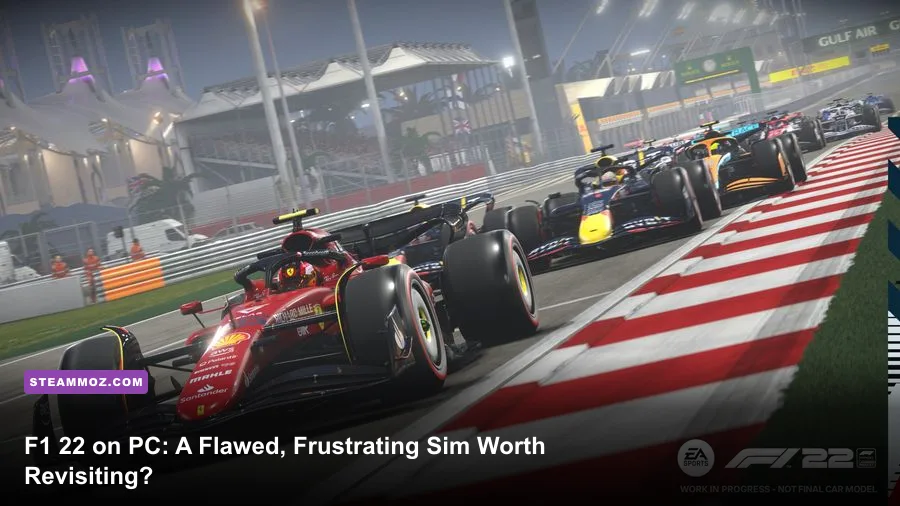
F1 22 on PC is not a hidden masterpiece waiting to be rediscovered, but it isn't an outright disaster either. If you find it for five bucks in a seasonal bundle, want to run the distinct 2022 regulation liveries, or crave an affordable entry point into native PC VR open-wheel racing, it delivers genuine thrills. However, if you are searching for a balanced, rewarding sim-cade handling model or a polished single-player campaign, you will quickly slam your desk in rage. Between its notorious "ice-skating" rear traction model, straight-line AI top-speed anomalies, and the tone-deaf addition of customizable living rooms in F1 Life, Codemasters produced one of the most divisive entries in modern racing history.
The Infamous Physics Model: Taming the Rear-End Beast
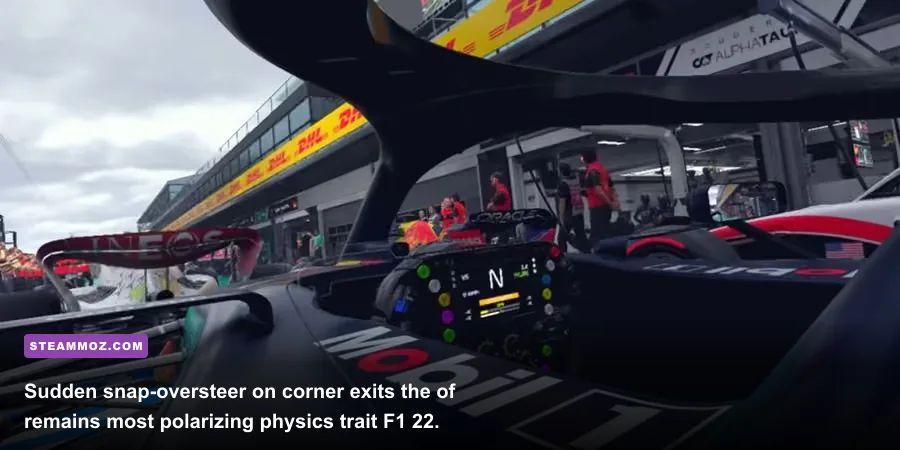
The transition to Formula 1's ground-effect aerodynamic regulations in 2022 flipped real-world motorsport on its head, and Codemasters scrambled to translate that shift into code. Real 2022 cars were stiff, heavy, prone to violent porpoising, and reliant on underfloor venturi tunnels for downforce rather than giant over-body wings. In F1 22 on Steam, that design philosophy translated into one catastrophic gameplay quirk: an almost total lack of low-speed rear traction.
If you touch a curb in second gear while leaving Turn 4 in Spielberg or exiting the slow chicane in Monza, the rear axle does not slip progressively—it snaps. The transition from grip to zero-traction feels instantaneous, leaving force feedback wheels feeling hollow for a microsecond before your car pirouettes into the barrier. Wheel users on high-end Direct Drive wheelbases from Fanatec or Moza felt this disconnect acutely. The simulation simply did not telegraph the tire carcass flexing before letting go.
To survive without burning through flashbacks, competitive players adopted an absurd setup meta that prioritized exploits over realistic engineering:
- On-Throttle Differential: Set dead low to 50% or 55% to minimize wheel-spin imbalances when opening the steering wheel.
- Suspension Geometry: Camber maxed out to the right, toe set flat to minimize unpredictable scrub friction over kerbs.
- Anti-Roll Bars: Softened drastically (often 1-1 or 2-2 front/rear) to trick the game into absorbing curbs that would otherwise shatter your suspension geometry.
- Throttle Linearity: Pad and pedal users had to jack pedal linearity up to 35-50 in the calibration menu just to create usable travel at 20% throttle input.
Short-shifting into third or fourth gear before even touching mid-corner acceleration wasn't an advanced skill—it was mandatory self-defense against the game's brutal torque curve.
PC Performance, VR Support, and Visual Fidelity
Graphically, F1 22 marked a massive technical step forward for Codemasters' proprietary EGO Engine. It introduced ray-traced shadows, reflections, and ambient occlusion, completely transforming night races like Singapore and Bahrain. Rain droplets streaked realistically across the visor, and spark effects cast dynamic light off the titanium skid blocks under every car floor. Much like optimizing graphics pipelines for maximum frame rates, tuning F1 22 requires balancing heavy post-processing against rock-solid frametimes.
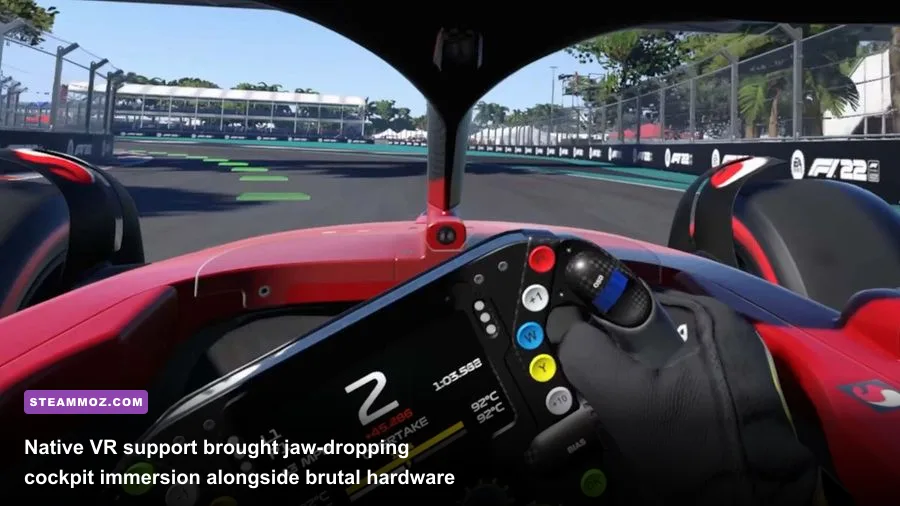
Crucially, F1 22 was the very first entry to introduce native PC Virtual Reality. Strapping into an Oculus Quest 2, Valve Index, or HP Reverb G2 delivered an unbelievable sense of scale. Sitting inside the cockpit of the Ferrari F1-75, looking up at the curved halo pillar, and judging apexes with true stereoscopic depth perception was breathtaking. Unfortunately, the launch VR implementation was notoriously unoptimized, plagued by reprojection stutter, blurry temporal anti-aliasing, and heavy CPU bottlenecks during wet starts with a full 20-car grid.
| Graphic Setting | Recommended Value | FPS Impact | Competitive & Sim Impact |
|---|---|---|---|
| Ray Tracing (All Options) | Off | Extremely High (-35%) | Adds massive latency; turn off for competitive consistency and high refresh rates. |
| Post Processing | Medium | Moderate (-8%) | Eliminates aggressive camera bloom and motion blur while preserving clear apex tracking. |
| Lighting Quality | High | Low (-4%) | Crucial for night races in Bahrain, Singapore, and Abu Dhabi without tanking frame stability. |
| Shadows | Medium | Moderate (-10%) | Softens cockpit ambient shadow compute loads; huge boost to minimum 1% lows. |
| Weather Effects | High | High in Wet (-15%) | Keeps track spray readable so you can spot standing water puddles on intermediate tires. |
| Anti-Aliasing | TAA + FidelityFX Sharpening | Minimal (-2%) | Cuts temporal shimmering along track fences while maintaining sharp braking board readability. |
If you encounter bizarre driver freezes or crash-to-desktop errors during podium cutscenes, treat the game's runtime the same way you approach ironing out sudden crashes and stuttering: roll back unstable GPU overclocks and lock your framerate through your driver control panel. For older gaming rigs, checking baseline expectations against retro PC optimization benchmarks or modern specs can save you hours of troubleshooting.
Career Mode, Adaptive AI, and the Straight-Line Rocket Bug
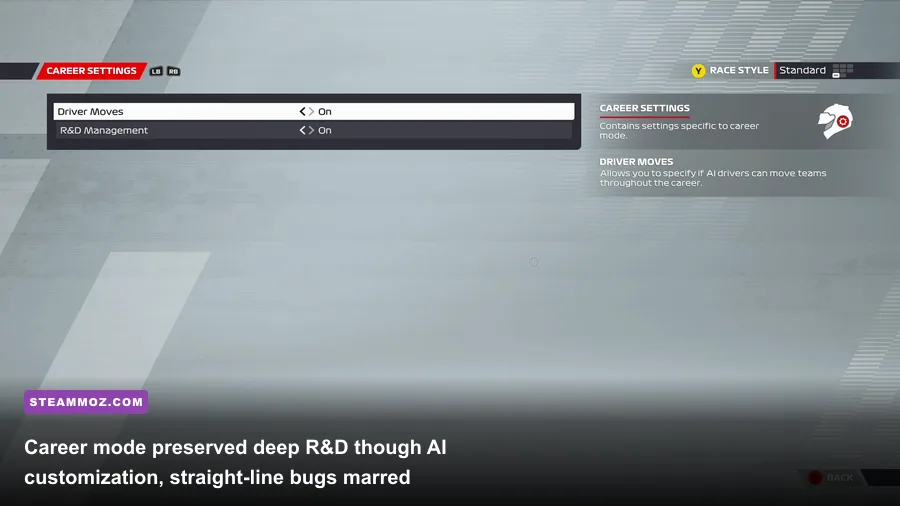
My Team and the traditional Driver Career were supposed to be the core gameplay loop, building upon the fantastic team management mechanics introduced in F1 2020. You still invest your sponsor cash into aerodynamic wind tunnels, chassis durability, and powertrain dynos. You still micromanage component wear across internal combustion engines (ICE), MGU-K, and Turbochargers. But the actual racing in single-player suffered from one of the most frustrating bugs in sim-racing history: the AI straight-line acceleration glitch.
For months after launch, AI drivers possessed impossible straight-line acceleration out of slow corners. Even if you nailed your exit onto the long straight in Miami, Baku, or Circuit Paul Ricard with DRS open and battery deployment set to "Overtake," an AI Williams or Haas would effortlessly pull away from you as if carrying zero drag and 200 extra horsepower. Despite several post-launch patches detailed via Codemasters official updates, the AI physics never felt fully governed by the same tire thermal model or aerodynamic drag constraints that bound the player.
Adaptive AI was added to help casual players match the pace of the computer dynamically, but it suffered from violent rubber-banding. Instead of creating natural wheel-to-wheel battles into heavy braking zones, the AI would swarm your gearbox along straights and then park on corner apexes, leading to endless broken front wings and agonizing race restarts.
F1 Life and Supercars: The Fluff Nobody Asked For
You cannot talk about F1 22 without addressing its most controversial inclusion: F1 Life. Marked as EA's signature fingerprint on the franchise, this hub area forced players to unlock designer couches, luxury wall art, floor tiles, and designer streetwear for their digital avatar. In a sport defined by telemetry, tire pressures, and tenths of a second gained in sector two, spending time unlocking a digital armchair felt completely tone-deaf.
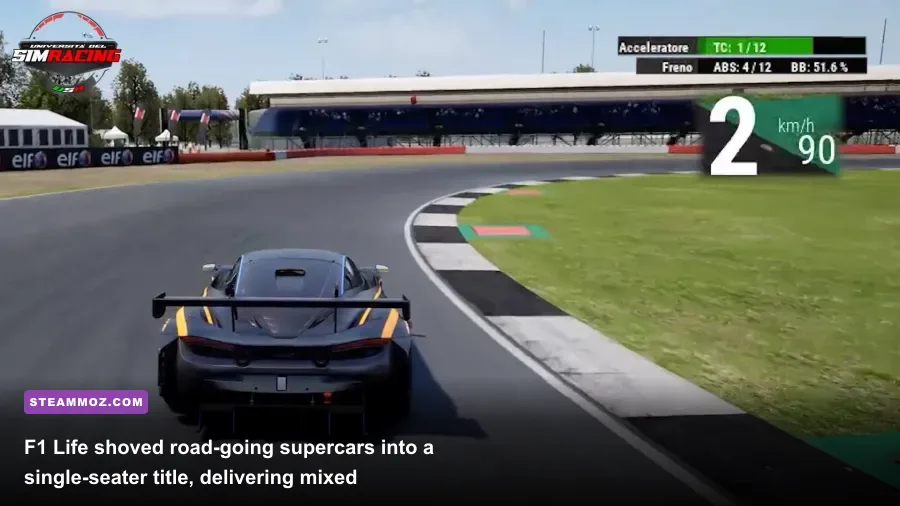
Tied directly to this feature was the inclusion of road-going supercars. You could pilot the Aston Martin DB11 V12, McLaren 720S, and Mercedes-AMG GT Black Series in Pirelli Hot Lap challenges between race weekends. On paper, driving iconic high-performance sports cars on grand prix circuits sounds fun. In execution, it was dreadful.
The EGO physics engine was built from the ground up to simulate downforce-dependent, ultra-responsive open-wheel race cars. Shoving heavy, road-going production cars with soft road springs into that engine made them feel like runaway pontoon boats on flat tires. The steering response lagged, weight transfer felt entirely artificial, and sliding across the kerbs at Silverstone in a road car felt more like an arcade minigame than a motorsport simulation. Codemasters wisely ditched the heavy emphasis on supercars in subsequent franchise iterations.
Generational Showdown: F1 22 vs. F1 2020 vs. F1 23
When assessing whether F1 22 has a place in your Steam library today, context is everything. Modern sim racers frequently debate whether it is better to play the classic, highly polished F1 2020 or jump straight to F1 23 and beyond. In almost every technical and mechanical metric, F1 22 sits squarely in the awkward middle child seat.
F1 2020 is widely regarded as the pinnacle of the previous generation. It featured classic historic cars (including Schumacher's legendary Benetton and Ferrari rides), stable traction physics that let you feather the throttle smoothly without unpredictable spinouts, and lightweight CPU overhead. On the other end, F1 23 completely overhauled the physics through its "Precision Drive" technology. F1 23 restored predictable rear-axle grip, fixed the torque curve out of slow hairpins, introduced red flags, and dramatically improved controller usability.
| Game Feature | F1 2020 (The Gold Standard) | F1 22 (The Transition Era) | F1 23 (The Modern Refinement) |
|---|---|---|---|
| Throttle & Traction Model | Smooth, linear, highly forgiving on corner exit. | Hair-trigger snappy; prone to sudden rotational oversteer. | Reworked grip curve; balanced, realistic slip angle. |
| Controller / Gamepad Feel | Excellent; smooth stick steering dampening. | Difficult; requires high steering linearity adjustments. | Exceptional; introduction of Precision Drive tech. |
| VR Implementation | None (Requires third-party modding tools). | Native VR support; visually heavy but functional. | Optimized VR; sharper clarity and better UI scaling. |
| Car Era / Regulations | Previous Gen (High-downforce, light cars). | Ground Effect Era 1.0 (Stiff, heavy chassis). | Ground Effect Era 1.5 (Refined aerodynamics). |
| Bonus Content / Modes | Classic Historic F1 Cars (1988-2010). | F1 Life furniture, Pirelli Supercar Hot Laps. | Braking Point 2 story mode, F1 World events. |
| Track Accuracy | Pre-update Abu Dhabi, Australia, Spain layouts. | Updated Abu Dhabi, Australia, Spain; Miami debut. | Includes Lusail (Qatar) and Las Vegas Strip circuit. |
If you enjoy dialing in hardware configurations, achieving smooth pacing requires tuning PC settings for fluid frame timing. When balancing system load, modern simulation titles challenge even modern processors, making evaluating PC hardware requirements a valuable exercise before diving into heavy sim titles.
The Final Verdict: Who Should Still Play It?
So, does F1 22 still warrant space on your SSD? The honest answer depends entirely on the price tag and your patience for sim-racing compromises.
Skip It If:
- You play primarily on a gamepad. Without the Precision Drive physics overhaul introduced in F1 23, wrestling the raw throttle on an Xbox or PlayStation controller trigger without full traction control enabled is an exercise in pure frustration.
- You want an authentic single-player campaign. The relentless straight-line speed of the AI on standard career difficulty levels ruins the strategic joy of tire conservation and undercut pit strategies.
- You already own F1 23 or F1 24. There is virtually nothing mechanical or structural that F1 22 does better than its direct successors.
Buy It If:
- You find a digital Steam key heavily discounted for under $10. At bargain-bin prices, getting access to 22 modern Grand Prix circuits—including the brand-new Miami International Autodrome and re-profiled layouts for Melbourne, Barcelona, and Yas Marina—is tremendous value per dollar.
- You want to run VR without spending full price on the newest yearly installments. F1 22 gives PC sim racers an authentic first-person cockpit view in modern machinery that supports custom wheel rims and pedal sets with minimal fuss.
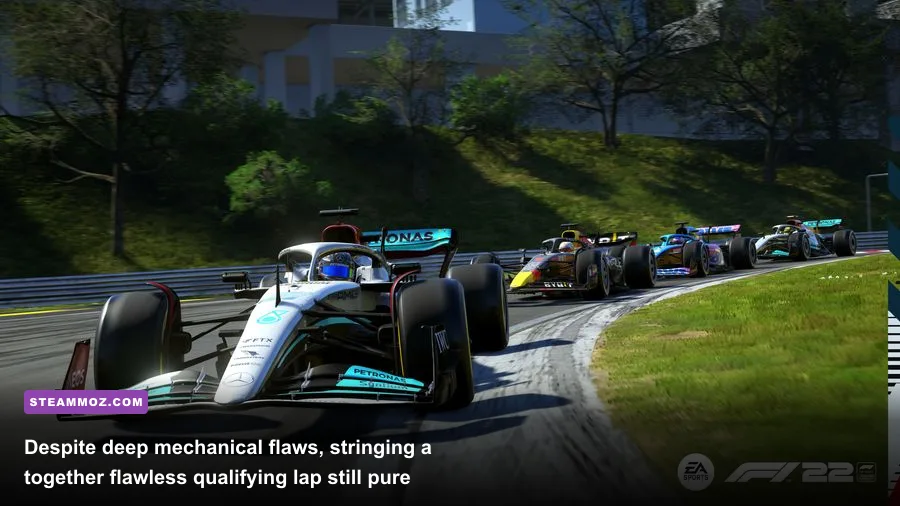
- You want to experience the raw, unruly beginning of modern ground-effect cars. The 2022 cars were unruly, stiff, and terrifyingly difficult to wrestle across kerbs, and F1 22 captures that unrefined brutality like no other game.
F1 22 will always be remembered as the messy transition title of Codemasters' racing catalog. It introduced groundbreaking features like VR and accurately reflected the massive aerodynamic reset of the sport, but it stumbled hard over throttle physics and unnecessary lifestyle fluff. If you approach it as an intense hot-lapping time trial sandbox with a high-end force feedback wheel, you can extract some fantastic racing joy. Just make sure you short-shift out of slow corners, keep off the curbs, and ignore the digital living room furniture.