Modding Overwatch 2 on Steam isn't about dropping loose .dll files into your install directory—doing that will get your account permanently nuked by Blizzard's anti-cheat before you even load into the practice range. Instead, transforming your experience means tapping into the game's rich in-engine Workshop scripting architecture, leveraging external non-hook overlays, and executing targeted Steam-level configuration tweaks. When you combine battle-tested custom Workshop codes, precision engine overrides via Steam launch commands, and low-overhead utility mods, you completely overhaul input latency, aim training efficiency, audio clarity, and visual feedback.
The Golden Rule of Modding Overwatch 2 on Steam
Before touching a single file, you need to understand the boundary between game transformation and an instant account termination. Blizzard's proprietary security suite, known as the Defense Matrix, monitors game memory in real time. Any third-party injector that modifies memory addresses, injects code into Overwatch.exe, or alters encrypted asset archives will trigger an automated hardware ban. You can read more about Blizzard's enforcement philosophy directly on Blizzard's Defense Matrix updates.
Because traditional client-side texture and model swapping is strictly off-limits, the PC competitive community has built an alternative modding culture. This ecosystem relies on three safe pillars:
- In-Engine Workshop Scripts: Deep, algorithmic modifications created within Blizzard's official scripting engine that load server-side without risking your account.
- Steam Ecosystem Overlays: Non-intrusive tools operating through the Steam overlay interface or Windows desktop composition layer (such as hardware crosshairs and spatial audio pipelines).
- Engine Configuration and Launch Properties: Under-the-hood configuration file parameters and Steam client flags that tune thread dispatching, garbage collection, and input polling.
Approaching modifications through this pipeline guarantees your client stays completely compliant while delivering the competitive advantages, UI cleanups, and performance gains typical of a heavily modded PC title. If you've spent time tuning other stubborn titles using our guide to fixing game crashes and rescuing FPS, you'll feel right at home tweaking these low-level variables.

🎮 FORM
Looking to experience this game? Grab your digital key directly on our store for $14.99.
View on Steammoz Store →Essential Workshop Mods That Completely Redefine Practice
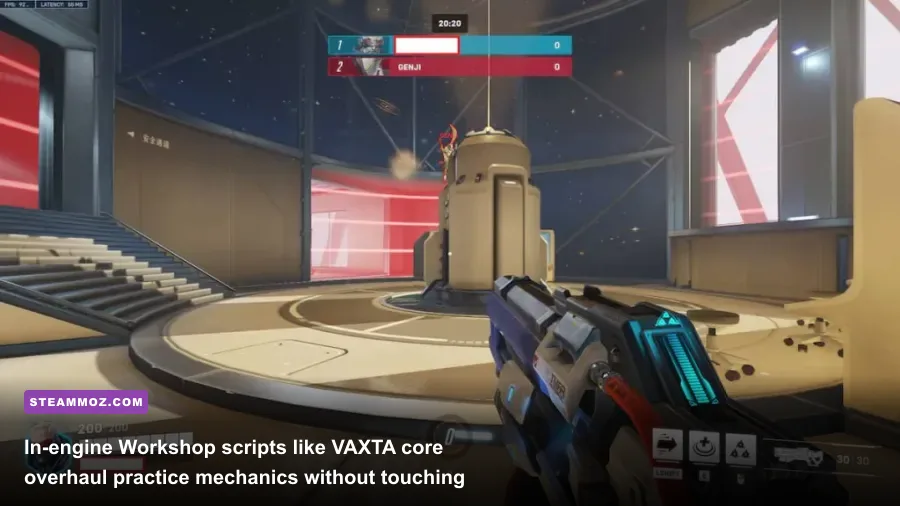
The Overwatch 2 Workshop is effectively an integrated programming language running visual scripting logic on Blizzard's dedicated servers. These aren't simple custom lobbies with inflated health pools; they are complex algorithmic practice mods featuring custom pathfinding, dynamic hitscan tracking routines, and real-time damage telemetry. You load them directly from the Custom Game menu by importing unique alphanumeric codes preserved by the community on the Workshop.codes community repository.
Standard practice range bots wander in predictable linear paths with oversized hitboxes, building terrible muscle memory. The premier aim-training mod, universally known under the code VAXTA (developed by visual scripter Seita), completely replaces static training with responsive bot strafing. Bots simulate actual player movement profiles, mixing short AD-strafe spams, erratic crouch timings, and vertical displacement mimicking real human panic patterns. You can adjust bot movement speed from 100% up to 140% to train twitch reactions on flick-reliant heroes like Cassidy, Ashe, and Illari.
For projectile heroes, the mechanical hurdle isn't just crosshair placement—it's projectile travel speed and vertical drop. Kiriko's Kunai travels at 90 meters per second, while Hanzo's Storm Bow caps at 110 meters per second at full draw. Using targeted reaction mods lets you train micro-flicks against aerial targets like Pharah and Echo while the script calculates and displays your real-time accuracy percentage, headshot conversion rate, and damage per second directly onto a custom HUD layer.
| Mod Code | Category | Transformative Feature | Target Heroes |
|---|---|---|---|
| VAXTA | Aim Training | Custom strafe algorithms, speed scaling, elevation toggles | Hitscan (Cassidy, Tracer, Soldier: 76) |
| PMAJEQ | 1v1 Arena | Instant respawn duels, active stat tracking, arena bounds | Genji, Tracer, Reaper, Hanzo |
| BTRGB | Reaction Trainer | Telegraphed Ultimate canceling, micro-window sleep dart practice | Ana, Sombra, Roadhog |
| EBAXM | Movement / Tech | Momentum indicators, rollout checkpointing, wall-ride timers | Lucio, Doomfist, Wrecking Ball |
| MHGGS | Cooldown Management | Infinite ability cycle testing, dynamic damage mitigation meters | Kiriko, Baptiste, Sigma |
Specialized movement trainers like EBAXM transform the engine into a precision platformer. Lucio's wall-ride mechanic features hidden acceleration curves that award stacking horizontal speed when leaping off curved surfaces within a 120-millisecond window. The script draws visual vectors directly onto the map architecture, showing you the exact angle of approach required to preserve jump momentum across King's Row or Rialto rooftops. Mastering these routes manually without a script would take hundreds of hours of trial and error.
Steam Launch Parameters and Engine Config Tweaks
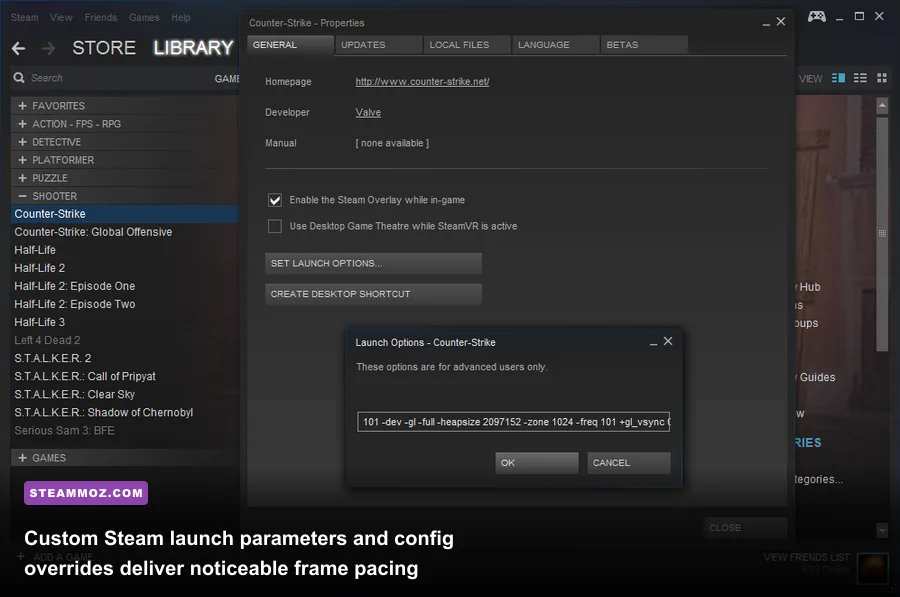
When Blizzard launched Overwatch 2 on the Overwatch 2 Steam store hub, it unlocked native access to Valve's robust launch environment. By default, the game runs unnecessary background telemetry threads and generic shader compilation steps that cause micro-stutters during heavy graphical moments, such as a Graviton Surge paired with a Kitsune Rush.
To implement low-level system mods without modifying game binaries, right-click Overwatch 2 in your Steam Library, select Properties, and scroll down to the Launch Options input field. These command-line switches manipulate how Windows allocates processor affinities and handles pipeline caches:
--tank_log=0 -high -threads [LogicalCores] +set software_occlusion_culling 0
The --tank_log=0 parameter shuts down Blizzard's verbose diagnostic logging daemon. In standard play, the engine writes hundreds of non-critical combat events to disk every minute, causing I/O spikes on SATA SSDs and mechanical drives. Disabling this logging completely smooths out frametime delivery. Much like we uncovered in our analysis of optimizing settings for max FPS, cutting background telemetry yields measurable improvements to 1% low framerates.
| Command / Setting | Target System | Performance / Mechanical Impact | Safety Rating |
|---|---|---|---|
--tank_log=0 |
Steam Launch Option | Eliminates disk write spikes; raises 1% low FPS by 4-8% | 100% Safe (Native Argument) |
-high |
Steam Launch Option | Forces Windows CPU scheduler to prioritize process threads | 100% Safe (OS Native) |
MaxFrameLatency = 1 |
Settings_v0.ini | Forces absolute minimal pre-rendered frame queue; reduces lag | 100% Safe (Config Mod) |
FullScreenRefresh = [Hz] |
Settings_v0.ini | Prevents engine fallback to 60Hz during desktop focus loss | 100% Safe (Config Mod) |
NVIDIA Reflex: Boost |
In-Game Video Menu | Keeps GPU clocks maxed even during CPU-bound teamfights | 100% Safe (Built-in) |
Beyond launch flags, your Settings_v0.ini file (located in Documents\Overwatch\Settings) holds several parameters that Blizzard's in-game UI hides. Open this file in a text editor and locate the [Render.13] header. Ensure MaxFrameLatency is manually locked to 1. While the in-game 'Reduced Buffering' toggle attempts this, it frequently desyncs after an Alt-Tab event, causing unnoticed input delay to climb from 4ms up to 18ms. Hardcoding this value in the configuration file keeps your click-to-photon pipeline consistently tight.
If you've tackled frustrating hardware bottlenecks before—similar to resolving stuttering outlined in our guide for higher FPS in complex puzzle engines—you know how much an unoptimized engine can ruin twitch reactions. Locking these parameters guarantees rock-solid stability across every round.
Visual and Audio Overlays That Sharpen Competitive Clarity
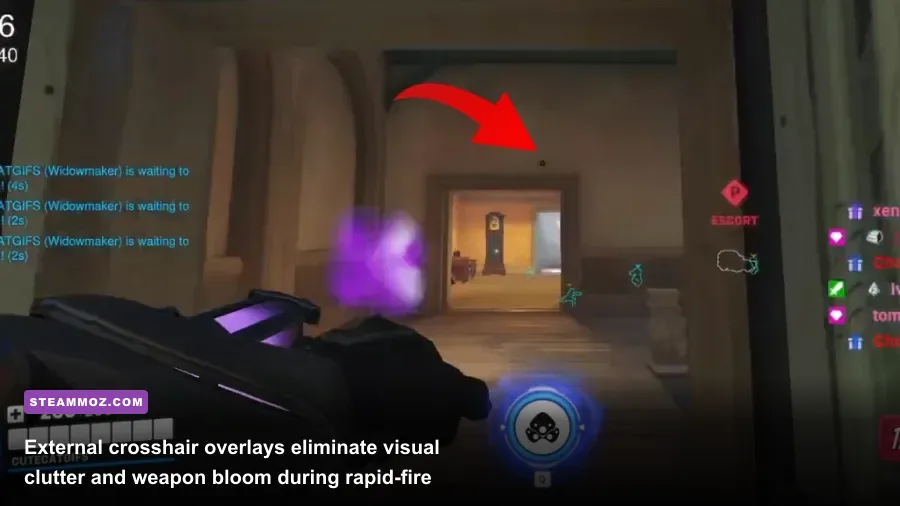
Overwatch 2's visual density is notorious. When ten players unleash ultimate abilities inside a choke point, visual clutter makes target tracking nearly impossible. The default in-game reticles expand dynamically with weapon bloom (especially on Soldier: 76 and Tracer), obscuring the enemy's head hitbox precisely when you need pinpoint accuracy.
Enter utility mods like HudSight or Crosshair X, both available directly through Steam. These tools operate via hardware-accelerated Windows overlays, drawing custom, static reticles on an independent desktop layer that sits over the game without hooking into the memory space of Overwatch.exe. Because they don't modify the game client, they are fully allowed by anti-cheat systems. A static 2-pixel neon-green dot or an ultra-thin crosshair remains crisp and motionless regardless of weapon recoil, jump animations, or explosive screen shake.
Audio is just as critical. The soundscape in Overwatch 2 prioritizes footsteps based on who the game engine calculates is the biggest immediate threat to your life. Unfortunately, this algorithm frequently miscalculates, burying a flanking Reaper's teleport audio underneath a nearby friendly D.Va primary fire barrage.
You can reshape this auditory environment using custom Parametric Equalizer profiles via open-source tools like Equalizer APO combined with the Peace GUI. By applying an aggressive low-shelf cut below 80Hz, you strip away the boomy, cinematic bass from ambient explosions. Then, boosting the 1.2kHz to 3.5kHz midrange bracket by +4dB brings out the high-frequency friction of enemy footsteps on concrete and metallic surfaces. This audio modification turns audio cues into an unmistakable radar, giving you split-second warnings before an enemy flanker strikes.
If audio or visual stuttering ever creeps into your session, check your system baseline against modern competitive specs. Ensuring your machine meets rigorous performance thresholds—much like reviewing PC specs explained for responsive competitive fighters—will keep your background equalization and overlay tools from dropping a single frame.
Steam Input and Controller Mods for Handheld Domination
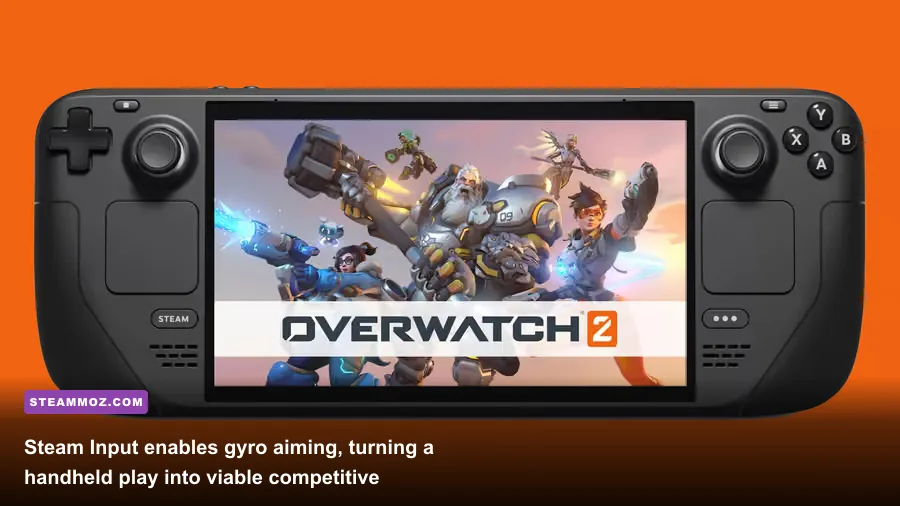
Playing Overwatch 2 on the Steam Deck or with a standard controller is notoriously punishing because Blizzard disables console aim assist the moment you join a PC matchmaking pool. If you try aiming against mouse-and-keyboard players using traditional dual-analog sticks alone, you will be outmatched in every engagement. Thankfully, the Steam version grants full access to the Steam Input configuration suite, enabling true mouse-level control on handheld hardware.
The real game-changer here is Gyro Aiming paired with Flick Stick. Through Steam Input, you map the controller's internal gyroscope to output raw mouse input coordinates rather than simulating an analog stick. When your thumb touches the right capacitive joystick, the gyro sensor engages instantly. Micro-movements of your hands translate into instantaneous, sub-pixel crosshair corrections.
Set your Steam Input configuration with these specific parameters:
- Gyro Output Mode: As Mouse
- Gyro Sensitivity (Horizontal/Vertical): Scaled to 2.5 (matching an in-game sensitivity of 4.00% at 800 DPI)
- Gyro Enable Button: Right Stick Touch (aim activates only when your thumb rests on the stick)
- Smoothing Threshold: Low (filters out minor pulse twitches without adding input delay)
- Flick Stick: Enabled on the Right Stick (snaps the camera instantly to the exact physical angle you push the stick)
With Flick Stick active, pulling the right analog stick downward spins your hero 180 degrees in a single frame, while the gyro handles the fine vertical and horizontal tracking. This input modification lets a skilled Steam Deck player snap onto an airborne Genji with the same speed and precision as a player on an expansive desktop mousepad.
For Linux and SteamOS players, running the game through the Proton GE (Glorified Edition) compatibility layer functions as an essential engine mod. Proton GE integrates custom patches for VKD3D-Proton and asynchronous shader compilation. This stops the notorious shader-generation hitching that plagues standard Proton whenever new ability particles render on screen for the first time. If you run into persistent frame hiccups on Steam Deck, applying targeted performance adjustments—comparable to the methods found in our guide to fixing FPS drops and crashes—will keep your framerate pinned at a buttery 60 or 90 FPS.
Building Your Ultimate Overwatch 2 Steam Environment
Transforming Overwatch 2 on Steam doesn't require risky hacks that jeopardize your profile. By anchoring your daily warmups in elite community Workshop mods like VAXTA and PMAJEQ, you build genuine mechanical skill far faster than casual Quick Play matches ever allow. Layering clean Steam launch arguments removes unnecessary thread stalls, third-party overlays keep your crosshairs rock steady during chaotic visual effects, and customized Steam Input profiles unlock competitive play on handheld hardware.
Take twenty minutes to enter these launch flags, adjust your configuration files, and bookmark the Workshop codes provided above. Once you drop into your next competitive match with crystalline frametimes, pinpoint audio cues, and an unshakeable reticle, you'll immediately see that the right setup makes all the difference.