
Dustborn does not have conventional weapons, loot rarity, or an equipment inventory. That means the best possible tier list ranks Pax's Voice, crew abilities, and encounter choices instead of guns or armor. For most fights, Pax's control-focused Voice options sit in S-Tier, defensive support belongs in A-Tier, and purely situational damage tools fall into B-Tier. If you arrived expecting an arsenal like the one in our Death Howl weapon ranking, Dustborn plays by a completely different set of rules.
This distinction matters because Dustborn is a narrative road-trip adventure from Red Thread Games, set in a fractured 2030 version of North America. You play Pax, an exile traveling with the crew of the bus Justice. Combat appears in bursts, but progression is driven by story decisions, relationships, dialogue, and the evolving use of rhetoric. There is no weapon damage number to chase, no shop where you replace a pistol with a legendary rifle, and no armor score that turns Pax into a tank.
What Counts as Equipment in Dustborn?

For this guide, equipment means any repeatable tool that changes how you approach an encounter. That includes Pax's Voice, the crew's combat contributions, dialogue-based preparation, and the choices that determine who is available or willing to help. The ranking is based on reliability, crowd control, safety, and how often a tool remains useful across the campaign.
Dustborn never presents a standard DPS spreadsheet. There are no publicly displayed weapon stats such as damage, rate of fire, magazine size, critical chance, or durability. Its combat language is closer to a staged confrontation: read the situation, select an effective response, interrupt pressure, and keep the scene moving. Treating each ability like a traditional gun will make the system feel much thinner than it really is.
| Combat Tool | Tier | What It Does Best | Main Limitation |
|---|---|---|---|
| Pax's control-focused Voice | S-Tier | Interrupts pressure and creates openings | Requires correct timing and target selection |
| Crew support abilities | A-Tier | Stabilizes difficult encounters | Depends on available crew and scene context |
| Dialogue preparation | A-Tier | Changes confrontation conditions | Not available as a mid-fight button |
| Direct damage responses | B-Tier | Finishes exposed threats quickly | Less flexible when multiple enemies apply pressure |
| Environmental interaction | B-Tier | Solves specific encounter problems | Highly dependent on the location |

🎮 Dustborn
Looking to experience this game? Grab your digital key directly on our store for $2.99.
View on Steammoz Store →S-Tier: Pax's Voice and Control Options
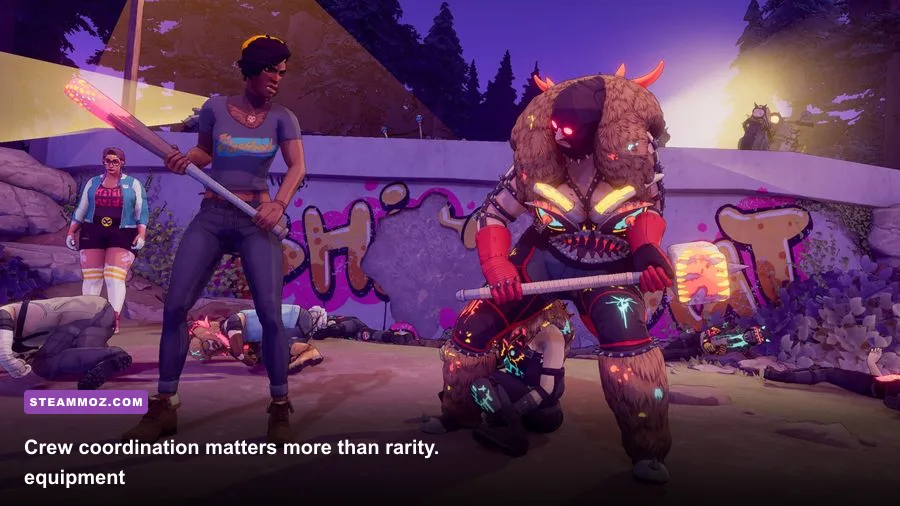
Pax's Voice — the clear S-Tier pick
Pax's Voice is the closest thing Dustborn has to a signature weapon. It is not a pistol, sword, or magic spell, but it gives Pax the ability to shape confrontations through rhetoric. The strongest applications are the ones that interrupt an enemy's momentum, force a response, or create breathing room for the rest of the crew.
Control is more valuable than raw damage because Dustborn's encounters are designed around pressure. A threat left active can disrupt your rhythm, while a controlled target gives you time to reposition, identify the next danger, and coordinate another response. This is why a seemingly modest interruption can outperform a flashy attack. The game rewards winning the exchange, not producing the largest number.
Use Voice options early when several opponents begin crowding the scene. Saving everything for a dramatic finishing moment is usually a mistake. The safest rhythm is to interrupt the most disruptive threat, exploit the opening, then switch attention before the encounter becomes chaotic. Against a single exposed opponent, direct damage may be faster, but control remains the better default.
Why there is no damage-maxing meta
Players searching for an exact best weapon should know that Dustborn has no conventional build math. You cannot stack attack power, reload speed, or elemental bonuses. The best setup is determined by the encounter's demands and by how comfortably you can recognize telegraphs. A player who consistently interrupts attacks will perform better with a control-first approach than someone chasing a fictional high-damage loadout.
A-Tier: Crew Support and Preparation
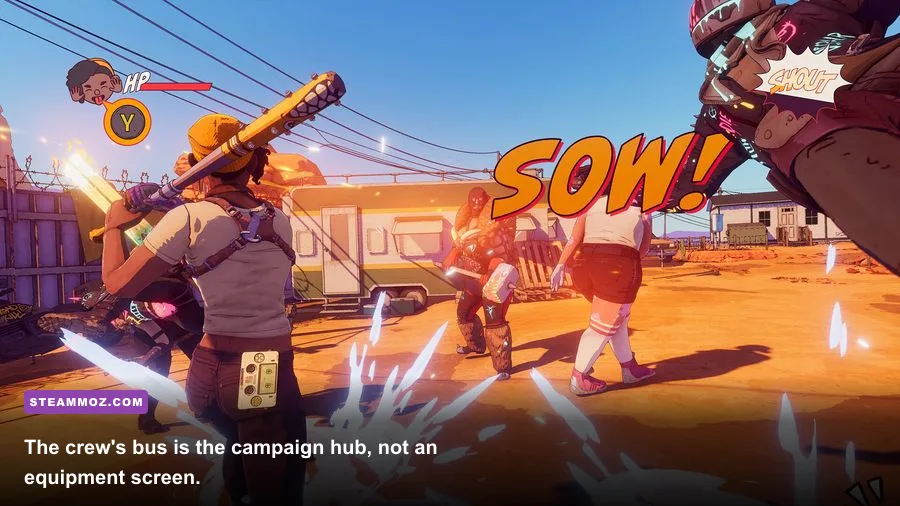
Crew abilities — the best supporting equipment
The Justice crew is effectively Pax's equipment wheel. Companions bring different personalities, perspectives, and practical strengths to the road trip, and their presence influences how encounters feel. The important decision is not which character has the highest item level; there are no item levels. It is which companion combination gives you the response you need for the situation.
Support is A-Tier because it makes Pax's Voice more reliable. A well-timed crew contribution can reduce pressure while Pax handles the central threat, and it can turn a messy encounter into a short sequence of manageable decisions. The limitation is availability. Story outcomes, relationships, and route decisions can change who is traveling with you, so there is no universal party composition that applies to every playthrough.
Build relationships deliberately. Conversations on the bus are not filler between combat missions. They help define the crew's trust and can affect later scenes, so repeatedly choosing the option that sounds safest may close off useful support or alter who stands beside Pax. If a future encounter feels harder than expected, the cause may be your story path rather than an underpowered character.
Dialogue choices — an underrated A-Tier tool
Preparation begins before the fight. Dustborn's dialogue and rhetoric systems can change the tone of encounters, open alternate approaches, and determine whether a confrontation escalates. Read every response carefully instead of treating conversations as a race toward the next action scene. The strongest equipment in a narrative game is often information.
That design puts Dustborn closer to a choice-driven adventure than a conventional looter. If you enjoy games where decisions have mechanical weight, our Daymare: 1998 starting-build guide covers a more traditional survival setup, while Dustborn asks you to manage people and language instead of ammunition.
B-Tier: Direct Damage and Environmental Options

Direct attacks — useful, but rarely the whole answer
Direct offensive responses belong in B-Tier only because they are less adaptable. They can be excellent when an enemy is already vulnerable or when the encounter presents one obvious target. They become less attractive when several threats are active, because removing one target does not necessarily stop the others from disrupting Pax's sequence.
Use damage after control, not instead of it. A simple rotation is to identify the enemy currently creating the most danger, apply a Voice response that breaks its momentum, then use the opening to pressure the exposed target. Once the field is calmer, finish the remaining threat. This is faster and safer than attacking the nearest opponent without considering the whole encounter.
Environmental interactions — powerful in the right scene
Dustborn's road-trip locations are built for narrative context rather than open-ended sandbox combat. Environmental options can be highly effective when the scene clearly points toward them, but they are not dependable enough to form a universal build. Look for objects, positioning opportunities, and contextual prompts, then use them when they solve the immediate problem. Don't force an environmental trick when Pax's Voice already provides a clean answer.
| Situation | First Choice | Follow-Up | Why It Works |
|---|---|---|---|
| Several threats applying pressure | Control-focused Voice | Target the exposed threat | Reduces incoming disruption before damage |
| One enemy already vulnerable | Direct offensive response | Return to control if pressure rises | Converts an opening into a quick finish |
| Crew member is available to assist | Use support contribution | Keep Pax on the priority target | Splits attention without sacrificing control |
| Scene contains a clear contextual object | Environmental interaction | Reassess the battlefield | Can bypass a problem without prolonged combat |
| Dialogue confrontation before combat | Read responses carefully | Choose the option matching your goal | May prevent escalation or change the encounter |
Best Dustborn Setup for a First Playthrough

For a first run, use a control-first approach: prioritize Voice responses that interrupt or manipulate the most dangerous threat, keep a crew member available for support, and avoid escalating every conversation just to see the combat system. This is not a permanent character build, so you lose nothing by experimenting. The campaign is designed around discovery, and replay value comes from seeing how different relationships and decisions reshape the journey.
On PC, prioritize stable performance over maximum image quality. Dustborn's encounters depend on readable animation cues and clean timing, so a consistent frame rate is more useful than pushing every setting to ultra. If your system struggles with the game, compare your hardware against our Eternal Threads PC requirements guide and our PC performance troubleshooting guide for practical optimization habits.
| Priority | Recommended Approach | Reason |
|---|---|---|
| 1 | Learn Voice timing | Control creates the safest openings |
| 2 | Track the most disruptive threat | Stopping pressure matters more than attacking randomly |
| 3 | Invest in crew relationships | Story choices influence available support and scenes |
| 4 | Use direct attacks opportunistically | Damage is strongest after an enemy is exposed |
| 5 | Keep frame pacing stable | Readable cues make timing-based encounters easier |
Dustborn's official Steam page and Red Thread Games website make the game's identity clear: this is a story-driven road trip about a crew, a stolen package, and the power of language. The official Dustborn site is also worth checking for the latest platform and game information.
So, the final ranking is straightforward. Pax's control-focused Voice is S-Tier, crew support and smart dialogue preparation are A-Tier, and direct damage or environmental tricks are B-Tier because they depend more heavily on the scene. There is no secret legendary weapon to farm. The best equipment in Dustborn is the response that gives you control of the moment—and the judgment to know when to use it.