Yes, Door Kickers: Action Squad is still worth playing in 2026—especially if you want a cheap, sharp co-op action game that rewards room knowledge rather than twitch reflexes alone. Its pixel-art presentation is dated, the campaign can feel repetitive, and solo runs sometimes expose the limits of the AI. But the core loop remains excellent: kick in a door, read the room in a split second, suppress threats, save civilians, and survive long enough to reach the exit. Few games make that sequence feel this immediate.
Released by KillHouse Games and PixelShard, Action Squad is not a traditional top-down tactical simulator like the original Door Kickers. It is a side-scrolling SWAT shooter built around short missions, class-based abilities, destructible doors, hostages, traps, and deliberately dangerous enemy placement. That change in perspective makes it more accessible, but it doesn't make it simple. The best runs still come from planning, restraint, and knowing exactly when not to fire.
For more compact action recommendations, Steamoz's lists of games like 10 Second Ninja X and games like F.E.A.R. 2 are useful companions, but Action Squad occupies a much more specific lane.
The breach-and-clear loop is still fantastic
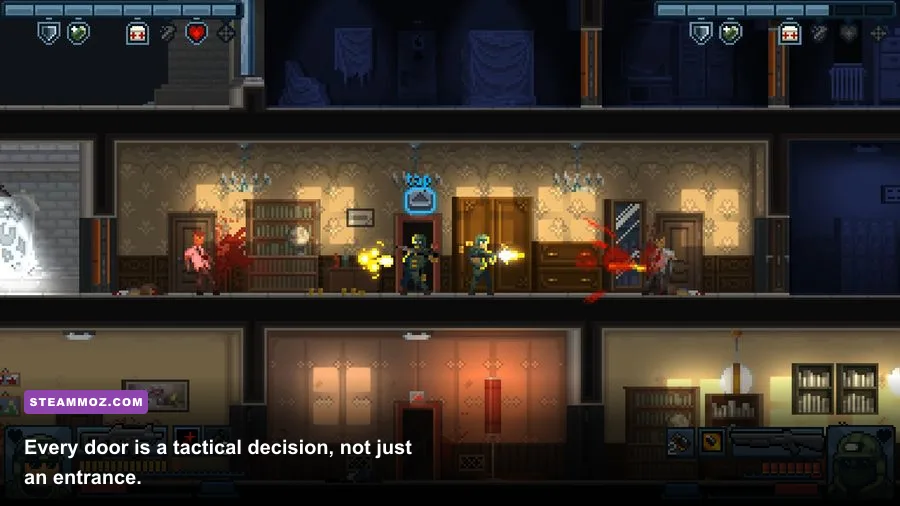
Action Squad's best idea is how much information it gives you before a firefight. You can see the building's rooms, doors, windows, ladders, enemies, and civilians in a single horizontal slice. That sounds generous, yet the game constantly hides the most important detail: what waits on the other side of a closed door. A slow breach might let an enemy line up a shot. A fast kick can stun a target, but it also commits you to the room before you've identified every threat.
Movement is straightforward, with aiming controlled independently from your character's position. That separation is the foundation of the combat. You can hold a doorway while edging forward, shoot through certain surfaces, crouch beneath attacks, and clear a room without blindly walking into the center. Weapons feel punchy because enemies react quickly to hits, but the game is not a pure run-and-gun shooter. Accuracy, reload timing, and sightlines matter more than raw fire rate.
Hostages complicate every encounter. Killing civilians damages your mission result, while rescuing them safely improves the reward structure and gives you a reason to check rooms instead of sprinting toward the exit. Some objectives also force you to manage alarms, bombs, or heavily defended floors. The result is a satisfying rhythm: gather information, make a breach, stabilize the room, then decide whether the next door deserves a grenade or a careful peek.
The star-rating structure gives completed missions a second life. You can finish a stage and still have reasons to replay it for faster completion, fewer civilian casualties, or cleaner execution. It is not a deep roguelike progression system, but it creates the kind of “one more attempt” pull that works brilliantly in 10-minute sessions.

🎮 Door Kickers: Action Squad
Looking to experience this game? Grab your digital key directly on our store for $2.79.
View on Steammoz Store →Six classes make the campaign worth replaying
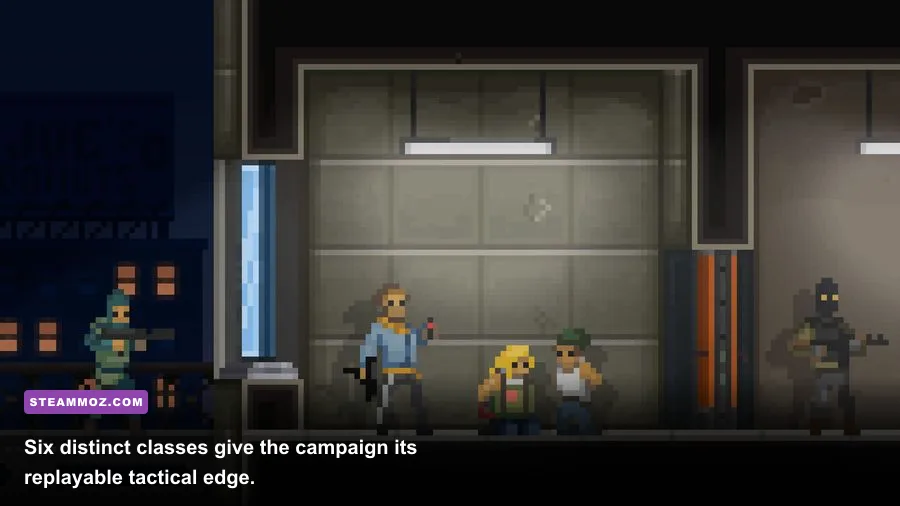
The roster is the game's real progression system. Each class changes how you approach the same room, and the difference is more than cosmetic. Assault is the dependable all-rounder, carrying a rifle and using tools that make standard breaches safer. Breacher is the obvious choice for aggressive players: shotguns and breaching explosives let you force entry, remove clustered threats, and keep momentum through cramped interiors.
Support trades some direct killing power for team utility. Armor, ammunition support, and defensive tools become increasingly valuable in longer missions or co-op sessions where a teammate's reload or survivability can decide the run. Scout is built around speed and precision, making the class excellent for players who like to move ahead, identify threats, and exploit open sightlines rather than absorb punishment.
CQC specializes in close-range dominance. This class shines when the level is packed with narrow rooms, stairwells, and enemies positioned just beyond a doorway. Agent is the more technical option, relying on gadgets and controlled engagements instead of simply pushing forward. The final class, Recon, rewards awareness and target selection, giving experienced players another way to solve missions that feel awkward with heavier operators.
| Class | Best strength | Weakness | Best situation |
|---|---|---|---|
| Assault | Reliable rifle combat | Few extreme advantages | First campaign runs and mixed objectives |
| Breacher | Fast entry and room clearing | Limited long-range control | Dense interiors and armored targets |
| Support | Team sustain and defensive utility | Lower solo tempo | Long missions and four-player co-op |
| Scout | Speed and accurate positioning | Less forgiving when hit | Open layouts and timed objectives |
| CQC | Close-range burst damage | Struggles across long sightlines | Stairwells, corridors, and tight rooms |
| Agent | Gadgets and controlled engagements | Higher learning curve | Trap-heavy stages and careful clears |
That variety is why the game works better with a small group than its simple presentation suggests. A Breacher can open the route, a Scout can cover the far side, and Support can keep the team alive after a messy exchange. You don't need voice-chat perfection, but communication turns chaotic mistakes into deliberate improvisation. If your group enjoys games such as the convoy-management tension described in Badlands Crew, Action Squad offers a similarly satisfying reward for staying coordinated under pressure.
Campaign progression rewards mastery, not grinding
The campaign is organized around compact urban missions rather than one long narrative journey. Levels introduce new combinations of hostages, locked doors, vertical routes, explosives, and enemy placements. You unlock classes, weapons, and skills as you play, but the game wisely avoids turning the experience into a damage-number treadmill. A newer operator can clear a mission with the right approach, while a veteran can chase a cleaner rating through better positioning and faster decision-making.
That design keeps the early progression brisk. You are constantly learning a tool that changes your options rather than simply adding five percent damage. Skills can improve a class's survivability, accuracy, reload behavior, or utility, and the strongest choices depend on the map. A stun-focused setup is excellent for a room with several armed enemies, while a more defensive build is smarter when the level funnels you through repeated ambushes.
There is also a custom-mission and challenge flavor that helps extend the package beyond the first campaign pass. Still, don't expect a live-service stream of new content in 2026. The game is a finished indie release, and that is part of its appeal: no battle pass, no seasonal grind, and no enormous launcher ecosystem standing between you and a mission.
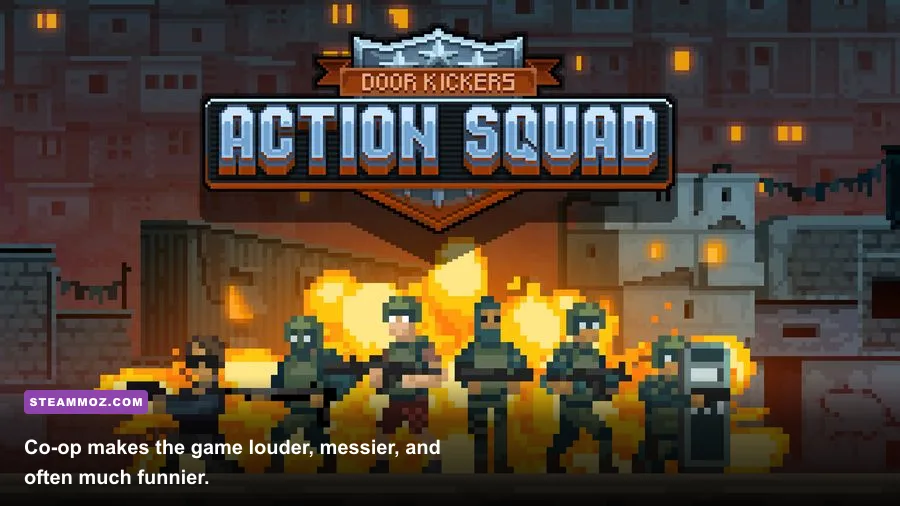
Co-op supports up to four players, but the difficulty does not vanish with a full squad. More players can cover more angles, yet they can also trigger alarms, block doorways, waste explosives, or shoot civilians during a panic. The best teams assign jobs before breaching: point player, rear security, hostage handling, and overwatch. Without that discipline, four operators become four separate sources of noise.
Difficulty is where Action Squad shows its teeth
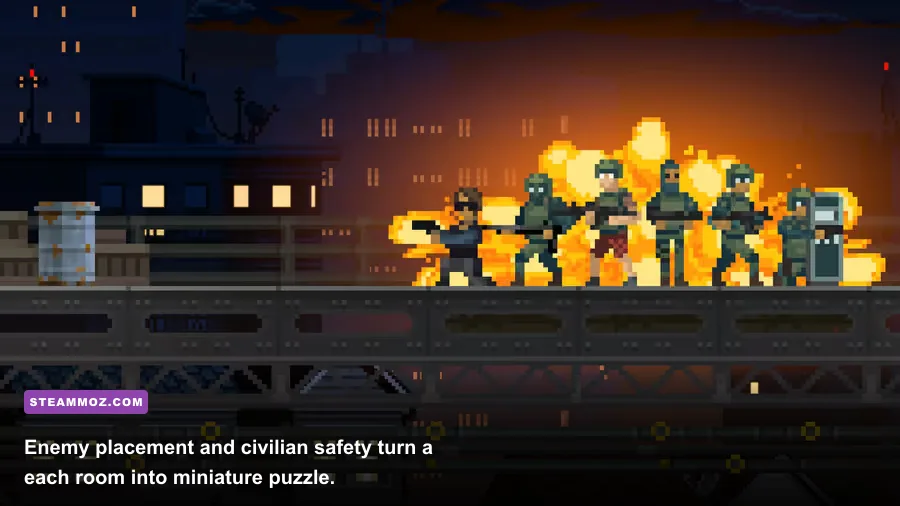
The game is approachable for the first few missions and surprisingly unforgiving once enemy density rises. Enemies don't need elaborate boss phases to be dangerous. A rifleman behind a partially open door, a shotgunner around a blind corner, or a suicide attacker entering from a side route can erase a run before you have time to react. The key is learning the visual telegraphs and respecting the geometry of each room.
Don't reload in the middle of a breach unless you have hard cover. Don't stand in a doorway after opening it. Don't throw a grenade into an unknown room when a hostage might be inside. Those rules sound obvious, but the game's speed encourages exactly the kind of rushed behavior it punishes. A short pause to aim through a doorway is often safer than charging in with a full magazine.
| Threat | Why it is dangerous | Counter strategy | Useful tool |
|---|---|---|---|
| Shotgunner | Huge close-range burst | Stun before entering and keep distance | Flashbang or controlled rifle fire |
| Rifleman | Locks down long sightlines | Use cover and attack from a second angle | Breaching charge or accurate rifle |
| Shielded enemy | Absorbs frontal fire | Flank, stun, or attack from above | Team crossfire and explosives |
| Suicide attacker | Forces an immediate reaction | Spot early and eliminate at range | Scout positioning or fast sidearm |
| Hostage cluster | Limits explosive options | Clear angles manually and slow down | Precision weapon and patience |
Difficulty spikes are most noticeable when the game introduces a new layout pattern without giving you much room to practice it. That can feel unfair after a clean run ends instantly, but failure usually teaches something concrete: a missed upper window, a neglected flank, or an overconfident breach. The game rarely asks for perfect reflexes; it asks you to stop repeating the same mistake.
Performance, controls, and value in 2026
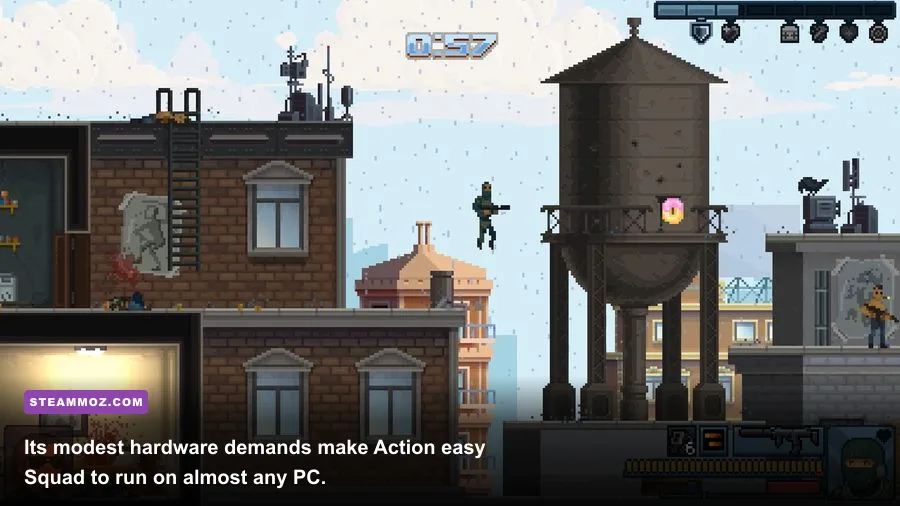
On PC, Action Squad is exceptionally easy to run. Its pixel-art levels, compact effects, and modest system requirements mean even an older laptop should handle it comfortably. You won't find modern ray tracing, ultrawide showcase features, or a long list of graphics toggles. That is not a serious weakness here, because the art style is clean and readable, and enemy silhouettes remain visible during busy firefights.
| Component | Minimum | Recommended | 2026 expectation |
|---|---|---|---|
| Processor | 1 GHz-class CPU | Any modern dual-core CPU | Stable performance on low-end systems |
| Memory | 2 GB RAM | 4 GB RAM or more | Minimal memory footprint |
| Graphics | Integrated graphics | Any modern integrated GPU | High frame rates at native resolution |
| Storage | About 500 MB | 1 GB free space | Fast installation and tiny footprint |
The control scheme is better with a gamepad for movement and aiming, though keyboard and mouse remain perfectly viable. On a handheld PC, the readable sprites and short mission structure are a strong fit. Battery life is generally more important than visual tuning, since lowering resolution offers little practical benefit. If you're troubleshooting a much heavier game, Steamoz's A Year of Rain performance settings and Bionic Dues settings guide cover the more demanding end of PC optimization.
Value depends on whether you want variety or replayable execution. The campaign doesn't have the cinematic spectacle of a modern tactical shooter, and solo players may grow tired of repeating familiar breach patterns. But the low asking price, four-player co-op, generous mission count, class variety, and near-zero hardware barrier make it an easy recommendation for a group library. It is also a particularly good palate cleanser after huge open-world games.
Verdict: a small tactical game with a big replay loop
Door Kickers: Action Squad is worth playing in 2026 because its fundamentals have aged better than its presentation. The shooting feels immediate, the classes genuinely change your decisions, and every mission gives you enough information to understand why a plan failed. It isn't flawless: the AI can be inconsistent, the visual style is intentionally limited, and the campaign's structure eventually shows repetition.
Those flaws matter less when you treat it as a mission-based tactical action game rather than a full-scale SWAT simulator. Buy it for short, replayable scenarios; bring friends if you can; and expect to restart missions because one bad breach can unravel everything. The official Steam page remains the best place to check current platform and bundle details, while KillHouse Games' official site provides developer information and related releases.
Final score: 8/10. Door Kickers: Action Squad is compact, affordable, easy to run, and still wonderfully tense. If you like tactical decisions delivered at action-game speed, it deserves a spot in your 2026 backlog.