
Yes—Dino Crisis 2 is worth playing in 2026, especially if you want a compact, aggressive PlayStation-era action game rather than another slow-burn survival-horror maze. Its fixed camera, crunchy presentation, and six-to-eight-hour campaign have aged unevenly, but the weapon variety, dinosaur encounters, combo scoring, and Regina-and-Dylan partnership still give it a pulse that many modern throwback games can’t fake.
The important catch is that Dino Crisis 2 is not really Resident Evil with dinosaurs. Capcom stripped away much of the first game’s locked-door tension and inventory anxiety, then replaced it with speed. You shoot, dodge, collect points, buy upgrades, and keep moving. That design makes the sequel more approachable than Dino Crisis, but also less frightening. In 2026, it’s best understood as a polished arcade-action adventure trapped inside a survival-horror shell.

A sequel that trades fear for momentum

Dino Crisis 2 follows Special Operations Unit members Regina and Dylan after a time-jump disaster strands them in a prehistoric environment. The story is pulpy science fiction, complete with military conspiracies, unstable timelines, and the mysterious Third Energy project. It isn’t subtle, but it understands the appeal of its premise: put trained soldiers in a world where every bush might contain a raptor.
Regina and Dylan don’t play identically. Regina is the sharper, more agile combat specialist, while Dylan’s sections lean into heavier firepower and environmental interaction. You’ll switch between them at scripted points, and the change matters because the game uses different weapons, routes, and encounter pacing to keep the campaign from becoming one long corridor of identical velociraptors.
The biggest structural change from the 1999 original is the removal of traditional item-box friction. Instead of constantly asking whether you can afford to carry a healing item, Dino Crisis 2 gives you a more generous supply loop. You earn points by killing dinosaurs, maintaining combos, and avoiding damage, then spend those points at shops or terminals on weapons, ammunition, healing disks, and protective equipment.
That loop is simple, but it works. A clean encounter feels profitable. A sloppy encounter costs health, breaks your combo, and leaves you poorer. The game quietly encourages mastery without burying the player under skill trees or crafting menus.

🎮 Dino Crisis 2
Looking to experience this game? Grab your digital key directly on our store for $4.99.
View on Steammoz Store →Combat is the reason to come back
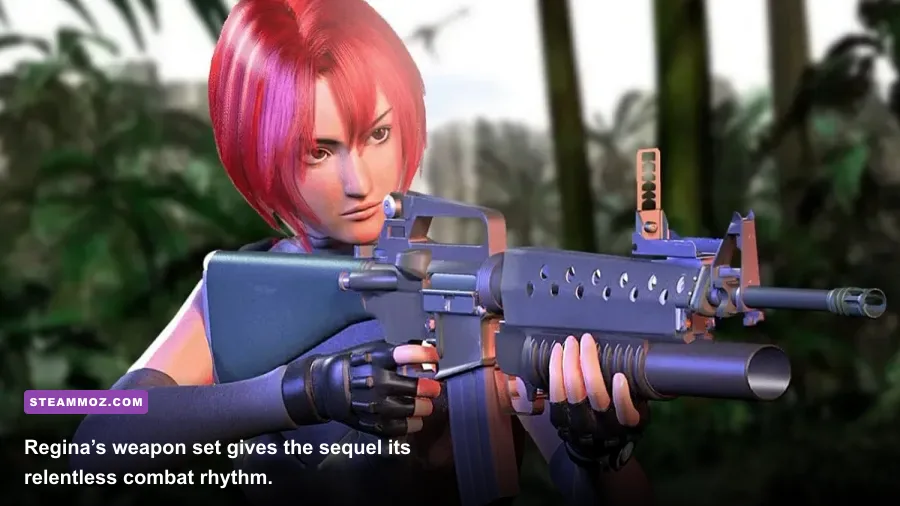
Dino Crisis 2’s combat remains its strongest argument in 2026. The original PlayStation hardware targets roughly 30 frames per second in the NTSC release, and the game’s controls are built around that slower cadence. Regina and Dylan can rotate, retreat, fire, and reposition quickly enough to make crowded encounters readable, but the game still punishes panic.
The weapon roster has distinct jobs rather than cosmetic upgrades. Regina’s handgun is economical against smaller threats, the shotgun is ideal for creating space, and the grenade gun handles clusters or tougher targets. The flame launcher is especially useful when several dinosaurs funnel through a narrow route, while the heavy machine gun turns sustained fire into a safer answer for aggressive enemies. Dylan’s arsenal gives the campaign a different weight, with the missile pod delivering powerful bursts against larger targets.
Capcom does not expose modern-style damage numbers, enemy health bars, recoil values, or weapon DPS in the original game. That matters because many online guides present speculative figures as hard statistics. The reliable in-game data is functional: weapon names, ammunition types, purchase prices, and the enemy’s visible reaction to each hit. A shotgun blast can stagger and create breathing room; a handgun conserves resources; explosive weapons punish grouped enemies; heavy weapons shorten dangerous encounters at a higher point cost.
| Weapon | Best Use | Main Limitation | 2026 Verdict |
|---|---|---|---|
| Handgun | Velociraptors and routine targets | Low stopping power | Excellent for saving points and ammo |
| Shotgun | Close-range crowd control | Short range and limited shells | Essential when enemies surround you |
| Grenade Gun | Groups and tougher dinosaurs | Expensive ammunition | Best all-purpose power weapon |
| Flame Launcher | Narrow corridors and clustered enemies | Situational reach | Brilliant when the encounter is designed for it |
| Heavy Machine Gun | Sustained fire against durable targets | Rapid ammo consumption | Strong, but wasteful for basic enemies |
| Missile Pod | Large dinosaurs and boss pressure | Scarce ammunition and slower commitment | Save it for moments that can go bad quickly |
The key combat skill is not aiming. It’s route control. Learn which door or corner gives you room to turn, then use a short retreat to pull dinosaurs into a line. Don’t unload the grenade gun on a single raptor when a shotgun blast can stagger it. Conversely, don’t stubbornly conserve ammunition during a boss encounter and lose half your health. The game rewards efficient aggression, not hoarding for its own sake.
Dinosaurs, telegraphs, and the real difficulty curve

The enemy design is more varied than the famous premise suggests. Velociraptors are fast flankers that punish standing still. Allosauruses hit harder and occupy more space, making the camera a bigger threat during close fights. Pteranodons attack from above and can interrupt your rhythm, while Compsognathus are smaller nuisances that become dangerous when they appear alongside larger creatures.
Later encounters introduce heavy dinosaurs such as Carnotaurus, Suchomimus, and Triceratops. These enemies are not simply damage sponges. Their size changes how you move through an arena. A Triceratops can turn a safe-looking lane into a dead end, while a charging Carnotaurus demands that you recognize its forward commitment before firing.
The Tyrannosaurus Rex is the obvious spectacle, but it also shows the sequel’s design philosophy. The T-Rex is intimidating because of its reach, roar, and screen presence—not because the game offers a complex multi-stage health-bar puzzle. Watch the attack animation, keep a clear retreat path, and use heavy weapons when the opening is safe. Trying to circle endlessly around a boss with a fixed camera is how the game steals your healing disks.
Difficulty rises in waves rather than smoothly. Early jungle sections teach you to shoot and move. The military facility adds tighter spaces and more frequent interruptions. The third act mixes larger creatures with story pressure, making resource decisions more important. On a first run, the game is forgiving enough for newcomers, but a high-score run is much harsher because taking damage breaks the combo economy.
| Enemy | Threat Pattern | Best Response | Common Mistake |
|---|---|---|---|
| Velociraptor | Fast lateral rushes and flanking | Backpedal, line up shots, use shotgun if boxed in | Standing still to finish a reload |
| Allosaurus | Heavy close-range pressure | Keep distance and use sustained fire | Fighting beside a wall or doorway |
| Pteranodon | Airborne dives and interruptions | Prioritize it before engaging ground enemies | Ignoring the sky during a crowd fight |
| Carnotaurus | Fast charge with strong forward reach | Bait the charge, sidestep, punish recovery | Retreating in a straight line |
| Triceratops | Large-area charge and corner control | Fight in open space and preserve an exit | Entering the arena without a route out |
| Tyrannosaurus Rex | Large reach and punishing contact attacks | Read the lunge, use heavy weapons during openings | Wasting ammo while trapped by the camera |
Where Dino Crisis 2 shows its age
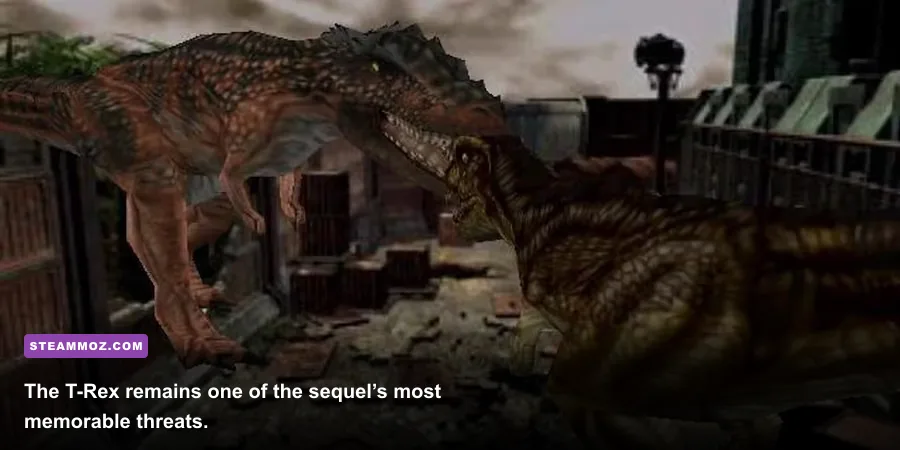
The fixed camera is the first obstacle for modern players. It creates suspense when a dinosaur enters from outside the frame, but it can also hide an attack, a doorway, or the exact edge of a combat arena. The tank-style movement feels deliberate rather than broken, yet anyone raised on twin-stick controls will need a few rooms to stop fighting the controls.
Visual clarity is another problem. The original 240p-era presentation has excellent atmosphere, but muddy backgrounds can make interactive objects blend into scenery. Pre-rendered environments also mean that a cinematic camera angle can suddenly become a practical disadvantage. Enhanced resolution helps character models and text, but it cannot fully repair the original composition.
There’s also a tonal mismatch. Dino Crisis 2 frequently presents itself as a desperate military survival story, then turns around and rewards you for mowing down dinosaurs like an arcade score attack. That contradiction is part of its charm, but players expecting the oppressive resource management of the first game may find the sequel strangely breezy.
The narrative has aged less gracefully than the action. Regina remains one of Capcom’s most memorable protagonists, and Dylan brings a useful contrast, but the script leans heavily on exposition and melodrama. The ending goes for big science-fiction ideas without giving every character enough room to land them. If you’re here for tightly written survival horror, try Capcom’s original official game catalog context first; if you’re here for dinosaurs, weapons, and momentum, the story’s rough edges are easy to forgive.
How it holds up on modern hardware
There is no current official PC release or modern remaster to evaluate. That’s the central practical problem in any Dino Crisis 2 review in 2026. Availability depends on the region and platform, and players should use a legally obtained copy and a reputable emulator where permitted. PlayStation support is the safest place to check current compatibility and account options, while RetroArch’s official site documents its own platform and core setup.
On original hardware, the NTSC version’s approximately 30fps target is part of the game’s feel. On an emulator, avoid chasing extreme enhancements that introduce timing or texture problems. A stable 30fps presentation, integer scaling, a mild texture filter, and a correctly configured controller usually produce a better experience than a heavily sharpened widescreen hack.
| Setting | Recommended Value | Performance Impact | Visual Note |
|---|---|---|---|
| Internal Resolution | Native or 2x | Very low on modern PCs | Preserves the original look and avoids unstable hacks |
| Frame Pacing | Locked 30fps | Minimal | Matches the original NTSC rhythm |
| Aspect Ratio | 4:3 | None | Prevents stretched characters and scenery |
| Texture Filtering | Nearest or mild bilinear | Minimal | Nearest keeps pixel art and text sharper |
| Widescreen Hack | Off for first playthrough | Minimal | Original camera framing is more reliable |
| Controller | Digital gamepad mapping | None | Best match for tank controls and fixed-camera turns |
If you’re used to modern ultrawide displays, 4:3 may look strange for ten minutes. Stick with it. The game was composed around that frame, and stretching it makes the already awkward camera feel even less trustworthy. For broader retro-performance advice, Steamoz’s Dungeon Siege classic review and PC performance guide offer useful comparisons for older games on current systems.
Replay value, unlocks, and who should play it

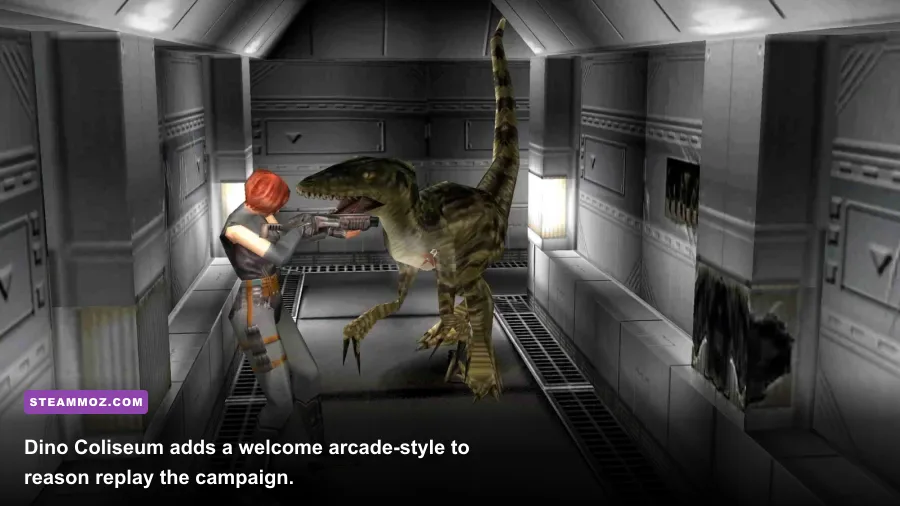
Dino Crisis 2’s campaign is short, but it isn’t disposable. The point system gives skilled players a reason to replay encounters cleanly, experiment with weapon purchases, and improve their route. The game also includes Dino Coliseum, an unlockable mode that turns the creature roster into a more direct arcade challenge. It’s not a modern roguelike or a deep combat laboratory, but it adds exactly the kind of post-campaign diversion the main adventure needs.
Expect roughly six to eight hours for a first playthrough, depending on how often you explore, reload, or struggle with boss arenas. A replay can be much faster once you know the route and understand which fights deserve ammunition. The campaign’s length is a strength today: it gets to the good stuff quickly and leaves before the combat loop becomes exhausting.
You should play Dino Crisis 2 if you enjoy fixed-camera action, PlayStation-era atmosphere, Capcom’s exaggerated character design, and games that reward movement more than perfect aim. You should probably skip it if you need modern controls, extensive accessibility options, fully voiced cinematic storytelling, or a genuinely frightening survival-horror experience. Players searching for another classic RPG review can also compare its compact campaign philosophy with Steamoz’s Don’t Be Afraid 2 review, though the two games pursue very different kinds of tension.
| Player Type | Fit | Why | Expectation to Set |
|---|---|---|---|
| Classic Capcom fan | S-Tier match | Strong weapons, memorable leads, readable arcade loop | More action than horror |
| Survival-horror purist | A-Tier match | Fixed cameras and resource pressure remain | Fear gives way to score-driven combat |
| Modern action player | B-Tier match | Fast encounters and clear weapon roles | Tank controls require patience |
| Story-first player | C-Tier match | Big sci-fi ideas and entertaining characters | Dialogue and pacing can feel dated |
| Completionist | A-Tier match | Point economy, replay routes, Dino Coliseum | Unlocks are modest by modern standards |
Final verdict: Dino Crisis 2 is worth playing in 2026, but play it for the right reasons. It isn’t a lost modern blockbuster waiting for a remaster to reveal its true potential. It’s a focused, occasionally messy, surprisingly replayable action game whose dinosaur encounters still have bite. The fixed camera will test your patience, the story will make you smile for the wrong reasons, and the original presentation needs careful handling on modern displays. Give it a stable setup and a little control-adjustment time, though, and Regina’s prehistoric shooting gallery remains one of Capcom’s most enjoyable experiments.