
Death Ray Manta doesn’t have character levels, XP, weapons, or a gold economy. The fast-leveling and gold-farming advice you’ll see elsewhere is aimed at the wrong game. Rob Fearon’s neon twin-stick shooter is built around clearing stages, surviving enemy patterns, and improving your score. The fastest way to “progress” is to learn the 50-level route, protect your multiplier, and replay short stages until your movement and aim become automatic.
That distinction matters because you can waste hours hunting for an upgrade menu that simply isn’t there. The Steam listing presents Death Ray Manta as an arcade-style shooter, not a loot-driven RPG. It includes 50 levels, multiple game modes, a level editor, and local multiplayer, but no persistent character sheet or spendable gold. Think of every run as a score attack session: your reward is a higher leaderboard position, not a stronger avatar.
What “leveling” really means in Death Ray Manta

Death Ray Manta’s progression is entirely player-facing. The game doesn’t raise your damage number after a mission, unlock a talent tree, or hand out coins for buying permanent upgrades. You improve by learning which parts of a stage are safe, which enemies can be ignored, and when chasing a target will put you inside the next projectile pattern.
That makes the game closer to an old-school arcade cabinet than a modern roguelite. A successful session has three measurable goals: reach later stages, finish more stages without dying, and beat your previous score. If a guide promises gold drops, rarity tiers, passive bonuses, or an XP bar, it’s almost certainly confusing Death Ray Manta with another twin-stick shooter.
| System | What Death Ray Manta actually has | Best progression target |
|---|---|---|
| Character levels | None | Learn stage layouts and enemy timing |
| Gold or currency | None | Improve score and leaderboard placement |
| Gear upgrades | None | Use movement, spacing, and aim more efficiently |
| Stages | 50 levels | Clear deeper stages consistently |
| Custom content | Level editor | Build or practice difficult patterns |
That also changes how you should measure a “good” run. Don’t restart because you missed an imaginary currency pickup. Restart when you lose control of the arena, break your route, or take a death that teaches you nothing. The game rewards clean repetition, not a long, unfocused grind.

🎮 Death Ray Manta
Looking to experience this game? Grab your digital key directly on our store for $2.49.
View on Steammoz Store →The fastest score-farming loop

For the quickest improvement, use a three-pass loop rather than repeatedly throwing yourself at the final stage. First, make a survival pass. Your only job is to identify the enemy order, safe corners, crossing lanes, and moments when the arena becomes crowded. Don’t chase a perfect score yet. A death while experimenting is useful; a death caused by panic teaches very little.
Second, run the same stage for efficiency. Keep your firing direction controlled while moving along the outside of the arena, then cut inward only when the center is genuinely safe. Twin-stick shooters punish circular movement that becomes predictable, so vary your direction instead of hugging one wall for the entire wave. The edge gives you reaction time, but it can also trap you when projectiles close the exit.
Third, attempt a score run. Start with a route you already understand and focus on maintaining pressure. In an arcade shooter, time spent disengaged is usually time spent earning nothing. Clear the most dangerous target first, but don’t cross the entire screen for a low-value kill if doing so breaks your positioning. The best score route is the one you can repeat without gambling a life on every wave.
Use short stages as your “farm” even though they don’t pay gold. A compact level with familiar patterns gives you more meaningful attempts per hour than a late stage that kills you before the first difficult sequence. Once you can clear that stage several times in a row, move forward. This is the practical equivalent of fast leveling: you’re increasing consistency and learning speed, not inflating statistics.
Players coming from loot-heavy games may find this harsh at first. The mindset is closer to the route discipline discussed in our God’s Trigger run-cleaning tips than to a traditional farming build. Every restart should have a reason.
Movement, aim, and enemy-wave discipline

Movement is your real build. Keep enough open space around the character to react to a sudden spawn, and avoid parking directly beside an enemy just because your shots are landing. The safest position is often one step away from maximum range: close enough to maintain pressure, far enough to sidestep without colliding with a threat.
Use deliberate micro-movements rather than constant full-screen loops. A long circular route feels safe until two enemy patterns overlap and remove the lane you were planning to use. Short left-right corrections keep more escape options available. When the screen gets busy, prioritize a clean exit over finishing a target. Surviving with one enemy alive is better than dying while trying to force the last hit.
Separate enemies by behavior, not appearance. Fast pursuers demand early movement; slow threats shape the arena and can be left alive briefly if they aren’t blocking your route. Projectile-heavy waves should be approached as spacing puzzles. Before firing, ask where your character will stand when the next pattern arrives. That half-second of planning prevents most score-run deaths.
| Situation | Common mistake | Better response | Why it works |
|---|---|---|---|
| Fast pursuer enters | Run directly away in a straight line | Cut sideways and preserve an open lane | Breaks the pursuit line without cornering yourself |
| Several threats overlap | Chase the nearest target | Move first, then fire from the safest angle | Positioning prevents a forced collision |
| One enemy remains | Rush for the final hit | Wait for a clean approach | Protects the run’s accumulated score |
| Edge becomes crowded | Stay pinned against the boundary | Cross early through the widest gap | Creates escape space before the pattern closes |
There’s no character build to rescue poor fundamentals. If aiming feels inconsistent, lower your sensitivity or change controller bindings, then keep the same setup for several sessions. Constantly changing controls resets your muscle memory and makes the game feel more random than it is. For broader PC performance habits, our Dead in Antares FPS settings guide covers the same principle: stable input beats decorative visual tweaks.
Modes, co-op, and the level editor

Death Ray Manta’s extra modes are useful because they let you practice without treating every session like a campaign push. The exact value depends on your goal: solo play is the cleanest way to build a personal route, while local co-op creates more targets, more chaos, and more opportunities to learn how overlapping movement changes a room.
Co-op is not a gold-farming shortcut. It can make survival feel easier when another player helps clear threats, but it also changes screen control and may make score optimization less predictable. For a high-score attempt, both players need a plan: divide attention by side or threat type, avoid crossing through each other’s escape routes, and call out when one player is being forced toward the center.
The level editor is arguably the closest thing the game has to an endgame system. Use it to design controlled drills instead of immediately building a giant chaos map. Create one stage with a narrow opening, one with layered enemy pressure, and one that tests movement through a shrinking safe lane. Repeat each until you can survive without improvising every second. That kind of deliberate practice is far more valuable than searching for nonexistent gold.
If you enjoy games where execution matters more than equipment, Steamoz’s Ghostrunner gear breakdown offers a useful contrast: Death Ray Manta removes the gear layer almost entirely, leaving route knowledge and reflexes exposed.
Performance settings for cleaner score runs
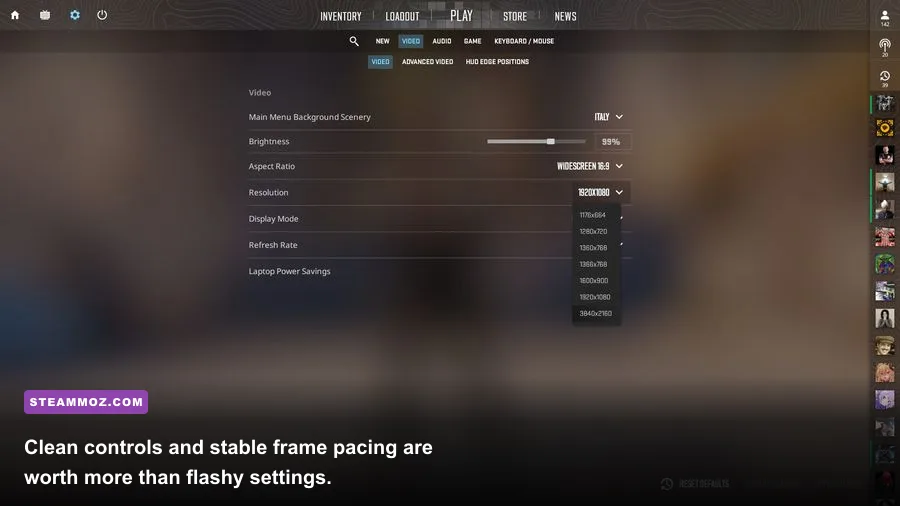
Death Ray Manta is visually simple compared with modern 3D releases, so almost any recent gaming PC should run it comfortably. That doesn’t make performance irrelevant. A stable frame rate and responsive input are crucial when a late-wave projectile leaves only a narrow escape window. Use fullscreen if windowed mode introduces distractions, disable overlays that interrupt focus, and keep your control scheme consistent.
| Setting or factor | Recommended value | Performance impact | Score-run benefit |
|---|---|---|---|
| Display mode | Fullscreen | Low | Fewer desktop distractions and cleaner focus |
| Resolution | Native monitor resolution | Low on this game | Sharper enemy silhouettes and arena edges |
| Frame rate | Stable monitor refresh target | Low | More predictable movement and aiming |
| Steam Overlay | Disable if it causes interruptions | None during play | Prevents accidental overlay input |
| Controller dead zone | Lowest stable setting | None | Improves small directional corrections |
Don’t chase visual effects at the expense of clarity. Neon backgrounds can look spectacular, but the important information is the character’s position, the enemy silhouette, and the available escape lane. If your display adds motion blur or aggressive post-processing at the driver level, turn it off. You want the arena to read instantly.
For troubleshooting unrelated PC hiccups, our guides on crashes and stutter and general PC stability fixes are useful references, but Death Ray Manta itself is lightweight. If the game feels sluggish, check background software, controller polling, display scaling, and overlays before blaming the game.
A practical 30-minute improvement routine
Start with five minutes of survival play on a stage you already know. Ignore score and identify the first moment where your route collapses. Next, spend ten minutes repeating that section, deliberately moving earlier than feels necessary. Early movement is the key lesson in arcade shooters: waiting for danger to become obvious usually means the safe lane has already disappeared.
Use the next ten minutes for score attempts. Keep the same controls, resolution, and route. After each death, name the cause in one sentence: collision, tunnel vision, bad crossing, or panic. If you can’t name the mistake, take a slower survival run instead of immediately restarting.
Finish with five minutes in the level editor or a lower stage. This cool-down prevents frustration from becoming your final memory of the session and reinforces the movement you just practiced. Repeat the routine across the 50-level campaign, advancing only when your current stage feels repeatable rather than lucky.
So, the honest answer to “Death Ray Manta fast leveling and gold farming guide” is simple: there’s no XP route and no gold farm. The winning route is a score loop—learn a stage, stabilize movement, clear dangerous waves efficiently, and replay until a risky section becomes routine. For official details, check Rob Fearon’s developer site and the official Steam page. Death Ray Manta doesn’t hide a progression system; it asks whether you can become better without one.