
God's Trigger rewards a patient, room-by-room approach: scout first, isolate targets, preserve your special ability, and only then commit to a fast takedown. These 10 tips cover the habits that keep new players alive, explain when to use Harry or Judy, and show how to turn the game's one-hit danger into a weapon rather than a frustration.
Released by One More Level, God's Trigger is a top-down action game built around stealth, instant kills, short reaction windows, and explosive four-player-friendly encounters. Harry is an angel, Judy is a demon, and their different abilities matter far more than simply choosing the character whose design you prefer. You can find the game's official Steam page for the current PC version, while our broader Chaos Control tips offer useful twin-stick fundamentals for the same kind of frantic top-down shooting.
1. Learn the one-hit loop before chasing speed
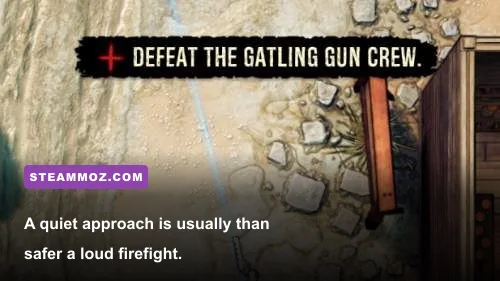
Most early deaths happen because players treat God's Trigger like a conventional shooter. It isn't. Enemies can kill you quickly, and your strongest answer is usually an instant takedown from the correct position rather than sustained gunfire. Move to the edge of a room, watch patrol routes, and identify which target can see another target. The first kill should create a safer angle for the second, not alert the whole map.
Use the retry screen as a scouting tool. A failed attempt still teaches you which guard turns first, where the camera cone overlaps, and which doorway becomes dangerous once the alarm starts. Don't sprint into the same room faster; enter it with better information.

🎮 God's Trigger
Looking to experience this game? Grab your digital key directly on our store for $2.99.
View on Steammoz Store →2. Treat every room as a puzzle

Before attacking, count enemies and mark the threats that can punish movement: ranged guards, shielded opponents, explosive hazards, and anyone positioned beside an alarm or narrow corridor. God's Trigger's compact arenas are designed around sightlines. A wall can protect you from three enemies while leaving one patrol completely exposed.
Break the room into lanes. Clear the nearest isolated enemy first, then relocate instead of assuming the body position is safe. Doorways are excellent funnel points, but they become traps if you stand there after firing. Peek, strike, retreat, and make the next enemy walk into your prepared angle.
3. Pick Harry and Judy for the problem, not the outfit
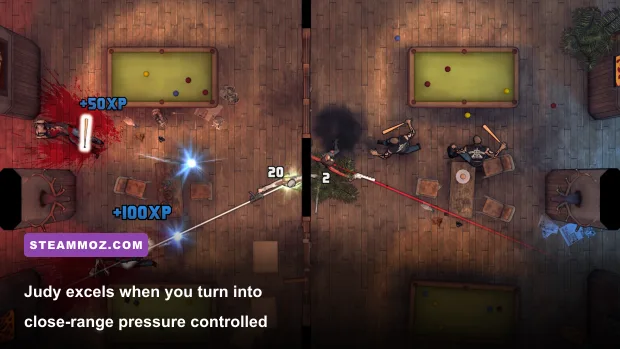
Harry, the angel, is the more forgiving starting point for learning movement and disengagement. His mobility-focused toolkit lets you cross a dangerous gap, escape a bad sightline, or reach a priority target before the room collapses. Judy, the demon, is excellent when you understand spacing and want to convert close-range pressure into rapid kills. Her abilities feel strongest when you deliberately enter a room with a plan instead of improvising at point-blank range.
Neither character is a permanent upgrade over the other. The better choice depends on the arena. Use Harry when the route contains long sightlines or separated targets. Choose Judy when cover, corners, and clustered enemies let you control the distance. In co-op, pairing their strengths is much better than both players selecting the same rhythm and competing for the same lane.
| Character | Best learning use | Primary strength | Common mistake |
|---|---|---|---|
| Harry | Movement and repositioning | Escaping sightlines and reaching priority targets | Spending mobility before identifying the exit |
| Judy | Close-range pressure | Turning corners and clustered targets into quick kills | Entering open ground without a retreat route |
4. Save abilities for the second mistake

Your active ability is not just a damage button. It is insurance for the moment when a patrol turns early, a shot clips the wall, or an enemy survives with enough time to raise the alarm. New players often burn it on the first target they see, then have nothing when the room's actual threat appears.
Use an ability when it changes the room's geometry: cross a firing lane, bypass a locked angle, interrupt a dangerous enemy, or create enough time to finish a chain. If the first kill is already safe, keep the cooldown available. A clean normal attack is better than a spectacular ability used on a target you could have handled with positioning.
5. Use weapons by distance and exit plan
God's Trigger's weapons are deliberately situational. A shotgun is devastating around corners and in tight rooms, but its limited reach makes it a poor answer to enemies across an open arena. A pistol gives you more flexibility at range and is easier to use while learning patrol patterns. Automatic weapons can erase a group quickly, yet the noise and ammunition pressure make them a risky first choice when stealth is still possible. The crossbow is especially useful when you want a quieter, deliberate pick.
Don't swap weapons because one feels more powerful in a vacuum. Swap because the next room changes the distance. Check the route, equip the tool that wins the first engagement, and always know where you will move after the shot. Our weapon tier-list breakdown covers the same important principle: a weapon's value comes from the situation, not a simple damage number.
| Weapon type | Strongest situation | Main weakness | Beginner rule |
|---|---|---|---|
| Shotgun | Corners and tight rooms | Short effective range | Fire after closing distance, then move immediately |
| Pistol | Mixed-range arenas | Less burst at point-blank range | Use it while learning enemy spacing |
| Automatic weapon | Emergency crowd control | Noise and ammunition pressure | Keep it for a failed stealth approach |
| Crossbow | Quiet, planned eliminations | Less forgiving when rushed | Line up the shot before entering the room |
6. Break line of sight instead of trading shots
When the alarm triggers, your instinct may be to stand still and win the damage race. That is usually the losing play. God's Trigger's top-down view makes walls and corners powerful defensive tools. Move behind cover, let enemies funnel toward your position, then eliminate the first target that enters your chosen lane.
Breaking vision also resets your decision-making. You can reload, switch weapons, wait for an ability, and separate a group that was dangerous in the open. If you cannot see a safe exit, don't fire. Run toward cover first; accuracy comes after survival.
7. Read enemy behavior before attacking
Every enemy is a timing problem. Patrols expose themselves in cycles, guards turn toward noise, and ranged opponents punish standing in a predictable lane. Watch one complete movement loop before committing in a new room. That extra second often reveals the gap that makes the entire encounter simple.
Prioritize enemies by what they prevent you from doing, not by who looks strongest. A distant ranged guard can make a melee takedown unsafe, while a nearby isolated target may be harmless if you can retreat. Eliminate the enemy that controls your movement first. This is also why shooting the closest target is not always the correct opening.
8. In co-op, split jobs instead of doubling fire
Co-op becomes dramatically easier when Harry and Judy control different parts of the arena. One player should pull attention or clear the near lane while the other handles a ranged threat, flank, or escape route. Calling targets aloud matters: “left guard first” is better than both players silently attacking different enemies and triggering the entire room.
Don't revive or rescue a teammate from an exposed position without checking the sightlines. A rushed save can turn one death into two. If one player is down, the survivor should break vision, clear a safe pocket, and only then attempt the recovery. The same discipline applies to other tactical games; our Daymare survival tips explain why panic rescues so often snowball.
9. Optimize performance before blaming your aim
God's Trigger is visually stylized rather than technically demanding, but stable input still matters in a game built around narrow reaction windows. The official Steam listing specifies Windows 7, an Intel Core i5 2.4 GHz processor, 4 GB of RAM, and a GeForce GTX 660-class graphics card for the minimum configuration. On modern hardware, prioritize a stable frame rate over excessive post-processing or resolution scaling.
Use a wired controller if that is your preferred input, disable distracting overlays, and test sensitivity in a safe early room. If aiming feels inconsistent, check frame pacing, controller dead zones, and background capture software before changing your whole playstyle. For more PC-focused troubleshooting, see our stutter and low-FPS fixes.
| Component | Minimum listed specification | Practical recommendation | Why it matters |
|---|---|---|---|
| Operating system | Windows 7 | Windows 10 or 11 | Newer drivers and better controller support |
| Processor | Intel Core i5 2.4 GHz | Modern quad-core CPU | Helps maintain consistent frame pacing |
| Memory | 4 GB RAM | 8 GB RAM or more | Leaves room for overlays and background apps |
| Graphics | GeForce GTX 660 class | Any recent dedicated or capable integrated GPU | Allows stable resolution and effects settings |
10. Practice one repeatable clear route
Don't measure improvement by how quickly you finish a level. Measure it by whether you can repeat the first room without improvising. Pick an opening: scout, remove the isolated target, fall back to the corner, then handle the ranged threat. Repeat that sequence until it feels automatic. Once the route is stable, experiment with faster movement, louder weapons, and alternate character abilities.
Finally, keep a mental list of failed assumptions. Did you think an enemy was outside your line of fire? Did you spend Harry's mobility before seeing the exit? Did Judy's close-range plan leave you exposed to a second patrol? Correct one mistake at a time. God's Trigger becomes far less brutal once every death gives you a specific adjustment rather than vague frustration.
The cleanest God's Trigger runs are built on control
The winning formula is simple: scout the room, choose the correct character tool, isolate the enemy who controls your movement, and preserve an escape option. Harry's mobility and Judy's close-range pressure both become powerful when they support that plan. For more official information, check God's Trigger on Steam and One More Level's official site. Play slowly until the route is reliable, then add speed. That is how the game's stylish chaos starts working for you.