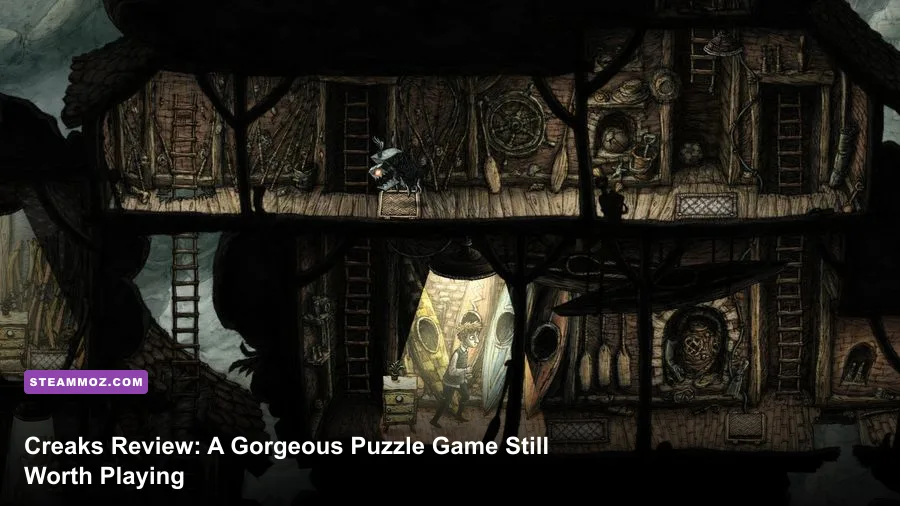
Yes, Creaks is still worth playing in 2026—especially if you want a compact, atmospheric puzzle adventure that respects your intelligence without turning every room into a brutal logic exam. Amanita Design's 2020 game is short by modern open-world standards, but its hand-drawn underground mansion, clever light-based hazards, and quietly strange story have aged far better than its launch-era price tag suggests. The catch is simple: if you need combat, character builds, or dozens of hours of progression, Creaks won't give you much to chew on.
Creaks begins with a child discovering a hidden passage behind bedroom wallpaper. That passage leads to a sprawling world beneath the house, populated by bird-like people, mechanical contraptions, curious paintings, and creatures that look like oversized dogs made from darkness. There are no weapons, inventory screens, or experience points. Your entire toolkit is observation, timing, switches, ladders, moving platforms, and a very important rule: light changes what the monsters are.
What Makes Creaks Worth Playing in 2026?
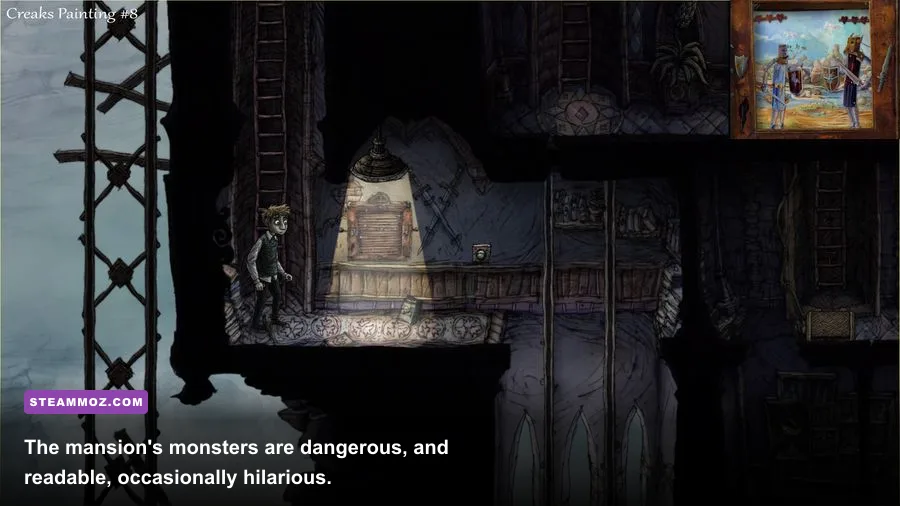
Creaks remains compelling because it understands the value of a good puzzle reveal. A room usually introduces one idea, lets you test it safely, and then combines it with something you learned earlier. That structure sounds basic, but Amanita Design executes it with unusual discipline. The game rarely throws five unexplained systems at you at once. Instead, it teaches through placement, animation, and consequences.
The central enemies are the game's best example. The dog-like Creaks patrol platforms and react to light. When illuminated, they transform into harmless pieces of furniture, allowing you to pass or use their new shape as part of the room's layout. In darkness, they return to their dangerous form. Other creatures introduce different movement patterns, including enemies that fly, track your position, or occupy a fixed lane. You aren't memorizing arbitrary rules; you're reading a living machine.
That readability makes failure feel fair. If a creature catches you, the restart is fast and the lesson is obvious. Creaks doesn't punish experimentation with a long animation, a distant checkpoint, or a resource drain. This is a major reason it still works for players who have grown tired of puzzle games confusing inconvenience with challenge.
| Review Area | 2026 Verdict | Why It Matters |
|---|---|---|
| Puzzle design | Excellent | Rules are introduced clearly, then layered with timing and positioning. |
| Atmosphere | Excellent | Hand-drawn rooms, lamps, machinery, and sound create a memorable subterranean world. |
| Story | Good | Mostly environmental and visual, with a deliberately dreamlike payoff. |
| Length | Mixed | Expect roughly 6–8 hours for the main route, longer with secrets. |
| Replay value | Limited | Collectibles and achievements add reasons to revisit, but puzzles don't randomize. |
If you enjoy unusual indie adventures, Creaks belongs in the same broad conversation as other tightly authored experiences covered in our classic game reviews, though its pace and priorities are completely different. This is not an RPG masquerading as a puzzle game. It knows exactly what it is.

🎮 Crea
Looking to experience this game? Grab your digital key directly on our store for $14.99.
View on Steammoz Store →How Creaks' Puzzle Mechanics Actually Work
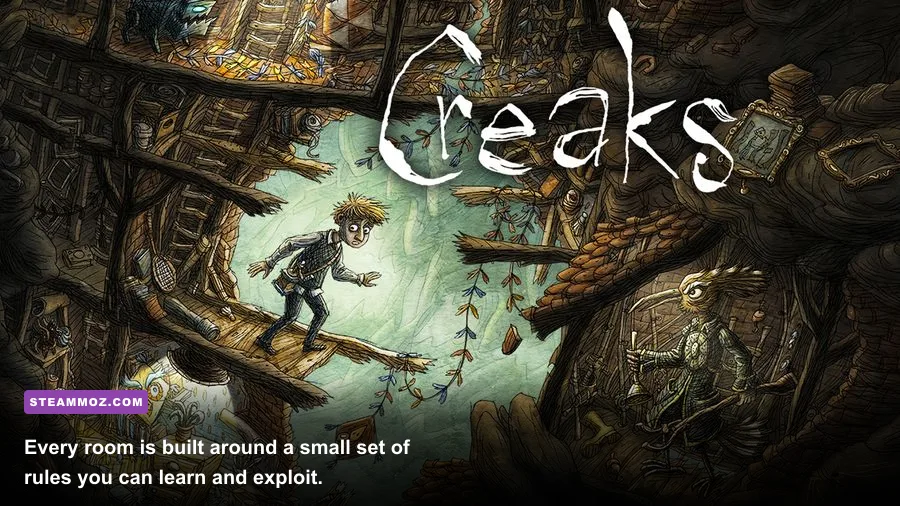
Most rooms are built from a small vocabulary of objects. Wall switches toggle lamps or activate mechanisms. Ladders let you move between vertical layers. Platforms carry you across gaps, while doors and lifts control the order in which you can access the room. The cleverness comes from combining these ordinary pieces with enemy behavior.
Light is both weapon and architecture
The lamp system is more than a way to defeat monsters. Turning on a light can change a creature into furniture, block a route, reveal a safe landing, or remove the only obstacle standing between you and a switch. Sometimes you need the enemy alive because its body occupies a platform. Sometimes you need it frozen because you need to cross the exact space it is guarding. That small reversal keeps the solution from becoming a simple “turn on every lamp” routine.
Timing puzzles arrive later, but Creaks is not a twitch platformer. You won't need frame-perfect inputs or controller gymnastics. The challenge is deciding the correct sequence: hit a switch, wait for the patrol to move, climb, deactivate another lamp, then cross before the first creature returns. If you move too early, the room exposes the mistake immediately.
Why the difficulty curve works
The opening sections are deliberately gentle. They teach the difference between a creature's idle state and its alert state, then introduce multi-switch rooms and vertical navigation. Later areas ask you to track two or three moving threats at once. The final stretch can feel demanding, but it generally tests combinations of established rules rather than adding a last-minute mechanic.
That makes Creaks a strong recommendation for players who bounced off more opaque adventures. It offers the satisfaction of discovery without requiring you to consult a walkthrough every twenty minutes. If you do get stuck, stop moving and watch the room for a full cycle. Enemy paths, lamp ranges, and platform timing usually reveal the intended order.
Art, Sound, and the Strange World Beneath the House
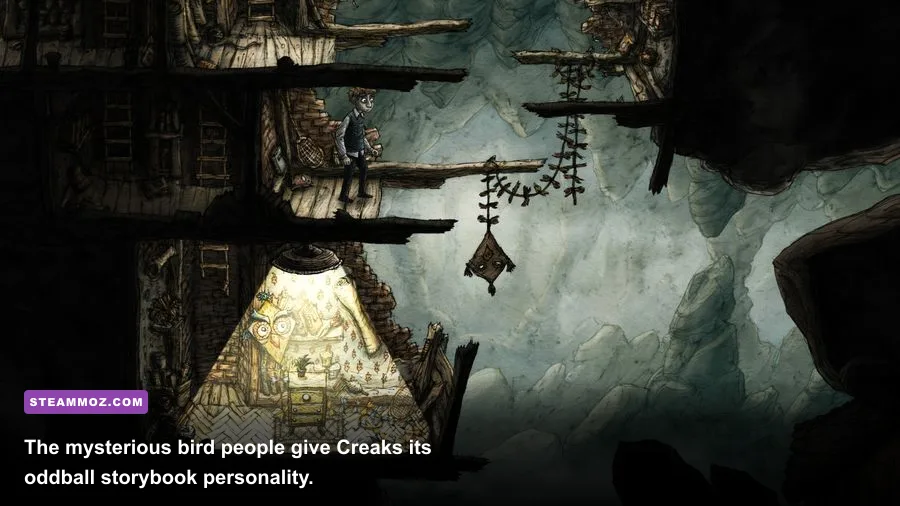
Creaks' hand-drawn art is still its knockout feature. The underground setting is full of wood, brass, rope, stained glass, dusty lamps, and impossible architecture. Rooms feel constructed rather than procedurally assembled, and every background detail supports the idea that generations of eccentric inhabitants have been maintaining this place.
The bird people give the world a distinct identity. They aren't a conventional fantasy race with a codex full of political history. Instead, they appear through animation, gestures, brief scenes, and visual jokes. Their homes and machines communicate more than dialogue could. You see what they value by looking at the objects they protect, repair, and display.
The sound design does just as much work. Wooden mechanisms creak, switches snap, lamps buzz, and distant machinery creates a low industrial pulse. The soundtrack knows when to disappear, leaving a room's mechanical rhythm to build tension. The result is eerie without becoming relentlessly grim. Creaks can look like a horror game in screenshots, but its mood is closer to a macabre picture book.
It also runs comfortably on modern hardware. This isn't a technically demanding game, and there is no meaningful reason to chase ultra-high frame rates over image quality. On PC, a stable 60 frames per second is more than enough for its deliberate movement and puzzle timing. The biggest visual choice is whether you prefer a larger display for environmental detail or a handheld screen for relaxed, portable sessions.
| Platform Profile | Best Use | Performance Expectation | Trade-Off |
|---|---|---|---|
| Steam Deck | Portable puzzle sessions | Comfortable target at 60 FPS | Small text and background details are less striking. |
| Standard laptop | Budget PC play | 60 FPS on modest integrated hardware | Lower display brightness can soften dark rooms. |
| Desktop monitor | Best visual presentation | 60 FPS with headroom | Less convenient for short, casual sessions. |
| Console or TV | Controller-first play | Stable and responsive | Some distant environmental details are easier to miss. |
For comparison, our coverage of lightweight PC games shows how little hardware you need for experiences in this space. Creaks is similarly accessible, but its polished animation makes it feel much more premium than a typical low-spec release.
Story, Secrets, and Completionist Value
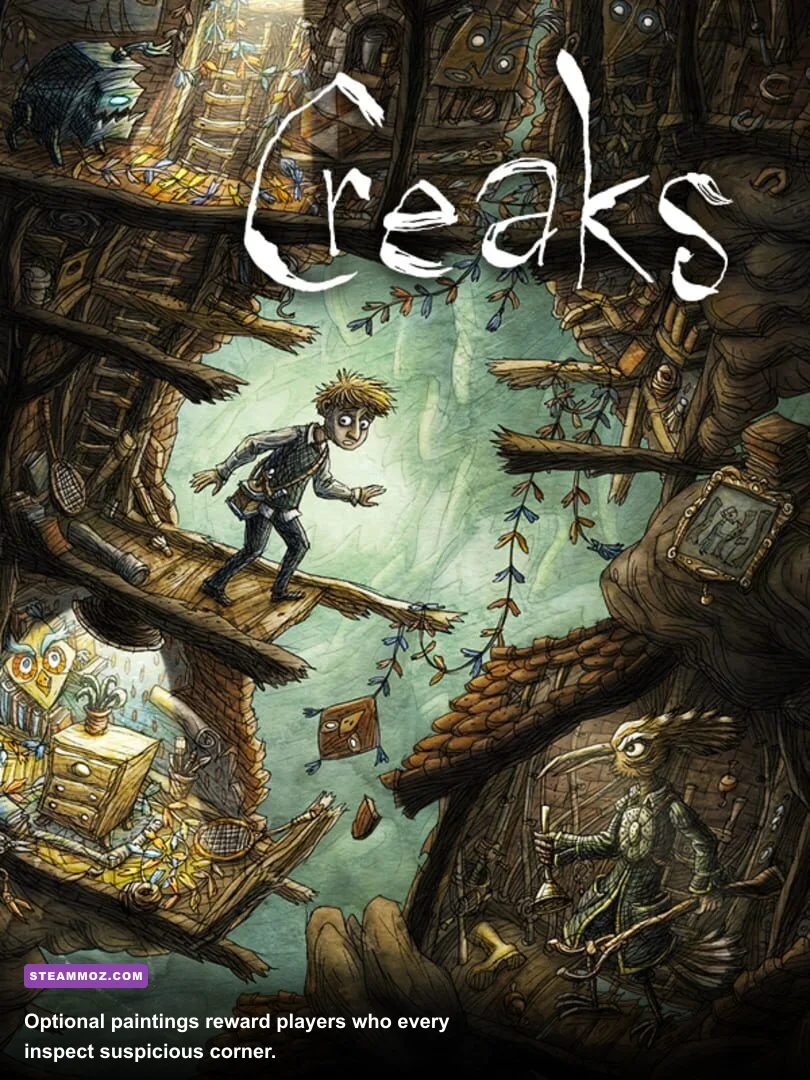
Creaks tells its story through movement and atmosphere rather than exposition dumps. You discover the underground society by passing through its rooms, observing its inhabitants, and connecting visual clues. The narrative is intentionally slippery. It invites interpretation instead of explaining every strange event with a final monologue.
That approach won't satisfy everyone. If you want a heavily voiced adventure with explicit character arcs, the story may feel underwritten. But the quiet presentation fits the game's dream logic. The lack of conventional dialogue also keeps the focus on puzzle flow. You don't leave a room to sit through a ten-minute conversation just when the mechanics become interesting.
Optional secrets add welcome texture. Hidden areas often contain paintings and small visual discoveries rather than combat upgrades or stat bonuses. They reward curiosity, not power. Look for suspiciously empty walls, side passages that seem too narrow to matter, and routes that only become accessible after you understand how a nearby lamp affects an enemy.
The main campaign is best treated as a focused weekend game. A first playthrough usually lands around 6–8 hours depending on how often you pause to study rooms. A completionist run takes longer, especially if you hunt every collectible without a guide. There is no procedural mode, branching campaign, or build system to create endless replay value, so buy Creaks for the first journey—not for an infinite endgame.
Who Should Play Creaks—and Who Should Skip It?
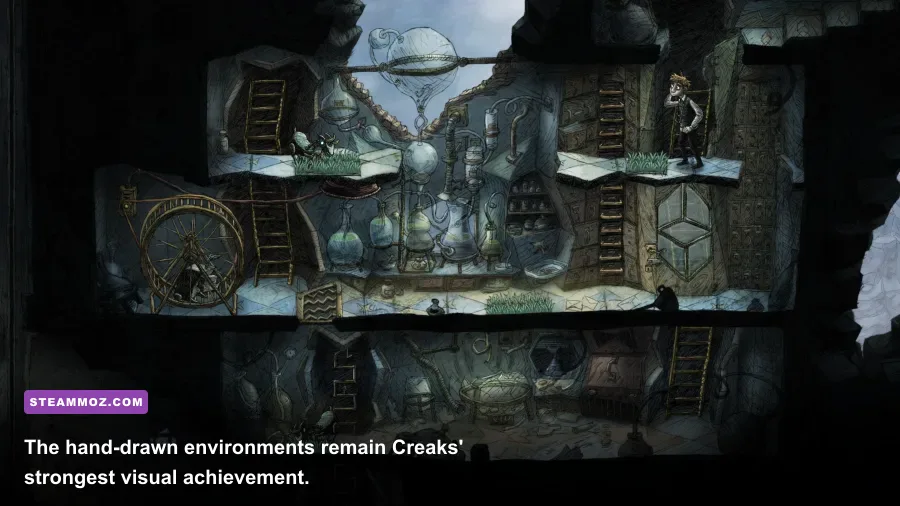
You should play Creaks if you like hand-crafted puzzles, environmental storytelling, and games that let you solve problems at your own pace. It is especially good for players who enjoyed Amanita Design's Machinarium or Samorost, though Creaks is more mechanically focused and less dependent on traditional point-and-click item logic.
It also works brilliantly as a co-pilot game. One person can handle movement while another watches enemy routes and suggests switch orders. Because the rules are visible, conversations stay productive instead of turning into random item-combination guesses. For more recommendations in this general lane, our 2026 game reviews cover several other narrative-focused adventures, although Creaks is considerably more compact.
Skip it if your ideal puzzle game needs a huge campaign, competitive leaderboards, procedural generation, or deep character progression. There are no weapons to upgrade, no talent trees, and no combat encounters to break up the logic rooms. The danger is present, but it exists to sharpen the puzzles rather than create an action game.
| Player Type | Recommendation | Best Reason |
|---|---|---|
| Atmosphere-first explorer | Strong buy | The underground mansion is distinctive from the first room to the last. |
| Casual puzzle player | Strong buy | Fast restarts and readable rules make failure low-stress. |
| Completionist | Buy on sale | Secrets extend the campaign, but there is no post-game system. |
| Action-focused player | Try first | Enemy danger exists, but combat and reflex challenges are absent. |
| Hardcore puzzle solver | Recommended | Later rooms provide layered logic without resorting to obscure clues. |
Final Verdict: Is Creaks Worth Playing in 2026?
Creaks is absolutely worth playing in 2026, provided you want a polished, finite puzzle adventure rather than a forever game. Its 6–8-hour campaign is tightly paced, the light-and-monster rules remain fresh through smart combinations, and Amanita Design's artwork gives the whole experience a personality that most puzzle games never find.
The limitations are equally clear. The story is impressionistic, replay value is modest, and players expecting combat or progression systems will finish before they feel fully invested. But those aren't missed features—they're the result of a focused design. Creaks knows the room is the star, and it builds every supporting system around making that room satisfying to understand.
Check the official Steam page for current pricing and platform details, then browse Amanita Design's Creaks page for the game's official artwork and information. If you want to see what else the studio makes, the developer's official site is the best starting point.
My recommendation is simple: buy it on PC, console, or Steam Deck when you want something atmospheric, clever, and refreshingly free of filler. Creaks may be small, but it still knows how to make a single lamp, a moving platform, and a monster in the dark feel like a complete adventure.
For another focused experience with a very different kind of challenge, see our guide to progressing through Decay: The Mare. Creaks is friendlier, stranger, and much more puzzle-driven—but both reward players who pay attention to the world around them.