
The safest way to start City of Gangsters: Atlantic City is to build a compact liquor network, keep your early rackets supplied, and treat cash, favors, and heat as separate resources. Don't rush across the map. Establish one dependable production chain, recruit people who cover your immediate weaknesses, and expand only when your current neighborhood can pay for the next step.
Atlantic City looks like a jackpot, but the DLC's crowded economy makes sloppy growth especially punishing. More customers mean more opportunities, yet every extra building also creates delivery problems, police pressure, and new demands for ingredients. These 10 tips will help new players turn a small front into a stable criminal operation without burning through their starting cash.
1. Pause Before You Spend Your First Dollar

Your first turn should be reconnaissance, not shopping. Open the map and inspect nearby customers, production sites, suppliers, law-enforcement pressure, and the walking distance between potential businesses. The ideal opening area has several reachable customers, at least one realistic source of basic liquor inputs, and enough empty space for a front or production building.
City of Gangsters is built around action points and travel time. A character who spends most of a turn walking between distant locations is not merely inconvenient; that character is failing to generate value. Keep your first operations close together. A short route lets one crew member collect supplies, another handle sales, and a third pursue favors or construction.
Don't confuse a busy area with a good starting area. Atlantic City's boardwalk can offer strong demand, but a high-demand district is worthless if every delivery requires a long trip through hostile or expensive territory. Look for density and convenience first. Profit comes after the route works.

🎮 City of Gangsters: Atlantic City
Looking to experience this game? Grab your digital key directly on our store for $2.99.
View on Steammoz Store →2. Build One Complete Supply Chain

Your first target should be a complete loop: acquire ingredients, produce liquor, move it to a front, and sell it to customers. A half-built network is a money pit. Buying a still or another production site before securing its inputs leaves you with an expensive building that cannot generate reliable cash.
Track each recipe's input requirements and output carefully. Basic liquor is useful because it gives a new operation something dependable to sell, while more advanced products should wait until you have stable supply and storage. The key question is not “What has the highest sale price?” It's “What can I produce every turn without emergency purchases?”
| Operation | Early Priority | Main Bottleneck | Best Use |
|---|---|---|---|
| Basic liquor production | High | Ingredients and transport | Reliable first revenue stream |
| Speakeasy or front | High | Product supply and customers | Converting stock into cash |
| Warehouse or storage | Medium | Upfront money | Buffering irregular deliveries |
| Premium production | Low initially | Multiple inputs | Scaling profit after the basics work |
Keep a small reserve of ingredients rather than buying only what the next production action needs. A missed delivery can idle a building for a full turn, and Atlantic City's travel distances make recovery slower than it first appears.
3. Spend Favors Before You Spend Cash
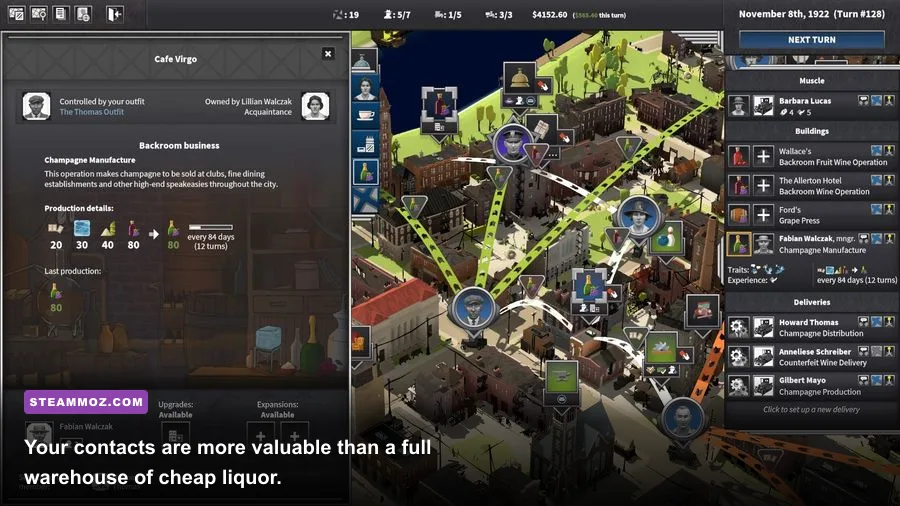
Favors are one of the strongest early-game currencies in City of Gangsters. Money buys buildings and goods, but favors unlock relationships, services, and opportunities that would otherwise cost far more. When a contact offers a favor, read the requirement and reward before accepting. Some favors fit your current route perfectly; others drag a crew member across the city for almost no strategic gain.
Prioritize contacts who solve a real constraint. A supplier favor is excellent when your production chain is short on ingredients. A construction-related favor can accelerate your first expansion. A contact who reveals useful information or opens a new service may be worth more than an immediate cash payment because it improves several future turns.
Don't spend every favor immediately. Keep at least one flexible favor available when possible. Random events and new contact demands can create a sudden need for a specific relationship, and having no favor buffer can force you into expensive purchases.
Recruitment deserves the same discipline. A crew member with useful delivery, production, or negotiation ability is usually more valuable than a generalist who simply adds another body. Check the character's traits and existing relationships before hiring. Wages are permanent pressure; hire only when the new person has a job on the next turn.
4. Give Every Crew Member a Job

Early crew members should not wander between unrelated tasks. Assign clear roles: one person handles production, one manages deliveries and collection, and one works contacts, favors, or expansion. The exact arrangement changes with your map, but the principle stays firm: reduce wasted movement.
Use the character with the best relevant trait for the action that repeats most often. If a character can improve production or reduce the cost of a recurring task, keep that person near the building generating your core product. A talented negotiator should not spend every turn hauling crates unless the route itself is your current bottleneck.
Action points are more important than raw headcount. Before ending a turn, check whether a crew member can perform a cheap favor, collect an available payment, purchase a needed input, or move closer to tomorrow's objective. Tiny actions compound over the first 20 turns.
This is also why a compact opening beats a sprawling one. Three characters operating in one neighborhood can outperform five characters crossing Atlantic City in different directions. If you want more management-game efficiency advice, Steamoz's starting-build breakdown for Dungeons 4 applies the same useful rule: make early workers productive before adding more systems.
5. Treat Heat Like a Budget

Heat is not a meter you ignore until the police arrive. It is a budget. Every risky operation, visible expansion, and illegal action increases the chance that your empire loses time, stock, money, or access. Keep your most valuable production and sales operations away from unnecessary exposure when the map allows it.
Watch how much pressure a racket creates compared with what it earns. A business that generates a little more cash but attracts dramatically more attention may be a terrible early investment. Build a buffer before taking high-risk actions, and avoid stacking several suspicious activities in the same turn unless the payoff justifies the danger.
When enforcement pressure rises, don't respond by expanding again. Stabilize: finish deliveries, reduce idle buildings, use available contacts, and move vulnerable goods through safer routes. The best empire is not the one with the highest theoretical income; it's the one that keeps operating after an unlucky event.
6. Expand Only After Three Profitable Turns
A new building should have a job before you buy it. Ask three questions: what will it produce or sell, who will operate it, and how will supplies reach it? If you cannot answer all three, save your money.
Use a simple expansion test: your existing network should produce surplus cash for at least three consecutive turns after wages, purchases, and routine operating costs. That surplus is your expansion fund. Spending your entire balance on a new front leaves no room for ingredients, favors, or emergency repairs to your route.
| Expansion Signal | What It Means | Recommended Move | Common Mistake |
|---|---|---|---|
| Stockouts every turn | Demand exceeds production | Improve supply before adding sales | Opening another front |
| Cash rises steadily | Core loop is healthy | Add one complementary building | Buying several at once |
| Crew idle frequently | Operations are too small | Add a nearby task or contact route | Hiring more workers first |
| Heat climbs faster than income | Risk is outpacing reward | Stabilize and diversify routes | Taking bigger illegal jobs |
For a useful comparison, think of Atlantic City like the opening economy in Chroma Squad's first season: flashy upgrades are tempting, but consistency pays for ambition.
7. Keep Production Ahead of Sales
A front with empty shelves is not an asset. It is rent and wages with no return. Check inventory before committing to more customers or opening another sales location. If your sales demand regularly consumes everything you produce, improve the production side first.
Storage helps smooth the rhythm between production and sales, but it doesn't fix a bad chain. Use storage as a buffer for one or two disrupted turns, not as an excuse to ignore missing inputs. Keep different product types organized mentally and avoid filling capacity with goods that have no immediate buyer.
When comparing products, calculate profit per action and per trip, not just the sale price. A premium product that needs three inputs, a distant pickup, and a specialist may earn less practical profit than basic liquor produced locally. This is one of the biggest traps for new players.
8. Use Atlantic City's Demand Without Chasing It
The Atlantic City setting encourages you to chase the biggest crowds, especially around entertainment and gambling-focused areas. Resist the urge to move your entire operation toward every profitable customer. A demand spike is useful only if your logistics can serve it.
Instead, let your established neighborhood finance a second route. Keep your original production and sales loop running while testing the new district with a limited operation. If the route consumes too many action points or attracts too much heat, abandon the experiment without collapsing your main income.
Expansion by parallel networks is safer than expansion by replacement. Never dismantle a working route just because a new location looks richer on paper.
9. Save Before Risky Decisions
Turn-based strategy games reward planning, but City of Gangsters also rewards knowing when to protect a good position. Save before a major building purchase, a risky favor chain, or an action that could expose your most valuable operation. This isn't about reloading every minor setback; it's about learning how the game's event and enforcement systems respond.
Review the previous turn when something goes wrong. Did a crew member travel too far? Did you sell stock that should have been reserved for production? Did wages arrive before your next payment? Identify the actual failure instead of blaming bad luck. The same discipline helps in Gearshifters' early runs, where recognizing repeatable mistakes matters more than forcing a heroic recovery.
10. Set a Win Condition for Your First Empire
New players often lose focus because the game offers too many possible directions. Give your first Atlantic City campaign a concrete goal: establish one profitable liquor chain, secure a second sales front, recruit a dependable specialist, and survive long enough to build a cash reserve.
That goal teaches nearly every core system without demanding reckless expansion. Once the network is stable, you can pursue larger rackets, premium products, stronger relationships, and more ambitious district control. If your campaign ends early, use the official Steam page for City of Gangsters to check the base game's current updates and community notes before your next run.
The developer's City of Gangsters page is also worth bookmarking for the game's broader design context. For technical problems, Steamoz's guides to performance-focused PC settings and crash and stutter fixes cover useful troubleshooting habits, even though the games differ.
Atlantic City rewards patience more than bravado. Keep the opening compact, make every crew member productive, protect your supply chain, and spend favors with a plan. Once the money flows for several turns and your heat stays manageable, the boardwalk stops looking like a gamble and starts looking like the foundation of a real empire.