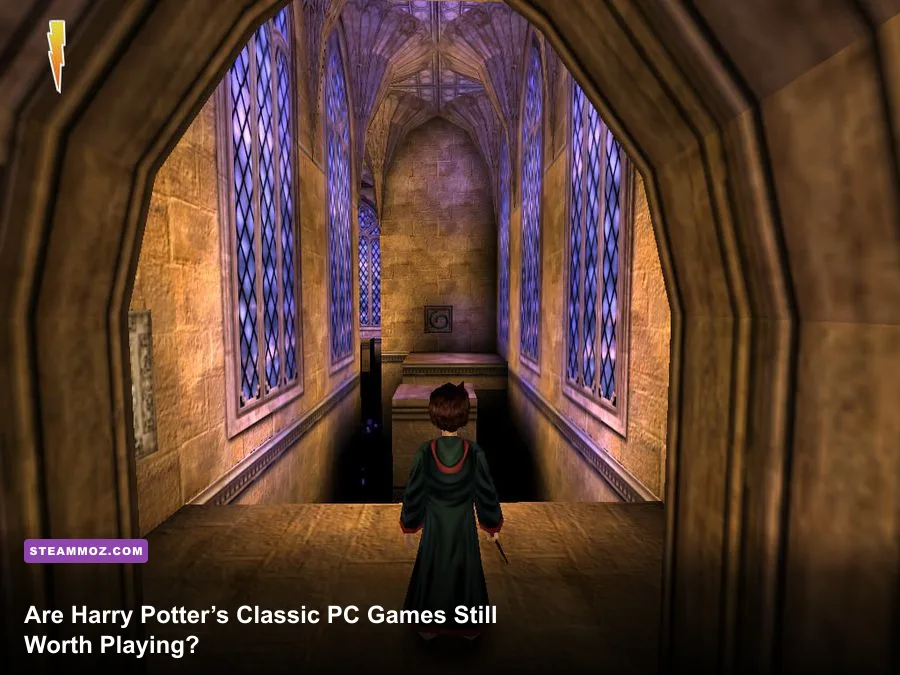
Yes—but only if you approach them as charming, awkward time capsules rather than polished modern RPGs. The classic Harry Potter PC games are still worth playing in 2026 for their compact Hogwarts exploration, inventive spell puzzles, and unmistakable early-2000s atmosphere. The best starting points are Harry Potter and the Chamber of Secrets and Harry Potter and the Prisoner of Azkaban. The catch is brutal by modern standards: availability is inconsistent, controller support is poor, widescreen presentation can break, and the original PC releases were never designed for current Windows hardware.
That distinction matters. If you want a huge open-world wizarding RPG, Hogwarts Legacy is the obvious destination. If you want to revisit the games that turned movie locations into compact playgrounds full of moving staircases, secret rooms, and absurdly dangerous school assignments, the older PC titles still have a pulse. They are shorter, stranger, and much more game-like than nostalgia alone suggests.
Which Harry Potter PC game is actually worth playing?
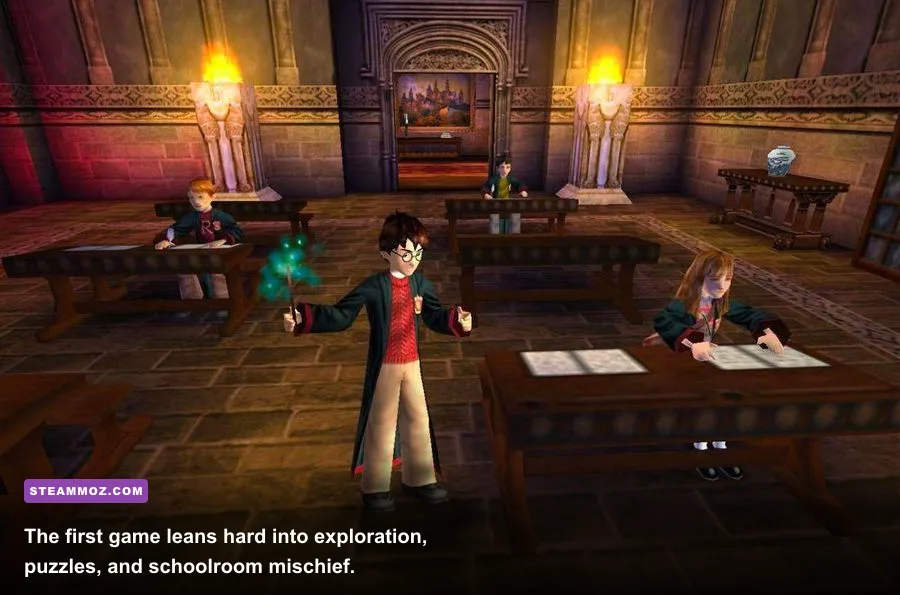
There is no single classic Harry Potter PC experience. Electronic Arts released several games with different developers, structures, and levels of quality. The first two movie adaptations are straightforward action-adventure games built around Hogwarts exploration. Prisoner of Azkaban expands the formula with character switching. Goblet of Fire changes direction into a linear, mission-based action game, while Order of the Phoenix and Half-Blood Prince push toward open-ended school exploration and minigames.
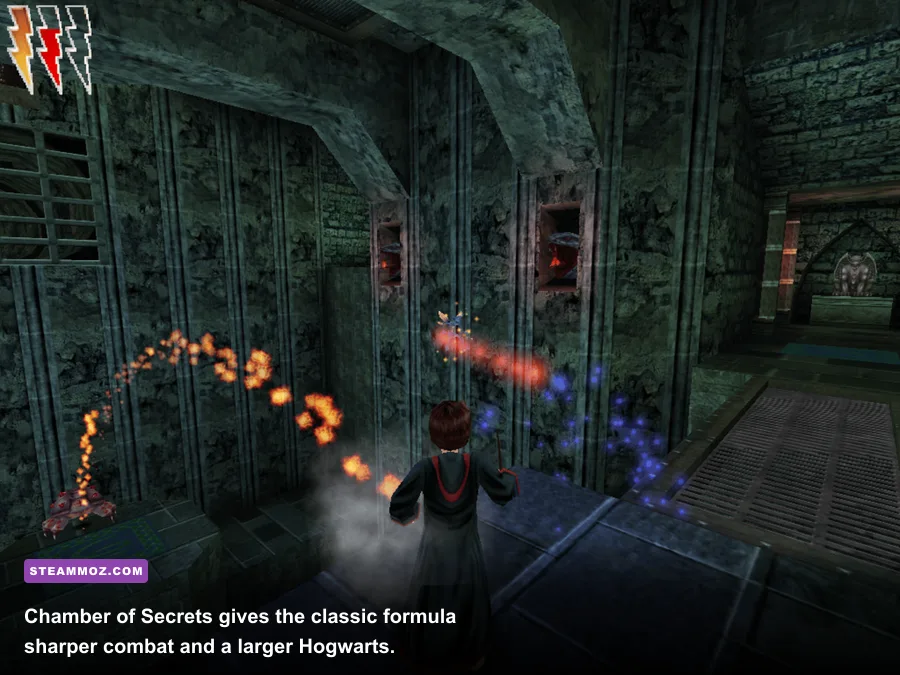
For a 2026 replay, the sweet spot is Chamber of Secrets. Its Hogwarts map is more coherent than the first game, the spell list feels useful instead of decorative, and the platforming is simple enough to remain readable. Prisoner of Azkaban is the more interesting game mechanically, but its short campaign and occasional camera problems make it feel less complete.
| Game | Best Feature | 2026 Verdict | Who Should Play It |
|---|---|---|---|
| Philosopher's Stone | First look at Hogwarts | Worth it with patience | Fans of retro adventure games |
| Chamber of Secrets | Best school exploration | Strongest starting point | Most returning players |
| Prisoner of Azkaban | Playable trio and spell variety | Still very good | Players who want more combat |
| Goblet of Fire | Fast arcade-style action | Mixed | Movie fans seeking missions |
| Order of the Phoenix | Large explorable Hogwarts | Interesting but clunky | Exploration-focused players |
| Half-Blood Prince | Potion-making and minigames | Decent nostalgia trip | Fans of the sixth film |
The PC versions are particularly interesting because they often differ from the PlayStation 2, Xbox, and GameCube releases. Philosopher's Stone on PC is built around a different design lineage from the console edition, while Chamber of Secrets has its own level layouts, camera behavior, and visual presentation. That means old walkthroughs can send you toward the wrong room or describe a mechanic you simply do not have.
Before buying anything, check the official EA Harry Potter page and the official Hogwarts Legacy site to separate current releases from delisted classics. The original movie games are not normally available through modern storefronts, so avoid shady downloads disguised as abandonware.
Why Hogwarts still feels better than the combat
The real reason these games remain playable is not spell damage. It is place design. Early Hogwarts is a series of memorable spaces rather than one seamless map: the Great Hall, dungeon corridors, courtyards, greenhouses, towers, and the Quidditch grounds all have strong visual identities. You learn them through repetition. A staircase becomes a shortcut, a portrait becomes a landmark, and a locked classroom becomes a promise that the game will eventually give you a reason to return.
Chamber of Secrets gets this rhythm right. You attend a lesson, receive a new spell, test it in a controlled room, and then notice that the same spell also opens an earlier route. Diffindo cuts ropes and plants, Rictusempra stuns enemies and activates certain objects, and Flipendo works as both a combat tool and environmental button. The spells are not a modern skill tree; they are keys in a physical puzzle box.
That design creates a satisfying little progression curve. The game rarely asks you to grind experience or farm equipment. Instead, your power comes from understanding which spell interacts with which object. It is closer to a Nintendo-style adventure game than a contemporary action RPG. You are not building Harry through statistics. You are building a mental map of Hogwarts.
The downside is repetition. You will push similar blocks, stun similar enemies, and search for collectibles whose payoff is mostly completionist satisfaction. The camera also struggles in tight corridors, especially when Harry is near a wall or a staircase. Modern players used to generous auto-targeting may find the old lock-on behavior surprisingly slippery.
That is where expectations decide everything. Treat the levels as handcrafted adventure stages and their limitations become part of the texture. Expect free-form combat, physics-driven traversal, and dozens of enemy types, and the games will feel primitive within minutes.
Combat, spells, and the mechanics that have aged
The classic PC games do not offer damage numbers, armor ratings, or loot builds. Their combat systems are deliberately readable. Enemies telegraph attacks, Harry selects a spell, and the encounter usually asks you to identify a weakness rather than out-level the opponent.
In Chamber of Secrets, Rictusempra is your reliable combat opener because it interrupts and exposes enemies. Flipendo is useful for direct pressure and environmental interactions, while Skurge clears ectoplasm and certain obstacles. The best approach is to keep moving, use the arena, and avoid standing still while cycling through spells. Enemy encounters punish panic more than low health.
Prisoner of Azkaban improves the formula by letting you switch between Harry, Ron, and Hermione. Each character brings a different toolset, so the trio feels more like a puzzle-solving party than three interchangeable skins. Hermione is especially useful when the game requires precise magical interaction, while Ron's role adds variety to combat and traversal. It is not a deep party system, but it gives levels a welcome change of rhythm.
| Mechanic | What It Does | How It Aged | Best 2026 Approach |
|---|---|---|---|
| Spell targeting | Locks attacks onto nearby targets | Can miss in tight spaces | Back away before casting |
| Flipendo | Pushes objects and damages targets | Simple but versatile | Test it on every suspicious object |
| Rictusempra | Stuns or interrupts enemies | Readable and dependable | Use it before heavier attacks |
| Diffindo | Cuts ropes, plants, and barriers | Mostly puzzle-focused | Revisit locked routes after lessons |
| Character switching | Changes abilities in Prisoner | Still a smart idea | Swap quickly during puzzle rooms |
| Cauldron ingredients | Supports potion collection | Can feel like busywork | Search corners before leaving areas |
The weakest combat appears in Goblet of Fire, where the campaign becomes a string of linear stages built around action set pieces. It is faster and occasionally exciting, but it loses the feeling of attending Hogwarts. Order of the Phoenix swings back toward exploration, though its wand gestures and contextual interactions can feel awkward with a mouse and keyboard.
If you want a combat-heavy wizard game, these are not hidden masterpieces waiting to replace modern RPGs. If you enjoy seeing a simple mechanic reused creatively across puzzles, fights, and secrets, they remain surprisingly satisfying.
How the classic PC versions run on modern hardware

Performance is rarely the problem. Compatibility is. A modern gaming PC can render these games effortlessly, but old DirectX behavior, fixed-resolution interfaces, missing widescreen support, and unstable launcher behavior can create more friction than the games themselves.
Do not assume that a powerful graphics card fixes everything. The original PC releases were designed around Windows XP-era drivers and display modes. Depending on the title, you may encounter stretched menus, invisible effects, audio issues, mouse sensitivity problems, or crashes when switching applications. Keep your first session conservative: run the game at its native resolution, disable aggressive overlays, and save often.
| Component | Minimum for the Original Games | Recommended in 2026 | Practical Note |
|---|---|---|---|
| Operating system | Windows 98/2000/XP-era support | Windows 10 or 11 with compatibility tools | Older installers may need extra steps |
| Processor | Early Pentium-class CPU | Any modern four-core CPU | Raw CPU power is not the issue |
| Graphics | DirectX-compatible 3D card | Integrated graphics is sufficient | Driver behavior matters more than power |
| Memory | 128MB to 256MB era hardware | 8GB system RAM | Modern memory is more than enough |
| Display | 4:3 resolutions | 1080p window or corrected widescreen | Native aspect ratio can look cleaner |
| Input | Keyboard and mouse | Keyboard and mouse | Controller mapping is usually unofficial |
For troubleshooting, our guides on PC crash fixes and higher-FPS settings cover the same broad habits: remove unnecessary overlays, test fullscreen and windowed modes, and change one variable at a time. Those articles are not specific patches for Harry Potter, but the diagnostic workflow applies.
Frame rate is another odd consideration. These games do not need 144 frames per second. Some old engines behave better when capped near 60 FPS, particularly during physics-heavy scenes or scripted transitions. A stable 60 FPS windowed presentation is preferable to forcing an uncapped refresh rate and discovering that animations, timing, or menus act strangely.
Use legal copies from legitimate second-hand sources, preserve the original installer files if you find them, and scan anything downloaded from an unfamiliar archive. The nostalgia is not worth turning a retro replay into a security problem.
What the stories and level design get right—and wrong
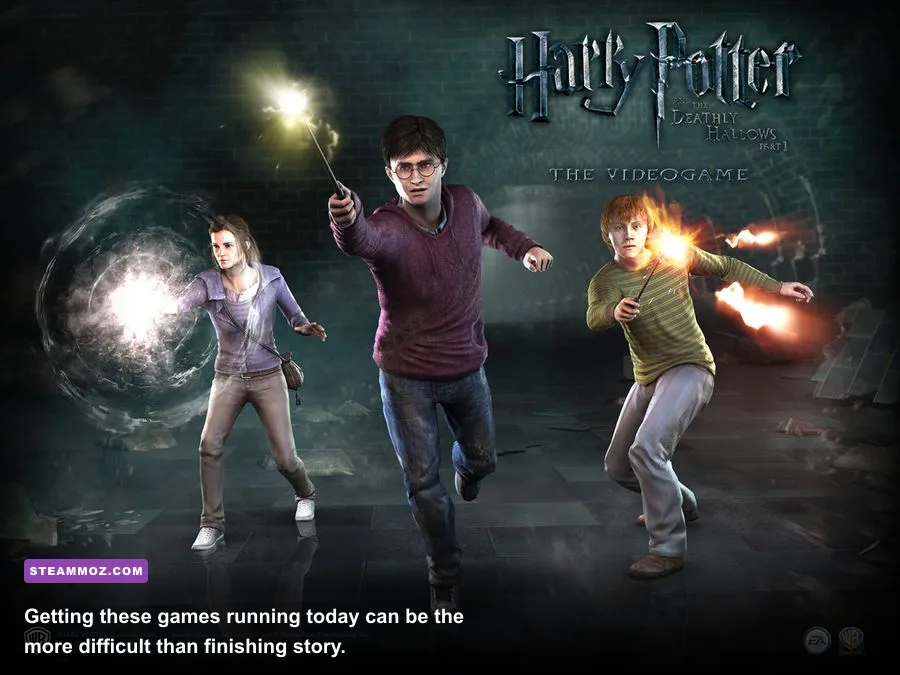
The writing is lightweight, but the games understand the appeal of the books better than their cutscenes sometimes do. The best moments are not dramatic retellings of film scenes. They are the small school details: sneaking through corridors after dark, hunting for Bertie Bott's Every-Flavour Beans, finding a shortcut behind a statue, or discovering that a supposedly decorative room is actually part of a puzzle route.
The first game is the most openly playful. It turns lessons into obstacle courses and gives Hogwarts a storybook quality that still looks attractive in motion. Its problems are rough edges: repeated voice lines, stiff animation, uneven checkpointing, and a final stretch that feels more like a sequence of tasks than a satisfying climax.
Chamber of Secrets improves pacing and gives Hogwarts more connective tissue. The school feels like somewhere you are learning to navigate, not just a set of film backdrops. It also has more confidence in its secrets. You can pass a corridor several times before realizing that a spell or companion interaction opens a nearby reward.
Prisoner of Azkaban is arguably the strongest adaptation in terms of mechanical ambition. Switching between Harry, Ron, and Hermione helps the level design feel less repetitive, and the darker story gives the locations more atmosphere. Its short length is a real drawback, though. A modern player can finish it quickly, especially if they are not chasing every collectible.
The later games are uneven in a different way. Order of the Phoenix creates a broad Hogwarts playground but occasionally turns simple objectives into vague scavenger hunts. Half-Blood Prince adds potion-making, dueling, and Quidditch, yet its structure can feel like a collection of minigames stitched around movie scenes. Neither is bad, but both are less focused than the second and third games.
For another perspective on older PC design and hardware expectations, see our retrospectives on Far Cry 2 PC requirements and modern PC specification breakdowns. Harry Potter's technical demands are tiny; its preservation challenges are the real story.
Should you play the originals or LEGO Harry Potter?
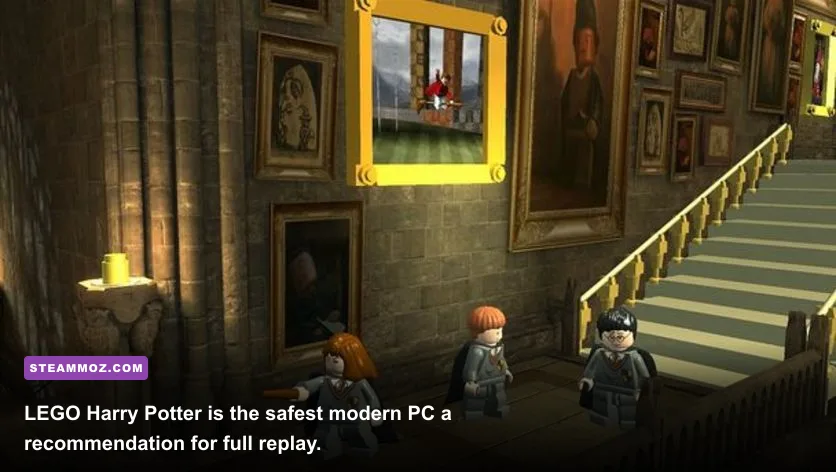
If your goal is a comfortable family-friendly replay, LEGO Harry Potter: Years 1-4 and Years 5-7 are better recommendations. They are more stable on current PCs, support modern display resolutions more gracefully, include cooperative play, and cover the whole film saga with a consistent ruleset. The humor is broader, but the games remain excellent at turning Hogwarts into a toy box.
The original games are preferable when atmosphere matters more than convenience. They have a slightly uncanny movie-game tone that LEGO deliberately sands away. The corridors feel emptier, the objectives can be weirder, and the stakes sometimes jump from classroom comedy to dangerous monster encounter without warning. That unevenness is part of their identity.
| Your Priority | Best Choice | Why | Main Warning |
|---|---|---|---|
| Best classic Hogwarts | Chamber of Secrets | Strong exploration and spell puzzles | Old controls and compatibility |
| Most creative mechanics | Prisoner of Azkaban | Switching trio members adds variety | Short campaign |
| Complete movie saga | LEGO Years 1-7 | Reliable structure and co-op | Less atmospheric and less serious |
| Modern open-world RPG | Hogwarts Legacy | Large world, gear, builds, and quests | Not a direct remake of the classics |
| Arcade Quidditch | Quidditch World Cup | Fast matches and simple controls | Very dated presentation |
Quidditch World Cup deserves a special mention. It is not a Hogwarts adventure, but its arcade structure remains immediately understandable: choose a team, build momentum, score, and unleash the Golden Snitch sequence. It lacks the depth of a modern sports game, yet it has the kind of focused loop that can still produce a satisfying evening session.
Do not confuse nostalgia with obligation. You do not need to play every licensed release to appreciate the good ones. Start with Chamber of Secrets, move to Prisoner of Azkaban if the formula clicks, and use LEGO if you want a complete, low-friction marathon. Players who want a giant contemporary RPG should go straight to Hogwarts Legacy instead.
Final verdict: worth playing in 2026?
The classic Harry Potter PC games are still worth playing in 2026, but selectively. Chamber of Secrets earns the clearest recommendation because its Hogwarts exploration, spell-driven puzzles, and compact campaign still fit together beautifully. Prisoner of Azkaban is the more mechanically adventurous choice. Philosopher's Stone is worth sampling if you enjoy rough-edged retro adventures, while Goblet of Fire is mainly for dedicated fans.
They have not aged into hidden modern masterpieces. The camera fights you, the combat is shallow, and the PC versions can demand more technical patience than their tiny system requirements suggest. But they preserve something newer games often lose: a sense that Hogwarts is a place to poke at. Every lesson gives you a tool, every corridor hints at a secret, and every familiar room feels slightly different once you know how to reach it.
That makes the replay worthwhile. Play with a stable frame-rate cap, keep expectations aligned with early-2000s design, and judge the games by their spaces rather than their technology. If you want a polished wizarding power fantasy, choose Hogwarts Legacy. If you want to spend a few evenings rediscovering why a digital school full of beans, books, portraits, and dangerous staircases felt magical in the first place, the classic PC games still have enough charm to cast their spell.
For more retro-friendly PC recommendations and fixes, browse Steamoz's guides to hidden game rewards and crashing and low-FPS troubleshooting. For official franchise information, the Wizarding World website remains the safest starting point.