
Alien Spidy is worth playing in 2026 only if you enjoy compact, old-school precision platformers and can tolerate repetition. Its web-swinging feels surprisingly tactile, the art direction remains charming, and a complete run through its 114 levels can be picked up cheaply on PC. But this is also a game built around trial and error, inconsistent difficulty spikes, and a camera that occasionally turns a fair challenge into a blind guess. It is a $5-or-less recommendation, not a must-own classic.
Released in 2013 by Enigma Software Innovations, Alien Spidy follows a tiny alien spider searching for his missing companion Virgi after crash-landing on Earth. The premise is deliberately light. There is no upgrade tree, no equipment screen, and no combat system to master in the traditional sense. Instead, the entire game is about controlling Spidy's jump, web shot, air movement, and landing position through a long chain of compact stages.
That narrow focus is both the game's strongest quality and its biggest limitation. If you want another sprawling adventure like the games covered in our Far Cry Primal alternatives list, this isn't it. Alien Spidy is closer to a bite-sized arcade platformer where shaving two seconds off a level can feel more rewarding than unlocking new story content.
What You Actually Do in Alien Spidy
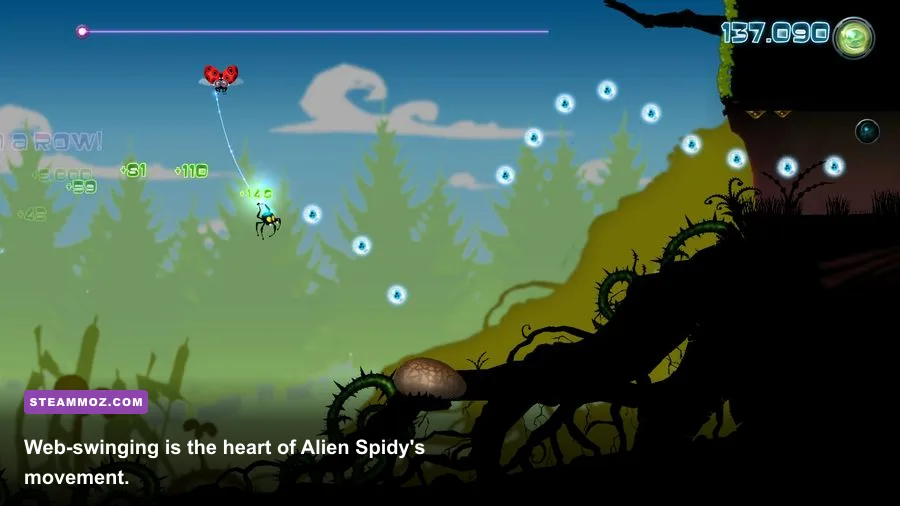
Each stage asks you to move from the entry point to the exit while collecting glowing particles, avoiding hazards, and rescuing or locating the required objectives. Spidy's toolkit is intentionally small. You can jump, fire a web projectile toward compatible surfaces, swing or pull yourself through a gap, and use momentum to reach platforms that a normal jump cannot touch.
The web is not a universal grappling hook. It only attaches to marked surfaces and objects, so learning which parts of the scenery are interactive is part of the puzzle. A web shot can also make a bad situation worse: attach too low and Spidy swings underneath the next platform; attach too late and he smacks into a wall; release too early and the character loses the arc needed to clear a hazard.
Movement has a useful rhythm. Jump toward a ledge, fire the web slightly above your intended landing point, let the swing build, then release before Spidy reaches the lowest point of the arc. That timing gives you horizontal speed without sacrificing too much height. Players who treat the web as a panic button will struggle. Players who treat it as a momentum tool will start finding routes that initially look impossible.
| Mechanic | What It Does | Why It Matters | Common Mistake |
|---|---|---|---|
| Jump | Provides basic vertical movement | Controls spacing and launch timing | Jumping before lining up the next web point |
| Web shot | Attaches to compatible surfaces | Creates swing arcs and extra reach | Firing at scenery that cannot be hooked |
| Momentum | Carries Spidy across gaps | Allows advanced shortcuts and safer landings | Releasing at the bottom of the swing |
| Air control | Adjusts trajectory after launch | Corrects small positioning errors | Overcorrecting near hazards |
The controls are simple enough for a child to understand and precise enough to reward practice. That sounds ideal, but the game rarely explains the subtleties. It expects you to learn by failing. In 2026, that design still works for players who enjoy experimenting, though newcomers may find the first few hours more irritating than inviting.

🎮 Alien Spidy
Looking to experience this game? Grab your digital key directly on our store for $0.99.
View on Steammoz Store →Worlds, Levels, and the Difficulty Curve

Alien Spidy's campaign is divided across three broad environments, moving from bright forest-like areas into more dangerous and visually distinct zones. The full package contains 114 levels, including short stages designed around traversal, collection, or survival. Most levels can be finished in a few minutes once you know the route, but first attempts often stretch much longer because a single missed jump sends Spidy back to a checkpoint.
The opening levels teach the basic language effectively: jump, hook, swing, release. Soon after, the game starts stacking hazards. Moving enemies, spikes, narrow ledges, breakable surfaces, and awkward vertical transitions appear together. The problem is not that any single mechanic is unfair. The problem is that the difficulty curve sometimes jumps before the game has properly taught the new timing.
Checkpoint placement softens the punishment, but it doesn't eliminate the friction. Some stages are over almost immediately after a checkpoint, while others make you repeat a sequence that you had already solved. There is no modern rewind feature or generous instant retry flow, so failed runs can feel dated compared with newer precision platformers.
| Campaign Element | Strength | Weakness | 2026 Verdict |
|---|---|---|---|
| Early forest stages | Clear introduction to web movement | Basic visual variety | Good tutorial arc |
| Mid-game traversal | Best use of momentum and swinging | Difficulty spikes arrive quickly | Strongest section |
| Hazard-heavy stages | Demand precise route planning | Camera can hide incoming danger | Appealing to experts, rough for newcomers |
| Collectible runs | Add replay value after completion | Some routes feel trial-and-error driven | Worth revisiting selectively |
The collectible structure gives the campaign more life than a simple point-to-point sprint. You can finish a level without grabbing everything, then return when you understand the route. That second pass is where the game becomes more enjoyable: instead of merely surviving, you're planning efficient swings and testing whether a risky shortcut saves time.
Is the Platforming Still Good?

Mostly, yes. Alien Spidy's best moments come from the small correction windows between a web attachment and a landing. You don't have a dozen abilities competing for attention. You have one movement system, and the game keeps asking whether you understand it.
The satisfying part is the game's physicality. A successful web swing has a visible arc, and Spidy's body makes it clear when he's gaining or losing momentum. That feedback lets you improve through observation rather than memorizing every stage. On a good run, you stop thinking about individual button presses and start reading the level as a sequence of curves.
The less satisfying part is the camera. In tight vertical sections, the view can reveal a hazard only after you've committed to a jump. This isn't constant, but it happens often enough to sour otherwise clever layouts. There are also moments where foreground decoration blends into the playable space, making it difficult to tell whether an object is background scenery, a web anchor, or a collision hazard.
Compared with the smoother presentation and more adjustable performance targets discussed in our A Year of Rain settings guide, Alien Spidy is technically undemanding but less flexible. Its challenge is mechanical, not hardware-based. A modern computer will run it easily; whether you enjoy it depends almost entirely on your patience with repeated attempts.
Three practical movement tips
First, aim high. Attach the web above the platform rather than directly to its edge. The higher anchor gives you a better swing and more time to release. Second, release early. The lowest point of the arc looks powerful, but it often sends Spidy too low. Release as the character starts climbing toward the target. Third, stop chasing every collectible on the first attempt. Learning the safe route first makes the later completion run dramatically less frustrating.
Presentation and Performance on PC
The cartoon art has aged better than the technology underneath it. Bright colors, oversized plants, and expressive animations give the alien spider a distinctive identity. The environments aren't detailed by modern standards, but they communicate danger clearly when the camera behaves. Sound effects are functional, while the soundtrack provides a pleasant backdrop without becoming memorable.
PC performance is almost a non-issue. The Steam version was designed for very old hardware, with the listed minimum requirements including Windows XP SP3, a 2 GHz processor, 1 GB of RAM, Shader Model 3.0 graphics, and roughly 1 GB of storage. Any current Windows gaming PC is vastly beyond that baseline.
| Setting or Hardware | Original Baseline | Recommended in 2026 | Practical Result |
|---|---|---|---|
| Operating system | Windows XP SP3-era support | Current supported Windows version | Runs comfortably, though legacy compatibility may vary |
| Processor | 2 GHz CPU | Any modern dual-core or better | No meaningful CPU bottleneck |
| Memory | 1 GB RAM | 4 GB or more available | Game itself uses very little memory |
| Graphics | Shader Model 3.0 GPU | Integrated graphics is sufficient | Stable performance at typical resolutions |
| Storage | About 1 GB | 2 GB free for installation overhead | Tiny install by modern standards |
Don't expect a sophisticated settings menu. This isn't a game with ray tracing, texture streaming, or the kind of graphics profile covered in our Aragami: Nightfall performance guide. The main concerns are controller detection, resolution behavior, and whether the game behaves properly on a modern display. A wired Xbox-style controller is generally the most comfortable option, especially for fine air corrections.
Before buying, check the official Alien Spidy Steam page for current operating-system notes, community reports, and controller compatibility. The Steam community hub is also useful if you run into a launch or input issue that the original release never addressed.
What Makes It Worth Playing in 2026?
Price is the biggest part of the answer. Alien Spidy has enough content to justify a low-cost purchase, particularly if you're looking for a short game you can play in focused sessions. The 114-level structure is convenient for handheld-style gaming, and the basic movement has enough depth to support replay attempts after the credits.
It also fills a specific niche. This isn't a story-heavy indie game, a hardcore roguelike, or a physics sandbox. It's a colorful precision platformer with a spider-like grappling mechanic. If that description immediately sounds fun, the game delivers its central idea quickly. If you need constant novelty, character upgrades, or a forgiving learning curve, the limited toolset will feel thin.
There are better modern alternatives in almost every category. Newer platformers offer cleaner cameras, smarter checkpoints, more generous accessibility options, and better controller support. Alien Spidy survives because its core loop remains readable: enter a level, find the route, swing through danger, and try to make the next run cleaner than the last.
That same focused design is why it pairs well with short sessions alongside games that demand more commitment. For technical troubleshooting on other older PC releases, our Beacon Pines PC fixes and Brothers in Arms system check offer useful context for running legacy titles, though Alien Spidy is usually the simpler installation.
Final Verdict
Alien Spidy is worth playing in 2026 at the right price, but it isn't essential. Give it a chance if you like web-swinging movement, short replayable levels, collectibles, and the satisfaction of mastering a fixed route. Skip it if repeated deaths, occasional camera problems, or dated presentation quickly drain your patience.
Steamoz score: 7/10. The movement earns that score. Web-swinging has genuine character, the three-world structure provides a respectable amount of content, and the art still looks cheerful rather than merely old. The deductions come from uneven pacing, limited accessibility, and challenge design that sometimes mistakes surprise for difficulty.
| Player Type | Recommendation | Why |
|---|---|---|
| Precision-platformer fan | Buy on sale | The web mechanics reward practice and route optimization |
| Casual story player | Maybe | There is little narrative beyond the rescue premise |
| Completionist | Buy on sale | 114 levels and collectibles offer substantial replay goals |
| Modern accessibility-focused player | Skip or sample first | Few tools soften repeated failure or camera issues |
| Retro PC enthusiast | Buy | Very low hardware demands and a distinctive movement hook |
In short, Alien Spidy is a modest game with one genuinely good idea. It doesn't need to become a massive adventure to justify itself. It just needs the web to catch, the next platform to be reachable, and the price to stay low. In 2026, that remains enough for a pleasant afternoon of platforming—provided you're willing to miss a few jumps before the game starts making sense.