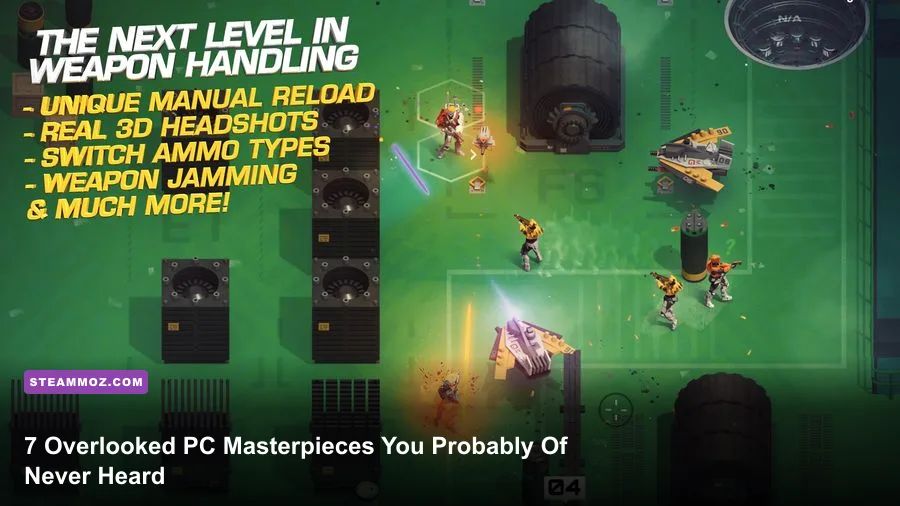
If you're exhausted by cookie-cutter $70 releases with recycled battle passes and hollow open worlds, Steam's storefront algorithm is quietly hiding some of the greatest PC experiences ever engineered. Titles like Underrail, Synthetik: Legion Rising, Troubleshooter: Abandoned Children, Brigador, and Lunacid deliver staggering mechanical depth, surgical gunplay, and uncompromising build freedom that mainstream studios stopped attempting years ago. While the front page pushes live-service treadmills, these sleeper hits focus strictly on player agency, rock-solid frame pacing, and gameplay loops that swallow hundreds of hours without asking for a dime in microtransactions.
Underrail: The Hardcore Iso-RPG Fallout Fans Deserve
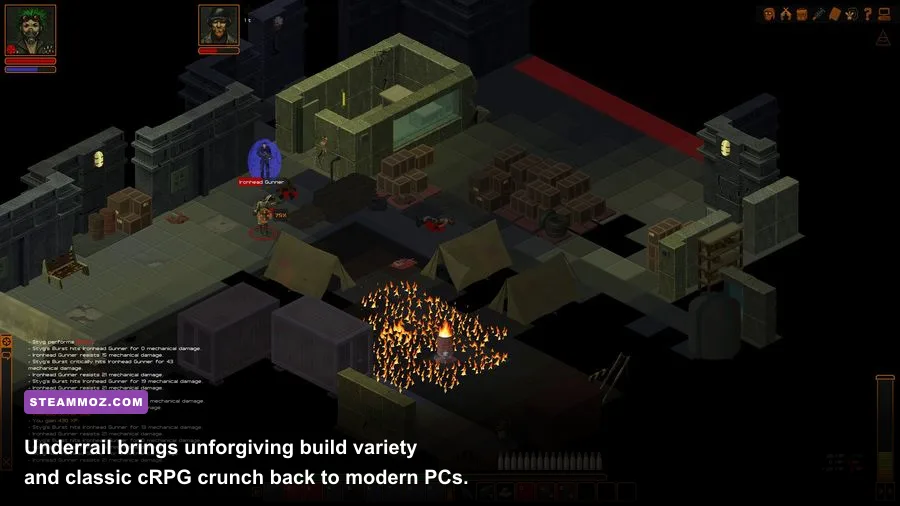
Developed by Stygian Software, Underrail is an isometric, turn-based post-apocalyptic role-playing game that respects your intelligence by refusing to hold your hand. Set in a sprawling underground subway network centuries after surface life collapsed, it strips away quest markers and objective compasses. You navigate this brutal underworld using station maps, environmental cues, and player notes. If you cut your teeth on classic turn-based cRPGs or survived ruthless Euro-style world scaling like the hurdles detailed in our Elex PC fixes and optimization guide, Underrail will immediately feel like home.
Combat revolves around a strict Action Point (AP) and Movement Point (MP) budget, typically starting at 50 AP and 30 MP per turn. Every single action—swapping a magazine, throwing an EMP grenade, or injecting an adrenaline shot—demands precise AP budgeting. The character system features seven core attributes, dozens of skills, and over a hundred specialized feats. Building an effective operative requires ruthless focus. Spreading points evenly is the fastest way to get completely walled by early-game Rathounds in the Lower Underrail tunnels.
Build Archetypes and Combat Synergies
The game's psionics system serves as one of the deepest spellcasting frameworks in modern gaming, split across four distinct disciplines: Thought Control, Metathermics, Psychokinesis, and Temporal Manipulation. Unlike typical magic systems governed by basic mana bars, Underrail uses Psi Points and Psi Reserves, forcing you to manage your thermal buildup and cognitive strain. A Temporal Specialist can cast Psycho-temporal Acceleration to pump an additional +15 AP and +20 MP for two turns, chaining burst-fire rounds from a custom-crafted 9mm Hammerer pistol before ducking behind cover.
Crafting is equally uncompromising. Weapons and armors aren't just looted; they're fabricated using base components graded from Quality 40 to Quality 160+. Sourcing a high-frequency energy modulator to build electroshock knives or tanning Siphoner leather for acid-resistant boots will genuinely make or break your survival against late-game Ironhead bandit fortresses.
Synthetik: Legion Rising: Mechanical Gunplay Perfection
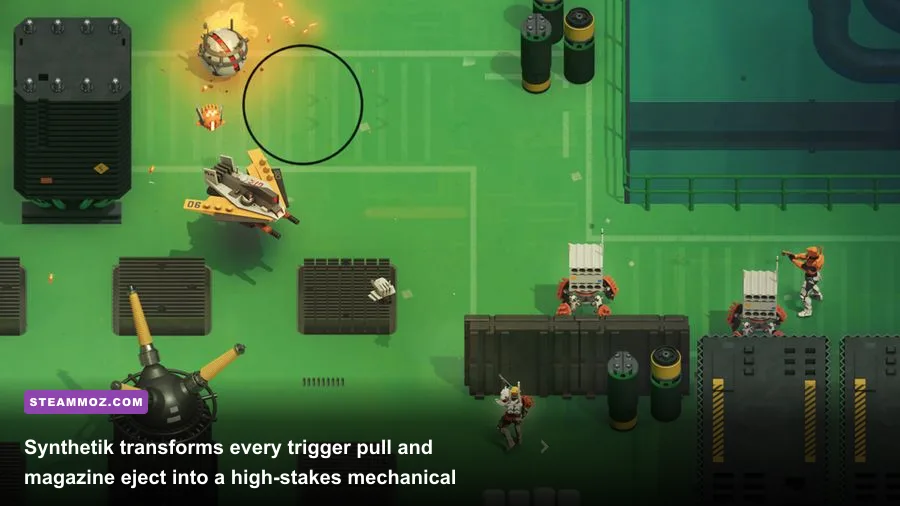
Top-down rogue-lites are a dime a dozen, but Flow Fire Games' Synthetik: Legion Rising approaches firearms with the tactical reverence of a military flight simulator. This isn't a brainless twin-stick shooter where you hold down left-click and spray corridors. Every weapon handles with tangible physical weight, violent muzzle climb, and mechanical friction that demands absolute presence of mind in the middle of chaotic machine uprisings.
In Synthetik, reloading is an active, multi-step mechanical chore. You don't just hit a button and wait for an animation to finish. You press E to eject the half-spent magazine—dumping any unfired rounds unless you've timed your reload perfectly—and then press Spacebar inside an active reload timing window to chamber the next round. Miss the window, and your operative fumbles the magazine, leaving you defenseless against incoming chronoswarmers. Fire too rapidly, and your weapon's heat gauge surges toward 100%, causing dangerous jams that require frantic taps of the eject key to clear the breech.
Weapons, Classes, and Damage Modifiers
Much like the weapon grading in our Far Cry 3 Blood Dragon weapon tier rankings, weapon choice dictates your tactical posture. Synthetik splits its roster into eight classes spread across four specializations: Rogue (Raider, Sniper), Specialist (Engineer, Demolitions), Commando (Heavy Gunner, Riot Guard), and Vanguard (Breacher, Eliminator).
The ballistic simulation calculates angle of deflection, armor penetration values, and critical headshots from a top-down view. Scoring a headshot requires lining up your laser dot with pixel precision on an enemy patrol bot's core while accounting for the weapon's deviation cone. Finding an ultra-rare variant like the Nemesis Prototype sniper rifle or the Armageddon heavy railgun feels game-changing because every round packs realistic penetration values that pierce through reinforced ballistic doors and chain-react explosive fuel cells.
Troubleshooter: Abandoned Children: The Sleeper Anime XCOM
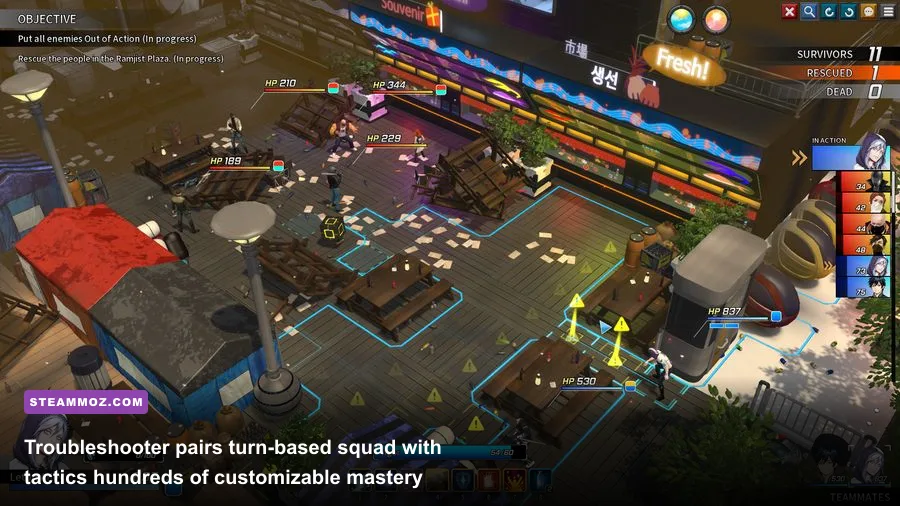
If you pitched a turn-based tactical squad game featuring the strategic depth of XCOM: Enemy Within, the intricate grid progression of Final Fantasy Tactics, and an sprawling urban sci-fi crime narrative, most players would assume it doesn't exist. Yet Korean developer Dandylion built exactly that with Troubleshooter: Abandoned Children. Despite holding thousands of "Overwhelmingly Positive" reviews on Steam, it remains criminally under-discussed in mainstream PC gaming circles.
You control Albus Bernstein and his fledgling private detective company—licensed as "Troubleshooters"—operating in the autonomous metropolitan district of Valhalla. Where XCOM relies on rigid two-action player-turn/alien-turn phasing, Troubleshooter utilizes a fluid Action Time (AT) delay timeline. Every step moved, skill activated, or heavy spell cast adds a specific number of delay ticks. An agile sword user like Albus can execute a light puncture strike, incur a tiny delay of 25 AT, and act twice before a heavy enemy shock trooper even finishes swinging their hydraulic hammer.
The Mastery System: Unrivaled Customization Depth
The true genius of Troubleshooter is its Mastery Board. Characters possess hundreds of equippable masteries divided into Basic, Support, Defense, Attack, and Special categories. As you defeat hostile gang lieutenants, your operatives study and permanently unlock their signature masteries. Slotting specific masteries together triggers emergent synergy passives that fundamentally reshape combat:
- One Shot One Kill: Scoring a critical kill instantly refunds your action points and resets sniper cooldowns.
- Second Wind + Breakthrough: Prevents fatal damage once per mission, granting a free movement phase and an automatic 50% damage buff for one turn.
- Catharsis Matrix: Converts excess incoming bleed and poison ticks directly into offensive SP meter generation.
Managing this sprawling web of abilities mirrors the rewarding team optimization found in deep management titles like the Empires of the Undergrowth progression and leveling systems, giving tacticians endless theory-crafting fuel across 100+ hour campaigns.
| Game Title | Genre / Subgenre | Core Signature Mechanic | Campaign Length | Mechanical Skill Ceiling |
|---|---|---|---|---|
| Underrail | Isometric Turn-Based cRPG | AP/MP economy & dynamic psi thermal dissipation | 80–120 Hours | Extreme (Brutal build checks) |
| Synthetik: Legion Rising | Top-Down Rogue-lite Tactical Shooter | Active reload, heat buildup & chamber jams | Infinite (Rogue-lite) | High (Manual twitch execution) |
| Troubleshooter: Abandoned Children | Tactical Turn-Based Strategy RPG | Action Time delay & 600+ slotable Mastery boards | 90–150 Hours | Very High (Synergy math & positioning) |
| Brigador: Up-Armored Edition | Isometric Tactical Mech / Vehicle Combat | 100% terrain destruction & acoustic awareness | 30–50 Hours | High (Inertia physics & target priority) |
| Lunacid | First-Person Dark Fantasy Dungeon Crawler | Nonlinear vertical level design & cryptic puzzles | 15–25 Hours | Moderate (Spatial navigation & builds) |
Brigador: Up-Armored Edition: Cyberpunk Tactical Carnage
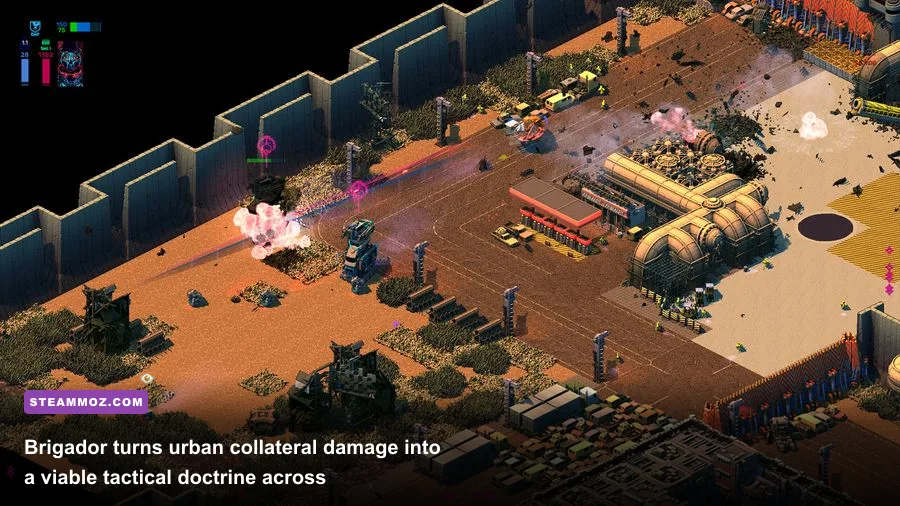
Set across the rain-slicked, neon-drenched metropolis of Solo Nobre, Stellar Jockeys' Brigador: Up-Armored Edition puts you in the cockpit of heavily armed mechs, hover-tanks, and armored industrial ag-rigs. Contracted by the Solo Nobre Concern to assassinate planetary leaders and eliminate orbital defense grid towers, your goal is simple: level the city, liquidate the targets, and reach the extraction gate alive.
What elevates Brigador from standard isometric arcade shooters is its fully realized destructible physics engine and tactical acoustic simulation. Every single building, wall, tree, and neon billboard can be leveled. If a squad of heavily armored Corvid battle tanks has you pinned down at a street choke-point, you don't trade shots. You pilot an ultra-heavy Touro mech directly through the structural pillars of an adjacent residential high-rise, collapsing tons of reinforced concrete directly onto their hulls.
Loadouts, Vehicle Types, and Heat Management
Choosing your chassis alters your movement physics fundamentally:
- Mechs (Walkers): Feature independent torso rotation and weapon aiming, enabling you to retreat at full sprint while maintaining continuous fire down narrow avenues.
- Tanks (Treads): Boast massive hull armor and devastating front-facing ramming damage, but require tank-steering controls that punish bad pathing in tight alleyways.
- Agravs (Hovers): Zero friction hovercraft capable of gliding over deep water and collapsed ruins, but carry terrifying drift inertia that requires counter-strafing to control.
Your weapon hardpoints demand the same weapon synergy calculations seen in space dogfighting gear guides like the Everspace weapon loadout rankings. Pairing an EMP burst projector like the Black Hand to strip energy shields with a high-velocity kinetic cannon like the Caesar allows you to core hostile heavy mechs in seconds before their sound-alerted reinforcements arrive.
Lunacid: King's Field Reborn for Modern PC Gamers
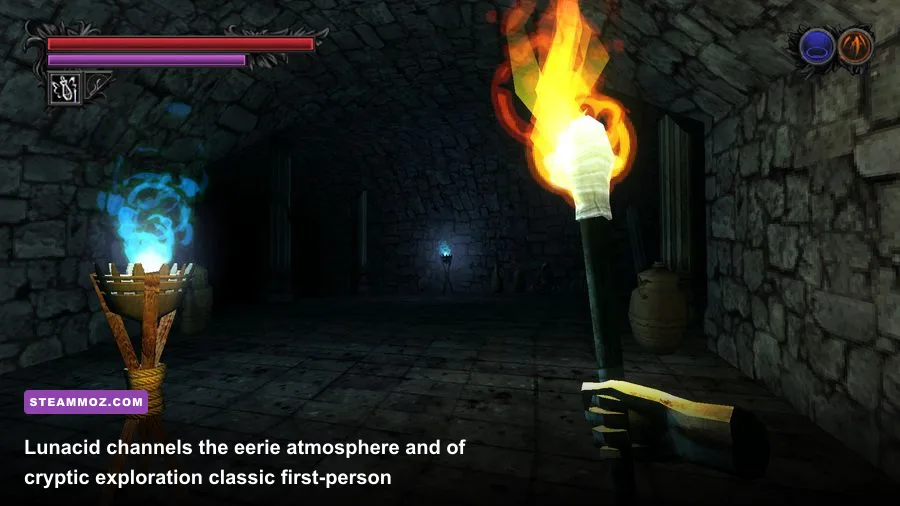
Before FromSoftware became a household name with Dark Souls and Elden Ring, their golden era was forged in the eerie, slow-paced corridors of King's Field and Shadow Tower. Solo developer KIRA resurrected that forgotten design philosophy with Lunacid, a masterclass in atmospheric first-person dungeon exploration that runs circles around modern fantasy walking simulators.
Cast into the Great Well—a massive subterranean abyss where humanity tosses criminals, heretics, and societal outcasts—you wake up in a subterranean realm bathed in pale moonlight and toxic mist. Lunacid doesn't care about flashy cinematic cutscenes. It pulls you into its world purely through environmental storytelling, eerie synth-choral soundscapes, and intricate vertical dungeon geometry that loops back onto itself with rewarding shortcuts.
Exploration Mechanics and Cryptic Progression
Much like hunting down elusive secrets in obscure dungeon crawlers—an itch explored in our Eternal Destiny secret locations guide—Lunacid treats hidden doors and cryptic environmental puzzles as core gameplay mechanics. Walls with faint textural discrepancies can be smashed open with blunt bludgeons. Hidden pools of consecrated water cleanse persistent curses, and reading dusty gravestones reveals recipes for ancient elemental blade infusions.
Combat is deliberate and methodical. Weapons range from rusty iron shortswords to enchanted scythes and the iconic Moonlight blade tribute. Every swing drains a sliver of stamina, while your movement speed scales directly with your Agility attribute. Invest heavily into Agility and Dexterity, and your operative transforms from a sluggish, lumbering prisoner into an untouchable spell-blade leaping over toxic floor vents while hurling Ice Tear and Flame Flare projectiles into mutated subterranean chitterers.
Performance Benchmarks and Engine Optimization Settings
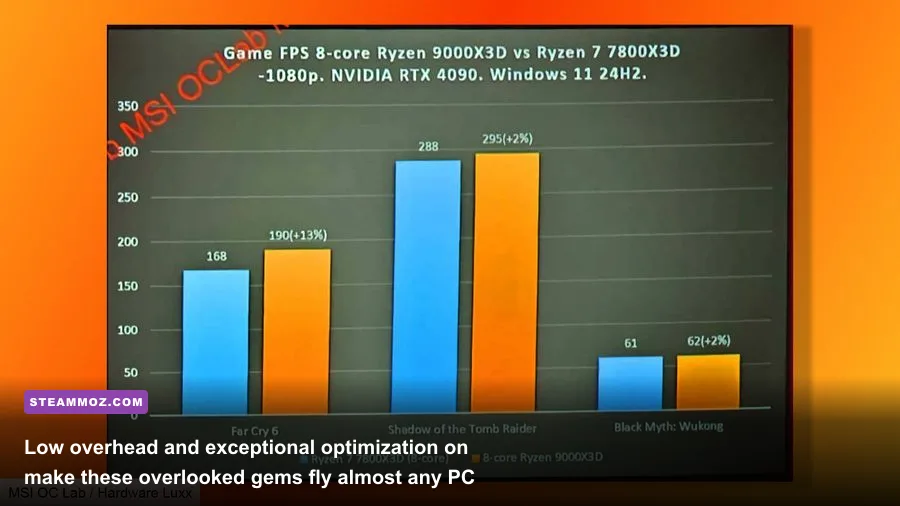
One of the single greatest perks of diving into overlooked PC gems is their exceptional technical optimization. Because these games rely on lean proprietary engines or custom-tuned Unity/Godot frameworks rather than bloated Unreal Engine 5 presets, they run with blistering frame rates, zero shader-compilation stutters, and minimal system latency—even on aging hardware or handheld gaming PCs like the Steam Deck.
To squeeze every drop of smoothness out of your setup—much like fine-tuning graphics settings in our Filament FPS optimization profile—review the technical performance profiles and configuration recommendations below.
| Game | Game Engine | Baseline GPU for 1080p / 60+ FPS | VRAM Usage | Key Optimization Setting / Config Tweak |
|---|---|---|---|---|
| Underrail | Custom C# / Microsoft XNA | Intel HD Graphics 4000 | < 1.0 GB | Set UI Scale to 100%; disable "Vsync" in-game and force via GPU driver |
| Synthetik | GameMaker: Studio 2 | NVIDIA GTX 750 Ti / AMD RX 460 | ~1.5 GB | Disable "Screen Shake" and "Bloom Distortion" to eliminate micro-drops |
| Troubleshooter | Custom In-House 3D Engine | NVIDIA GTX 960 / AMD R9 280 | ~2.5 GB | Cap framerate at 60 FPS; drop "Shadow Map Resolution" from Ultra to High |
| Brigador | Custom C++ Proprietary 2D/3D | NVIDIA GTS 450 / AMD HD 5770 | < 1.5 GB | Lock lighting resolution to "Native"; disable MSAA on low-end APUs |
| Lunacid | Unity (Custom Retro Pipeline) | NVIDIA GT 1030 / Intel Iris Xe | < 2.0 GB | Lower "Volumetric Fog" to Medium for an immediate +25% framerate uplift |
Maximizing Responsiveness on Modern Rigs
If you are playing on a high-refresh monitor (144Hz to 240Hz), these titles yield astonishingly crisp input response once properly configured. For Synthetik and Underrail, running in Exclusive Fullscreen rather than Borderless Windowed drops input latency by up to 12ms—a difference that directly affects whether you hit your active eject window or eat a railgun shell from an enemy scout drone.
For titles like Lunacid that capture a retro PS1-era visual aesthetic, avoid enabling external anti-aliasing overrides through your graphics card control panel. Smoothing the deliberately chunky polygon edges washes out the intended high-contrast lighting, muddying the moody underground crypts. Let the native pixel scale shine, uncap your frame limit, and enjoy mechanical brilliance running at hundreds of frames per second.
The next time you scroll through Steam's seasonal sales feeling like there's nothing new to experience, skip the marketing banners. Fire up any of these five masterworks instead. Between Underrail's surgical turn-based survival, Synthetik's white-knuckle weapon handling, Troubleshooter's peerless tactical theory-crafting, Brigador's crushing mech physics, and Lunacid's haunting dark-fantasy corridors, you'll rediscover why PC gaming remains the ultimate home for true interactive depth.