
If your digital garage never ventures beyond Forza Horizon 5, Gran Turismo 7, or the latest annualized F1 title, you're missing out on the most mechanically distinct driving experiences in PC gaming. Mainstream racing games have hit a creative plateau of sanitized physics, hand-holding assists, and sterile open worlds stuffed with map icons. The real soul of digital motorsport has retreated into the underground indie scene, where developers build games driven by obsessive mechanical authenticity, niche street subcultures, and punishing vehicle handling that demands absolute precision.
Whether you're looking for midnight highway battles where your turbo pressure literally melts your head gasket, bolt-by-bolt project car builds in rural backwaters, or minimalist rally sims with unforgiving weight transfers, these under-the-radar driving titles deliver thrills you simply cannot find on a retail store shelf. Here are six hidden gem car games that belong in your library right now.
Night-Runners Prologue: The Raw 1990s Wangan Experience Mainstream Racers Refuse to Make
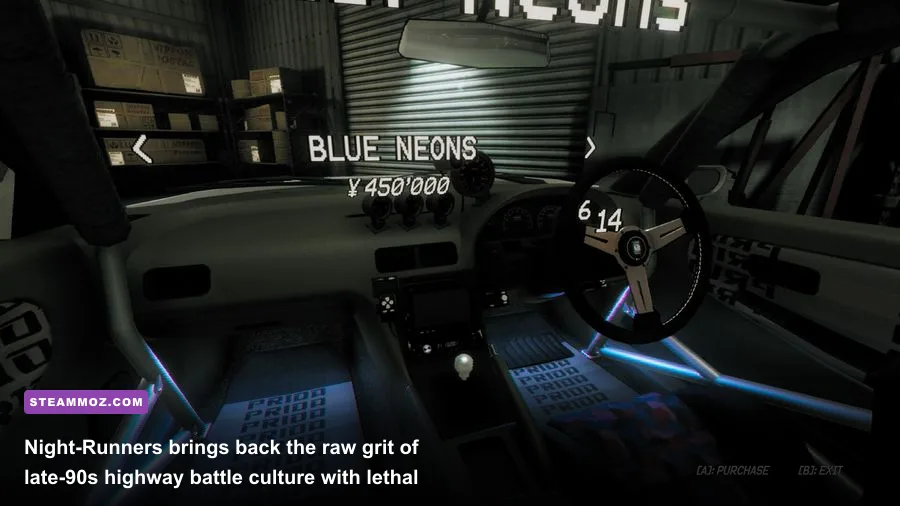
Mainstream street racers have spent the last decade chasing neon-lit social media festival vibes, completely ditching the grimy, dangerous atmosphere that made Japanese street racing legendary. Enter Night-Runners Prologue, a solo-developed psychological love letter to the infamous Mid Night Club and Tokyo's Shutoko Expressway. Set between the late 1990s and early 2000s, this title abandons clean menus for an authentic VHS filter, CRT scanlines, and an oppressive, claustrophobic atmosphere where you stalk rival crews across highway parking areas like Tatsumi PA.
What makes Night-Runners revolutionary isn't just its immaculate aesthetic—it's how mechanical failure governs every single high-speed run. When you flash your high beams at a rival cruising the C1 loop or the Bayshore route, you aren't just racing their car; you are racing your own engine's cooling limits. The game puts deep emphasis on thermal management:
- Coolant and Oil Thermals: Pinning the throttle on a modified 2.0-liter turbocharged coupe (heavily inspired by the Nissan 180SX and Silvia S13) at 1.4 bar of boost down the straightaways will rapidly cook your fluids past 105°C. Keep your foot down, and your head gasket will blow, showering your windscreen in steam and oil.
- Highway Seam Instability: The asphalt on Tokyo's elevated expressways features harsh expansion joints. Setting your custom coilovers too stiff means bottoming out at 260 km/h, unsettling your rear axle, and spinning you directly into a concrete bridge support.
- Hyper-Detailed Cockpit Tuning: You don't buy blanket "Stage 2" upgrades. You physically purchase aftermarket Defi-style auxiliary gauges, mount them to your A-pillar, adjust individual boost controller dials, and wire up custom tachometers to catch engine knock before a rod exits the block.
The handling model balances accessible drift mechanics with lethal snap-oversteer. If you're tired of arcade handling models where every vehicle drives like an immovable brick glued to a track, Night-Runners is a masterclass in tension, mechanical preservation, and raw automotive mood.
Art of Rally: Hardcore Scandinavian Physics Disguised as Minimalist Art

At first glance, Art of Rally looks like a serene, isometric art piece destined for a cozy gaming playlist. But boot it up, turn off the driving assists, and you'll quickly realize developer Funselektor Labs engineered one of the most punishing and mechanically genuine rally handling models outside of Richard Burns Rally. This is an authentic homage to the golden eras of rally—spanning Group 2, Group 4, the terrifying Group B era, and the theoretical Group S prototypes.
Because the camera sits pulled back in a high-chase perspective, you have no co-driver barking pace notes into your ear. Instead, your eyes must read the road topography ahead, assessing surface crests, camber shifts, and sudden tree lines. Surviving requires strict adherence to classic rally vehicle dynamics:
- The Scandinavian Flick: Entering hairpins across loose dirt requires pitching the car outward before throwing the nose into the apex, forcing weight onto the outside front tire while feathering the handbrake.
- Surfaces and Grip Coefficients: The transition between the high-traction tarmac of Japan, the loose gravel of Sardinia, and the slick pack-ice of Norway fundamentally alters your braking zones. Locking up your tires for even half a second pushes you helplessly off a cliffside.
- Group B Monster Taming: Mid-engine homologation beasts like the "Turbo 3S" and "The Hammer" generate absurd turbo lag followed by violent torque spikes. If your wheels aren't pointed dead straight when the boost builds, the chassis immediately snaps into an uncontrollable spin.
To master the physics without micro-stutter ruining your cornering lines, dialing in stable frame pacing is crucial. Gamers who have implemented PC fixes that rescue low FPS and stabilize frame rates know that low input lag is the difference between nailing a gravel drift and wrapping your car around a Finnish pine tree.
Mon Bazou: Grassroots Bolt-by-Bolt Wrenching and Dirt Track Racing

While mainstream racers give you hundreds of supercars with the click of a button, Mon Bazou forces you to earn every single horsepower through sweat, grease, and backyard engineering. Set in rural Quebec in 2005, you start with a hollowed-out, rusted-out shell of an old "König" (an unmistakable tribute to the BMW E36) sitting on cinder blocks. Your goal? Build a grassroots race car capable of dominating the local dirt track and drag strip, funded by chopping firewood, boiling maple syrup, and building an underground auto empire.
Unlike games that hide your engine bay behind a graphical user interface, Mon Bazou requires manual, physical assembly with individual socket wrenches (from 8mm to 19mm):
- Complete Engine Fabrication: You mount the crankshaft, bolt down the piston rods, install the cylinder head, route fuel lines, and connect custom turbo piping. If you miss torquing down an engine mount, the entire block will twist and crack your driveshaft under hard acceleration.
- Differential Dynamics: Starting with a junkyard open differential means your inside wheel simply spins and burns out through corners. You have to physically remove the diff, carry it to your workbench, weld the spider gears solid for drift handling, or save up for a proper limited-slip unit to hit competitive lap times at the Sainte-Flavie speedway.
- Air-Fuel Ratio (AFR) Dyno Tuning: Once you bolt on an aftermarket turbo, you must run the König on your home dyno, reading wideband oxygen sensors and manually adjusting your carburetor screws or ECU fuel maps to prevent running lean and melting your pistons.
Much like running older titles that require manual driver tweaks—similar to troubleshooting whether your rig can handle budget-friendly classic PC specs—Mon Bazou runs light on GPU requirements but relies heavily on CPU physics calculations for its thousands of unboltable parts. It turns the mundane act of automotive upkeep into an intoxicating, satisfying sandbox.
Street Legal Racing: Redline: The Unforgiving Father of Engine Teardowns
Long before modern simulators existed, Invictus Games released Street Legal Racing: Redline (SLRR) in 2003. Decades later, thanks to extensive fan patches and the active community on Steam, it remains the deepest, most unapologetically hardcore street car building game ever coded. Modern games like Car Mechanic Simulator let you click parts onto a frame, but they never give you the terrifying freedom—or the handling consequences—that SLRR provides.
In SLRR, cars are not treated as static 3D models with stat modifiers; they are collections of hundreds of individual stress-bearing components. You buy a bare-metal unibody chassis from a sketchy classified ad, drop it onto a hydraulic lift in your garage, and construct an engine from the bare block up:
- Surgical Engine Customization: You don't just pick an "engine upgrade." You specify crankshaft stroke length, piston compression ratios, valve spring tension, camshaft lift duration, and individual exhaust manifold runner sizes.
- Catastrophic Structural Wear: Clip a concrete curb at 70 mph, and the game doesn't just display a superficial scrape texture. Your lower control arm bends, your tie rod snaps, your steering rack binds up, and your chassis unibody twists out of alignment. You have to put the car on a frame straightener or cut your losses and scrap the shell.
- Dynamic Street Hustling: You drive your hand-built creation into Valo City, cruising the streets looking for bets against local racing clubs. Winning lets you strip parts straight off your rival's engine bay on the spot.
It's notoriously janky and unpolished around the edges, but no other game on the market gives you the raw pride of winning a quarter-mile drag race with an inline-six engine you assembled with your own bare hands.
Distance: Sci-Fi Parkour Meets High-Speed Atmospheric Survival
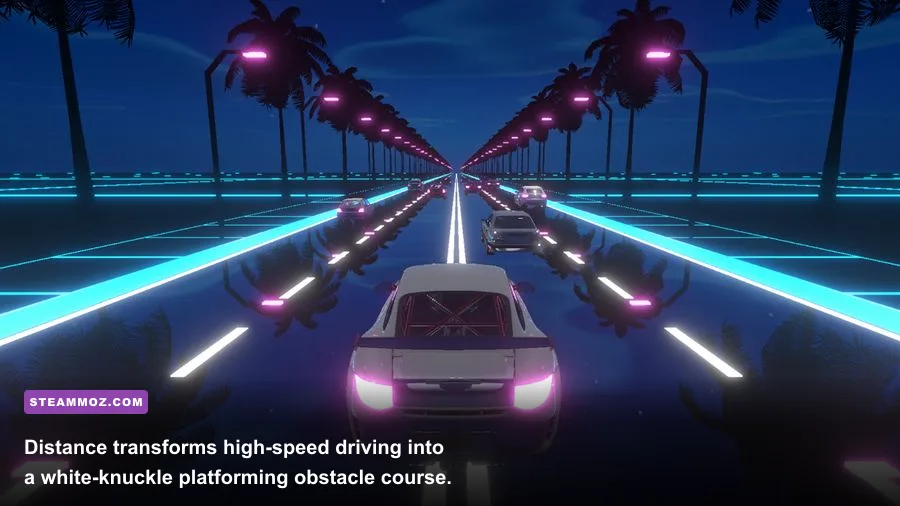
If your taste in driving skews toward arcade thrill rides, standard asphalt circuits can feel limiting. Distance, created by Refract Studios as a spiritual successor to their viral student project Nitronic Rush, tosses traditional racing conventions out the window. It is a survival driving platformer set within a haunting, desolate, neon-drenched cyberpunk megastructure that actively tries to kill you.
Your vehicle is equipped with thrusters, jumping jets, and aerodynamic control surfaces that let you roll, yaw, and glide through the air. The tracks aren't mere roads—they are twisting obstacle courses suspended over bottomless voids where you transition seamlessly from floor to wall to upside-down ceilings:
- Full Rotational Physics: Launching off a broken highway span requires mid-air pitch and roll adjustments. You engage thrusters to plant your wheels onto a sheer skyscraper wall while managing your car's internal reactor core. Overuse your thrusters or boost, and your car overheats and explodes into a fireball.
- Dynamic Car Dismemberment: Giant industrial lasers sweep across the track. Miss your jump timing, and a horizontal laser will slice your vehicle in half. Because the car's mechanics are modular, you can keep driving on two wheels with half an engine block, desperately limping through a repair ring before the next checkpoint.
- Community Workshop Depth: With thousands of player-created tracks featuring mind-bending visual architecture, speedrunning in Distance demands twitch reflexes and routing mastery that rival competitive rhythm games.
Fast-paced physics engines like this rely on absolute visual clarity. If you run into stuttering or frame delivery problems, applying proper settings for higher FPS and smooth frame rates ensures your mid-air car rotations land with millisecond accuracy.
Grip: Combat Racing: The Mach-1 Rollcage Successor Nobody Remembers
Back in 1999, Psygnosis released Rollcage on the original PlayStation and PC, shocking gamers with vehicles sporting massive, double-sided monster tires that allowed cars to drive completely upside-down on tunnel ceilings. Decades later, ex-Rollcage developers teamed up under the banner of Caged Element to build Grip: Combat Racing, a hyper-kinetic futuristic combat racer running on Unreal Engine 4 that somehow slipped under the radar of mainstream racing enthusiasts.
In Grip, you routinely break the sound barrier, rocketing past 760 mph. Because the vehicle's tires extend higher and lower than the central armored chassis, flipping your car doesn't bring you to a halt. The floor simply becomes the roof, your controls automatically flip their vertical orientation, and your momentum carries forward uninterrupted:
- True Gravitational Defiance: By carrying enough raw velocity into curved banking, you can drive up vertical tunnel walls, lock onto structural ceiling girders, and launch across multi-tiered planetary racing complexes.
- Aggressive Combat Weaponry: The game avoids generic kart-racer tropes in favor of devastating sci-fi ballistics: Raptor machine-gun pods, Scorpion explosive swarms, and EMP disruptors that strip your opponents of their active downforce.
- Unforgiving Speed Physics: Driving at Mach 1 leaves zero room for sluggish reflexes. You must constantly trim your flight trajectory, monitor track transitions, and exploit environmental boost pads to stay ahead of the pack.
When juggling supersonic speeds and explosive weapon particles, frame pacing can take a hit. Optimizing your machine using tactics similar to fast-paced flight and combat FPS optimization steps guarantees you won't suffer split-second camera drops right as you enter a high-gravity corkscrew.
Hidden Gem Benchmark: Mechanics, Specs, and Tuning Tiers
To help you decide which under-the-radar experience belongs in your rotation, we've broken down all six titles by their core physics style, mechanical depth, best control method, and overall hardware accessibility. Whether you own an entry-level laptop or a high-end direct-drive sim rig, there is an overlooked driving gem here tailored to your playstyle.
| Game Title | Handling & Physics Archetype | Mechanical / Tuning Depth | Ideal Controller | Hardware Demand |
|---|---|---|---|---|
| Night-Runners Prologue | Sim-Cade / Authentic Wangan Drift | High (Gauges, ECU, Fluids, Suspension) | Gamepad / Force Feedback Wheel | Medium (Custom Shaders) |
| Art of Rally | Hardcore Weight-Transfer Sim | Medium (Vehicle Classes, Tuning Sliders) | Gamepad (Analog Triggers Mandatory) | Low (Well-Optimized Low Poly) |
| Mon Bazou | Realistic Sandbox Physics | Extreme (Bolt-by-Bolt Assembly, Dyno) | Keyboard & Mouse (Wrenching) / Wheel | Medium (CPU-Heavy Physics) |
| Street Legal Racing: Redline | Full Mechanical Disassembly Sim | Unmatched (Pistons, Camshafts, Unibody) | Gamepad / Keyboard | Very Low (Vintage Engine) |
| Distance | Sci-Fi Parkour / Physics Platformer | Low (Thermal & Reactor Core Systems) | Gamepad (Dual-Stick Aerial Control) | Low to Medium |
| Grip: Combat Racing | High-Speed Anti-Gravity Arcade | Low (Weapons & Boost Optimization) | Gamepad | Medium (Fast Draw Calls) |
Configuring Your Hardware for Niche Driving Sims
Unlike AAA racing games that come pre-packaged with auto-configured control profiles for every modern steering wheel, indie driving games demand a little elbow grease to feel their best. If you're setting up a force-feedback (FFB) wheel or dialing in an analog gamepad for these underground titles, use the following performance and calibration baseline:
| Setting / Variable | Recommended Baseline | Performance / Gameplay Impact | Why It Matters |
|---|---|---|---|
| Steering Linearity / Sensitivity | 1.0 (Completely Linear) | Zero input lag or artificial acceleration curves | Ensures your steering rack matches real-world wheel rotation without snap surprises. |
| Force Feedback Damping | 0% to 10% Maximum | Significantly frees up motor response latency | High damping masks critical front-tire scrub and early weight-transfer loss. |
| Deadzone Calibration | 0.00 Inner / 1.00 Outer | Instantaneous trigger and steering response | Allows micro-corrections in games like Art of Rally where 2% throttle saves a slide. |
| Monitor Refresh Rate & V-Sync | G-Sync/FreeSync Enabled, V-Sync OFF | Cuts input latency by up to 25ms | Fast highway runs in Night-Runners require sub-frame twitch steering around traffic. |
If you experience unusual stuttering or unexpected physics freezes when swapping between multiple USB controllers or steering wheels, you can troubleshoot these engine hang-ups with quick fixes that resolve indie crashing and low FPS spikes to keep your physical inputs operating without latency.
The next time you find yourself bored by the predictable, sanitized progression loops of modern AAA racers, look past the front page of digital storefronts. Whether it's the greasy, oil-streaked engine bays of Mon Bazou, the high-stakes highway dueling of Night-Runners, or the razor-sharp Scandinavian flicks of Art of Rally, these hidden gems celebrate what makes driving truly thrilling: mechanical danger, rewarding skill ceilings, and an undeniable passion for automotive culture.