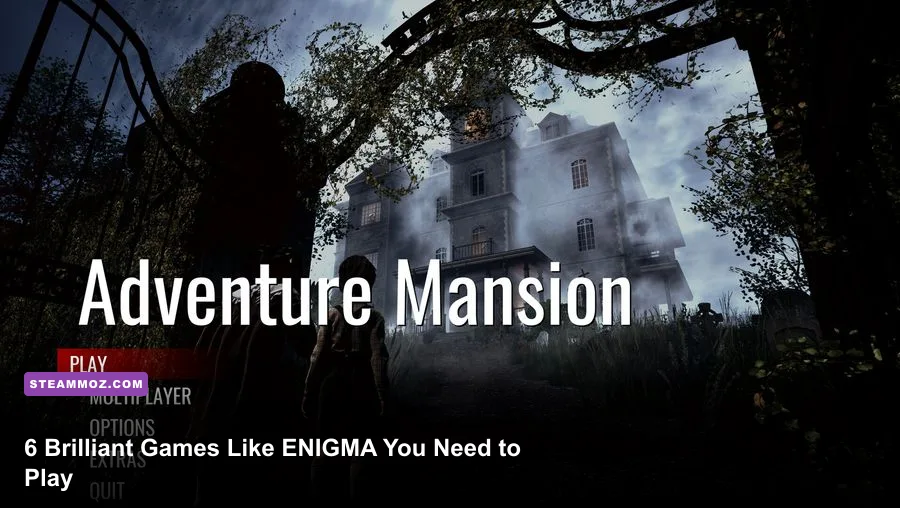
If ENIGMA hooked you with cryptic rooms, environmental clues, and the satisfaction of solving a puzzle without a glowing waypoint, start with Lorelei and the Laser Eyes. It is the closest overall match, but The Room 4: Old Sins, Obduction, The Talos Principle 2, Return of the Obra Dinn, and Viewfinder each capture a different reason ENIGMA works. These are the six games I would put at the top of a 2026 mystery-puzzle playlist.
That distinction matters. ENIGMA-style games aren't just collections of arbitrary riddles. The best ones make the setting itself part of the interface. A painting is a clue, a locked drawer is a promise, and a strange machine usually becomes understandable only after you've noticed one tiny detail three rooms earlier. I ranked these recommendations by clue quality, puzzle logic, atmosphere, exploration friction, and how well each game respects the player's intelligence.
How These ENIGMA Alternatives Compare
Before picking one, decide what you actually want more of. ENIGMA fans often use the same words—mystery, puzzles, exploration—to describe very different experiences. Some want tactile locks and keys. Others want a detective board, a huge world, or a story that refuses to explain itself.
| Game | Best For | Puzzle Style | Approximate Length | Difficulty |
|---|---|---|---|---|
| Lorelei and the Laser Eyes | Layered mystery and note-taking | Codes, logic, visual patterns | 15–25 hours | High |
| The Room 4: Old Sins | Tactile object puzzles | Mechanical boxes and hidden mechanisms | 5–8 hours | Medium |
| Obduction | Slow-burn exploration | Machines, routes, environmental logic | 8–12 hours | Medium-high |
| The Talos Principle 2 | Large-scale logic challenges | Lasers, fans, connectors, gates | 20–30 hours | Medium-high |
| Return of the Obra Dinn | Pure deduction | Observation and identity matching | 8–12 hours | High |
| Viewfinder | Fresh visual mechanics | Photography and perspective manipulation | 6–8 hours | Medium |
My personal order is Lorelei first, Obra Dinn second, and The Room 4 third. That isn't a statement about production value. It's about the feeling of making a connection yourself. The Talos Principle 2 is the most generous with accessibility and optional content, while Obduction is the least forgiving if you dislike backtracking or unclear objectives.
🎮 ENIGMA:
Looking to experience this game? Grab your digital key directly on our store for $7.49.
View on Steammoz Store →1. Lorelei and the Laser Eyes Is the Closest Match

Lorelei and the Laser Eyes is the recommendation for players who want ENIGMA's atmosphere pushed into something stranger, denser, and more deliberately theatrical. You arrive at a black-and-white hotel in Italy and become tangled in a mystery involving an artist, a film production, numbered rooms, and an absurd amount of paper. The game does not drip-feed every answer. It gives you fragments and expects you to build a mental model.
The key mechanic is not a single gadget. It's information management. You will collect notebooks, blueprints, photographs, cinema reels, newspaper clippings, and mathematical hints. Some puzzles use Roman numerals. Others rely on dates, room numbers, symmetry, or details hidden inside fictional documents. The hotel functions like a giant filing cabinet, and the smartest move is to keep your own notes instead of assuming the in-game map will remember every connection for you.
That is also the warning. Lorelei can feel opaque when you are carrying ten unsolved clues and don't know which one is relevant. Don't brute-force its locks. If a code has four digits, there is usually a contextual reason for those digits to exist. Look for repeated numbers, colors, symbols, and names. The game is much fairer than its surreal presentation suggests.
Why It Beats Most Mystery Adventures
The puzzles aren't isolated minigames glued to a story. They actively reshape your understanding of the hotel. A room that first looks decorative may become a coordinate system. A film sequence may reveal how to interpret a photograph. Even its optional challenges contribute to the central mood rather than feeling like filler.
On PC, the game is more comfortable with a controller for slow movement, but mouse interaction is faster when scanning documents and objects. Use headphones, turn off distractions, and resist searching for solutions too quickly. A single online hint can spoil an entire chain of deductions because the game often builds answers several steps in advance.
If you want an even more abstract puzzle experience after this, Steamoz's guide to games like Bottle Pilgrim is worth browsing. The overlap is strongest in the quiet, interpretive style of exploration.
2. The Room 4: Old Sins Makes Objects Feel Real
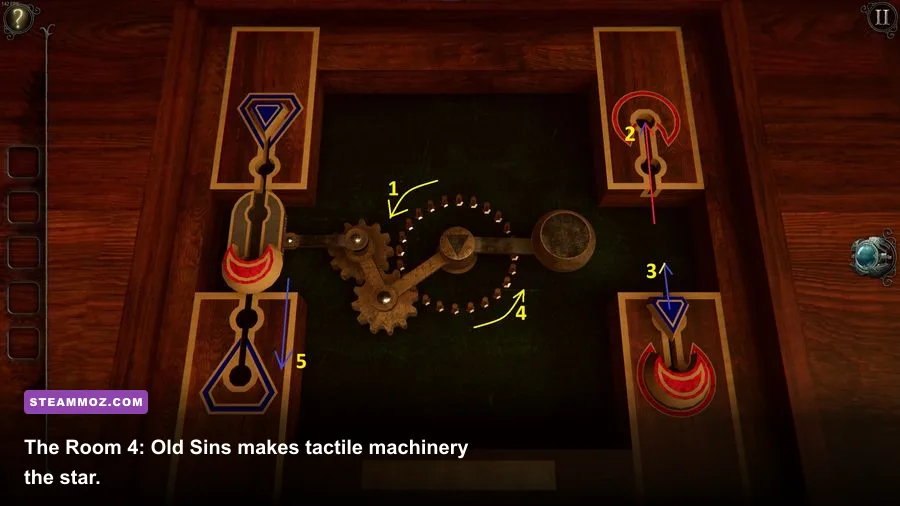
The Room 4: Old Sins is the most immediately satisfying game on this list. Its setting—a dollhouse found in an engineer's attic—gives every puzzle a physical presence. You rotate brass mechanisms, slide panels, align lenses, pull hidden levers, and use the eyepiece to reveal details that ordinary vision misses. The best puzzles feel like miniature engineering projects rather than abstract keypad exercises.
The central object is the dollhouse, which expands into multiple rooms and transforms as you solve its mechanisms. That design creates a clean progression curve. Early locks teach you to inspect seams and moving parts. Later sections combine several mechanisms, requiring you to remember what changed in one room while investigating another. The game rarely overwhelms you with more than one major interaction at a time, so it is an excellent first stop for players who found ENIGMA's puzzles appealing but occasionally too cryptic.
Pay attention to tactile feedback. A mechanism that clicks but doesn't open may have completed only one stage. Rotate objects slowly, especially when using the eyepiece, because some symbols are visible only from a specific angle. The hint system is also unusually well judged: it gives a nudge rather than immediately revealing the sequence.
| Player Type | Recommended Approach | Common Mistake | Best Tool |
|---|---|---|---|
| New puzzle player | Inspect every movable surface before using an item | Searching for a key instead of a mechanism | Eyepiece |
| Experienced player | Track room changes after each major solution | Ignoring previously visited compartments | Manual notes |
| Completionist | Revisit the dollhouse after each chapter | Assuming every secret is on the critical path | Slow camera rotation |
Old Sins is shorter and more linear than Lorelei, but that's part of its appeal. You can finish it in a weekend, and almost every puzzle has a clear physical language. Players who prefer atmospheric horror can also compare its environmental storytelling with Steamoz's thoughts on Layers of Fear, although The Room is far more puzzle-focused and much less interested in sudden scares.
3. Obduction Is ENIGMA With a Bigger Horizon
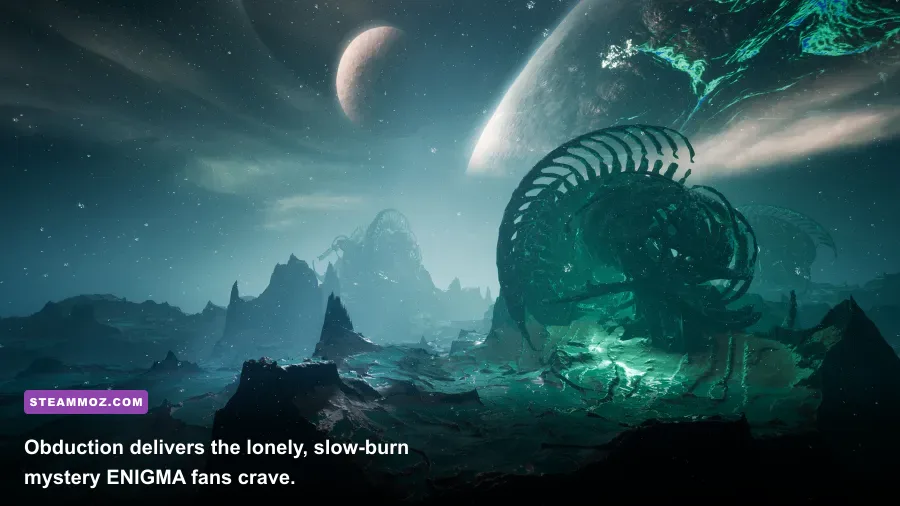
Obduction, from Myst developer Cyan, takes the classic first-person adventure formula into alien territory. You wake near a strange machine after a mysterious abduction, then explore environments that connect through portals, power systems, rails, and transport devices. It is a slower game than ENIGMA, but the payoff is bigger: you aren't simply opening a cabinet; you are learning how an entire world operates.
The game's strongest puzzles are systemic. A machine in one zone may alter access in another. A route that seems blocked may become available after you understand the area's power network. This makes observation more important than reflexes. Write down gate symbols and take screenshots of unfamiliar control panels. Obduction occasionally asks you to remember a visual pattern from a location you visited an hour earlier, and its sparse interface won't rescue you if you forget.
There are two major things to know before buying. First, movement and loading can feel dated compared with newer Unreal Engine adventures. Second, the game sometimes mistakes obscurity for mystery. If you're allergic to backtracking, choose The Room 4 instead. But if you love the moment when a huge environment suddenly clicks into place, Obduction is still one of the strongest alternatives available.
On modern PCs, use a solid-state drive if possible and cap the frame rate to the refresh rate of your display. This is not a competitive game; stable frame pacing matters more than chasing 144 frames per second. Players looking for more exploration-heavy recommendations may also enjoy Steamoz's Central Intelligence recommendations, particularly if the appeal of ENIGMA is its sense of hidden systems rather than pure horror.
4. The Talos Principle 2 Delivers the Best Logic Puzzles
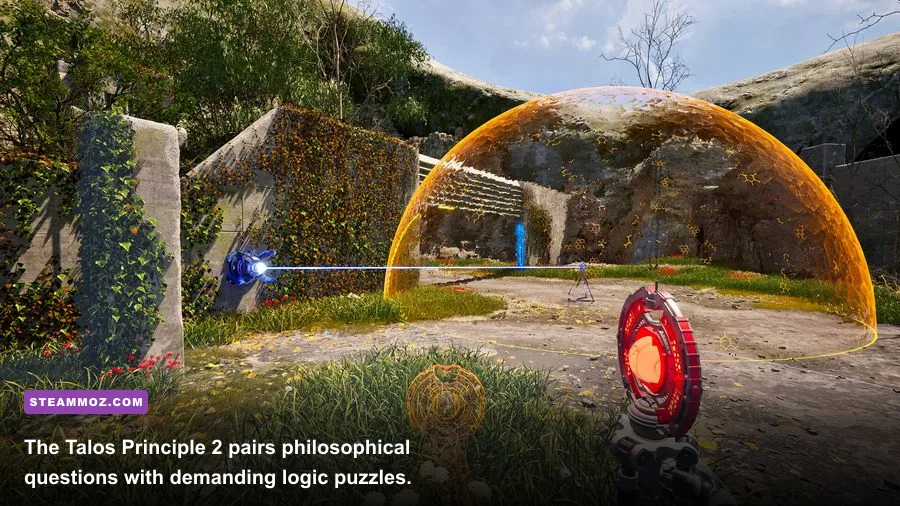
The Talos Principle 2 is the choice for anyone who wants ENIGMA's puzzle-solving satisfaction but needs more structure, scale, and mechanical variety. You play as 1K, a new android exploring a world built by the remnants of humanity. The story deals with identity, progress, and whether a society should repeat the mistakes of its creators, but the real star is the puzzle design.
The standard toolkit includes connectors, fans, jammers, RGB converters, teleporters, and a drill. A connector can carry a laser signal between a source and receiver, but later puzzles require you to chain devices, cross colored signals, manage line of sight, and preserve a route through moving elements. The game teaches each mechanic in isolation before combining them, which produces a smoother learning curve than many open-ended puzzle adventures.
Don't rush to solve every puzzle the moment you see it. Each region contains optional challenges and additional golden puzzles that become easier after you acquire more knowledge. If a room seems impossible, look for the intended order: move the fan first, create a temporary signal, or use a device as a bridge rather than as the final solution. The game rewards elegant solutions, but it doesn't always require the shortest one.
| Tool | Primary Function | Strongest Combination | Typical Failure |
|---|---|---|---|
| Connector | Transfers colored laser energy | Connector plus RGB converter | Breaking line of sight |
| Jammer | Disables barriers and certain devices | Jammer plus movable block | Using it before positioning the block |
| Fan | Launches objects or the player | Fan plus connector timing | Entering the launch path too early |
| Drill | Creates openings in specific walls | Drill plus signal routing | Assuming every wall is drillable |
| RGB Converter | Combines or changes laser colors | Two sources plus connector chain | Mixing colors without checking receivers |
The Talos Principle 2 is also the easiest recommendation here to tailor to different players. You can adjust field of view, subtitles, motion blur, and several accessibility options, while its large regions give you room to step away from a puzzle. Visit the official Steam page for The Talos Principle 2 for the current PC specifications and platform details.
5. Return of the Obra Dinn Is the Purest Deduction Game
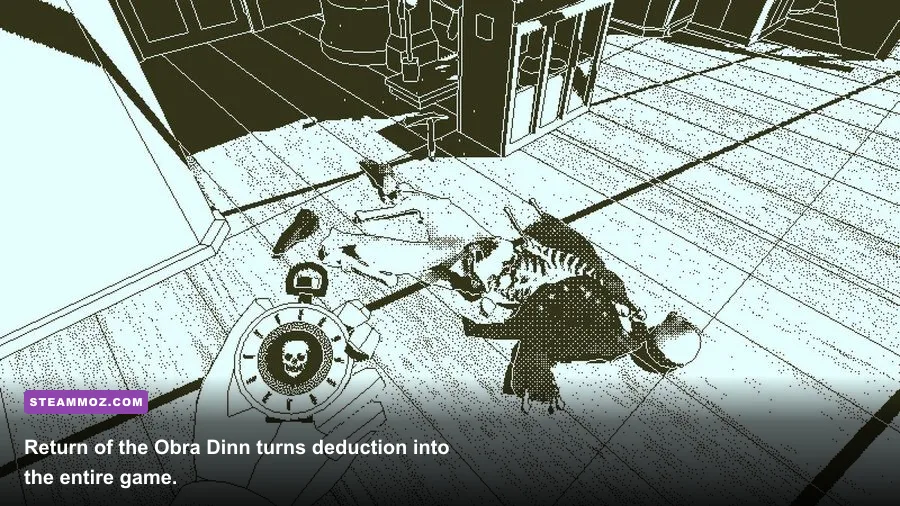
Return of the Obra Dinn strips away almost everything except evidence. You are an insurance investigator boarding a ship whose crew has vanished or died. Your pocket watch lets you revisit the moment of each death, freeze the scene, listen to the final seconds, and inspect the people present. From there, you identify names, roles, nationalities, causes of death, and the chain of events connecting one scene to another.
The monochrome 1-bit art is more than a visual gimmick. It limits detail in a way that forces you to focus on silhouettes, uniforms, accents, weapons, and positioning. You won't win by clicking every body until the game gives up. You need to build a case. If three crew members share a nationality, their spoken language and clothing may help identify all of them. If a sailor appears in multiple memories, compare scars, hats, and where they stand on the ship.
Use the book constantly. Mark tentative answers, then revisit them when a later memory adds evidence. The game confirms deductions in groups of three, but that doesn't mean a confirmed trio was guessed randomly; it means your broader theory is probably coherent. Avoid reading character lists or walkthroughs online. Obra Dinn is one of the few puzzle games where a spoiler can erase the entire point.
For players who enjoy investigative structure more than supernatural atmosphere, this is arguably the best game like ENIGMA on the list. The official developer site for Lucas Pope also provides useful context about the game's unusual visual direction and design philosophy.
6. Viewfinder Turns Photographs Into Level Geometry
Viewfinder is the most mechanically original recommendation here. Its central rule is wonderfully easy to understand: take a photograph, place that image into the world, and watch the pictured geometry become real. A photograph of a staircase can create a staircase. A picture of a wall can fill a gap. Perspective determines how the object is reconstructed, so the same image can produce very different results depending on where you place it.
The game builds its puzzles around that idea with a clear escalation. Early levels teach you to create missing platforms. Later rooms ask you to manipulate camera position, rotate photographs, preserve limited images, and combine objects that exist in two-dimensional pictures with the three-dimensional level around them. There are also rewind-style interactions that let you recover from a bad placement without restarting the entire chapter.
Viewfinder is less mysterious than ENIGMA and more openly playful. Its story about scientific research, memory, and perception provides mood, but the puzzles are the main event. Choose it when you want clever visual problems and a brisk campaign rather than a bleak investigation. It is also the safest recommendation for players who dislike inventory management and extensive backtracking.
Try solving each room by identifying the required destination first. Ask what surface needs to exist, then find the simplest photograph that supplies it. Many players waste time hunting for a perfect image when a rotated, imperfect one will work. The game is about spatial relationships, not making a pretty composition.
Which ENIGMA Alternative Should You Play First?
The short answer is simple: choose Lorelei and the Laser Eyes for atmosphere and layered clues, The Room 4 for tactile puzzle boxes, Obduction for large-scale exploration, The Talos Principle 2 for sophisticated logic, Return of the Obra Dinn for deduction, and Viewfinder for a genuinely new mechanic.
| Priority | Best Pick | Why It Wins | Who Should Skip It |
|---|---|---|---|
| Closest ENIGMA mood | Lorelei and the Laser Eyes | Surreal hotel, documents, codes, layered mystery | Players who dislike taking notes |
| Best short campaign | The Room 4: Old Sins | Excellent pacing and tactile interactions | Players wanting a large world |
| Best exploration | Obduction | World-scale systems and environmental discovery | Players who hate backtracking |
| Best logic challenge | The Talos Principle 2 | Deep tool combinations and optional puzzles | Players seeking a pure detective story |
| Best investigation | Return of the Obra Dinn | Every answer comes from evidence | Players who want conventional graphics |
| Most inventive mechanic | Viewfinder | Photographs become functional 3D geometry | Players wanting horror or heavy narrative |
One final piece of advice: don't treat these games like conventional action adventures. Turn off the instinct to sprint from objective to objective. Read the documents, inspect the machinery from multiple angles, and write down patterns before they disappear from your working memory. ENIGMA's magic comes from the instant a confusing space becomes legible, and every game here understands that feeling.
For more focused recommendations, Steamoz's guides to Dungeon Siege starter builds and Ace Combat 7 equipment cover very different genres, but they share the same principle: the right recommendation depends on what you want the game to make you think about. For ENIGMA fans, these six are the strongest places to start in 2026.