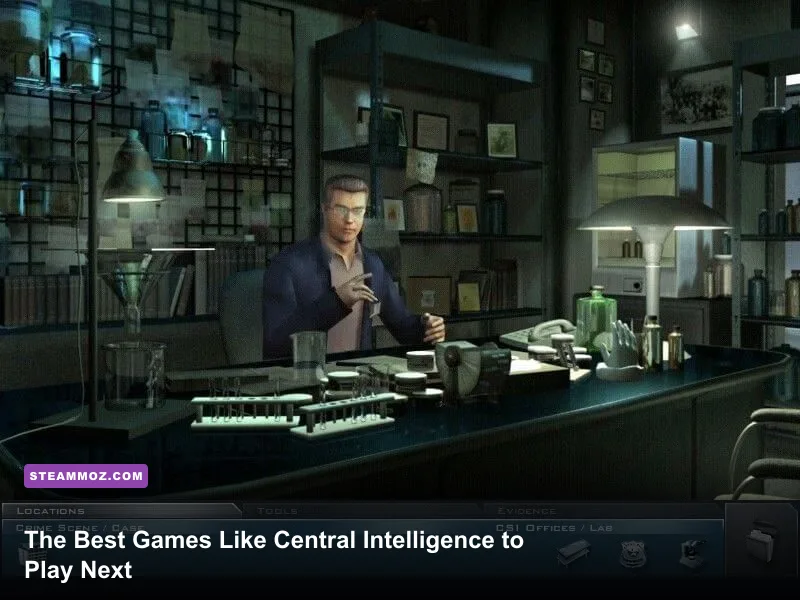
If Central Intelligence hooked you with surveillance, secret files, and the satisfaction of connecting one dangerous clue to the next, start with Orwell: Keeping an Eye On You. It is the closest match for turning a computer screen into a morally uncomfortable investigation, while The Operator, Return of the Obra Dinn, Shadows of Doubt, and Invisible, Inc. each push the same appeal in a different direction.
This isn't a list of random detective games wearing a trench coat. These recommendations are built around the specific fantasy that makes Central Intelligence interesting: you are not simply shooting spies or following quest markers. You are collecting fragments, testing assumptions, tracking people, and deciding how much of the truth you can actually trust. Some picks focus on narrative deduction; others add hacking, procedural crime scenes, or turn-based stealth. All of them respect the player's ability to notice patterns.
What makes a great Central Intelligence alternative?
The key question is whether the game lets you interpret information instead of merely receiving it. A standard detective adventure may hand you a clue, play a musical sting, and point toward the next room. The strongest alternatives make you decide whether a photograph matters, whether a suspect's timeline holds together, or whether opening one more file will expose an innocent person.
That distinction separates the recommendations below. Orwell has the cleanest surveillance interface and the sharpest ethical choices. Obra Dinn is the purest deduction challenge, with almost no traditional exposition. The Operator captures the office-and-terminal atmosphere, but adds searchable databases and a more conventional campaign structure. Shadows of Doubt is less authored and more chaotic, while Invisible, Inc. turns intelligence gathering into a high-stakes strategy game.
| Game | Best Match For | Difficulty | Typical Length |
|---|---|---|---|
| Orwell: Keeping an Eye On You | Surveillance and moral choices | Moderate | 5–7 hours |
| The Operator | Computer-based investigations | Moderate | 6–8 hours |
| Return of the Obra Dinn | Pure deduction | High | 8–12 hours |
| Shadows of Doubt | Open-ended detective work | Variable | 20+ hours |
| Invisible, Inc. | Espionage strategy | High | 15–30 hours |
For a broader mystery-game mood, Steamoz's roundup of games like A Monster's Expedition is also worth a look, especially if the puzzle-solving side matters more to you than the spy fiction.

🎮 Central Intelligence
Looking to experience this game? Grab your digital key directly on our store for $1.49.
View on Steammoz Store →1. Orwell: Keeping an Eye On You is the closest fit

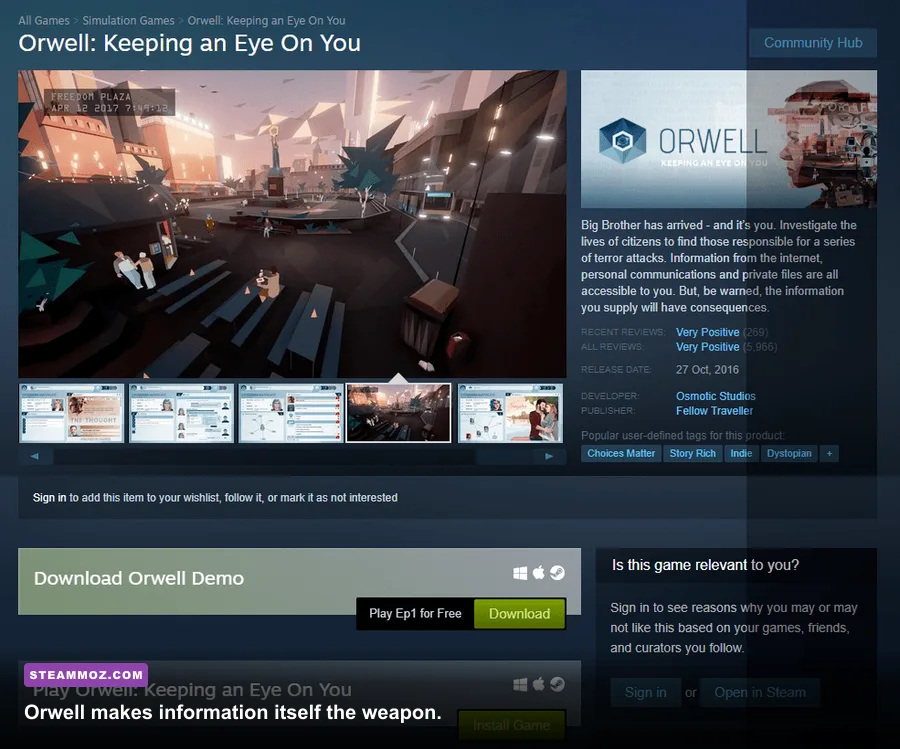
Orwell: Keeping an Eye On You understands that surveillance is most powerful when it looks boring. You work through a government monitoring system, read chats and articles, inspect social media posts, and upload selected pieces of information into a dossier. The interface is deliberately plain: windows, highlighted text, profile pages, and a stream of evidence. That restraint makes every conclusion feel like your responsibility.
The central mechanic is the distinction between relevant and dangerous information. When you find a data chunk, you choose whether to send it to Orwell. Some entries advance the investigation; others reveal private details that can damage a target's life without proving anything. The game doesn't treat every discovery as equally valid. A suspect's connection to a protest group may be true, but it doesn't automatically establish guilt.
Play it slowly. Read dates, usernames, and quoted messages instead of clicking every highlighted phrase. Orwell rewards chronology: a post from one year ago can reframe a supposedly spontaneous action, while a deleted message may explain why two people suddenly stop communicating. You don't need reflexes or an optimized build, but you do need to resist confirmation bias.
Its biggest limitation is linearity. Once you understand the investigation's intended shape, the number of meaningful conclusions is narrower than it first appears. Still, the writing, interface, and political tension make it the best first recommendation for anyone searching for games like Central Intelligence. Begin with the official Orwell Steam page if this is the exact atmosphere you want.
Why it ranks so highly
- Best feature: evidence selection that creates ethical pressure.
- Best for: players who prefer reading, tracing relationships, and making uncomfortable calls.
- Watch out for: a mostly authored structure with limited replay value.
2. The Operator turns your desktop into a spy desk
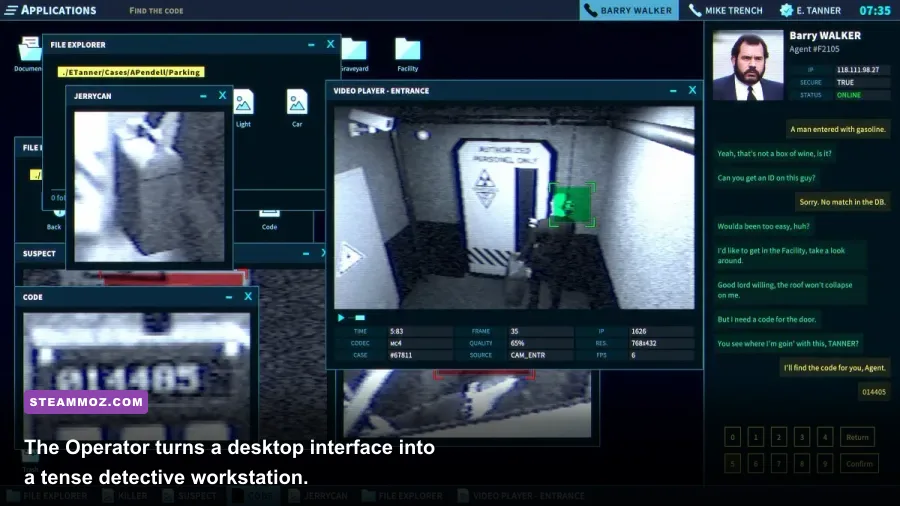
The Operator is the obvious choice if your favorite part of Central Intelligence is the feeling of working behind a monitor while someone else handles the danger outside. You act as a new operator for a covert agency, using databases and digital tools to investigate cases. The game leans into the fantasy of being the person who finds the one connection field agents missed.
Its most satisfying puzzles come from combining mundane records. A name, vehicle plate, phone number, or location can become useful when entered into the right database. The fun is not simply locating a clue; it is understanding which search will narrow the problem. If you keep throwing random terms into the system, you create noise. If you track a suspect's aliases and movements, the case begins to form a readable shape.
The Operator also has a stronger episodic rhythm than Orwell. You receive a case, examine evidence, communicate with colleagues, and occasionally deal with threats to the agency itself. That structure keeps the campaign moving, although it sometimes makes the deduction feel more guided. The game wants you to feel clever without letting you get permanently stuck.
| Investigation Tool | What It Reveals | Best Use | Common Mistake |
|---|---|---|---|
| Identity database | Aliases and personal records | Confirming who a suspect really is | Assuming a matching name is proof |
| Vehicle search | Ownership and registration links | Connecting people to locations | Ignoring shared or stolen vehicles |
| Phone records | Calls and contact patterns | Building a relationship timeline | Reading one call as a complete motive |
| Image analysis | Visual details and hidden clues | Checking backgrounds and timestamps | Missing small environmental evidence |
The tension is lighter than in Orwell, but the workflow is more interactive. It is also an excellent follow-up if you want the same screen-based format without immediately jumping into a difficult deduction marathon. Check the developer's official site for The Operator for the game's current availability and details.
3. Return of the Obra Dinn is the ultimate deduction test

If Central Intelligence appeals to the part of your brain that wants to build a case from incomplete facts, Return of the Obra Dinn is essential. You arrive aboard a merchant ship whose entire crew has vanished or died. With the Memento Mortem pocket watch, you can revisit the moment of each death, freeze the scene, inspect its surroundings, and identify what happened.
The game gives you a manifest containing the names and roles of the crew, but it doesn't tell you who died in each memory. You infer identities from accents, uniforms, friendships, rank, nationality, and where people appear in earlier scenes. The monochrome 1-bit art looks simple, yet it makes silhouettes and clothing details critically important. A topman's position in the rigging may solve a clue that dialogue never explains.
Three correct identities are usually needed before the game confirms a set of deductions. That rule prevents blind guessing and forces you to maintain a working theory. Use a notebook or spreadsheet if you enjoy the investigation; record names, locations, relationships, and possible causes of death. The game's official tools are good, but a separate timeline makes the later chapters far less intimidating.
Pay special attention to cause-of-death wording. “Killed by a beast” is not interchangeable with “dismembered by a beast,” and “fell from the rigging” may describe the final event rather than the original attacker. Obra Dinn is demanding because it expects precision. It also has the strongest payoff on this list when a seemingly unrelated death suddenly confirms three other identities.
Purchase it through the official Return of the Obra Dinn Steam listing. Don't look up solutions unless you're genuinely stuck; spoilers erase the exact moment the investigation clicks.
4. Shadows of Doubt makes every case unpredictable
Shadows of Doubt is the right pick if you want Central Intelligence's investigative fantasy expanded into a living city. Its procedurally generated environments contain apartment blocks, offices, shops, security systems, citizens, schedules, fingerprints, phone records, and hidden rooms. You play a private investigator who must locate suspects, gather proof, and close cases before the trail goes cold.
The game's greatest strength is that information exists in physical space. You can break into an apartment, inspect a wall safe, follow a target through the rain, search a workplace desk, or check a security terminal. A fingerprint can connect a suspect to a crime scene, but it doesn't automatically explain motive. An address may lead to the wrong person if you haven't checked aliases and employment data.
Start each murder case by photographing the crime scene and checking every accessible surface. Look for blood patterns, weapon type, fingerprints, notes, and unusual objects. Then use the city directory to search addresses and employment records. The best investigators build a chain of evidence before confronting anyone; rushing to a suspect because their name appeared once can lead to a weak case and a failed arrest.
Performance depends heavily on city size and simulation activity. Lowering the voxel resolution or shadow quality can help on older hardware, but reducing simulation density may make the city feel less alive. A stable 60 frames per second is useful during chases, yet the game is primarily CPU-heavy because it tracks citizens and schedules. Close background applications before blaming the GPU.
| Setting | Recommended Value | Performance Impact | Visual Trade-Off |
|---|---|---|---|
| Resolution scale | 100% at 1080p | High | Keep native scale for readable evidence |
| Shadows | Medium | Medium | Lower settings reduce depth in alleys |
| Voxel resolution | Medium | Medium to high | Lower values make geometry chunkier |
| View distance | High | CPU-heavy | Important when tailing suspects |
| City simulation | Default | CPU-heavy | Reducing it can hurt immersion |
Shadows of Doubt is less polished than the authored games here. Bugs, awkward pathfinding, and occasional procedural nonsense are part of the package. But when a suspect escapes through a service tunnel, changes clothes, and disappears into a crowd you never thought to question, it delivers a kind of detective story no fixed script can replicate. The official Steam page has the current feature and system information.
5. Invisible, Inc. adds tactical consequences
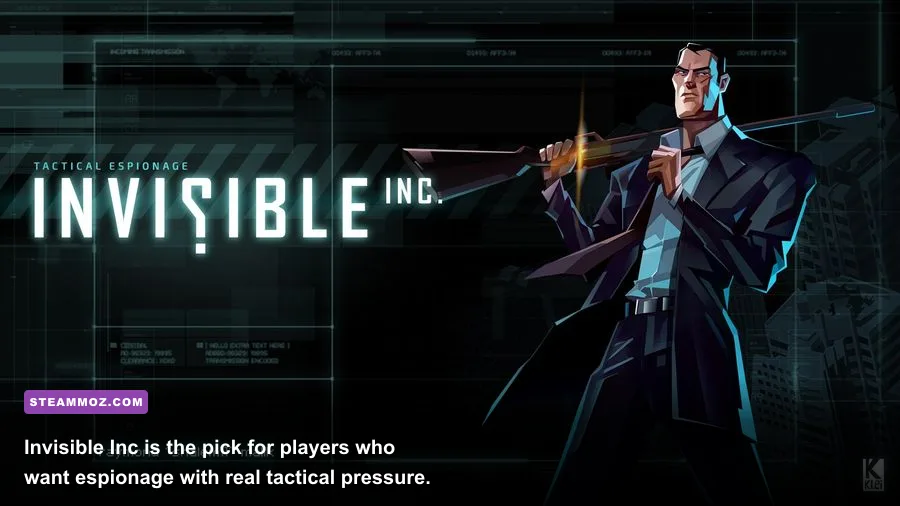
Invisible, Inc. is the recommendation for players who want intelligence gathering to matter in combat. You control agents working against corporations and security networks, moving through procedurally generated facilities while hacking cameras, manipulating alarms, and stealing technology. It is turn-based, but the pressure is constant: the alarm tracker increases each turn, and every extra search makes the next room more dangerous.
The core resource is not just health. Power fuels Incognita's programs, while PWR and cooldown management determine whether you can disable a camera, breach a database, or hide a mistake. Incognita programs such as Lockpick help open electronic security, while stronger upgrades let you manipulate the network more aggressively. Agents bring different strengths: Internationale can reveal nearby devices with her Augment, while Banks is built around infiltration and hacking.
A dependable early plan is to scout before committing. Open doors from cover, peek at camera cones, and avoid spending all your movement points until you know where the exit lies. Use Stim III when a critical turn matters more than long-term resource conservation, and don't hack every safe just because you can. The alarm system turns greed into a measurable threat.
| Approach | Key Tools | Strength | Risk |
|---|---|---|---|
| Ghost infiltration | Cover, peek, camera avoidance | Preserves resources | One mistake can expose the team |
| Network control | Incognita programs, database hacks | Disables security remotely | Consumes power and raises alarm pressure |
| Fast extraction | Run-and-gun movement, Stim III | Escapes before the facility escalates | Leaves loot and intel behind |
| Heavy hacking | Augments and upgraded breach tools | Opens high-value routes | Needs careful power management |
Unlike Central Intelligence, Invisible, Inc. doesn't let you calmly study a dossier for ten minutes. The information is useful because it changes your next move immediately. A guard's patrol route, a camera's cone, and an alarm level become tactical facts rather than narrative decoration. The game is also tougher and more replayable than the other picks, with procedurally assembled missions that can punish overconfidence.
See the developer's official Invisible, Inc. page before buying, particularly if you want to compare the base game with the Contingency Plan expansion.
Which Central Intelligence alternative should you play first?
Choose Orwell if you want the nearest match in tone and interface. It delivers the cleanest surveillance story and asks the most pointed questions about privacy. Pick The Operator if you want a more active computer-workstation campaign with databases, case files, and a stronger thriller pace.
Go with Return of the Obra Dinn if the real attraction is deduction rather than espionage. It is less comfortable, less guided, and much more rewarding when you solve a difficult chain without outside help. Shadows of Doubt is the long-term sandbox choice, especially if you enjoy generating your own stories from imperfect evidence. Finally, Invisible, Inc. is the best fit for players who want every clue to affect stealth, resource management, and survival.
| Rank | Game | Why It Belongs Here | Ideal Player |
|---|---|---|---|
| S-Tier | Orwell: Keeping an Eye On You | Closest surveillance and moral-choice match | Story-focused investigators |
| S-Tier | Return of the Obra Dinn | Best pure deduction system | Players who enjoy difficult logic puzzles |
| A-Tier | The Operator | Excellent terminal-based investigation flow | Fans of databases and casework |
| A-Tier | Shadows of Doubt | Most freedom and replayability | Sandbox detectives |
| A-Tier | Invisible, Inc. | Espionage with meaningful tactical stakes | Strategy and stealth players |
One last warning: don't judge these games by their screenshots alone. Their appeal is in the process. Orwell makes you decide what deserves to be seen. Obra Dinn makes you prove what happened. The Operator makes you search intelligently. Shadows of Doubt makes you investigate a messy world. Invisible, Inc. makes every piece of intelligence valuable because the next alarm could end the run.
That is why these are the best games like Central Intelligence to play in 2026. They don't just copy the surface details of spies, computers, or secret agencies. They understand the deeper fantasy: being the person who notices what everyone else missed.
If you also want more demanding PC recommendations, Steamoz's guides to games like AI War: Fleet Command and vampire RPG alternatives to Cabernet are strong next reads. For performance troubleshooting before you dive in, check the site's Hunt: Showdown FPS fixes as well.