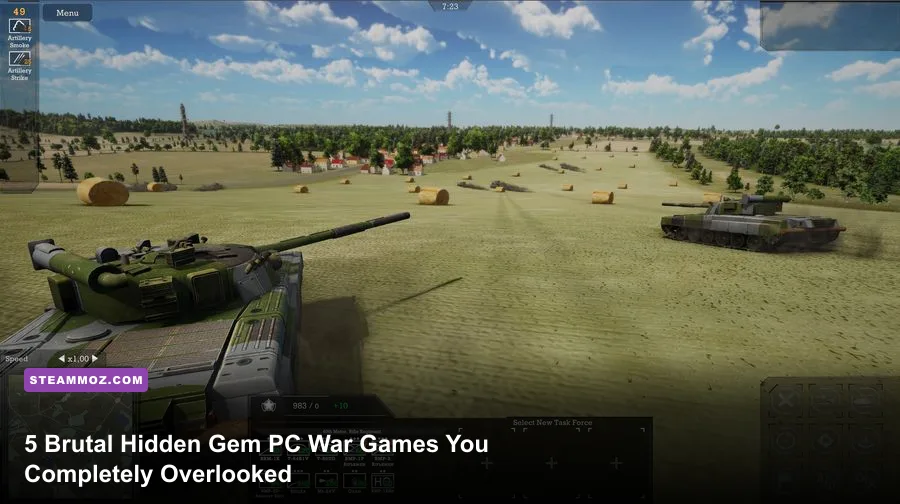
If your idea of military gaming is limited to sprint-sliding through corridors or watching scripted air support level a city block, you're missing out on the best war experiences PC has to offer. The truly unforgettable war games aren't flashy multi-million-dollar blockbusters designed to flatter your twitch reflexes; they're uncompromising, atmospheric tactical simulations developed by dedicated teams who care deeply about ballistics, logistics, and command friction. Mainstream military titles treat war like an amusement park, but hidden gem PC war games treat it like a deadly, unforgiving puzzle where a single bad reconnaissance call will wipe out an entire platoon in thirty seconds flat.
1. Regiments: Cold War Tactical RTS Without the Micro-Hell
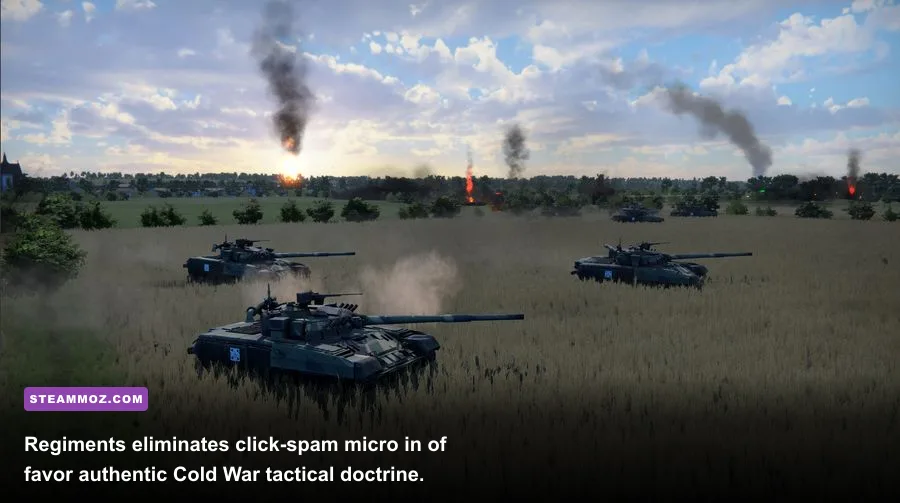
While mainstream strategy fans were busy arguing over balance patches in competitive RTS lobbies, developer Bird's Eye Games quietly dropped Regiments, and it might be the finest single-player Cold War tactical game ever made. Set in 1989 Germany across an alternate-history escalation, the game throws you into regimental-level operational warfare where you command combined-arms formations of Leopard 2s, T-72Bs, Bradley IFVs, and attack aviation.
What makes Regiments brilliant is its complete rejection of high-APM (actions per minute) micromanagement. Unlike games that force you to babysit every rifleman's reload animation, Regiments groups units into cohesive platoons. You issue doctrine-level orders: advance under fire, establish defilade positions, or pop multi-spectral smoke screens to break missile lock. If you appreciate gritty operational grit rather than arcade nonsense—the kind of mechanical immersion we analyzed when exploring Far Cry 2 PC specs and raw realism—this title hits the exact sweet spot.
The game's signature "Operations" mode runs across multi-stage combat phases. Casualties carry over, ammunition stores dwindle, and battlefield wreckage remains right where it burned. Calling in an off-map 152mm artillery strike requires precise timing; shells take twenty real-world seconds to land, forcing you to lead enemy columns based on recon data rather than real-time visual tracking. It's fluid, tense, and graphically gorgeous, running smoothly even during screen-shaking saturation bombardments where lower-spec rigs might normally stutter.
2. Graviteam Tactics: Mius-Front: Uncompromising Tactical Realism
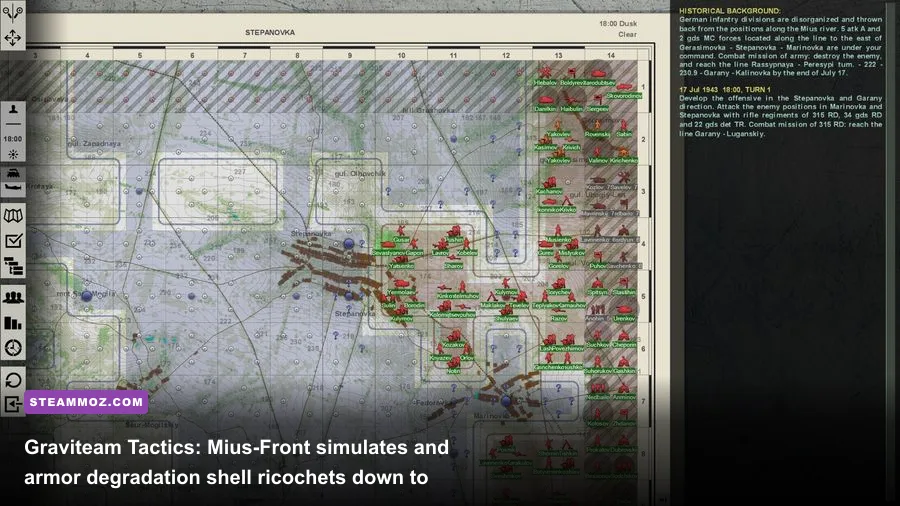
There is no gentle learning curve in Graviteam Tactics: Mius-Front. The Ukrainian development team at Graviteam built what can only be described as the most ruthlessly accurate Eastern Front simulation engine in commercial gaming. While casual players bounce off its dense, utilitarian Soviet-style interface, players who take the time to learn its systems discover an unmatched tactical masterpiece.
Combat in Mius-Front operates on two layers: an operational turn-based campaign grid and a 1:1 scale real-time tactical battlefield. When two battlegroups collide, the game constructs a photorealistic sector of the Ukrainian steppe based on real historical cartography. Armor penetration isn't dictated by an arbitrary hit-point bar; the engine calculates shell diameter, velocity, impact angle, steel Brinell hardness, and internal spalling. If a 76mm high-explosive round strikes a Panzer IV's drive sprocket at an oblique 45-degree angle, the track shatters, the suspension shears off, and the crew panics—yet the chassis remains completely intact.
Crucially, your orders don't execute instantly. Units communicate via physical field telephone lines and human runners. If an enemy mortar barrage severs your command wire or kills a messenger sprint-crossing a sunflower field, your frontline infantry squad will sit pinned in their trenches without updated orders. Much like optimizing complex sandbox performance in our guide to ELEX PC fixes that stop crashes and rescue FPS, mastering Mius-Front requires configuring your tactical mindset: turn off automatic behavior, establish overlapping fields of fire, and let defensive doctrine do the heavy lifting.
3. Radio Commander: Pure Fog of War from Behind a Desk
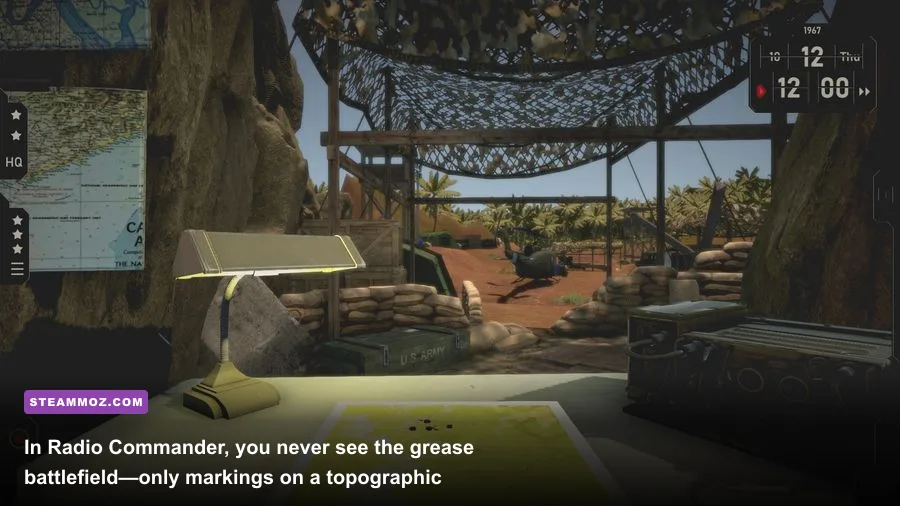
Every military RTS gives you a god-mode camera hovering 500 feet in the sky. Radio Commander completely strips that luxury away. You sit inside a sweltering military command tent during the Vietnam War. You have a radio handset, a grease pencil, a ruler, and a topographic contour map pinned to a plywood table. You cannot see your troops. You cannot see the enemy. You only know what your squad leaders yell over crackling voice frequencies.
When Alpha Platoon reports taking sniper fire from grid square Bravo-Niner, you have to physically pick up your grease pencil, find coordinates on the topographic map, and manually place a marker. Did they give accurate coordinates? Under stress, soldiers make mistakes. If you call in a napalm strike or a 105mm battery based on panicked radio chatter, you risk incinerating your own men. You find yourself listening desperately to ambient background audio through the handset—gunfire cadence, jungle foliage rustling, the panic in a voice—trying to determine if an encounter is a minor probing attack or an ambush by a full NVA company.
Managing this informational fog requires the same methodical planning needed in deep strategic micro-management titles, similar to the logistical efficiency covered in our Empires of the Undergrowth fast leveling guide. In Radio Commander, failure isn't a game-over screen caused by missing a click; it's the sickening silence on the other end of the frequency when a squad stops responding.
4. Armored Brigade: Grognard Precision in the Fulda Gap
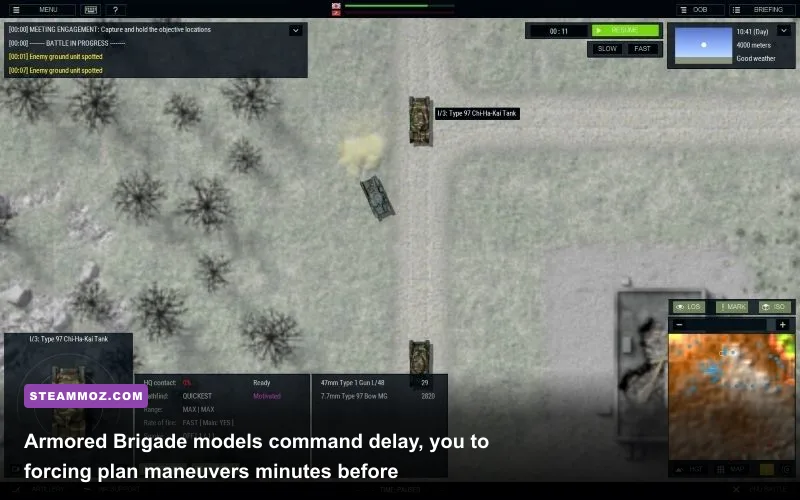
If you miss the golden era of Close Combat but want modern ballistics, real-time command friction, and maps spanning hundreds of square kilometers, Armored Brigade is mandatory playing. Focusing on a hypothetical Cold War outbreak across Central Europe, this top-down tactical sim pits NATO against the Warsaw Pact across painstakingly researched terrain sets.
The core mechanic that separates Armored Brigade from every conventional RTS is command latency. When you order an M1 Abrams troop to break cover and flank an incoming Soviet motorized rifle company, the order doesn't happen on the next game tick. Depending on training level, unit morale, battlefield smoke, and electronic countermeasures, that order incurs an execution delay ranging from twenty seconds to nearly three minutes. You cannot play reactively. You have to anticipate where the enemy's mechanized spearhead will be several minutes ahead of time.
Reconnaissance is life or death. The game models thermal sights, generation-1 night vision, and ambient weather with terrifying accuracy. If your scout vehicles fail to identify an enemy ATGM (Anti-Tank Guided Missile) battery hidden along a tree line 2,000 meters away, your multi-million-dollar tank platoon turns into flaming scrap metal before your gunners can even traverse their turrets. The sheer lethality mirrors the razor-thin margin for error highlighted in our breakdown of lethal weapon tiers and damage profiles.
| Game Title | Tactical Focus | Command Perspective | Learning Curve | Key Mechanical Hook |
|---|---|---|---|---|
| Regiments | Cold War Platoon Operations | Isometric 3D Tactical | Moderate | Zero-micro platoon control & multi-stage Operations |
| Graviteam Tactics: Mius-Front | Hyper-realistic WWII Combat | Free Tactical Camera | Extremely Steep | Microscopic armor penetration physics & physical C2 lines |
| Radio Commander | Vietnam Fog of War | First-Person Command Tent | Moderate to High | Zero visual contact; radio reports & manual map plotting |
| Armored Brigade | 1980s Combined Arms | Top-Down 2D Operational | Steep | Simulated command delay ticks & vast real-world maps |
| Carrier Command 2 | Modern Combined-Arms Naval Warfare | First-Person Physical Bridge | High | Full manual vehicle logistics, sensor screens, & drone loadouts |
5. Carrier Command 2: Modern Combined Arms from the Captain's Bridge
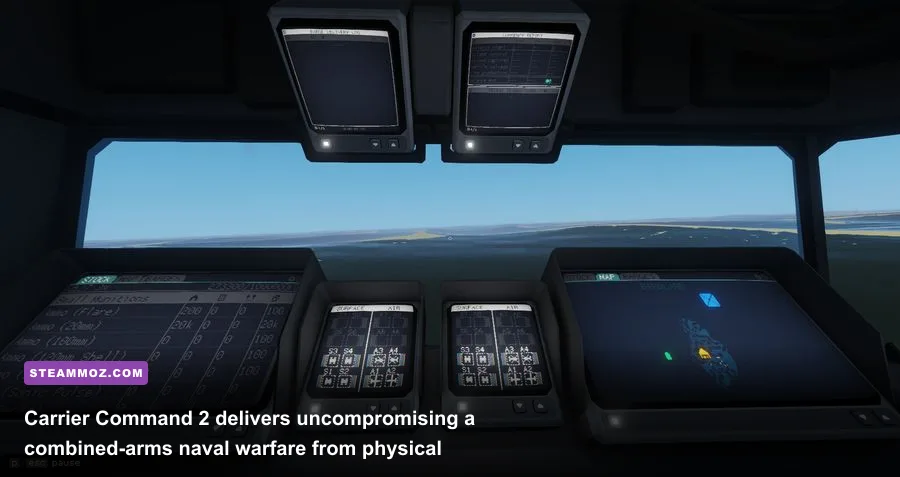
Published by MicroProse, Carrier Command 2 drops you onto the bridge of a massive futuristic aircraft carrier, demanding that you manage an archipelago-wide military campaign. You don't interact through clean menus or floating mini-maps; you physically walk around the carrier's bridge, pull levers, flip switches, and monitor radar consoles alongside your co-op crew or solo.
The magic is in the holistic logistical simulation. You don't just order an airstrike; you design the aircraft loadout. You equip an Albatross fixed-wing drone with laser-guided bombs, set up a Mantis recon drone to paint ground targets with an infrared beam, map out optimal flight altitudes to avoid radar-guided surface-to-air missile batteries, and coordinate the strike with a 100mm naval deck gun bombardment from your carrier hull. Meanwhile, an automated logistics barge must be routed between captured manufacturing islands to keep your ship stocked with aviation fuel, micro-turbines, and heavy ordnance.
The tension builds steadily as opposing enemy carriers stalk you across the open ocean. When an incoming torpedo alarm blares across the bridge, every second spent checking weapon telemetry or plotting defensive cruise missile trajectories feels electric. Managing performance while rendering wide ocean horizons and intricate ship interiors follows similar optimization principles found in our guide on tuning PC settings for maximum frame stability.
Tactical Doctrine: Core Rules for Surviving Hardcore War Games
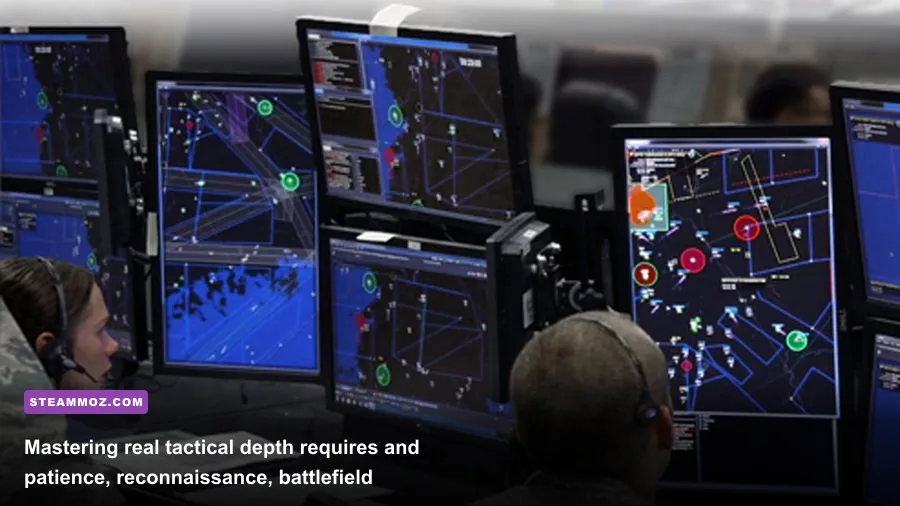
Jumping into deep PC war simulations without ditching your arcade habits will leave you frustrated within ten minutes. Mainstream titles condition you to believe that moving forward equals making progress. In authentic wargaming, aggressive blind movement is almost always suicide. To survive these titles, adapt your playstyle around four foundational tactical rules that govern genuine military engagements.
| Tactical Principle | Common Amateur Mistake | Pro-Tuned Counter-Strategy | Impact on Survival |
|---|---|---|---|
| Reconnaissance Pull | Advancing main armor blind down roads | Screen forward lines with stealthy recon infantry or drones | Prevents 90% of first-contact squad wipes |
| Defilade & Hull-Down | Parking tanks on hill crests for better view | Expose only turrets behind berms; reverse immediately after firing | Cuts incoming hit probability by up to 70% |
| Suppression Over Attrition | Holding fire until a guaranteed kill shot | Pour machine-gun & HE fire on suspect tree lines to pin targets | Destroys enemy aim and delays retaliatory strikes |
| Logistics Redundancy | Expending heavy ammo in opening skirmishes | Hold reserve munitions; designate dedicated resupply corridors | Ensures combat readiness during mid-mission counter-attacks |
These hidden gems don't cater to instant gratification. They demand patience, analytical thinking, and the willingness to learn from catastrophic tactical errors. If you've grown tired of predictable shooters with recycled annual release schedules, step away from the mainstream hype and load up one of these five masterclasses in digital warfare. Just don't say we didn't warn you when your first tank column gets eliminated from beyond visual range.