
If you want PC games with gameplay that stays sharp long after the opening hour, start with Baldur's Gate 3, Elden Ring, Hades, DOOM Eternal, Factorio, Sekiro, Red Dead Redemption 2, Portal 2, Slay the Spire, and Monster Hunter: World. They cover radically different genres, but each one has a powerful gameplay loop: meaningful decisions, readable feedback, escalating mastery, and systems that keep producing memorable moments.
This isn't a ranking based on graphics or launch-year hype. The best games here earn their place because they make ordinary actions feel deliberate. A dodge has a timing window. A weapon changes your rhythm. A factory bottleneck tells you exactly what went wrong. A card draft creates a plan you can either execute brilliantly or ruin spectacularly.
| Rank | Game | Core Gameplay Strength | Best For |
|---|---|---|---|
| 1 | Baldur's Gate 3 | Choice-driven tactical combat | Players who want freedom |
| 2 | Elden Ring | Exploration and boss mastery | Action RPG fans |
| 3 | Hades | Fast roguelike combat | Short, repeatable sessions |
| 4 | DOOM Eternal | Weapon-switching combat economy | Aggressive FPS players |
| 5 | Factorio | Automation and optimization | Systems-minded builders |
| 6 | Sekiro | Precision sword combat | Timing specialists |
| 7 | Red Dead Redemption 2 | Immersive world interaction | Slow-burn open-world fans |
| 8 | Portal 2 | Elegant puzzle escalation | Problem solvers |
| 9 | Slay the Spire | Deep deck-building decisions | Strategy players |
| 10 | Monster Hunter: World | Weapon mastery and hunts | Co-op action fans |
The Best Gameplay-First PC Games
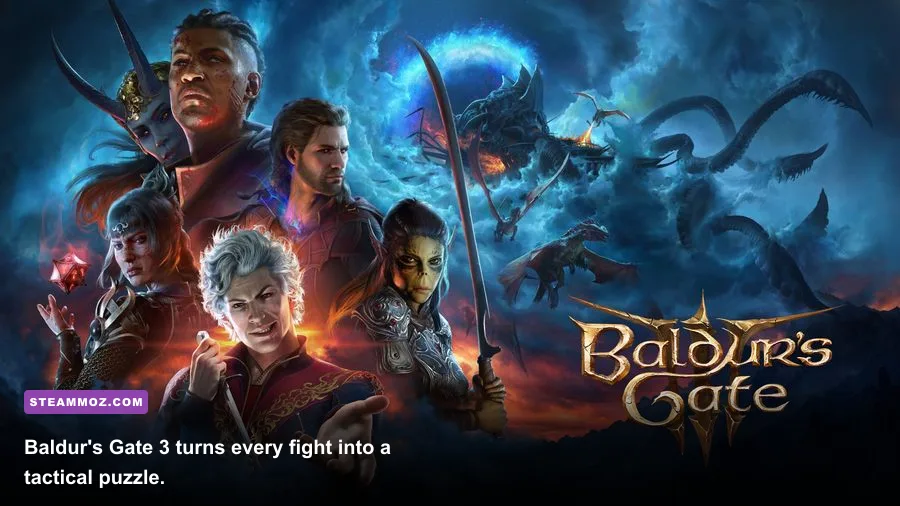
1. Baldur's Gate 3
Baldur's Gate 3 on Steam is the rare RPG where the rules are detailed enough to reward planning but flexible enough to support improvisation. Its combat uses Dungeons & Dragons 5e foundations: Action, Bonus Action, Movement, Concentration, saving throws, advantage, and resistance. That sounds technical, but the result is wonderfully physical. You can throw a Grease bottle, ignite it with Fire Bolt, shove an enemy from a ledge, or use Misty Step to reach a dangerous caster.
Build variety matters because classes feel mechanically distinct. A level-five Battle Master Fighter gains Extra Attack and maneuvers such as Trip Attack, while a College of Swords Bard turns Bardic Inspiration into mobile damage through Slashing Flourish. Meanwhile, a Circle of the Moon Druid can absorb punishment in Wild Shape without risking the same concentration-heavy setup as a wizard.
The strongest tip is to inspect the battlefield before starting a fight. High ground grants ranged accuracy, explosive surfaces create area denial, and an enemy's concentration icon tells you whether a single hit can break its spell. Don't treat dialogue as a break from gameplay; race, class, ability checks, and companion approval can completely change the next encounter. Larian's official Baldur's Gate 3 site is also worth checking for patch notes and updates.
2. Elden Ring
Elden Ring makes exploration itself a gameplay mechanic. The Limgrave map rarely tells you exactly what to do, yet landmarks, map fragments, NPC dialogue, and unusual silhouettes quietly point toward dungeons and bosses. The freedom to leave Margit, find upgrade materials, and return with a stronger build keeps difficulty from becoming a single locked gate.
Combat is built around stamina, poise, invincibility frames, and delayed enemy attacks. A common mistake is rolling as soon as a boss raises its weapon. Against Godrick or Morgott, waiting for the actual release often produces a clean dodge and a punish window. Heavy weapons can break stance faster, while frequent light attacks build status effects such as Bleed. A Blood Uchigatana paired with the Lord of Blood's Exultation talisman is a very different experience from a Strength build using the Greatsword and Lion's Claw.
Keep Vigor near 40 during the midgame and don't spread upgrade materials across six unrelated weapons. Weapon reinforcement usually matters more than a small damage increase from another attribute point. Spirit Ashes, including Mimic Tear and Black Knife Tiche, are legitimate tools, not shortcuts. For technical troubleshooting, our guide to PC crash and FPS fixes covers the kind of optimization habits that also help demanding RPGs.
3. Hades
Supergiant's Hades is the cleanest argument for trying “one more run.” Zagreus's six Infernal Arms create six different combat languages: the Stygian Blade rewards close-range timing, the Heart-Seeking Bow controls space, and the Twin Fists demand commitment. Daedalus Hammer upgrades can radically change a weapon, such as turning the Shield of Chaos into a safer ranged tool or making the Adamant Rail's Special explode.
Boons are where the build engine catches fire. Athena's Divine Dash gives defensive value and projectile reflection, Dionysus's Hangover stacks damage over time, and Artemis increases critical-hit potential. Some combinations are especially potent: Poseidon's attack knockback with Zeus's lightning adds repeated collision damage, while Demeter's Crystal Beam can control lanes during crowded rooms.
Don't restart a run because the first boon isn't perfect. Hades is designed around adaptation, and the Mirror of Night lets you tune fundamentals with upgrades such as Death Defiance, Greater Reflex, and Privileged Status. Spend Darkness on survivability before chasing flashy damage. Every death also advances character dialogue and relationship arcs, so the game constantly converts failure into new context.
Three More Games That Reward Mastery

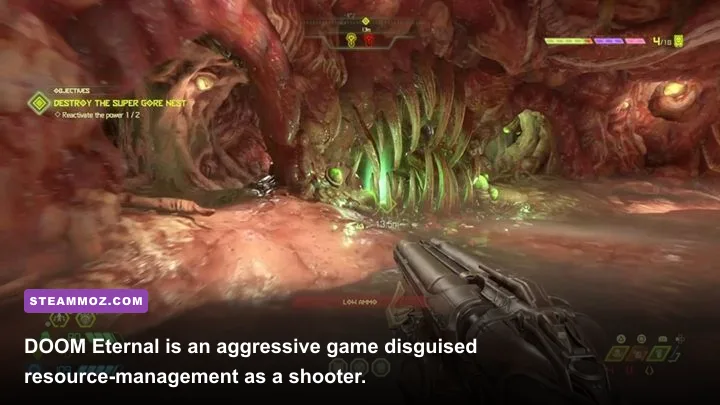
4. DOOM Eternal
DOOM Eternal is not merely a fast shooter. It's a combat economy where every demon is a moving resource. The Chainsaw restores ammunition, the Flame Belch generates armor, and Glory Kills create health. If you empty the Super Shotgun and keep firing, you aren't being aggressive enough; you're ignoring the loop that keeps the Slayer alive.
The standard rotation is practical: use the Flame Belch on a group, swap to the Super Shotgun or Ballista for priority targets, dash through danger, then Chainsaw a weaker demon when ammunition drops. The Heavy Cannon's Precision Bolt is excellent for Arachnotron turrets, while the Plasma Rifle strips energy shields. The Ballista's Arbalest mod punishes flying demons and can create breathing room in arenas such as Super Gore Nest.
Mouse sensitivity and frame rate directly affect the experience. Aim for a stable frame rate rather than a wildly fluctuating maximum, and disable motion blur if fast camera turns make targets harder to read. If you enjoy diagnosing performance issues, our FPS settings guide for Far Cry 6 explains the same texture, shadow, and resolution trade-offs.
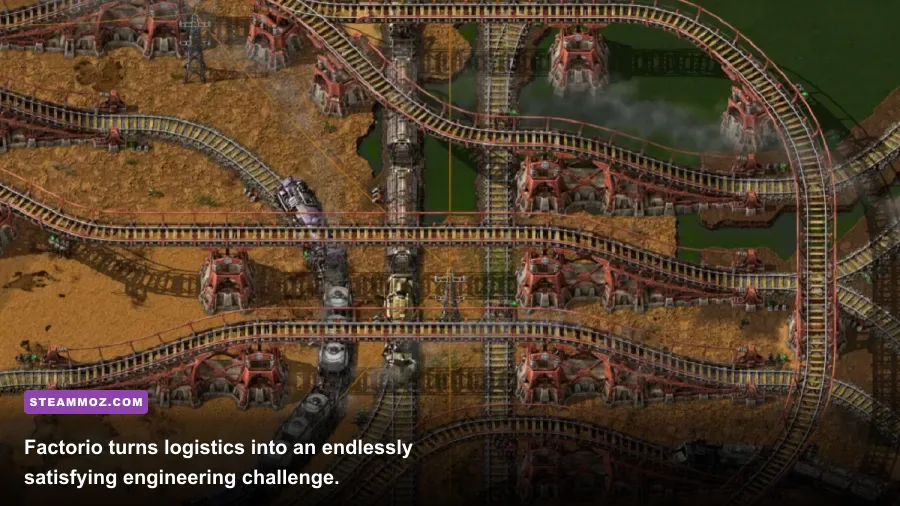
5. Factorio
Factorio begins with a burner mining drill and ends with a factory that resembles a living machine. The brilliance is that every inconvenience points toward a new system. Handcrafting becomes assembling machines, coal power becomes solar and nuclear, and scattered production becomes a rail-connected logistics network.
Start by separating your bus into predictable lanes: iron plates, copper plates, green circuits, gears, and steel. Place underground belts where you need to cross lanes, and leave room for expansion instead of packing furnaces against every available tile. A useful early ratio is 48 stone furnaces smelting iron plates from 24 electric mining drills, though actual throughput depends on belt tier, mining productivity, and module use.
Pollution and enemy evolution punish careless growth. Radar coverage shows how far your factory's influence reaches, while walls, gun turrets, and ammunition belts buy time to research stronger defenses. The real breakthrough comes when you stop patching shortages manually. Add production capacity, measure bottlenecks, and let the factory solve the problem while you work on the next one. Players who enjoy hidden systems can also browse our automation and resource-management guide.
6. Sekiro: Shadows Die Twice
Sekiro has fewer conventional builds than Elden Ring, but its combat is tighter because the game wants you to deflect rather than dodge everything. The posture meter is central: repeated perfect deflections fill an enemy's posture, and a Deathblow ends the phase. Holding block reduces posture damage taken, but passive blocking is not enough against bosses such as Genichiro Ashina.
Watch the danger kanji, then identify the follow-up. A thrust is countered by Mikiri Counter, a sweep demands a jump, and a grab usually requires distance. Genichiro's lightning attack can be reversed in the air by jumping, taking the hit, and attacking before landing. The Loaded Umbrella is useful against heavy projectiles, while the Firecrackers create short interruption windows against beasts and aggressive humanoids.
The game feels brutally difficult until you stop measuring success by health-bar damage. A boss at 90 percent health can be one deflection away from a posture break. Stay close, keep attacking until the enemy deflects, and respond instead of panic-rolling. That rhythm is the entire point, and few PC action games communicate their combat rules so honestly.
Four Deep Systems Games You Shouldn't Skip
7. Red Dead Redemption 2
Red Dead Redemption 2 is slower than the other entries, but its gameplay depth comes from interaction. Arthur Morgan's weapon maintenance, horse bonding, camp chores, hunting, and NPC encounters form a world that reacts to your habits. The guns have weight and reload animations, and Dead Eye evolves from basic targeting into a tool for marking multiple enemies and exploiting weak points.
The best way to play is to embrace preparation. Clean the Cattleman Revolver before a major mission, carry split-point ammunition for accuracy, and use the horse's weapon wheel rather than sprinting between cover with the wrong rifle. The Lancaster Repeater is versatile for medium-range fights, while the Springfield Rifle hits harder at distance but punishes missed shots.
Don't rush the story missions. Random encounters, treasure maps, legendary animals, and camp conversations are where the simulation earns its reputation. The opening hours are deliberately restrained; once the full weapon wheel, horse upgrades, and crafting systems open up, the slower pace becomes a strength rather than a barrier.
8. Portal 2
Portal 2 teaches mechanics through level design instead of dumping a manual on you. The blue and orange portals establish conservation of momentum, then the game layers in Repulsion Gel, Propulsion Gel, Conversion Gel, hard-light bridges, and Excursion Funnels. Each new tool changes how you read a room.
Think in terms of surfaces, velocity, and exit points. A portal is not just a doorway; it's a way to redirect momentum. If a chamber seems impossible, identify the final platform first, then work backward to find the launch surface. In co-op, communicate actions rather than vague intentions: “blue portal on the wall under me” is much better than “put one there.”
The puzzles are carefully paced, but the game also trusts you to notice connections. That makes it one of the best PC games for players who want challenge without combat. Its humor is memorable, yet the level design is the real star.
9. Slay the Spire
Slay the Spire turns a card game into a lesson in probability and risk management. The Ironclad can heal after combat and thrives on Strength, Exhaust, and block packages. The Silent can stack Poison or build rapid Shiv decks. The Defect manipulates Orbs, with Focus increasing Lightning, Frost, Dark, and Plasma output. The Watcher changes stance between Calm and Wrath, doubling damage but making mistakes far more expensive.
Card removal is often stronger than taking another mediocre card. A bloated deck makes key powers and defensive cards less reliable, while a focused 20-card deck can execute a plan consistently. Study the map before choosing a path: elites offer relics but require health, campfires can upgrade cards, and question marks can either rescue a run or wreck it.
Plan around the next boss, not only the current hallway fight. The Guardian punishes reckless damage cycles, Hexaghost makes your opening hand matter, and the Champ becomes dangerous below half health. Relics such as Ice Cream, Runic Pyramid, and Toxic Egg can redefine a run, but only if your deck can exploit them.
10. Monster Hunter: World
Monster Hunter: World makes preparation part of the hunt. Each of its 14 weapon types has a distinct moveset, resource loop, and positioning demand. The Great Sword is built around charged attacks and shoulder tackles; the Charge Blade switches between Sword and Shield mode and stores phials for an Amped Elemental Discharge; the Insect Glaive controls aerial movement and Kinsect buffs.
Learn monster tells instead of chasing the tail constantly. An Anjanath's head and throat glow before its fire breath, a Diablos burrows before a high-speed charge, and Nergigante's hardened black spikes increase the danger of staying in front of it. Flash Pods, traps, environmental falling rocks, and mounts create openings, but they don't replace knowing when to sheathe and heal.
Skills shape the weapon more than raw defense. Weakness Exploit increases affinity when striking weak spots, Critical Eye raises affinity directly, and Focus speeds charge-related attacks. Bring Mega Potions, Nullberries when relevant, and the correct elemental resistance. If you want another space-based game with similarly rewarding gear decisions, our weapon upgrade recommendations are a useful companion read.
Which Game Should You Play First?
Choose based on the kind of mastery you want. Baldur's Gate 3 is the best all-rounder for narrative freedom and tactical experimentation. Elden Ring is the pick for exploration and boss discovery. Hades fits players who want fast runs with constant progression, while DOOM Eternal is ideal if you want every second of combat to demand movement and weapon awareness.
| Player Preference | Best Choice | Why It Fits | First Skill to Learn |
|---|---|---|---|
| Build freedom | Baldur's Gate 3 | Classes, dialogue, and environments interact | Action economy |
| Boss combat | Elden Ring | Many viable weapons and approaches | Delayed roll timing |
| Short sessions | Hades | Runs last roughly 20–40 minutes | Dash positioning |
| Pure FPS intensity | DOOM Eternal | Weapons and resources form one loop | Quick weapon swapping |
| Creative optimization | Factorio | Every bottleneck can become a system | Leave expansion space |
| Precision combat | Sekiro | Deflection and posture replace grinding | Read perilous attacks |
| Immersion | Red Dead Redemption 2 | World systems react to your behavior | Prepare before missions |
| Puzzle solving | Portal 2 | Clear rules build toward clever solutions | Think backward from the exit |
| Turn-based strategy | Slay the Spire | Deck quality and route planning matter | Remove weak cards |
| Co-op hunting | Monster Hunter: World | Weapon roles and monster knowledge scale together | Learn attack tells |
PC Settings That Protect Gameplay Feel

Graphics settings should serve responsiveness. For action-heavy games, a stable 60 frames per second is usually more valuable than ultra shadows. In DOOM Eternal and Sekiro, inconsistent frame pacing can make aiming or deflecting feel unreliable. In Factorio, simulation performance eventually matters more than GPU settings, especially once your factory reaches thousands of active entities.
| Setting | Recommended Value | FPS Impact | Visual Trade-Off |
|---|---|---|---|
| Resolution Scale | 100%; use 90% only if needed | High | Slightly softer image below 100% |
| Textures | High if VRAM allows | Low to medium | Lower values reduce surface detail |
| Shadows | Medium or High | Medium to high | Less contact depth at lower settings |
| Volumetrics | Medium | Medium | Fog and light shafts look simpler |
| Ambient Occlusion | High or enabled | Low to medium | Scenes lose subtle grounding when off |
| Motion Blur | Off for competitive or precision play | Negligible | Cleaner camera movement |
| Ray Tracing | Off unless frame rate remains stable | High | Reflections and lighting are less accurate |
| Frame Cap | Refresh rate minus 2–3 FPS | Can improve consistency | Lower peak frame rate, steadier delivery |
Use an FPS cap that your system can hold, not one that it reaches only in empty rooms. Update GPU drivers, install games on an SSD where possible, and close overlays if a title stutters. Our FPS-first troubleshooting guide and graphics settings guide cover practical steps for diagnosing drops without blindly lowering every option.
The common thread across these ten games is not genre, budget, or camera angle. It's respect for the player's decisions. They give you systems, teach you how those systems behave, and then let you find the edge cases. That's why they remain must-play computer games: the moment-to-moment gameplay keeps revealing another layer, even after you think you've mastered it.