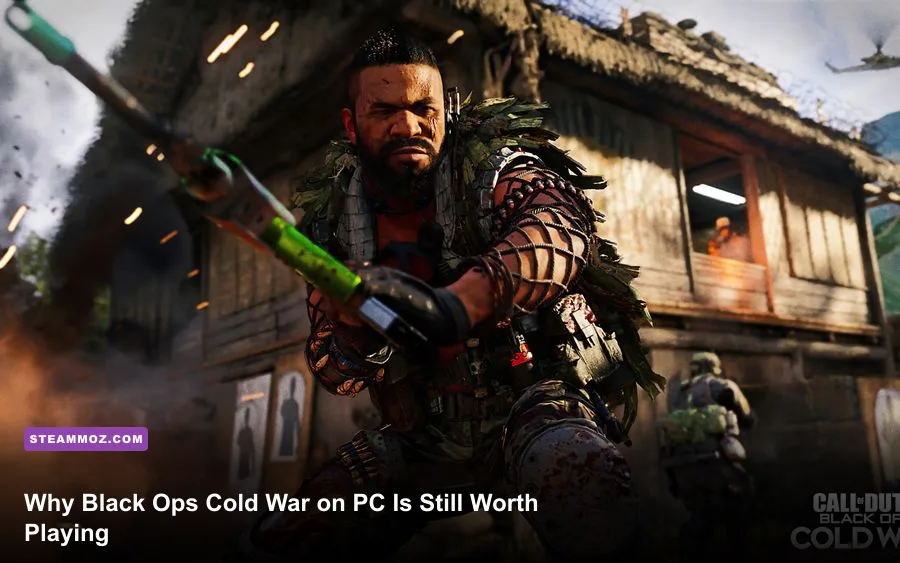
Yes, Call of Duty: Black Ops Cold War is still absolutely worth playing on PC, but only if you buy it on a steep discount and know exactly which modes to boot up. While modern entries in the franchise have doubled down on tactical sprint mechanics, clunky visual noise, and hyper-short TTK weapon balancing, Cold War stands as the last bastion of classic, arcade-speed Treyarch design. Its round-based Zombies mode is arguably the most mechanically refined offering in the franchise's history, its Raven Software-developed campaign is packed with genuine espionage puzzles, and its core multiplayer lobbies still fire off quickly—provided crossplay stays switched on.
The Campaign: Adler, Brainwashing, and Peak Black Ops Espionage
Most modern shooter campaigns are glorified two-hour tutorials designed to show off set pieces before ushering you into multiplayer queues. Cold War went the opposite direction. Raven Software handled the narrative heavy lifting here, crafting an intricate 1981 spy thriller that acts as a direct narrative sequel to the original 2010 Black Ops. Instead of running down endless linear corridors mowing down waves of nameless grunts, you spend a surprising amount of time in an abandoned CIA safehouse in East Berlin, piecing together evidence boards and speaking with handler Russell Adler.
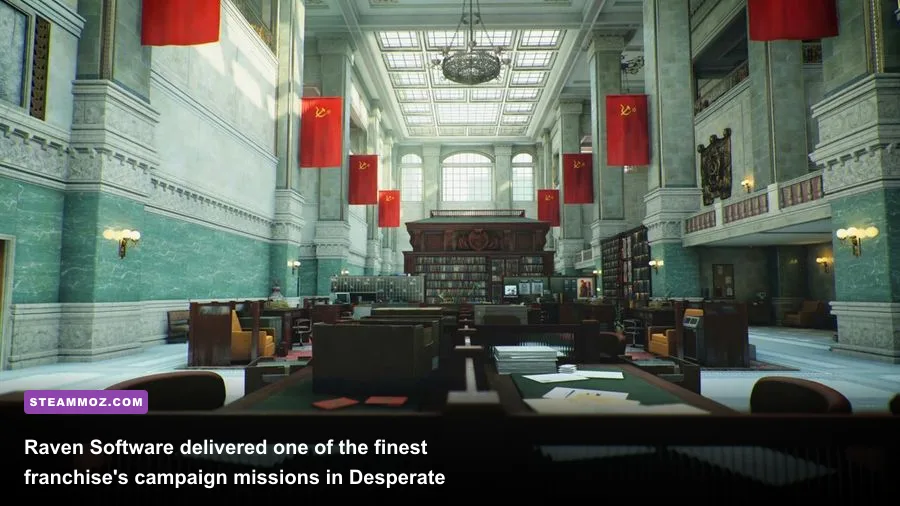
The standout set-piece, "Desperate Measures," drops you directly inside Moscow's KGB Lubyanka headquarters. Playing as double agent Dimitri Belikov, you are given an open-ended stealth sandbox with multiple paths to acquire a bunker keycard. You can poison a general's tea, frame a rival officer, blackmail a prisoner, or hack the security terminal. It feels far closer to an immersive sim like Dishonored than a mainline shooter. Much like hunting down clues in an open-ended exploration guide, the side missions "Operation Chaos" and "Operation Red Circus" actually force you to decrypt coded ciphers and analyze newspaper headlines rather than handing you answers on a plate.
The narrative reaches its peak during the mind-bending mission "Break on Through." Trapped in a psychological labyrinth of Vietnam memories, Adler commands you through a loudspeaker to enter specific doors. Defying his orders causes the environment to collapse, reset, and morph around you, brilliantly subverting player agency. With multiple branching endings—culminating in either the defense of the Solovetsky monastery or a ruthless betrayal at the Duga radar array—the campaign alone justifies a weekend playthrough if you grab the game on sale.

🎮 Cold War
Looking to experience this game? Grab your digital key directly on our store for $4.99.
View on Steammoz Store →Multiplayer Reality Check: Matchmaking Speeds, TTK, and Sandbox Balance
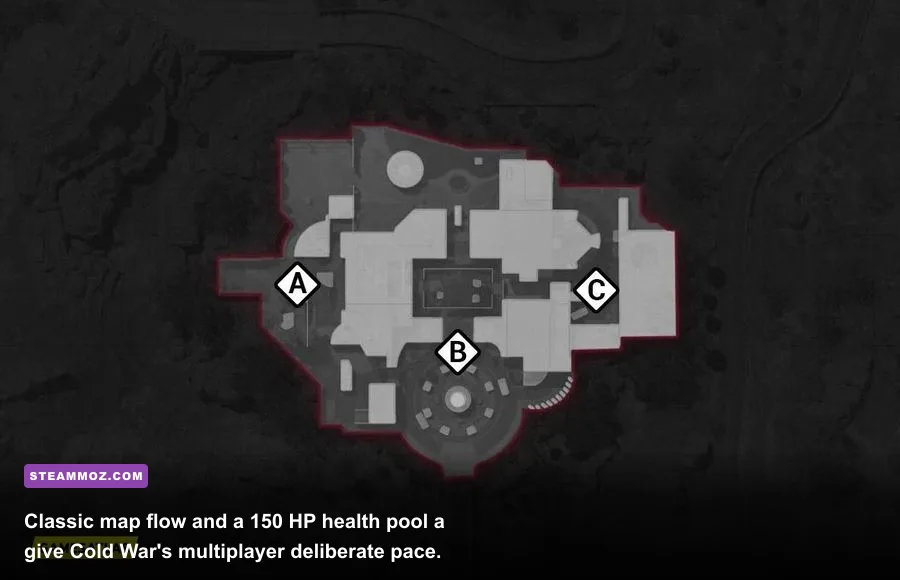
Cold War's multiplayer remains deeply divisive, but it holds a unique appeal today because it was built on an upgraded version of the classic Black Ops engine rather than the modern Modern Warfare IW engine. That means no tactical sprinting, no mounting on doorframes, and no doors to slam open and shut. Movement is brisk, slides cover predictable distances, and jump-shot momentum doesn't feel erratic. Crucially, the health pool is locked at 150 HP, pushing average time-to-kill (TTK) into the 300ms to 350ms territory. You actually have time to react, turn on an opponent, and break a camera angle with superior tracking aim.
What does the active multiplayer player base look like right now on PC? Thanks to crossplay spanning Battle.net, Black Ops Cold War on Steam, PlayStation, and Xbox, finding matches in core playlists takes under a minute. Core Team Deathmatch, Domination, Hardpoint, and the perpetual Nuketown '84 24/7 mosh pit remain instantly accessible throughout peak evening hours in North America and Europe. However, specialized large-scale modes like Fireteam Dirty Bomb and Combined Arms (12v12) are effectively dead outside of scheduled weekend community events.
The weapon sandbox settled into a mostly stable meta after its final balance patches, though certain legacy outliers dominate sweaty lobbies. If you enjoyed running classic loadouts like those in our breakdown of iconic arcade weapons ranked, Cold War's armory feels immediately familiar. Submachine guns with rapid fire rates and assault rifles with clean iron sights rule every lane.
| Weapon Name | Weapon Class | Base TTK (150 HP) | Recoil Stability | Current Lobby Viability |
|---|---|---|---|---|
| AK-74u | Submachine Gun | 258 ms | Exceptional | S-Tier (Dominates mid/close ranges) |
| Krig 6 | Assault Rifle | 312 ms | Laser Beam (Virtually zero climb) | S-Tier (Competitive standard rifle) |
| LC10 | Submachine Gun | 300 ms | Low Vertical Drift | A-Tier (Out-ranges most ARs) |
| TEC-9 (Full Auto) | Submachine Gun | 240 ms | Moderate Horizontal Kick | S-Tier (Highest DPS in close quarters) |
| Stoner 63 | Light Machine Gun | 276 ms | Heavy Initial Jump | B-Tier (Lethal lane holder, slow ADS) |
| Swiss K31 | Sniper Rifle | One-Shot (Chest/Head) | High Handling Speed | A-Tier (Aggressive quickscoping pick) |
Cheating is a fair concern for any older shooter. Activision's server-level Ricochet anti-cheat is technically functional in Cold War, but it receives fewer heuristic updates here than in active flagship titles. You will occasionally run into blatant wallhackers or spin-bots in Search and Destroy, but casual respawn modes (TDM and Domination) remain remarkably clean. If a lobby feels suspicious, back out to the main menu and re-queue; match finding is swift enough that dodging problematic lobbies takes less than 30 seconds.
Treyarch's Modern Zombies Masterpiece
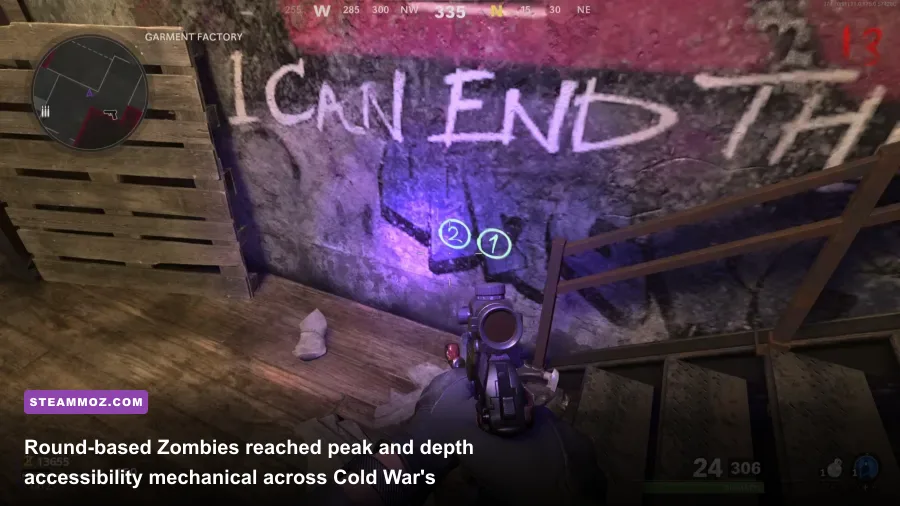
If you have zero interest in campaign narratives or sweaty multiplayer lobbies, Cold War is worth installing for one reason alone: its Zombies mode. Historically, Treyarch Zombies could be notoriously hostile to newcomers, demanding obscure twenty-step YouTube tutorials just to turn on the power switch or unlock a Pack-a-Punch machine. Cold War dismantled those barriers without sacrificing hardcore mastery, creating the most replayable round-based experience since Black Ops 3.
Across four primary round-based maps—Die Maschine, Firebase Z, Mauer der Toten, and Forsaken—the flow of combat is electric. Every weapon you bring into a match has dynamic rarity tiers (Common to Legendary) alongside three traditional Pack-a-Punch levels. Combined with an in-game scrap crafting table that lets you build armor vests, self-revives, monkey bombs, and air support killstreaks, the survival loop offers constant progression throughout high-round runs.
The progression system is anchored by permanent Aetherium Crystal upgrades. By completing main Easter eggs, surviving high rounds, or calling in an exfil helicopter, you earn Raw, Refined, and Flawless Aetherium Crystals. You spend these in the main menu to permanently upgrade weapon classes, field upgrades, and every single perk up to Tier V. For example, upgrading Juggernog to Tier V doesn't just increase your maximum health; it grants armor restoration on fatal hits and reduces armor durability loss. Deadshot Daiquiri at Tier V increases critical damage by 10% on consecutive hits, turning automatic weapons into precision meat grinders.
For PC players, the quality-of-life additions cannot be overstated. Playing solo allows you to cleanly pause the game at any moment to step away—a feature bizarrely absent in several subsequent franchise entries. The Wonder Weapons are creative powerhouses: Mauer der Toten's CRBR-S transforms into four unique energy weapons on the fly, while Forsaken's Chrysalax morphs seamlessly between an axe that restores armor on melee kills and a rapid-fire crystal rifle. Beyond standard maps, the open-world Outbreak mode delivers expansive vehicle exploration across massive Ural Mountain maps, offering a slower-paced cooperative loop that remains endlessly relaxing with friends.
PC Port Health: Optimization, Stutter Fixes, and Modern Hardware
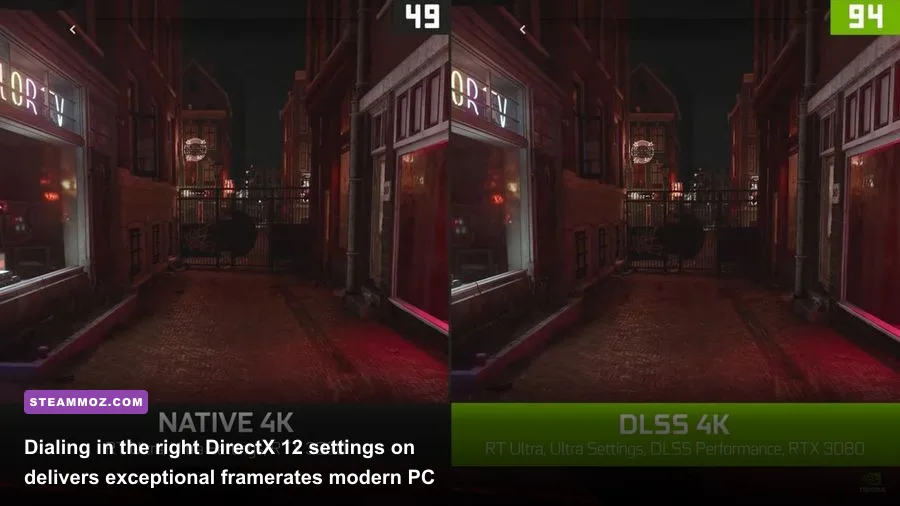
Developed by Beenox, the PC port of Cold War was notoriously demanding and prone to fatal DirectX errors when it launched in late 2020. However, years of client patches and mature graphics drivers have transformed it into a silky, high-refresh-rate performer on modern hardware. Unlike checking historical legacy system requirements like those in our look at Far Cry 2 PC specs, Cold War takes full advantage of modern multicore CPUs and high-bandwidth GDDR6 VRAM.
The biggest performance trap in Cold War is its ray tracing implementation. The game includes ray-traced ambient occlusion, sun shadows, and local shadows. Enabling all three will utterly crush your framerate—often slashing performance by 45% to 55%—while providing negligible visual upgrades during fast-paced gunfights. Disabling ray tracing entirely and utilizing Nvidia DLSS or AMD FSR on "Quality" mode allows even modest modern GPUs (like an RTX 3060 or RX 6700 XT) to hold 140+ FPS easily at 1440p resolution.
If you encounter random stuttering or crashing issues, the culprit is almost always the game's internal VRAM target setting. By default, Cold War attempts to allocate 80% to 90% of your GPU's video memory, which frequently collides with Windows background processes. Just like implementing proven performance tweaks in our guide for Elex PC fixes that rescue your FPS, adjusting Cold War's configuration file works wonders. Navigate to your player config file in Documents\Call of Duty Black Ops Cold War\player\config.ini, locate the line video_memory = 0.8, and adjust it downward to 0.65. This reserves ample overhead for the system, completely eliminating transient stutter during intense Zombie rounds.
| Graphic Setting | Competitive Recommendation | Framerate Impact | Visual Fidelity Trade-Off |
|---|---|---|---|
| Ray Tracing (All Options) | Disabled | Extreme (~45% gain when OFF) | Imperceptible in fast motion; cleans up visual clutter |
| Texture Quality | High (VRAM Permitting) | Negligible (<2% FPS cost) | Retains sharp weapon models and operator gear |
| Shadow Quality | Medium | Moderate (~8% FPS gain) | Softens harsh shadows; improves enemy visibility in corners |
| Screen Space Reflections | Low / Disabled | Moderate (~6% FPS gain) | Removes oily floor reflections that distract tracking aim |
| Nvidia DLSS / AMD FSR | Quality Mode | Massive (~25-35% boost) | Sharper temporal stability than native TAA |
| Field of View (FOV) | 100° to 105° | Minor (~4% FPS cost) | Dramatically expands peripheral vision without fisheye warp |
For players trying to extract every single frame out of their display panels, pairing these engine settings with external GPU driver optimizations can unlock tournament-grade smoothness, similar to the process used in our guide on settings for maximum FPS.
The Storage Tax and Purchase Strategy
Before rushing to hit the purchase button, you need to prepare for the game's brutal storage footprint. Fully installed with High-Resolution Assets, Campaign, Multiplayer, and Zombies, Cold War can balloon past 175 GB on your SSD. Fortunately, both the Battle.net launcher and the Steam client support modular installation via the Activision Support portal management tools. If you only plan to play Zombies and Multiplayer, you can untick the Campaign and High-Resolution Asset packs to shrink the footprint down to a manageable 90 GB to 105 GB.
Never pay the standard $59.99 retail price for Cold War today. Activision routinely runs franchise publisher sales across Steam and Battle.net, cutting the price by 67% down to $19.79. At twenty bucks, the sheer volume of content provided—a stellar 6-hour campaign, hundreds of hours of peerless round-based Zombies, and a functional, responsive multiplayer arcade—makes it an exceptional value compared to modern releases that feel incomplete at launch.
If you're exhausted by the bloated tactical design choices of recent shooters and miss the era of snappy 150 HP gunfights, classic mini-map red dots, and legendary Zombies survival, Call of Duty: Black Ops Cold War on PC still earns its spot on your hard drive. Check the patch notes on the official Treyarch development portal to see how the meta was left, grab a squad, and dive into Mauer der Toten—you won't regret it.