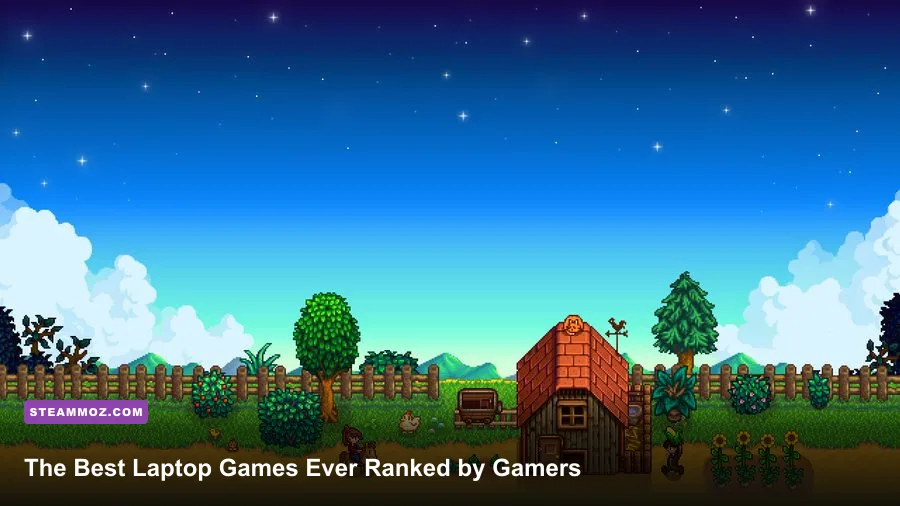
If you want the best games to play on a laptop, start with Minecraft, Stardew Valley, Hades, Portal 2, and The Witcher 3. They offer the strongest mix of replay value, community approval, controller and keyboard support, scalable graphics, and performance across everything from an integrated-GPU ultrabook to a modern gaming laptop.
This ranking weighs long-term player reception, Steam review history, critical reputation, replayability, input flexibility, and how well each game scales on laptop hardware. A game that runs at 240 fps but has nothing left to say after six hours isn't beating a classic that still owns your weekends a decade later.
S-Tier laptop games that belong on every PC
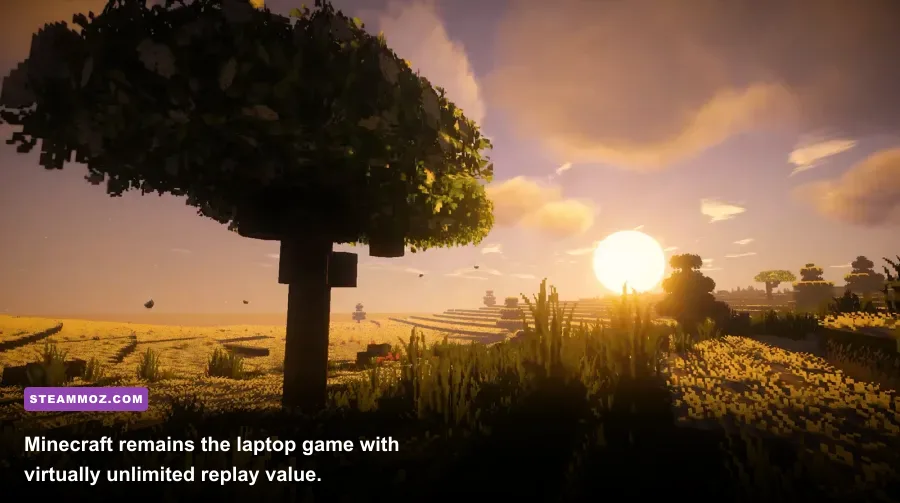
S-Tier means more than “good.” These are games you can recommend without knowing someone's favorite genre, available storage, or exact laptop model. They run well, remain easy to revisit, and have systems deep enough to reward hundreds of hours.
| Rank | Game | Why gamers keep returning | Laptop profile |
|---|---|---|---|
| 1 | Minecraft Java/Bedrock | Infinite building, survival, mods, servers | Integrated graphics to gaming laptop |
| 2 | Stardew Valley | Relaxing progression with surprising depth | Almost any modern laptop |
| 3 | Hades | Fast combat, meaningful runs, excellent writing | Low-end friendly at 60 fps |
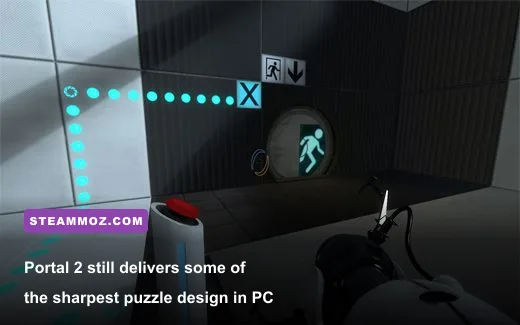
| 4 | Portal 2 | Perfect puzzle pacing and co-op | Very modest hardware |
| 5 | The Witcher 3 | Exceptional quests and a huge open world | Best on a GTX 1650-class laptop |
1. Minecraft is still the most complete laptop game
Minecraft takes the top spot because it can be a peaceful farming game, a technical engineering sandbox, a terrifying survival adventure, or a competitive multiplayer platform. The basic loop is wonderfully readable: collect wood, craft tools, mine for iron and diamonds, reach the Nether, then decide what “finishing” even means.
The exact edition matters. Java Edition offers the strongest modding scene, shader support, and server variety, while Bedrock Edition generally delivers smoother performance and cross-play. On a laptop with Intel UHD or Iris Xe graphics, use 8 to 10 render-distance chunks, simulation distance around 6, clouds off, particles decreased, and VSync enabled. Sodium, Lithium, and FerriteCore can dramatically improve Java performance, although you should download mods from trusted sources.
The technical ceiling is just as impressive. Redstone farms, villager trading halls, Ancient City expeditions, and Nether highways create goals long after the Ender Dragon is defeated. Keep render distance realistic: 32 chunks looks impressive in screenshots but can hammer CPU frame times when explored terrain loads in. Minecraft is also the easiest game here to make your own.
Check the official Minecraft download page before buying the wrong edition, and see our hidden-rewards guide if exploration is what keeps you playing.
2. Stardew Valley turns routine into an art form
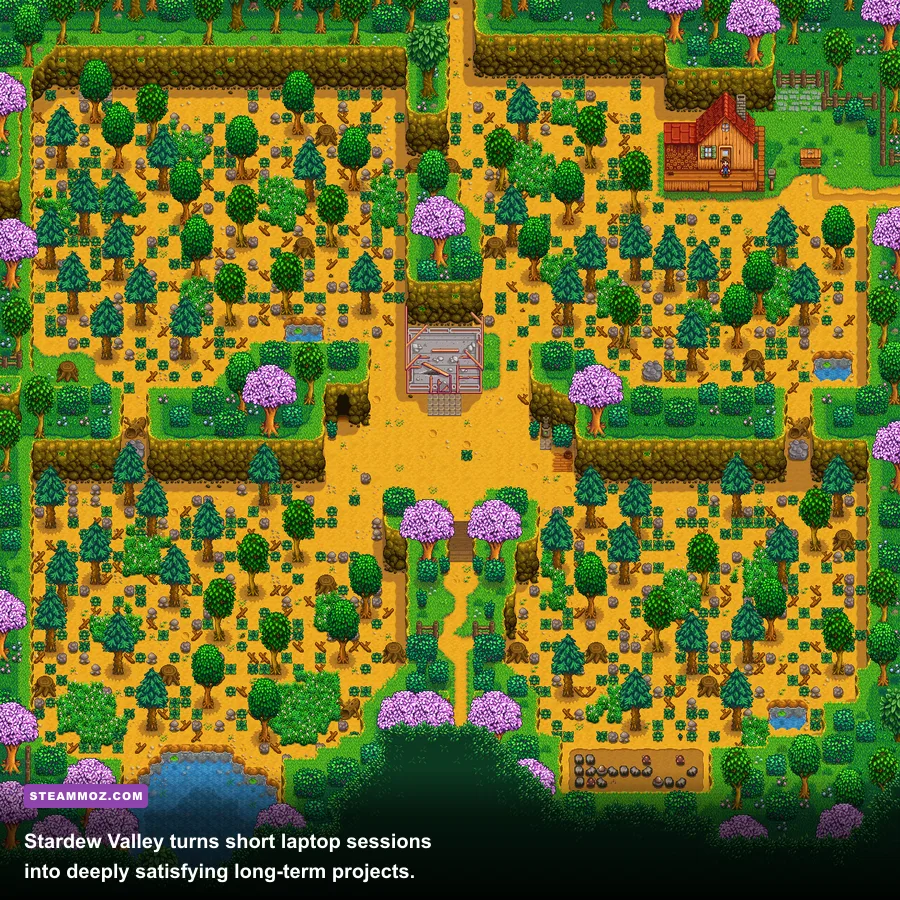
Stardew Valley is deceptively precise. The first spring teaches you to plant parsnips, fish, forage, and meet Pelican Town's residents, but its deeper systems reward planning every in-game minute. Crops have fixed growth times, tool upgrades consume both money and days, and the Community Center bundles force you to engage with fishing, mining, animals, and seasonal foraging.
A strong first-year plan is simple: upgrade the watering can before a rainy day, plant Kale in Spring, Blueberries in Summer, and Cranberries in Fall, then use quality sprinklers to reclaim your mornings. The Iridium Band, unlocked through the Adventurer's Guild after collecting 50,000 monster loot value, combines light and magnetism and remains useful throughout the game. In the mines, bring food instead of hoarding it; a field snack or cheese is worth more than a failed run that costs you the day.
There is no reflex tax, no punishing frame-rate requirement, and no “wrong” farm that ruins your save. The 1.6 update added new items, festivals, mastery progression, and late-game goals without damaging the cozy core. Multiplayer also works beautifully on laptops because farming tasks divide naturally between players.
🎮 1bitHeart
Looking to experience this game? Grab your digital key directly on our store for $2.99.
View on Steammoz Store →A-Tier classics with specific strengths
A-Tier games are outstanding, but each has a narrower audience or a more obvious limitation. They may demand a particular genre preference, more storage, a stronger GPU, or tolerance for repetition. None are compromises; they simply aren't as universal as the five above.
| Rank | Game | Best feature | Main limitation |
|---|---|---|---|
| 6 | Hades | Responsive room-to-room combat | Runs can feel repetitive before the story peaks |
| 7 | Terraria | Boss progression and crafting depth | Early progression is poorly signposted |
| 8 | Slay the Spire | Almost perfect deck-building decisions | Visual presentation is intentionally minimal |
| 9 | Balatro | Wildly flexible poker-based builds | Easy to lose an entire evening |
| 10 | Disco Elysium | Writing and role-playing freedom | Almost entirely dialogue-driven |
3. Hades is the best action game for short sessions
Hades makes the roguelike loop feel generous. Zagreus's escape attempts last roughly 20 to 40 minutes, but even a failed run gives you Darkness, Nectar, Titan Blood, gemstones, or story progress. The combat is built around clear priorities: dash through danger, use your cast to control space, and spend your Boons creating a coherent build rather than grabbing every shiny icon.
The safest early weapon is the Shield of Chaos, especially with the Chaos Aspect. Hold Block to absorb frontal damage, release Bull Rush for a gap-closing strike, and use your Special to tag distant targets. The Adamant Rail is faster but demands disciplined reload timing. For beginners, Athena's Divine Dash is one of the strongest defensive Boons because it reflects projectiles and turns many rooms into controlled counterattacks.
Heat changes the game's texture after your first clear. Extreme Measures upgrades boss fights, Tight Deadline pressures your route speed, and Forced Overtime makes enemies faster. Don't stack difficulty randomly. Add Pact modifiers that challenge your weakness while keeping your preferred weapon intact. Hades runs excellently at 60 fps on modest hardware, and stable frame pacing matters more than ultra shadows.
See the official Hades page for the developer's details, then tune your laptop profile using the same performance logic discussed in our FPS settings guide.
4. Terraria is Minecraft's combat-focused cousin
Terraria ranks above most 2D sandbox games because its progression is built around bosses rather than decoration alone. The Eye of Cthulhu, Eater of Worlds or Brain of Cthulhu, Skeletron, and Wall of Flesh form a clear pre-Hardmode ladder. After the Wall falls, Hardmode introduces new ores, biome threats, wings, and mechanical bosses that completely change preparation.
Use arenas, not flat ground. Platforms spaced about 10 to 12 blocks vertically give you room to jump over the Eye of Cthulhu's charges, while Campfires and Heart Lanterns provide sustained regeneration. The Hermes Boots and a grappling hook are more valuable than a small damage upgrade because mobility prevents damage before armor has a chance to matter. Once Hardmode begins, immediately break demon or crimson altars carefully and search for Cobalt or Palladium gear.
5. Slay the Spire, Balatro, and Disco Elysium reward patience
Slay the Spire is the purest strategy game on this list. The Ironclad's Burning Blood heals 6 HP after combat, the Silent starts with two extra cards, and the Defect's Orbs create an entirely different rhythm. The most important advanced skill is deck removal: a smaller deck makes your best attacks, powers, and defensive cards appear more often. Don't treat every Elite fight as mandatory; route around them when your health or deck is not ready.
Balatro replaces combat math with poker math. Flushes are easy to understand, but high-scoring runs come from Jokers that multiply one another, such as Blueprint, Brainstorm, and economy pieces that let you reroll the shop. Disco Elysium is the opposite experience: its 24 skills turn failure into content. Failing a skill check can open a stranger, funnier, or darker route, so don't reload every time the dice disagree with you.
B-Tier picks that are still absolutely worth installing

B-Tier doesn't mean mediocre. These games miss the top two tiers because of age, hardware demands, a steeper learning curve, or a more specialized appeal. For the right player, any one of them may be the personal number one.
| Game | Best for | Recommended laptop target | Why it remains relevant |
|---|---|---|---|
| Age of Empires II: Definitive Edition | Competitive strategy | Modern integrated graphics | Huge civilization roster and active multiplayer |
| RimWorld | Emergent storytelling | 8 GB RAM, strong CPU | Every colony creates memorable disasters |
| Factorio | Automation and optimization | Integrated graphics, fast CPU preferred | Endless production-line mastery |
| Left 4 Dead 2 | Co-op shooters | Nearly any gaming laptop | Excellent pacing and Workshop support |
| Vampire Survivors | Low-effort power trips | Very low-end hardware | Ridiculously addictive 30-minute runs |
RimWorld deserves special attention because its story generator is more convincing than many scripted campaigns. A colonist with the Pyromaniac trait may set fire to your dining room during a raid, while a wounded prisoner can become a valuable doctor after recruitment. Prioritize batteries, a freezer, bedrooms, and a reliable power source before chasing luxury. In Factorio, automate iron plates first, then copper, green circuits, and ammunition. Hand-crafting is a temporary bridge, not a strategy.
Age of Empires II: Definitive Edition is still a superb laptop RTS because matches remain readable at 1080p and the civilizations have distinct technology trees. Learn one opening rather than ten: three villagers to build a house and lumber camp, then maintain constant villager production while scouting sheep and enemy resources. Meanwhile, Left 4 Dead 2 remains the easiest co-op recommendation for four friends, thanks to the AI Director's pacing and the Workshop's enormous map library. The official Steam listing still reflects the game's remarkably active community.
The best demanding laptop game is The Witcher 3
The Witcher 3 ranks fifth overall but wins the heavyweight category. Geralt's adventure delivers more than 100 hours of quests, the excellent Hearts of Stone expansion, and Blood and Wine's huge Toussaint region. Its best writing appears in side quests such as “The Bloody Baron,” “The Last Wish,” and “The Towerful of Mice,” where choices rarely collapse into obvious good and evil.
Build around Quen early. The basic sign absorbs one hit, while active Quen converts stamina into a protective regeneration effect; that safety net is more useful than chasing raw sword damage while learning enemy patterns. Apply Necrophage Oil against drowners and ghouls, Hanged Man's Venom against humans and nonhumans, and use Tawny Owl to accelerate stamina regeneration when sign-heavy combat is your style.
On a gaming laptop, target a locked 45 or 60 fps rather than unstable ultra settings. HairWorks is one of the first options to disable, followed by foliage visibility range. Keep textures on High if your VRAM allows it; lowering textures often hurts image quality more than turning down shadows. The Complete Edition's recommended PC specification officially lists a GTX 1070 for higher settings, but a GTX 1650 laptop can produce a good 1080p experience with sensible compromises.
| Setting | Recommended value | FPS impact | Visual trade-off |
|---|---|---|---|
| Resolution | 1920x1080 | Baseline | Sharp image on most laptop panels |
| Textures | High | VRAM use, little frame-time cost | Keep armor and surfaces detailed |
| Foliage visibility | Medium | High CPU/GPU savings | Grass pops in sooner |
| HairWorks | Off | Moderate to high savings | Less detailed fur and hair |
| Shadows | Medium | Moderate savings | Softens distant shadows |
| Frame limit | 60 fps or 45 fps | Improves consistency | Less heat and fan noise |
Read the official Witcher 3 page for edition details. If your laptop struggles with older PC ports, our PC crash and FPS fixes are also useful troubleshooting references.
How to choose the right game for your laptop

Don't choose by genre alone. Choose by the constraint you actually have. If battery life matters, Stardew Valley, Slay the Spire, Balatro, and Vampire Survivors are obvious winners. If you need a game that survives years of evening sessions, Minecraft, Terraria, RimWorld, and Factorio offer the deepest long-term loops. If you want a cinematic single-player campaign, The Witcher 3 is the clear pick, provided your GPU is strong enough.
| Laptop situation | Best choice | Target settings | Expected experience |
|---|---|---|---|
| Integrated graphics and 8 GB RAM | Stardew Valley or Portal 2 | 1080p, medium to high | Stable 60 fps in most scenes |
| Integrated graphics and 16 GB RAM | Minecraft or Terraria | Moderate render distance, no heavy shaders | Comfortable sandbox play |
| GTX 1650 or RTX 2050 | Hades or The Witcher 3 | 1080p medium to high | 60 fps in Hades, 40-60 in Witcher 3 |
| RTX 3060 or better | Witcher 3 or heavily modded Minecraft | High settings, DLSS where available | High-refresh gaming with headroom |
Also watch thermals. Laptop GPUs often throttle when the chassis gets saturated, so a stable 45 fps can feel better than a nominal 70 fps that collapses during combat. Plug in for demanding games, lift the rear edge slightly, clean blocked vents, and use a sensible fan profile. For Minecraft, monitor CPU usage during chunk generation; for Witcher 3, monitor GPU temperature and VRAM. A cooling pad won't perform miracles, but airflow and a frame cap can prevent the ugly late-session slowdown.
For more laptop-focused reading, compare our Far Cry 2 PC requirements breakdown and the Filament performance settings guide. They reinforce the same rule: identify the bottleneck before lowering every option blindly.
The final verdict on the all-time rankings
Minecraft is number one because it adapts to almost any player and almost any laptop. Stardew Valley follows because its progression is warm, smart, and endlessly replayable. Hades is the best pure action game, Portal 2 remains the safest puzzle recommendation, and The Witcher 3 delivers the richest open-world RPG if your hardware can handle it.
Start with the game that matches your available time. Pick Hades for focused runs, Stardew Valley for a daily ritual, Portal 2 for a brilliant weekend, and Minecraft or Terraria when you want a hobby rather than a campaign. That flexibility is why these games keep appearing in gamer rankings years after release—and why they still deserve space on your laptop today.