
If Iratus: Lord of the Dead hooked you with disposable undead, grotesque dungeon management, and turn-based battles where stress can be deadlier than damage, start with Darkest Dungeon, Legend of Keepers, and The Last Spell. They are the closest 2026 alternatives, but Othercide delivers the sharpest combat, while Loop Hero best matches Iratus's addictive build-and-rebuild loop.
One quick clarification matters: Iratus's full game is officially titled Iratus: Lord of the Dead, while Wrath of the Necromancer is its major expansion. This list is aimed at that complete experience, including the fantasy of raising minions, sacrificing failures, and turning a losing run into a stronger next attempt. Every recommendation below earns its place for a specific reason rather than simply being another gloomy roguelike.
How These Iratus Alternatives Actually Compare
Iratus sits in an unusual space. It isn't just a dungeon crawler, and it isn't simply a Darkest Dungeon clone. You manage a base, harvest corpses and mana, craft equipment, and assemble a party of undead creatures whose roles are defined by anatomy and psychology. A Skeleton is a reliable front-line bruiser, a Lost Soul attacks from range, and a Banshee turns fear into a tactical weapon. The best alternatives reproduce at least two of those pillars: positional turn-based combat, resource pressure, dark-fantasy presentation, or a meaningful meta-progression layer.
| Game | Closest Iratus Feature | Learning Curve | Best For |
|---|---|---|---|
| Darkest Dungeon | Stress, formation, permanent losses | Very high | Players who want psychological attrition |
| Legend of Keepers | Dungeon defense and monster management | Medium | Players who prefer traps and preparation |
| The Last Spell | Wave defense and permanent progression | High | Tactical combat specialists |
| Othercide | Turn-based battles and sacrifice | High | Players chasing precise combat |
| Loop Hero | Death-powered progression loop | Medium | Buildcraft and experimental runs |
There is also a useful difference in pacing. Iratus often asks you to make a campaign-level decision before a fight: heal a creature, dissect it for resources, or preserve it for the next room. Darkest Dungeon makes the same pressure more emotional through stress and afflictions. Legend of Keepers makes it managerial. The Last Spell turns it into a nightly emergency. That distinction should decide your first purchase more than the screenshot style.
If you like learning complicated systems one mistake at a time, Steam's official Iratus Steam page is the best reference point for the original mechanics. For broader turn-based survival planning, our starting build guide for Warhammer 40,000: Inquisitor Martyr covers the same satisfying habit of planning around long-term power rather than one heroic encounter.
🎮 Iratus: Wrath of the Necromancer
Looking to experience this game? Grab your digital key directly on our store for $3.74.
View on Steammoz Store →S-Tier Picks for Iratus Fans

1. Darkest Dungeon
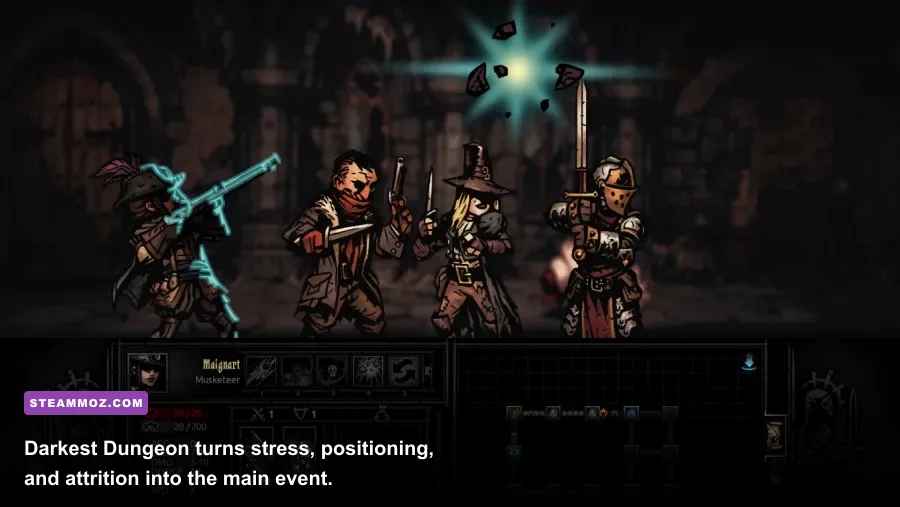
Darkest Dungeon is the obvious recommendation, but obvious does not mean lazy. Red Hook's game is the blueprint for stress-based party survival. Your roster of heroes enters locations such as The Ruins, Weald, Warrens, and Cove, then fights through rooms where light level, hunger, traps, and curios constantly tax the expedition. A Vestal can stabilize a group with Divine Grace, while a Highwayman can open with Point Blank Shot from rank one and use Grapeshot Blast to pressure multiple targets.
The crucial difference from Iratus is that your units are not disposable undead. A level-five hero with upgraded armor and weapons represents a serious investment, and losing one to a heart attack or a badly timed stun hurts. Stress begins at 0 and rises through attacks, darkness, traps, and failed actions; at 100, a hero tests their resolve and may develop an affliction or gain the rare Virtue state. That creates a more volatile combat rhythm than Iratus's predictable minion roster.
Build around role compression. A Plague Doctor using Blinding Gas and Battlefield Medicine can stun the back ranks while clearing bleed or blight. Pair that with a Man-at-Arms using Defender to redirect damage and Bolster to improve party reliability. Don't enter the Darkest Dungeon just because your heroes reached resolve level six; provision economy, camping skills, and quirks matter more than the number beside their names.
2. Legend of Keepers
Legend of Keepers: Career of a Dungeon Manager is the closest match if the part you loved was watching invaders collapse inside a carefully engineered dungeon. You play a manager employed by the Dungeons Company, recruit monsters, place traps, and send waves of defenders against increasingly prepared heroes. It reverses Iratus's perspective without losing the delicious cruelty.
Its combat is built around three damage families: physical, magical, and morale. A monster with strong physical output may still fail if the hero party resists its damage type or if your room order exposes it too early. Morale attacks are especially important because reducing an adventurer's morale to zero can remove them without relying on ordinary health damage. The best runs alternate direct damage, status effects, and morale pressure instead of stacking five similar monsters.
| Build Direction | Core Tools | Why It Works | Main Risk |
|---|---|---|---|
| Physical damage | High-armor monsters, bleed, physical traps | Consistent against fragile hero teams | Struggles into armor and healing |
| Magic damage | Spells, elemental monsters, resistance debuffs | Excellent against armored targets | Can collapse against magic resistance |
| Morale control | Fear attacks, morale traps, stress effects | Bypasses ordinary health totals | Slow if the team resists fear |
Pick Legend of Keepers first if you want rooms, traps, and staffing decisions more than direct battlefield movement. The official Steam listing shows its campaign and challenge structure, but the real appeal is how quickly a failed defense teaches you to stop building a one-note dungeon.
The Best Tactical Alternatives
The Last Spell
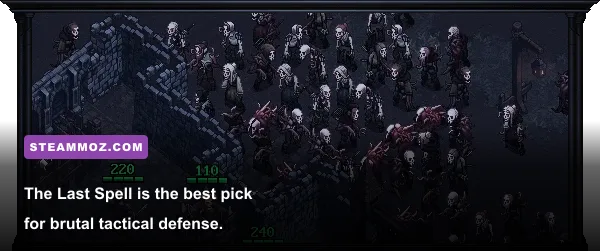
The Last Spell is the strongest choice for players who want Iratus's ruthless consequences but demand deeper tactical control. Humanity is trapped in a handful of fortified cities after magic destroys the world. During the day you repair buildings, recruit and equip heroes, and decide how to spend limited materials. At night, hordes of enemies pour through the fog, and every action point matters.
Its combat rewards movement and area denial. Heroes have action points, movement points, health, mana, and willpower, so a turn is not simply “attack the nearest monster.” A rifle user may push enemies back to protect a wall, while a melee specialist uses a momentum-heavy weapon to finish a cluster. Perks and gear can turn a hero into a critical-hit assassin, a status-effect specialist, or a durable blocker, but spreading upgrades evenly usually creates a team that is mediocre at everything.
The cleanest early priority is one dedicated crowd clearer, one ranged finisher, and one hero capable of controlling a lane. Watch the enemy preview before committing: some attacks have enough range to punish a hero who ends a turn one tile too far forward. Defensive buildings are not passive insurance either. Walls buy actions, and actions are the real currency. If you spend every turn repairing damage, your squad will eventually be surrounded.
The Last Spell is less gothic than Iratus and far more spatially demanding. It also has a longer runway before a run feels truly mastered. That makes it a superb follow-up rather than a casual substitute. Players who enjoy optimizing production chains may also like our guide to farming gold efficiently in Satisfactory; the games share that satisfying feeling of turning scarce inputs into one more powerful cycle.
Othercide
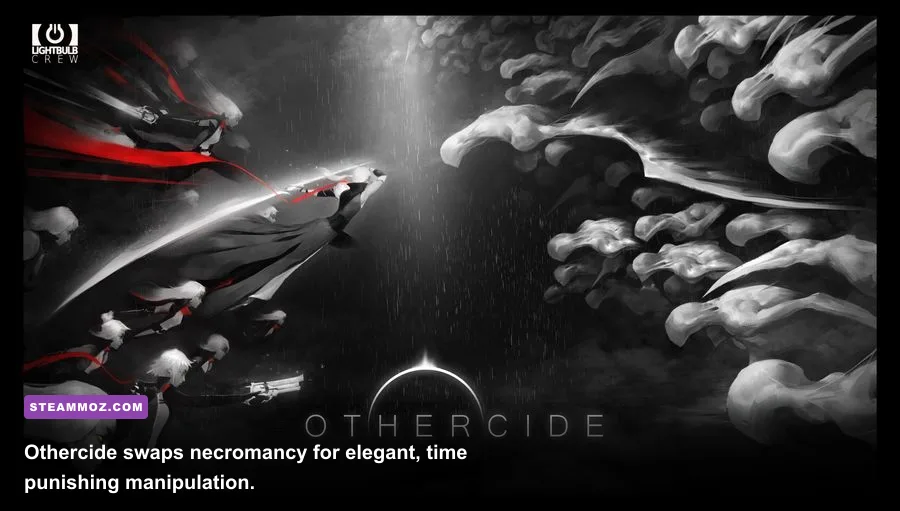
Othercide is the most stylish pick here and one of the best if your priority is combat precision. You command the Daughters, supernatural warriors fighting Nightmares through a stark monochrome world. The timeline system is the star: units act according to initiative, and certain abilities let you interrupt, delay, or manipulate upcoming turns rather than waiting for a conventional round.
The Soulstones system gives every decision a sharp edge. When a Daughter falls, she is gone, but sacrifice can also be a deliberate source of power. You may spend one Daughter to revive another or use memories and traits to create a more specialized replacement. That echoes Iratus's willingness to convert casualties into progress, though Othercide makes the loss feel much more personal.
Use a Blademaster to exploit melee damage and mobility, a Soulslinger to punish enemies from range, and a Scythedancer when you need wide-area control. The exact composition matters less than timeline discipline. Don't trigger a reaction skill just because it is available; reserve it for the enemy whose next attack would force you to spend a heal or lose a key unit. Othercide is unforgiving, but nearly every failure can be traced to an avoidable timing mistake.
Best Alternative for Long-Term Buildcraft
Loop Hero
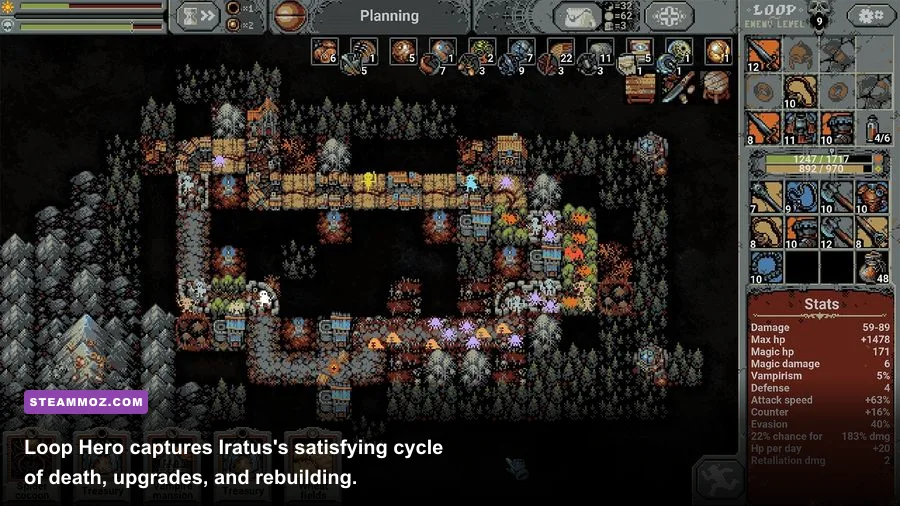
Loop Hero looks simpler than Iratus, yet its progression loop scratches the same dark little itch. The hero automatically travels around a circular expedition route while you place cards that create enemies, resources, buildings, and hazards. Every loop offers a decision: retreat with what you have, or risk another circuit for better loot and more materials.
The Necromancer class is the obvious Iratus-adjacent choice. Instead of relying on ordinary attack damage, it summons skeletons whose number, quality, and maximum level depend on your equipment and class bonuses. A build focused on skeleton power and summon quality can clear enemies safely, but it becomes vulnerable when a boss or elite outlasts the summons. Rogue and Warrior runs are more direct, while Necromancer is the best lesson in scaling an indirect army.
Card placement is where experienced players separate themselves from tourists. Put a Vampire Mansion beside a Village to create a Ransacked Village, then clear it through repeated loops to unlock a stronger support location. Place Blood Paths near battlefields to generate enemies and farm gear, but don't flood the route before your hero's healing and damage can keep up. The game is not idle; it is a controlled experiment in risk.
| Class | Primary Scaling | Best Card Synergy | Weakness |
|---|---|---|---|
| Warrior | Defense, attack speed, counter | Villages, battlefields, forests | Can be overwhelmed by elites |
| Rogue | Critical chance and evasion | Thickets, rivers, treasure cards | Damage is inconsistent early |
| Necromancer | Skeleton level and summon quality | Cemeteries, forests, river placement | Struggles when summons die quickly |
Loop Hero is also friendly to modest hardware. A locked 60 frames per second is easy on almost any modern PC, so the meaningful performance question is not frame rate but whether you enjoy indirect control. If you need more conventional character progression, our Valheim skill priorities guide covers a different but equally useful approach to choosing upgrades that improve every future expedition.
Which Game Should You Play First?
Choose Darkest Dungeon if stress, party formation, and the fear of losing an experienced character are the main reasons Iratus works for you. Choose Legend of Keepers if your favorite moment is arranging the dungeon and watching an enemy plan fall apart. Choose The Last Spell if you want the most demanding tactical combat and don't mind a steeper learning curve.
Pick Othercide for elegant initiative manipulation, dramatic sacrifice, and a campaign that expects you to think several turns ahead. Pick Loop Hero if you want the most portable-feeling progression loop, where every expedition feeds the next town upgrade and every retreat can be the correct decision.
| Rank | Game | Core Reason to Play | Who Should Skip It |
|---|---|---|---|
| S-Tier | Darkest Dungeon | Best overall match for stress and attrition | Players who dislike permanent hero losses |
| S-Tier | Legend of Keepers | Closest dungeon-management fantasy | Players wanting direct movement on a grid |
| A-Tier | The Last Spell | Deepest tactical defense system | Players seeking short, relaxed runs |
| A-Tier | Othercide | Best initiative and sacrifice mechanics | Players who dislike severe difficulty |
| B-Tier | Loop Hero | Excellent automated expedition loop | Players needing constant direct control |
Don't overlook the presentation differences. Iratus leans into corpse piles, body-part crafting, and villainous power fantasy. Darkest Dungeon is dirtier and more tragic. Legend of Keepers is knowingly comedic. Othercide is minimalist and theatrical. The Last Spell is a grim tactical sandbox, while Loop Hero turns bleak fantasy into chunky pixel-art systems design. The mood you want will decide whether a mechanically excellent alternative actually sticks.
For hardware and performance-conscious players, these games are generally lightweight, but late-run effects can still expose weak integrated graphics or background-heavy systems. Our guides to performance graphics settings and checking PC requirements explain the same practical rule: prioritize a stable frame rate and readable effects over unnecessary visual quality. In turn-based combat, consistency matters far more than chasing a benchmark number.
The Verdict for 2026
Darkest Dungeon remains the essential recommendation, but it is not automatically the best one. Legend of Keepers most closely recreates the pleasure of running a hostile dungeon, The Last Spell offers the richest tactical battles, and Othercide provides the cleanest high-skill combat. Loop Hero is the sleeper hit for anyone who loves watching a doomed run become a foundation for the next one.
Start with Legend of Keepers if you want to feel like Iratus's dungeon from the opposite side of the door. Start with Darkest Dungeon if stress and attrition are the real addiction. Whichever route you take, the common thread is clear: these games reward players who treat defeat as data. Track which status effects failed, which room order collapsed, and which upgrade arrived too late. Then build the next run around that lesson. That's the magic Iratus fans are really chasing.
For official details, compare the developers' current information through the Darkest Dungeon Steam page, the official The Last Spell listing, and Othercide on Steam. Prices, editions, and update support can change, but the core recommendation will hold: if Iratus made you enjoy losing beautifully, these are the games most likely to keep that obsession alive through 2026.