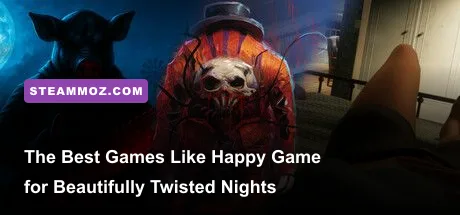
If Happy Game’s three chapters of smiling flowers, screaming toys, and nightmare logic left you wanting more, start with Fran Bow, Little Misfortune, and INSIDE. They capture the same unsettling contrast between cute presentation and emotional horror, while Samorost 3 delivers Amanita Design’s gentler puzzle craft and Darkwood supplies the survival systems Happy Game deliberately avoids.
Happy Game is a very particular kind of horror game. Released by Amanita Design in 2021, it is a compact point-and-click adventure split into three surreal chapters: a forest, a carnival-like playground, and a bedroom that feels increasingly hostile. There is no conventional combat, inventory spreadsheet, or skill tree to hide behind. You click, observe, experiment, and endure. The real hook is the collision between childlike art and grotesque imagery.
That makes “games like Happy Game” a broader search than it first appears. Some recommendations match its hand-painted visuals. Others share its wordless storytelling, disturbing transformations, tactile puzzles, or short, tightly controlled pacing. The ranking below focuses on the experience rather than superficial genre labels.
The Best Games Like Happy Game Ranked
S-Tier: Fran Bow, Little Misfortune, INSIDE. These are the closest matches for players who want a narrative built around trauma, strange worlds, and visual discomfort. Fran Bow is the strongest overall recommendation because its hallucination mechanic turns perception itself into a puzzle. Little Misfortune is more conversational and satirical, while INSIDE strips away dialogue and replaces point-and-click exploration with precise platforming.
A-Tier: Samorost 3, Darkwood, Detention. These games share Happy Game’s atmosphere and thematic confidence, but their structures differ more noticeably. Samorost 3 is whimsical rather than horrific. Darkwood is much harder and far more systems-driven. Detention leans into historical trauma and 2D exploration instead of Amanita’s surreal fairy-tale language.
B-Tier: Limbo, The Cat Lady, Sally Face. All three are worthwhile, but each emphasizes a different flavor of darkness. Limbo is mechanically spare, The Cat Lady is bleak and mature, and Sally Face uses episodic dialogue and investigation. They belong on the wider recommendation list, though they won't replicate Happy Game’s exact tactile puzzle rhythm.
| Game | Why It Matches Happy Game | Biggest Difference | Typical Length |
|---|---|---|---|
| Fran Bow | Surreal horror, disturbing imagery, puzzle exploration | More dialogue and inventory management | 7–10 hours |
| Little Misfortune | Childlike presentation, dark humor, tragic themes | More linear and dialogue-driven | 3–5 hours |
| INSIDE | Wordless storytelling, oppressive atmosphere, grotesque surprises | Platforming replaces cursor puzzles | 3–5 hours |
| Samorost 3 | Amanita art direction, tactile puzzles, strange creatures | Almost entirely cozy and exploratory | 4–6 hours |
| Darkwood | Surreal horror, warped environments, escalating dread | Top-down survival systems and combat | 15–25 hours |

🎮 Happy Game
Looking to experience this game? Grab your digital key directly on our store for $2.99.
View on Steammoz Store →1. Fran Bow Is the Closest Emotional Match
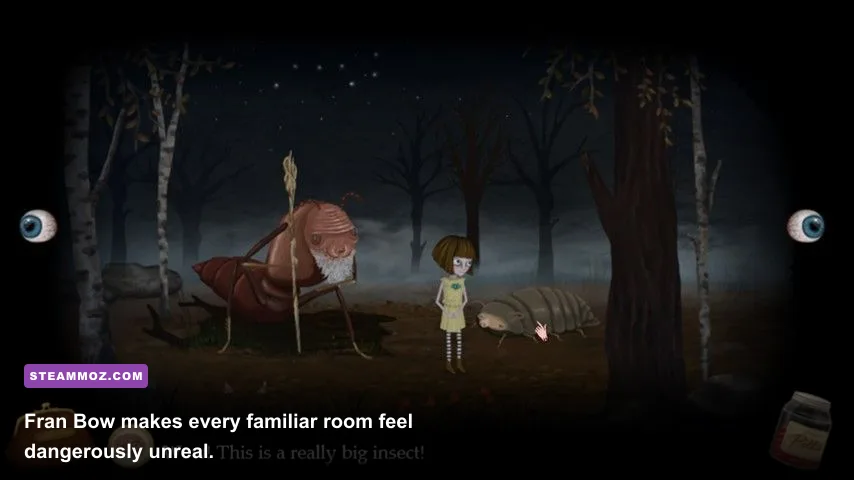
Fran Bow on Steam is the obvious first stop, but “obvious” doesn't mean overrated. Killmonday Games builds its horror around a nine-year-old girl, Fran Dagenhart, who is placed in an asylum after witnessing the brutal death of her parents. Her escape leads through Ithersta, a parallel realm revealed through the pills called Duotine.
The key mechanic is simple: Fran can take a Duotine pill to switch between two versions of the same location. One version may contain a usable key; the other may reveal mutilated corpses, hostile creatures, or a path that does not exist in ordinary reality. This is a much deeper interaction than Happy Game’s click-based object chains because the game asks you to compare two states of a scene rather than merely find the correct hotspot.
Fran’s inventory also gives the puzzles more texture. You’ll combine objects, inspect clues, and occasionally test solutions that feel morally uncomfortable. The trade-off is that Fran Bow can be less immediately readable than Happy Game. Some solutions depend on noticing a tiny visual detail or trying an item in an unexpected location. Keep multiple saves, inspect every screen edge, and don't assume a disturbing object is decorative.
Its five-chapter structure is longer than Happy Game’s roughly two-hour nightmare, but the emotional pacing remains focused. Fran Bow is the pick for players who want the child-perspective horror and psychological themes pushed much further.
2. Little Misfortune Nails the Cute-and-Cruel Contrast
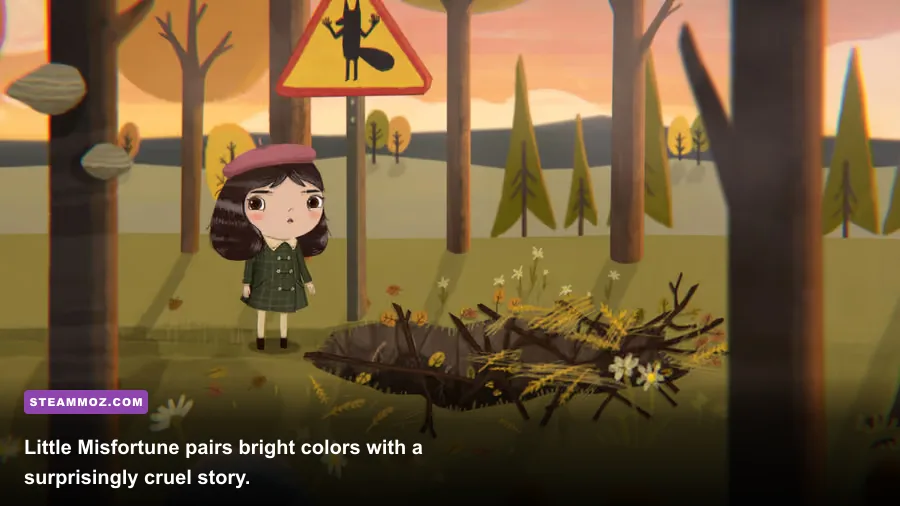
Little Misfortune comes from Killmonday Games too, and it shares Fran Bow’s universe, visual language, and talent for making a cheerful line read feel deeply wrong. You play Misfortune Ramirez Hernandez, an eight-year-old girl who follows the mysterious narrator Mr. Voice through a forest, a zoo, a cemetery, and other locations on a quest to win Eternal Happiness.
Where Happy Game uses animation and sound to make you uncomfortable, Little Misfortune uses dramatic irony. Misfortune interprets cruelty as play because she is too young to understand what the adults around her have done. Her “sparkles” let you interact with certain objects, and optional choices often reward curiosity with a joke, a collectible, or a sharper glimpse at the story’s tragedy.
There is no combat and almost no failure state, so this isn't the choice for players who want difficult puzzles. Its strength is pacing. Scenes move quickly, dialogue lands with purpose, and the 3–5 hour runtime avoids the repetition that can dilute a horror premise. It’s also a superb follow-up after Fran Bow because the shared world creates small thematic echoes without requiring you to know every connection.
Choose Little Misfortune if what you loved about Happy Game was the uneasy question underneath every bright image: is this world actually playful, or is the character simply too innocent to see the violence?
3. Samorost 3 Shows Amanita Design’s Gentler Side
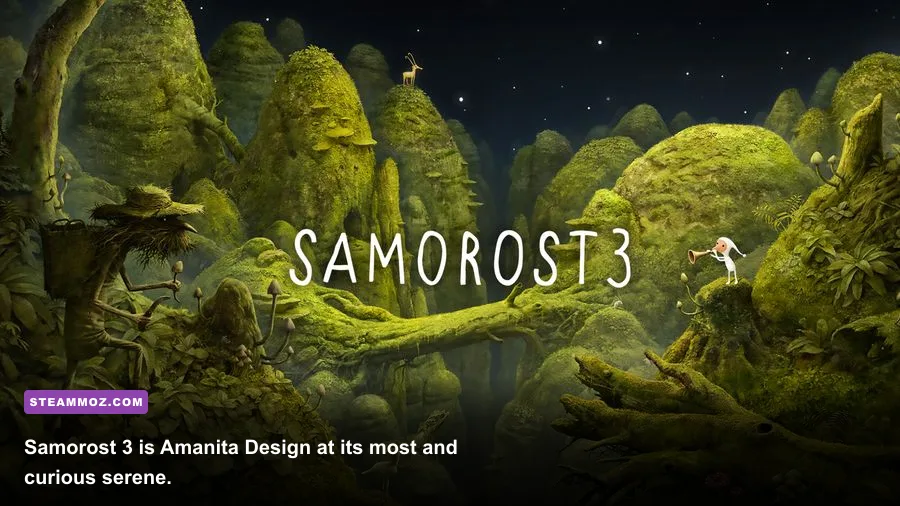
Samorost 3 is not a horror game, but it may be the best recommendation for understanding why Happy Game feels so distinctive. Amanita Design built both games around hand-crafted worlds, strange creatures, environmental sound, and puzzles that ask you to observe before you act.
You control the unnamed space gnome as he travels through a chain of planets and moon-like environments. A magical flute lets him communicate with characters and influence parts of the environment. There is no spoken dialogue, and the game rarely tells you exactly what an interaction does. Instead, you click on insects, machinery, plants, instruments, and peculiar animals until a visual or musical response gives you a clue.
Samorost 3’s puzzle design is more forgiving than Happy Game’s grotesque experiments. A failed interaction usually produces a funny animation rather than a punishment. That makes it a strong palate cleanser if Happy Game’s final chapter was too intense. The best way to play is with headphones and a notebook: the game’s audio cues and symbol-based clues matter more than its sparse text.
It’s also worth comparing Samorost 3 with our story-focused adventure recommendations if you prefer games where atmosphere carries as much weight as mechanics. Samorost 3 is the S-tier choice for visual discovery, not fear.
4. INSIDE Turns Wordless Dread Into Precision Platforming

Playdead’s INSIDE takes the silent storytelling and sinister child perspective of Happy Game, then rebuilds it as a cinematic puzzle platformer. You guide a nameless boy through a monochrome world of armed guards, laboratories, flooded rooms, and disturbing experiments. The controls are deliberately lean: move, jump, grab, and interact.
That limited toolkit is exactly why the game works. Every new obstacle teaches a rule before asking you to break it. Dogs telegraph their attacks with a lunge and can be escaped by timing a sprint or using environmental obstacles. Water puzzles introduce buoyancy, sound, and timing. Later sections add mind-control machinery and a strange biological mass that radically changes the boy’s movement profile.
INSIDE has more conventional failure than Happy Game. Death is frequent, but checkpoints are generous, usually placing you seconds before the failed action. The game’s 60-frame-per-second target is easy to hit on modern PCs, and the low-contrast art benefits from a calibrated display: raise brightness slightly if dark rooms blend together, but don't overcorrect or the lighting loses its menace.
The story is intentionally ambiguous, so don't expect Happy Game’s symbolic nightmare to be explained. INSIDE is about momentum and implication. Its most shocking moments work because the game has trained you to understand a machine, a room, or a creature before it turns that understanding against you.
5. Darkwood Is Happy Game’s Brutal Survival-Horror Cousin
Darkwood is the most mechanically demanding recommendation here. Acid Wizard Studio’s top-down horror game traps you in a procedurally twisted forest where daytime exploration gives way to nightly defense. The world is strange in the same way Happy Game’s is strange, but Darkwood makes every resource and mistake matter.
During the day, search locations such as the Dry Meadow, Silent Forest, and Old Woods for wood, gasoline, scrap metal, weapons, and mushrooms. At night, you return to a hideout, board windows, place traps, and survive until morning. A clock governs the pressure: darkness arrives at a predictable time, so wandering too far from shelter can turn a routine scavenging run into a desperate sprint.
Combat rewards patience rather than button mashing. The basic shovel has a charged attack with a long wind-up, while the Board With Nails offers a faster swing but less reach. Firecrackers can distract enemies, bear traps lock down doorways, and the Molotov creates area denial at the cost of scarce fuel. Stamina is the real limiting stat in a fight; swinging repeatedly leaves you unable to dodge when a Savage or dog closes in.
| Game | Core Interaction | Failure Pressure | Best For |
|---|---|---|---|
| Happy Game | Click-based environmental puzzles | Low; mostly observation | Short surreal horror |
| Fran Bow | Inventory puzzles and reality switching | Moderate; occasional obscure solutions | Psychological narrative |
| Little Misfortune | Dialogue choices and object interactions | Very low | Dark comedy and story |
| INSIDE | Platforming, timing, and machines | Moderate; frequent checkpointed deaths | Wordless cinematic dread |
| Darkwood | Scavenging, crafting, and combat | High; night cycles consume resources | Long-form survival horror |
Darkwood is not a casual follow-up to Happy Game, but it's an excellent escalation. If you want the same feeling of entering a beautiful world that has gone fundamentally wrong, it delivers that feeling with teeth. For more demanding recommendations, our Iratus-like games guide covers another batch of grim, systems-heavy alternatives.
Which Happy Game Alternative Should You Play First?
Pick Fran Bow if the asylum chapter, child protagonist, and psychological horror were your favorite parts of Happy Game. Pick Little Misfortune for a shorter, more dialogue-heavy story that weaponizes innocence. Choose INSIDE if you want silent storytelling and sharper mechanical puzzles.
Go with Samorost 3 when you want Amanita Design’s visual imagination without the stomach-churning imagery. Choose Darkwood only when you’re ready for resource management, real combat, and nights that can punish poor preparation. And if you’re still chasing strange, stylish indies after finishing these, our broader indie recommendations are a good next rabbit hole.
Happy Game works because it never stays comfortable for long. The best games like it understand that trick: give players something colorful, funny, or familiar, then quietly change the rules. Whether you want Fran’s reality-shifting nightmare, Misfortune’s cruel fairy tale, INSIDE’s industrial silence, Samorost’s cosmic curiosity, or Darkwood’s nightly panic, these games all know exactly when to make the smile disappear.
For official development details, visit Amanita Design’s official site and the Happy Game Steam page. If you're comparing darker adventure design with weapon-focused horror, Steamoz’s Alone in the Dark weapon guide offers a very different kind of nightmare analysis.