If Citizen Sleeper's blend of dice, deadlines, fragile relationships, and beautifully written science fiction got under your skin, start with Disco Elysium, Pentiment, and Roadwarden. They aren't clones, but each captures a different part of what makes Citizen Sleeper special: meaningful choices, pressure that never quite disappears, and characters who feel bigger than the mechanics carrying them.
Citizen Sleeper is unusually difficult to replace because its appeal comes from several systems working together. Every cycle gives you a limited pool of dice, your condition changes your odds, and the station's clocks keep moving whether you're ready or not. The result is a role-playing game where choosing to work a shift, repair a server, meet a friend, or chase a lead feels like spending a real piece of your life.
This list ranks the best games like Citizen Sleeper you need to play in 2026 by the kind of experience they deliver. Some are closer in structure, while others match the tone, writing, or pressure-cooker decision-making. For a broader look at narrative-heavy games, Steamoz's guide to the best games like Titanium Court is also worth a look.

The best Citizen Sleeper alternatives ranked
| Game | Tier | Closest Citizen Sleeper element | Best for |
|---|---|---|---|
| Disco Elysium | S-Tier | Internal voices, skill checks, reactive writing | Players who want deeper role-playing |
| Pentiment | S-Tier | Consequences, relationships, historical immersion | Slow-burn investigation fans |
| Roadwarden | A-Tier | Resource pressure, timed decisions, branching routes | Readers who want a harsher adventure |
| NORCO | A-Tier | Atmosphere, strange communities, personal stakes | Surreal Southern Gothic mystery |
| In Other Waters | A-Tier | Minimalist interface, discovery, humane sci-fi | Exploration without combat |
| The Life and Suffering of Sir Brante | B-Tier | Life simulation, social systems, irreversible choices | Players who enjoy brutal planning |
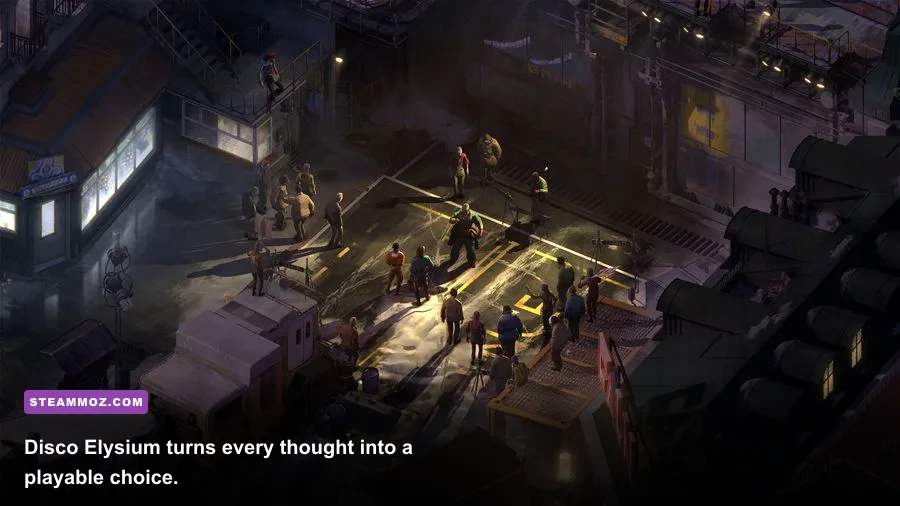
The ranking is less about production value and more about how successfully each game turns limited time and imperfect information into drama. Citizen Sleeper fans should also expect a different rhythm. Disco Elysium is more skill-driven, Pentiment is more historical, and Roadwarden is much more openly punishing. That difference is the point: these games give you new ways to play the same emotional theme of trying to survive inside a system larger than yourself.
🎮 Citizen Sleeper
Looking to experience this game? Grab your digital key directly on our store for $5.99.
View on Steammoz Store →Disco Elysium is the obvious S-Tier pick
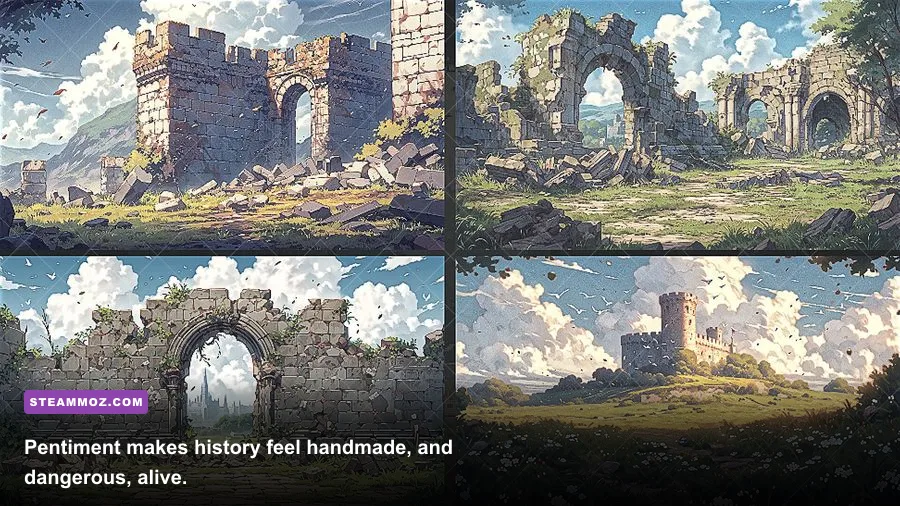
Disco Elysium is the closest recommendation if what you loved was Citizen Sleeper's ability to make a character sheet feel like a cast of people. Instead of Engines, Interface, Endure, and Intuit, you build the detective through four attributes: Intellect, Psyche, Physique, and Motorics. Each attribute contains six skills, including Logic, Empathy, Inland Empire, Shivers, Authority, and Electrochemistry.
The crucial difference is that skills don't merely raise a percentage. They interrupt you. Inland Empire may invent an unsettling theory, while Volition tries to keep the detective's dignity intact. When a skill is high enough, it can dominate conversations and steer your interpretation of Revachol. This resembles Citizen Sleeper's internal narration, but Disco Elysium gives those voices far more room to argue.
Its checks are also more transparent and more dramatic. A white check can usually be retried after you improve the relevant skill, use an item, or discover new information. Red checks are one-shot opportunities, so attempting one before you understand the situation can permanently close a route. The familiar dice logic is there, but the consequences are tangled into the investigation rather than a cycle-based station economy.
For a strong first run, don't spread skill points evenly. Put early points into Volition and Encyclopedia if you want a stable detective, or take Inland Empire and Shivers if you want the strangest version of Revachol. The Thought Cabinet adds another layer: thoughts such as Jamais Vu, Actual Art Degree, and Searchlight Division grant unusual bonuses while occupying limited slots. Internalizing a thought takes time, so even character development has a cost.
Combat is rare, awkward, and almost beside the point. The real danger is failing a conversation, losing morale, or making a political commitment you can't take back. That makes Disco Elysium an excellent follow-up for anyone who enjoyed Citizen Sleeper's quiet tension rather than traditional RPG combat. Read the official Disco Elysium Steam page for the complete edition details.
Pentiment makes every choice feel historical
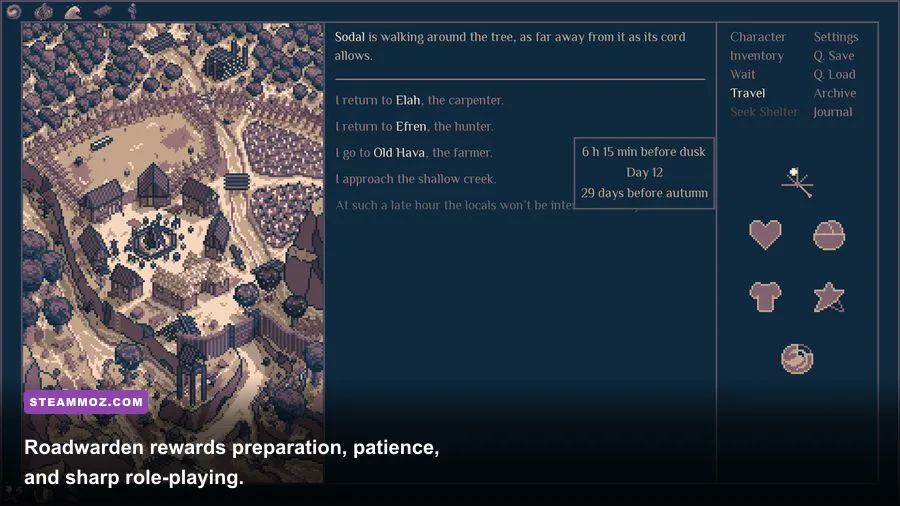
Pentiment is the best choice for Citizen Sleeper players who want relationships and consequences without sci-fi. You play Andreas Maler, a journeyman artist in 16th-century Bavaria, beginning in the town of Tassing and the nearby Kiersau Abbey. After a murder disrupts the community, Andreas has only a short window to investigate before the story moves forward.
Pentiment's defining mechanic is time. A day is divided into activities, and you can't question everyone, visit every location, or complete every task before the deadline. The game never presents this as a clean optimization puzzle. Instead, you decide which person deserves your attention, which rumor sounds credible, and whether finishing a manuscript matters more than helping a frightened villager.
Andreas's background choices shape dialogue in concrete ways. You can define his education, language knowledge, and social connections, giving him different ways to interpret religious arguments, village customs, and class tensions. A more scholarly Andreas may recognize references that another version misses, while a character with stronger local ties can access conversations outside the abbey's formal world.
The murder mystery is only the opening pressure point. Pentiment spans decades, and your choices affect who gains influence, which buildings survive, and how the community remembers earlier events. There are no conventional combat stats, no loot screen, and no perfect detective route. Evidence can be incomplete, witnesses can lie, and an accusation that feels emotionally right may still be factually wrong.
Its visual style is not just decoration. The game uses manuscript-inspired fonts, woodcuts, marginal illustrations, and shifting typography to show education, class, and cultural change. That makes it an especially good recommendation if Citizen Sleeper's art direction mattered as much as its systems. Microsoft published an excellent overview on the official Pentiment developer page.
Roadwarden is Citizen Sleeper with sharper survival edges
Roadwarden is the most mechanically similar game here if you want a text-heavy RPG built around travel, work, and limited time. You play a roadwarden sent into a dangerous frontier to map settlements, establish trade links, and investigate why the region is becoming less stable. The world is presented through detailed prose, a hand-drawn map, and carefully chosen interface elements rather than character animation.
At character creation, you choose an archetype such as Fighter, Scholar, or Mage, then assign attributes that determine which dialogue and exploration options are available. Strength helps with physical challenges, while Perception, Charisma, and Intelligence open different routes through conversations and investigations. Your build isn't cosmetic: a scholarly character can identify plants and ancient references that a fighter simply can't understand.
Roadwarden's calendar is the real antagonist. Travel costs time, sleeping restores you but advances the day, and quests often have deadlines connected to weather or local events. Food, money, reputation, and fatigue all matter. A failed negotiation may not end the game, but it can close a settlement, remove a future ally, or leave you without the supplies needed for the next journey.
| Roadwarden concern | What it changes | Smart response | Common mistake |
|---|---|---|---|
| Travel time | Quest deadlines and fatigue | Group nearby objectives together | Crossing the map for one conversation |
| Food and money | Recovery and future options | Keep an emergency reserve | Spending early on minor conveniences |
| Reputation | Dialogue access and settlement support | Finish small favors before demanding answers | Threatening cautious locals |
| Character skills | Investigation and traversal routes | Commit to a role before allocating points | Trying to cover every attribute |
The biggest warning is that Roadwarden doesn't cushion failure as generously as Citizen Sleeper. You can arrive too late. You can run out of food. You can misunderstand a faction and lose the chance to repair the relationship. That harshness makes success feel earned, especially when a clue finally connects several seemingly unrelated settlements.
Choose Roadwarden if you want the most direct version of Citizen Sleeper's limited-resource philosophy. It has less visual spectacle, but its writing turns every campfire, road junction, and wary conversation into a meaningful stop. The official Roadwarden Steam listing includes its full feature set and supported platforms.
NORCO delivers the strangest emotional mystery
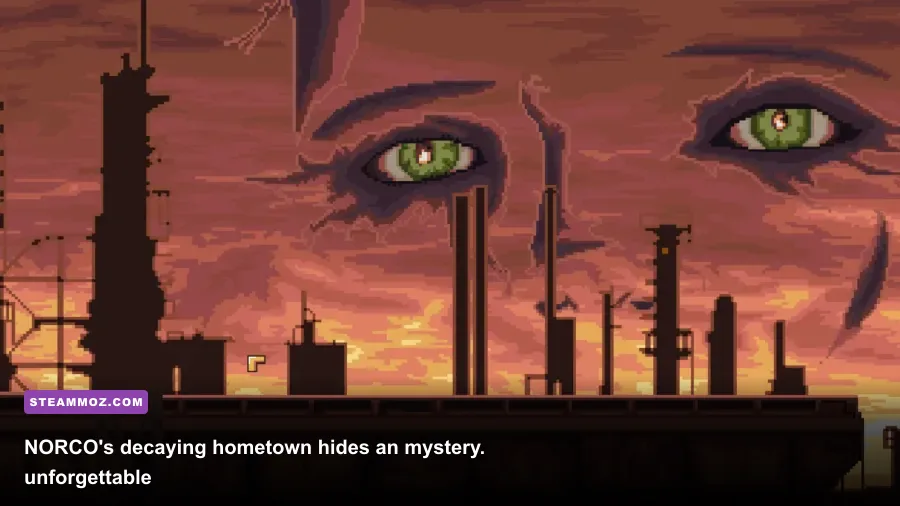
NORCO is a shorter, more focused recommendation, but its atmosphere is almost impossible to shake. Set in a distorted version of industrial Louisiana, it follows Kay as she returns home after her mother's death and searches for her missing brother Blake. The game moves through petrochemical facilities, flooded neighborhoods, churches, backyards, and online spaces where local grief has curdled into conspiracy.
There is no character build, dice pool, or economic cycle. NORCO instead uses exploration, inventory items, branching conversations, and a small number of memorable puzzles. That might sound less like Citizen Sleeper, but the emotional structure is close: ordinary people are trapped inside economic and ecological systems they didn't create, and personal survival depends on understanding those systems.
The game is at its best when it refuses to explain its weirdest images immediately. A mechanical bird, a strange cult, a corporate archive, and a family secret can all seem disconnected until the story reveals how industrial exploitation has shaped the town's private mythology. You won't optimize a build here; you'll pay attention, revisit places, and decide which version of a memory you believe.
Expect roughly six to eight hours for a first playthrough, depending on how thoroughly you inspect the environment. That makes NORCO an ideal weekend follow-up after a larger RPG. Its pixel art is dense rather than flashy, with polluted skies and rusted infrastructure doing narrative work in the background. The official NORCO Steam page is the best place to start.
In Other Waters turns exploration into observation
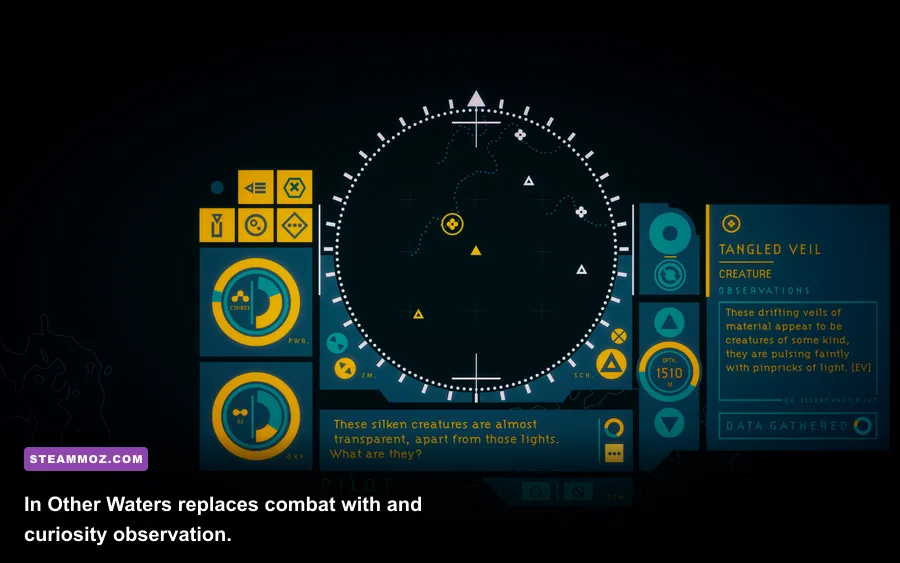
In Other Waters is the most peaceful game on this list and one of the most inventive. You operate an artificial intelligence assisting the xenobiologist Ellery Vas, who is exploring an alien ocean on the planet Gliese 667Cc. There is no conventional movement through a 3D world. Instead, you interpret sonar, biological signals, energy levels, depth, and map markers through a clean sci-fi interface.
The game's tension comes from incomplete knowledge. At first, a creature may appear as an unknown signal. You scan it, observe its behavior, record its traits, and decide whether to approach. Different depths and environmental conditions reveal new species, while limited energy makes careless movement costly. It shares Citizen Sleeper's fascination with systems you can understand only by living inside them.
Ellery's relationship with the AI also gives the exploration a personal center. The game asks what it means to care for an ecosystem while cataloging it, and whether an artificial intelligence should simply follow orders when the evidence points somewhere morally uncomfortable. The choices are quieter than Citizen Sleeper's station politics, but they carry the same interest in personhood and mutual dependence.
Don't choose In Other Waters expecting dialogue-heavy drama every few minutes. Choose it for texture, sound design, and the satisfaction of building a mental map from fragments. It is a superb palate cleanser between bigger narrative RPGs, especially if what you liked about Citizen Sleeper was its interface and sense of discovery rather than its social hubs. You can find the official In Other Waters store page here.
The Life and Suffering of Sir Brante is the brutal wildcard
The Life and Suffering of Sir Brante is the pick for players who want Citizen Sleeper's life-management structure pushed into something far more oppressive. You play Sir Brante from childhood through adulthood in a rigid empire divided between Nobles, Clerics, and commoners. Your family status determines what is possible, but your decisions can still reshape your relationships, skills, and eventual place in society.
The game tracks attributes including Might, Faith, and Wit, alongside traits that influence checks and events. Early choices might seem small, such as how you respond to a sibling or whether you obey a family rule, but they establish the relationships and convictions that determine later survival. The structure is closer to an interactive biography than a conventional RPG campaign.
Its key difference from Citizen Sleeper is the severity of its failure states. Death, imprisonment, social ruin, and permanent loss are all possible. The game expects you to learn through repeated runs, identify which events are worth preparing for, and accept that a successful life may still be morally compromised. If Citizen Sleeper asks how you build a future with limited time, Sir Brante asks how much of yourself you sacrifice to reach one.
| Game | Primary pressure | Failure style | Recommended player mindset |
|---|---|---|---|
| Citizen Sleeper | Cycles and condition | Soft failure that redirects the story | Spend resources on people and information |
| Roadwarden | Travel, food, and deadlines | Missed routes and damaged reputation | Plan each trip before leaving |
| Sir Brante | Class, family, and political power | Permanent death or social collapse | Learn from failed life paths |
It isn't as welcoming as the other recommendations, and its presentation can feel dense during the first few chapters. Stick with it if you enjoy reading event chains and planning around future consequences. The payoff is a remarkably coherent simulation of a society designed to keep ordinary people powerless.
Which Citizen Sleeper-like game should you play first?
Choose Disco Elysium if you want the richest writing and the most expressive character system. Choose Pentiment if you prefer a grounded mystery where time and community memory matter more than combat. Pick Roadwarden for the closest match to Citizen Sleeper's resource pressure, or NORCO for a compact, surreal story about family and industrial decline.
In Other Waters is the best fit for players drawn to Citizen Sleeper's interface, exploration, and gentle science-fiction melancholy. Sir Brante is the wildcard for anyone who wants a much harder life simulator with social systems that bite back.
None of these games reproduces the Erlin's Eye, the Sleeper's body, or Citizen Sleeper's exact dice economy. That's a good thing. The best games like Citizen Sleeper in 2026 aren't imitators; they're different experiments in making choices, relationships, and limited time feel mechanically important. Start with the mood you want, not just the genre label, and you'll find a game that stays with you long after the final cycle.
If you're tuning a PC for more narrative games, Steamoz's guides to Dishonored PC requirements and performance graphics settings offer useful optimization advice. For another choice-heavy adventure, see our Lost Judgment walkthrough.