The best desktop games of all time are Baldur's Gate 3, Minecraft, Counter-Strike 2, The Witcher 3: Wild Hunt, and Sid Meier's Civilization VI at the top of a much larger conversation. This ranking weighs long-term player numbers, critical influence, replay value, mod support, technical staying power, and the simple test that matters most: whether gamers still lose entire evenings to them.
That last point separates a classic from an expensive museum piece. The games below aren't ranked only by launch-day hype. They earned their positions because people continue to replay them, stream them, mod them, compete in them, or recommend them to friends who somehow haven't played them yet. The list also focuses on games that feel especially good on a desktop setup, where mouse precision, keyboard shortcuts, ultrawide displays, high refresh rates, and mod libraries can change the experience.
S-Tier: The Desktop Games That Set the Standard
S-Tier is reserved for games that do more than execute a genre well. They expand what the genre can be. Baldur's Gate 3 takes the top spot because its systems constantly overlap: ability checks shape dialogue, environmental surfaces alter combat, companion approval changes quests, and a single decision can close off hours of content. Larian's implementation of Dungeons & Dragons 5e is unusually readable, too. A level-five Wizard can combine Fireball with an oil surface for devastating area damage, while a Rogue with Cunning Action: Hide can turn elevation and line of sight into a tactical puzzle.
The combat is only half the reason it ranks first. Characters such as Shadowheart, Lae'zel, Astarion, and Karlach have personal arcs that react to your choices rather than waiting politely in a quest log. The game also respects failure. Missing a Persuasion check doesn't always mean reloading; it often creates a stranger, funnier route forward. On PC, split-screen co-op, robust mod support, quicksave freedom, and mouse-driven inventory management make the desktop version the definitive one. Check the official Baldur's Gate 3 site for patch information before installing major mods.
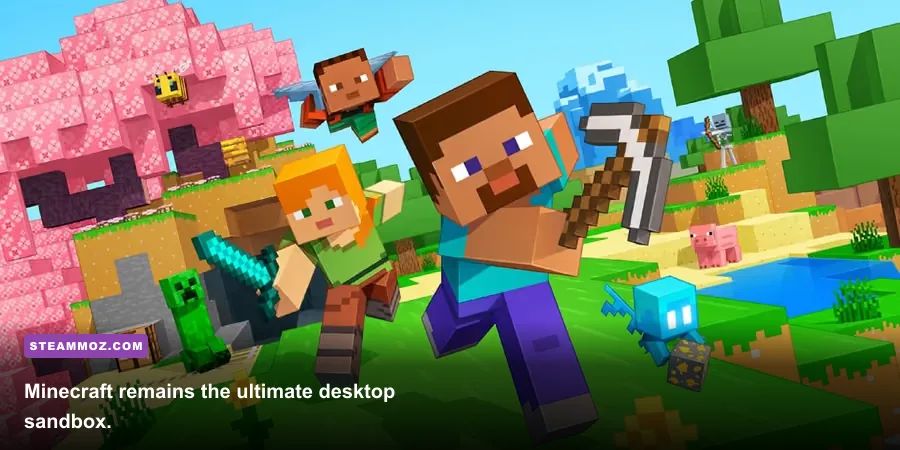
Minecraft sits beside it for a different reason: almost infinite flexibility. The Java Edition's redstone, command blocks, server ecosystem, shaders, and modpacks turn one purchase into survival crafting, automation, adventure RPG, or a technical sandbox. A beginner can spend the first night placing torches and cooking steak; an expert can build an iron farm, villager trading hall, or Nether hub that links continents. Its low hardware barrier and 2011 launch date only make its staying power more absurd.
Counter-Strike 2 is the competitive pillar. The core loop is brutally clear: five players, one economy, limited information, and rounds where a single pixel of visibility matters. The AK-47 kills with one headshot against an unhelmeted opponent and remains lethal through much of the armor economy, while the M4A1-S trades magazine capacity and raw spray characteristics for a quieter, more controlled rifle. Smoke grenades are dynamic in CS2, and a thrown smoke can be displaced by a HE grenade, opening sightlines that veteran teams immediately exploit. It isn't welcoming, but mastery has a clarity few multiplayer games can match.
| Rank | Game | Why Gamers Still Play It | Best Desktop Strength |
|---|---|---|---|
| 1 | Baldur's Gate 3 | Reactive story and systemic combat | Mouse controls, mods, co-op |
| 2 | Minecraft Java Edition | Unlimited creation and replayability | Servers, redstone, modpacks |
| 3 | Counter-Strike 2 | Pure competitive skill expression | High-refresh mouse precision |
| 4 | The Witcher 3 | Exceptional quests and world-building | Visual mods and expansive display options |
| 5 | Civilization VI | Deep strategy with endless scenarios | Hotkeys, mods, multitasking |
🎮 1bitHeart
Looking to experience this game? Grab your digital key directly on our store for $2.99.
View on Steammoz Store →A-Tier: Near-Perfect Games With Lasting Influence
The Witcher 3: Wild Hunt lands at No. 4 because its best writing remains difficult to beat. Geralt's main quest is excellent, but the real magic is in contracts and side stories such as “The Bloody Baron,” “The Last Wish,” and “The Towerful of Mice.” Choices rarely divide neatly into heroic and evil outcomes. Even a successful monster hunt can leave a village poorer, a family broken, or Geralt questioning whether the contract was worth taking.
Its combat is less precise than modern action RPGs, but the underlying preparation system gives it satisfying texture. Quen absorbs a hit, Yrden slows spectral enemies, and Axii can interrupt or influence targets. Oils matter against tougher monsters: Necrophage Oil helps against drowners and ghouls, while Specter Oil is essential for wraiths. On Death March difficulty, ignoring alchemy and enemy weaknesses turns ordinary fights into endurance contests. The official Witcher 3 page remains the best reference for editions and expansions.
Sid Meier's Civilization VI is the reason “one more turn” has become a gaming hazard. Its districts create a spatial puzzle on the map: Campuses want mountains and geothermal fissures, Commercial Hubs prefer rivers and harbors, and Industrial Zones gain adjacency from mines and strategic infrastructure. That means city planning starts on turn one, not when the empire is already developed. Leaders also push distinct strategies. Trajan's free Monument accelerates early culture, Germany's extra district capacity supports production-heavy cities, and Japan's adjacency bonuses reward compact layouts.
The game is particularly strong on desktop because keyboard shortcuts, yield icons, and detailed map overlays let experienced players read the board quickly. The complete edition's expansions add Governors, emergencies, loyalty pressure, natural disasters, and climate change, all of which make late-game decisions less predictable. The official Civilization VI site lists the current edition and expansion content.
Other A-Tier giants deserve a place in the conversation. Half-Life 2 made physics a weapon with the Gravity Gun, Portal 2 turned spatial reasoning into comedy, and StarCraft II remains a masterclass in readable real-time strategy. They miss the top five mainly because their campaigns or communities are narrower today, not because their design has aged badly.
B-Tier: Classics That Still Deserve Your Hard Drive
B-Tier doesn't mean “merely good.” These games are landmarks, but their age, onboarding friction, or platform limitations keep them just below the top group. World of Warcraft transformed online worlds with raids, class identity, and a social structure that made guilds feel like regular clubs. Terraria offers a more combat-heavy alternative to Minecraft, with bosses such as the Eye of Cthulhu and Wall of Flesh acting as genuine progression gates.
RimWorld earns its place through emergent storytelling. Colonist traits, injuries, addictions, raids, and relationships combine into disasters no scripted writer could reliably produce. A pawn with the Pyromaniac trait can turn a stable colony into a fire drill, while a captured raider may become a valuable doctor after recruitment. Factorio is the cleaner, more engineering-focused cousin. Its progression from burner drills to automated science packs teaches production-line thinking so effectively that players start seeing bottlenecks in real life.
Elden Ring belongs here because it proved that an enormous open world could preserve FromSoftware's demanding combat. The Bloodhound's Fang is a powerful early curved greatsword, Mimic Tear can duplicate your build, and Spirit Ashes allow players to manage pressure without trivializing every encounter. Its bosses telegraph attacks clearly, but delayed swings from enemies such as Margit and Malenia punish panic rolls. PC players should also use a stable frame cap; inconsistent frame pacing makes dodge timing feel worse even when the counter reads above 60 fps.
| Tier | Games | Signature Strength | Best For |
|---|---|---|---|
| S-Tier | Baldur's Gate 3, Minecraft, Counter-Strike 2 | Genre-defining systems | Players seeking a long-term main game |
| A-Tier | The Witcher 3, Civilization VI, Portal 2 | Polished, influential design | Story fans and strategy players |
| B-Tier | RimWorld, Factorio, Elden Ring, Terraria | Deep specialization and replay value | Players who enjoy mastery |
What Makes a Desktop Game Last for Decades?
Longevity usually comes from four ingredients: mechanical depth, a strong mod or server ecosystem, sensible performance scaling, and a progression curve that keeps revealing new decisions. RimWorld and Factorio are almost endlessly replayable because their systems generate fresh problems. Counter-Strike 2 lasts because the rules are stable while the human opponents are never predictable. Minecraft combines both approaches, letting players choose between a relaxing building session and a technical project that takes weeks.
Desktop-specific features matter more than they did a decade ago. A 144Hz monitor makes counter-strafing and target tracking clearer in CS2, though it won't compensate for poor positioning. Extra RAM helps heavily modded Minecraft and large Civilization VI maps, while an SSD cuts load times and reduces the irritation of restarting after a failed experiment. For older games, community patches can be more important than a new GPU. Steamoz's guides on ELEX performance fixes and Far Cry 6 graphics settings show the same principle: stable frame pacing beats a flashy but inconsistent benchmark.
Mod support is another quiet ranking advantage. The Witcher 3's HD texture projects and quality-of-life mods can modernize the interface, Civilization VI gains scenarios and balance changes, and Minecraft Java has entire modpacks that replace its progression. Always check version compatibility before adding a large load order. Back up saves first, especially when a mod changes world generation or adds new blocks, items, or quests.
The Best Game Depends on the Kind of Player You Are
There isn't one universal winner, even with a ranking this confident. Choose Baldur's Gate 3 if you want choices that produce visible consequences and turn-based combat with room for experimentation. Choose Minecraft if you want a game that can become whatever your mood demands. Choose Counter-Strike 2 if improvement itself is the reward and you enjoy studying utility lineups, recoil, economy, and positioning.
Pick The Witcher 3 for a story-driven road trip packed with morally messy quests. Pick Civilization VI if you want a quiet strategy game that can suddenly become an international crisis because another leader denounced you. For players who want technical depth, Factorio is unmatched; for emergent drama, RimWorld is the safer recommendation; for punishing exploration, Elden Ring still delivers the biggest rush when a boss finally falls.
| Player Type | Best Pick | First Goal | Why It Fits |
|---|---|---|---|
| Story-focused | Baldur's Gate 3 | Recruit all six early companions | Reactive quests and memorable characters |
| Creative builder | Minecraft Java | Build a safe starter base | Huge mod and server ecosystem |
| Competitive player | Counter-Strike 2 | Master counter-strafing and economy buys | Clear rules and limitless skill ceiling |
| Strategy obsessive | Civilization VI | Plan district adjacency from turn one | Deep systems and endless scenarios |
| Challenge seeker | Elden Ring | Learn boss telegraphs before changing builds | Exploration and demanding combat |
The final verdict is simple: Baldur's Gate 3 is the best all-round desktop game right now, but Minecraft has the strongest claim to all-time longevity, and Counter-Strike remains the purest competitive test. The perfect PC library isn't one game anyway. It's a rotation: a story RPG for the weekend, a strategy game for late nights, a sandbox for creative bursts, and a competitive match when you want every mouse click to matter. That variety is exactly why desktop gaming has never stopped producing classics.
For more PC-specific recommendations and troubleshooting, browse Steamoz's strategy progression guide, Everspace 2 secrets guide, and Far Cry 3 weapon ranking. They cover the same details that make these games worth keeping installed: strong systems, smart choices, and plenty of reasons to launch one more session.