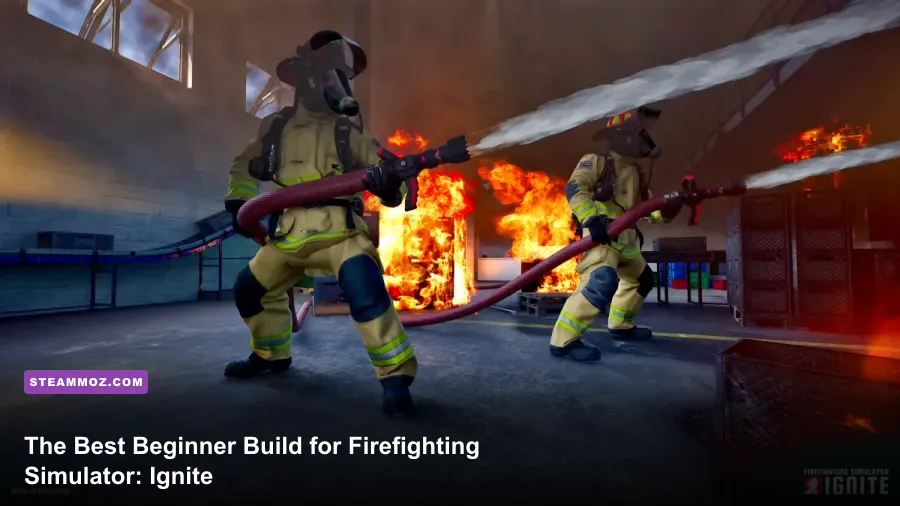
The best beginner build in Firefighting Simulator: Ignite is a balanced interior-response loadout: carry a hose for suppression, an axe or Halligan-style forcible-entry tool for access, a thermal imaging camera for search, and your SCBA for every smoke-filled structure. Treat the game as a role-and-equipment simulator rather than an RPG. There are no traditional strength points or damage perks to stack; your “build” is the order in which you unlock equipment, the job you accept on a call, and how efficiently you use the tools already on the truck.
That distinction matters. New players often grab the biggest-looking tool, rush through the front door, and then discover that a fire can be lost because nobody opened the right route, checked the upper floor, or managed their air supply. Ignite is at its best when every action has a purpose. This starter setup gives you a reliable answer to the three problems that decide most early incidents: finding victims, reaching the fire, and stopping spread without turning your crew into another casualty.
The guide below focuses on a first solo or co-op career, where you are still learning vehicle staging, hose handling, building searches, and the difference between a contained fire and a safe scene. For a broader look at simulation-game progression, Steamoz’s fast-leveling guide for Empires of the Undergrowth is worth a read, but Ignite demands patience rather than resource farming.
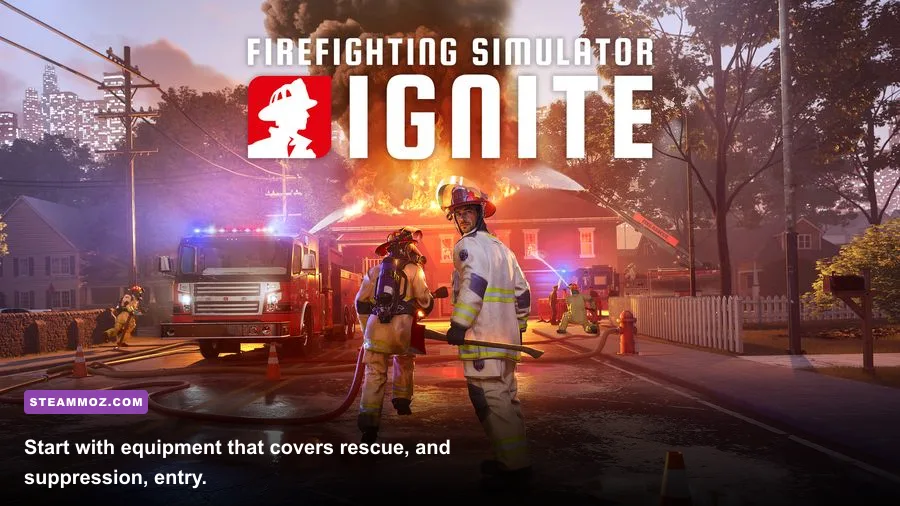
The Best Starter Build at a Glance
| Slot or Role | Starter Choice | Why It Matters | When to Replace It |
|---|---|---|---|
| Protection | Full structural gear with SCBA | Lets you work in smoke and heat while preserving survivability | Never skip it for an interior call |
| Suppression | Attack hose | Removes the main threat and protects your exit route | Use a lighter portable extinguisher only for small, isolated fires |
| Entry | Axe or forcible-entry tool | Opens locked access and breaks obstacles | Swap it when another crew member handles entry |
| Search | Thermal imaging camera | Finds heat sources and improves victim searches through smoke | Keep it for every structure search |
| Utility | Portable extinguisher | Quickly handles bins, appliances, and small spot fires | Drop it when the call clearly needs a second hose |
Think of this as the all-rounder build. It is not the fastest loadout for a tiny vehicle fire, and it is not the maximum-output setup for a four-player crew with assigned specialists. It is the safest starting point because it prevents dead ends. If a door is blocked, you have a tool. If smoke destroys visibility, you have a camera. If the fire grows beyond extinguisher range, you have a hose.
One important correction for search traffic around “builds”: Ignite does not reward an invented stat spread. You cannot create a firefighter with 20 points in stamina and 15 points in hose damage. Any guide promising a hidden strength, agility, or weapon-damage build is describing a different game. Your meaningful decisions are equipment selection, positioning, order of operations, and crew coordination.

🎮 Firefighting Simulator: Ignite
Looking to experience this game? Grab your digital key directly on our store for $20.99.
View on Steammoz Store →Build Order for Your First Hours
Step 1: Learn the truck before the fire
On your first calls, spend a few seconds identifying where the hose, extinguisher, axe, SCBA equipment, and other tools are stored. That sounds mundane until a room flashes over while you are looking at the wrong compartment. Your opening routine should become automatic: check the call type, park with an escape route, identify the nearest hydrant or water source, and take only the equipment you can actually use.
For a small exterior fire, begin with the extinguisher if the flames are compact and access is safe. For a building fire, skip the heroic extinguisher attempt and take the hose. The extinguisher is a precision tool; a hose is your sustained suppression option. Carrying both into a large interior call usually slows you down and leaves the crew short of the equipment that matters.
Step 2: Unlock capability, not spectacle
If Ignite presents equipment or mission progression, prioritize tools that expand the number of situations you can solve. The thermal imaging camera and forcible-entry equipment should come before niche convenience items. A camera does not put out flames, but it improves every search. An entry tool does not look as dramatic as a powered apparatus, but a locked door can waste more time than a small fire.
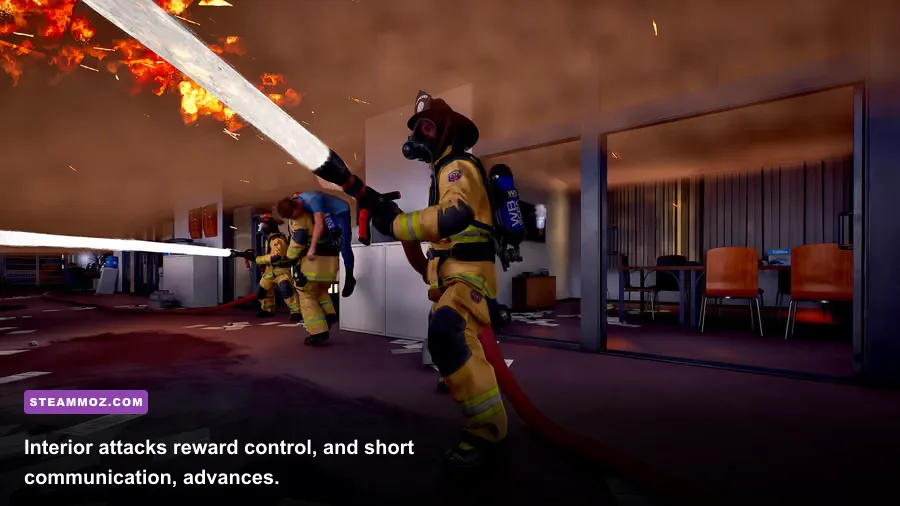
After that, improve your hose workflow. Practice deploying enough line to reach the seat of the fire without creating a tangled path across the doorway. Keep the hose behind you as you advance, and avoid parking yourself in a narrow corridor where another firefighter cannot pass. For solo players, this is the point where the balanced build becomes dramatically better than carrying multiple extinguishers.
| Progression Priority | Equipment or Habit | Reason to Prioritize | Beginner Mistake It Prevents |
|---|---|---|---|
| S-Tier | SCBA discipline | Preserves operating time and prevents panic during searches | Entering smoke without tracking air or exit distance |
| S-Tier | Attack hose control | Solves serious fires and protects the crew’s route | Trying to extinguish a room fire with a handheld extinguisher |
| A-Tier | Thermal imaging camera | Reveals heat and supports victim location | Walking past a hidden room or hot spot |
| A-Tier | Axe or entry tool | Creates access when doors or barriers block progress | Waiting at a locked entrance while fire spreads |
| B-Tier | Extra extinguisher | Excellent for isolated small fires but redundant on major calls | Overloading your hands with tools that cannot scale |
How to Use the Build on a Real Call
Exterior fires: contain first, chase second
Approach from a position that does not trap you between the fire and a wall, vehicle, or fence. Start with the extinguisher when the flames are small enough to control from a safe distance. Sweep deliberately across the base rather than waving at the top of the flame. If the fire touches multiple objects or keeps growing after a short application, transition to the hose instead of stubbornly staying with the smaller tool.
Vehicles deserve extra caution. Fire can hide around the engine compartment or passenger area, and the visual flames do not always tell you whether the incident is truly under control. Work around the vehicle, check for remaining heat, and do not declare success simply because the largest flame disappeared. The thermal camera is especially useful here, provided the call gives you access to it early.
Interior fires: entry, search, suppression
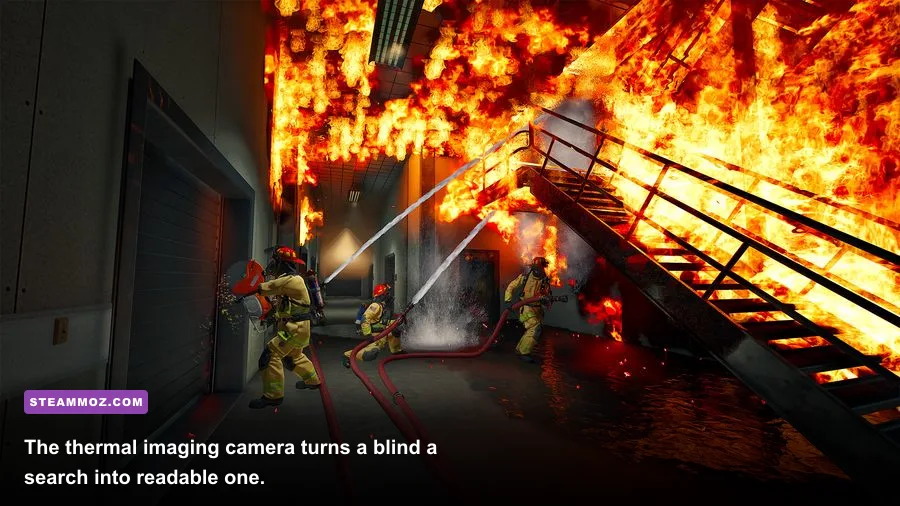
For a structure, use a simple rhythm: entry, search, suppression, overhaul. If a victim is reported, search priorities change; you are not entering merely to find the hottest room. Keep your camera available, mark your route mentally, and avoid pushing deeper than your hose and exit path support.
Doors are tactical information. A closed door can slow fire growth and preserve conditions on the other side. Opening every door immediately can make the scene harder, not easier. When you reach a closed room, check whether access is necessary, prepare your hose line, and open it in a way that lets you retreat. If the game models changing fire behavior, expect conditions to worsen when fresh air reaches a burning compartment. The safest beginner habit is to avoid opening several rooms at once.
Once the hose is flowing, target the fire’s base and sweep methodically. Do not waste water spraying smoke high above the flame unless the simulation specifically calls for cooling overhead gases. Advance only when the visible fire is shrinking and your route remains clear. After knockdown, use the camera to locate residual heat in corners, behind furniture, near ceilings, and around adjacent rooms. “No visible flame” is not the same as “no remaining fire.”
Solo and Co-op Role Variations
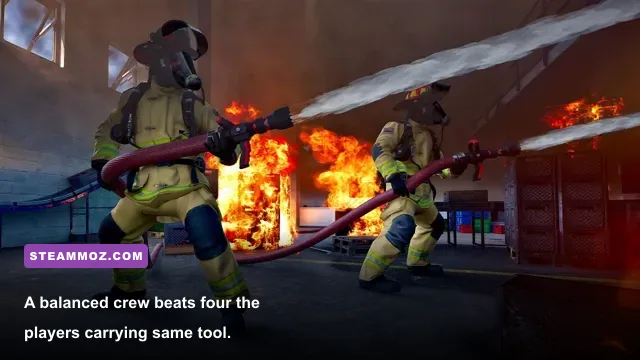
The all-rounder loadout works because solo play often forces you to solve several problems yourself. Co-op changes the calculation. Four players carrying a hose, extinguisher, and identical entry tool sounds prepared, but it creates bottlenecks: too many people at the doorway, no dedicated searcher, and nobody watching the exterior.
In a two-player crew, one firefighter should take the attack hose while the other carries the camera and entry tool. In a three-player group, add a dedicated search-and-rescue role. In a full group, assign exterior support or ventilation duties only when the incident and equipment justify it. Roles should be agreed before anyone enters; improvising after the first room is burning is how crews lose track of each other.
| Crew Size | Primary Role | Secondary Role | Recommended Loadout |
|---|---|---|---|
| Solo | Interior all-rounder | Self-rescue and overhaul | Hose, camera, entry tool, SCBA |
| Two players | Attack firefighter | Search and entry firefighter | Hose plus camera and forcible-entry tool |
| Three players | Attack pair | Search and victim recovery | Two hose users, one camera and entry specialist |
| Four players | Attack and support teams | Search, exterior watch, or utility | Two hose users, camera specialist, flexible support |
Use voice chat for short commands: “door closed,” “hose advancing,” “victim found,” and “out.” Long explanations are useless once visibility collapses. If somebody calls for a retreat, retreat. The game is more enjoyable when the crew behaves like a crew rather than four solo players competing to reach the flames first.
Performance Settings That Protect Your Reaction Time
Firefighting simulators punish unstable performance more than many slower games do. A sudden hitch while rotating a hose or opening a door can turn a manageable room into a bad escape. Aim for a stable frame rate rather than blindly pushing cinematic settings. The exact result depends on your GPU, CPU, resolution, and whether Ignite uses demanding volumetric smoke in the current build, so treat the profile below as a starting point rather than a promise of fixed numbers.
| Setting | Recommended Beginner Value | FPS Impact | Visual Trade-Off |
|---|---|---|---|
| Resolution | Native monitor resolution | High if reduced | Keep native first; lower only when GPU-limited |
| Volumetric effects or smoke | Medium | High | Smoke loses some depth, but visibility and consistency improve |
| Shadows | Medium | Medium to high | Edges and interior lighting look less precise |
| Textures | High if VRAM allows | Low to medium | Preserves equipment and building detail |
| Reflections | Low or medium | Medium | Wet streets and glass look flatter |
| Motion blur | Off | Minimal | Clearer camera movement during searches |
| Frame limit | Stable target below your average | Improves consistency | Less fluctuation during dense fire scenes |
Prioritize smoke, shadows, and reflections before textures. Textures make the truck and building materials look nicer, but volumetric effects and lighting can consume the budget during a large fire. If you are troubleshooting crashes or uneven frame pacing, Steamoz’s PC crash and FPS fixes for ELEX offers the same sensible baseline: update drivers, verify files, close overlays, and test one change at a time. Its low-FPS troubleshooting guide is also useful if your machine struggles with VRAM-heavy scenes.
Common Starter Mistakes to Stop Making
Rushing without a hose path
Reaching the fire first is meaningless if you cannot retreat or bring water with you. Lay the line with corners and doorways in mind. If the hose snags, do not continue deeper while fighting it; back up, clear the route, and advance again.
Using the extinguisher on every incident
The extinguisher is convenient, not universal. It is ideal for small, isolated flames and poor for sustained interior suppression. If the fire is spreading across a room, switch tools immediately. Saving a few seconds of equipment selection can cost the entire call.
Ignoring adjacent rooms
Fire control is not complete when the original flames vanish. Search neighboring rooms and check heat around doors, ceilings, and furniture. Hidden hot spots are where rushed crews lose mission credit and, more importantly, where the scene can reignite.
Splitting the team with no communication
Separate only when someone knows where the other person is going and how they will get out. If you are playing with friends, set a meeting point outside and use clear retreat calls. For more co-op habit-building, Steamoz’s co-op strategy tips for Dungeons 3 are a surprisingly good reminder that role clarity beats frantic multitasking.
Why This Build Scales Beyond the Tutorial
The balanced starter build remains useful because real calls rarely stay in their original category. A small exterior fire can spread to a vehicle. A search can reveal a victim behind a locked door. A room that looked manageable can require a second hose after fire reaches an adjacent compartment. The balanced kit gives you options without turning your firefighter into a walking equipment closet.
Once you know the maps and mission patterns, specialize. A dedicated attack firefighter can drop the extinguisher and carry equipment that supports sustained suppression. A search specialist can prioritize the camera and entry access. A support player can stay near the apparatus, manage water or utility tasks, and prevent the crew from becoming stranded. Specialization is stronger than the starter build only after you understand what the call is asking you to solve.
Before changing your setup, check the game’s official information through the official Steam listing and the developer’s astragon Games page, since equipment availability and mission systems can change between updates. The developer’s official site is the best place to confirm patch notes and current feature details rather than relying on an outdated build video.
Bottom line: start with SCBA, a hose, a thermal imaging camera, and an entry tool. Add the extinguisher when the call is small or your crew has room for it. Search deliberately, protect your hose route, communicate every retreat, and overhaul after knockdown. That is the beginner build that teaches Ignite’s real game: not chasing bigger numbers, but making fewer dangerous decisions.