If you ask a room full of PC gamers to name the single greatest strategy game ever coded, you won't get an answer—you'll get a bloodbath between StarCraft ladder purists, Civilization turn-addicts, and grand strategy nerds who speak fluent spreadsheet. But when you scrape away nostalgia, inspect Steam review histories, study active competitive metas, and evaluate structural depth, the cream rises fast. The absolute best PC strategy games aren't just engaging time-sinks; they're intricate computational sandboxes that test your spatial awareness, forward planning, and mental stamina under pressure. Whether you prefer the blister-inducing 300 APM demands of a real-time build order or the calculated agony of moving a battered squad through fog-of-war tiles, PC is the undisputed home of the genre.
The Definitive Strategy Pantheon: How We Evaluated Decades of Tactical Brilliance
Ranking the best PC strategy games of all time requires looking past surface-level review scores. We evaluated every contender on four uncompromising pillars: tactical skill ceiling (does the engine reward deep mechanical mastery?), emergent replayability (can two campaigns feel genuinely distinct across 500 hours?), balance resilience (does the meta collapse under scrutiny, or do counter-strategies flourish?), and active community longevity (do players, modders, and tournament organizers still keep the servers humming?).
Strategy gaming isn't a monolith. It spans the hair-trigger twitch mechanics of classic RTS, the sprawling historical spreadsheets of 4X, and the claustrophobic risk management of turn-based squad tactics. If you've ever found yourself micromanaging resource nodes or refining an opening build order—much like players do when optimizing resource pipelines in our Empires of the Undergrowth leveling and resource guide—you know that good strategy design lives and dies by friction. Every victory must feel earned through calculated decisions, not passive statistical bloat.
🎮 1bitHeart
Looking to experience this game? Grab your digital key directly on our store for $2.99.
View on Steammoz Store →S-Tier Masterpieces: The Absolute Apex of PC Strategy

These four titles represent the gold standard. They defined entire sub-genres, sustained professional ecosystems, and remain mandatory installs for anyone serious about PC gaming.
1. StarCraft II: Legacy of the Void
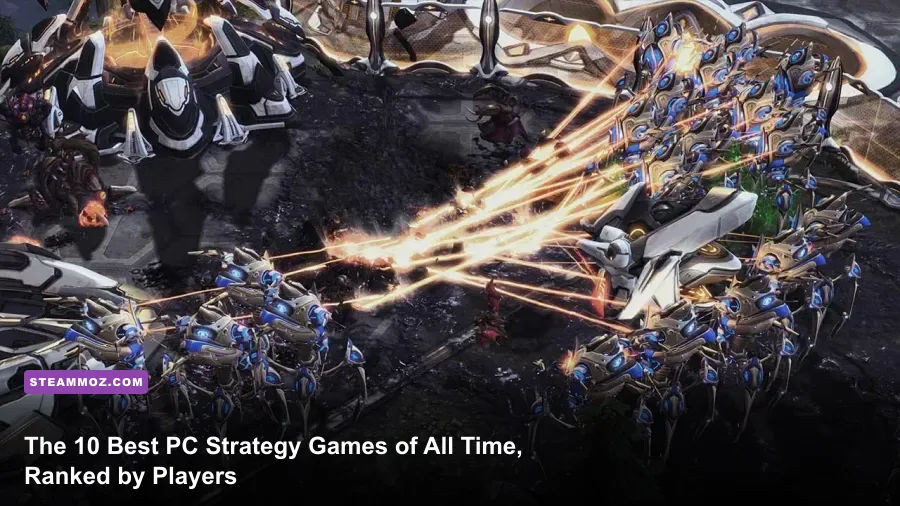
No RTS before or since has matched the mechanical purity of Blizzard's competitive titan. Released across three campaigns and perfected over a decade of balance patches, StarCraft II operates at an engine tick-rate that treats micro-management like high-speed fencing. Playing Zerg requires internalizing inject timers, creep spread cadence, and instantaneous supply management; Terran demands hyper-precise Marine splits against Baneling detonations and Siege Tank leapfrogging; Protoss turns energy economics, Warp Gate cooldowns, and Force Field geometry into an art form.
What locks StarCraft II at number one is its lack of RNG. Aside from high-ground vision checks, combat outcomes are deterministic. If your third base falls to a 16-Marine stim drop at the 5:10 mark, it wasn't bad luck—it was an unspotted scouting denial or an unrefined build order. With a thriving arcade community and an esports scene that refuses to die, it remains the sharpest competitive blade in gaming history.
2. Sid Meier's Civilization V: Complete Edition
While Civilization VI introduced district unstacking and climate shifts, Civilization V—fortified by the Gods & Kings and Brave New World expansions—stands as the most mechanically harmonious 4X ever designed. By switching the franchise from square tiles to hex grids and establishing the ruthless 1UPT (One Unit Per Tile) restriction, Firaxis transformed military campaigns from clunky "stacks of doom" into tactical meat grinders. Chokepoints between mountain ranges suddenly mattered. Archers positioned behind defensive spearmen could hold off invading empires three times their size.
Add the community-built Vox Populi mod suite, and Civ V reaches strategic nirvana. Balancing Social Policies, generating Great Person points, managing happiness thresholds, and executing timing attacks with Artillery before an opponent discovers Flight creates an obsessive, hypnotic game loop that defines "just one more turn."
3. Total War: WARHAMMER III (Immortal Empires)
Creative Assembly spent nearly a decade combining three massive strategy games into a single, monstrous campaign: Immortal Empires. It's an unprecedented engineering feat. You command nearly 100 playable factions across a colossal world map, seamlessly shifting from turn-based geopolitical administration to real-time tactical battles involving thousands of individual combatants.
The asymmetric balance here is staggering. Managing the mechanical logistics of the Skaven's Under-Empire feels nothing like balancing the High Elves' court intrigue or the Khorne faction's bloodletting mechanics. In tactical battles, physics-based artillery trajectories, monstrous infantry mass, and active magic reserves force you to think about hammer-and-anvil tactics in three dimensions. Check out the official Total War: WARHAMMER III store page to appreciate the sheer volume of content packed into this sandbox.
4. Crusader Kings III
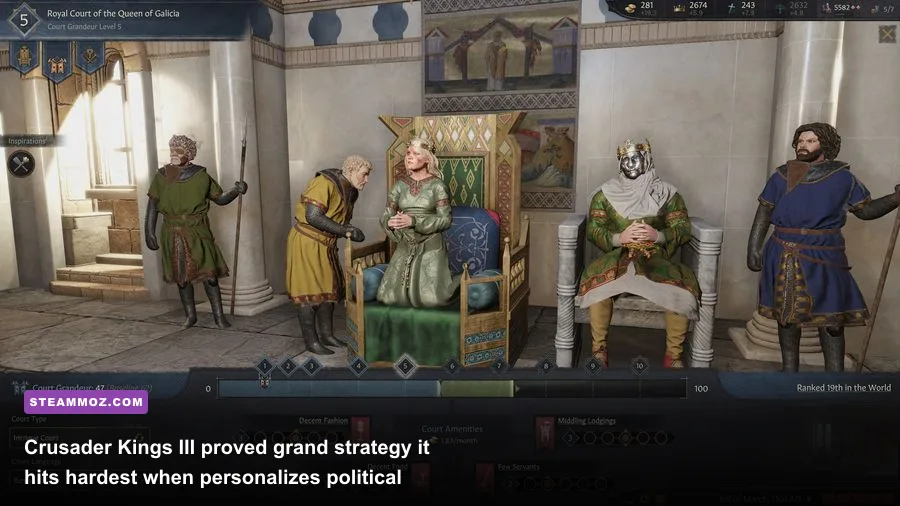
Grand strategy has a reputation for being cold, dry, and mathematically detached. Paradox Interactive blew that stereotype apart with Crusader Kings III. Instead of piloting a faceless nation-state, you inhabit an individual ruler within a medieval dynasty. Your empire doesn't fracture because an arbitrary rebellion meter filled up; it fractures because your firstborn son is an arrogant, vengeful drunkard who despises your spymaster, while your second son secretly fathered a bastard with your rival's wife.
Mechanically, the Stress System is CK3's stroke of genius. Forcing your character to act against their innate personality traits (like executing prisoners when your ruler is compassionate) accumulates mental strain, eventually triggering psychological breaks, alcoholism, or early death. By chaining grand strategy map painting to personal human drama, CK3 created an entirely new breed of emergent strategic roleplay.
Comprehensive Comparison: Metrics, Complexity, and Meta Longevity
To help you navigate between real-time APM challenges, long-form grand strategy simulations, and tactical turn-based puzzle boxes, we've broken down our top picks by their core performance indicators.
| Game Title | Sub-Genre | Complexity (1-10) | Pace / APM Demand | Defining Strategic Hook | Community Longevity |
|---|---|---|---|---|---|
| StarCraft II | Real-Time Strategy | 9.5 | Ultra-High (150-300+ APM) | Deterministic balance & frame-tight macro | Esports staple, massive Arcade scene |
| Civilization V: Complete | 4X Turn-Based | 7.5 | Turn-Based (Contemplative) | 1UPT hex tactics & social policy scaling | Thriving with Vox Populi mod overhaul |
| Total War: Warhammer III | Grand Strategy / RTS Hybrid | 8.5 | Moderate (Pauseable Battles) | Immortal Empires scale & combined arms | Vast Steam Workshop ecosystem |
| Crusader Kings III | Grand Strategy RPG | 8.0 | Pausable Real-Time | Dynastic inheritance & personality stress | Massive expansion and mod support |
| XCOM 2: War of the Chosen | Turn-Based Tactics | 8.5 | Turn-Based (High Tension) | Action economy, pod activation, permadeath | Immortalized by Long War of the Chosen |
| Age of Empires II: DE | Real-Time Strategy | 9.0 | High (80-180+ APM) | Economy balance, scouting, counter-units | Active world tours, 25-year ranked meta |
| Supreme Commander: FA | Scale RTS | 9.5 | High (Strategic Zoom Macro) | Flow economy & simulated ballistic physics | Kept alive by FAForever community servers |
| Company of Heroes 2 | Tactical RTS | 8.0 | High (Micro-Focused) | TrueSight system & directional vehicle armor | Dedicated competitive multiplayer scene |
| Stellaris | Space 4X / Grand Strategy | 8.5 | Pausable Real-Time | Empire customization & galactic crisis events | Continuous official custodian overhauls |
| Into the Breach | Deterministic Tactics | 7.0 | Turn-Based (Pure Puzzle) | Telegraphed enemy attacks & board push/pull | Revered by game design scholars |
A-Tier Tactical Titans: Relentless Depth and Turn-Based Brilliance
While the top four hold legendary status, these tactical heavyweights offer some of the most intense, mechanics-dense gameplay loops you can install on your rig.
5. XCOM 2: War of the Chosen
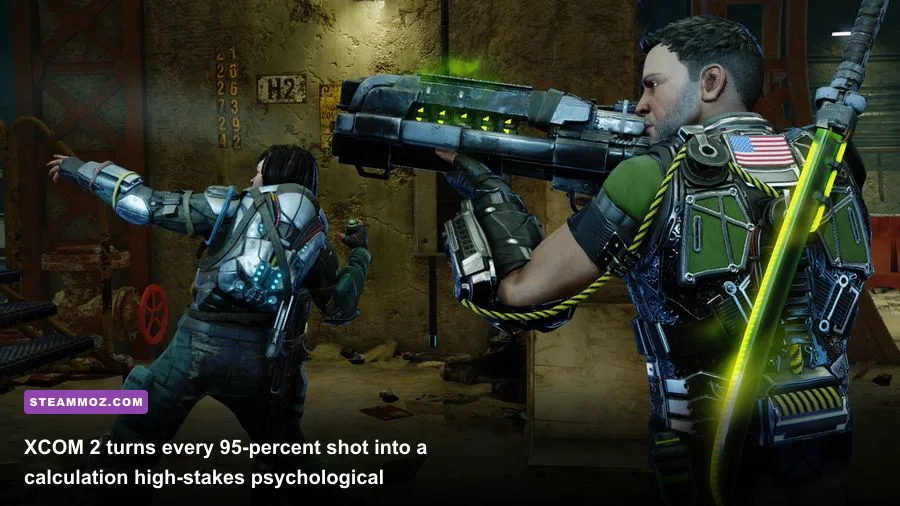
Firaxis took the brutal foundation of Enemy Unknown and perfected it in XCOM 2. By introducing the Concealment mechanic, the game transformed squad tactics from defensive creeping into lethal guerrilla ambushes. You control the engagement. Lining up a Reaper claymore with a sniper squad sightline to wipe out an entire ADVENT patrol before they fire a shot is intoxicating.
The War of the Chosen expansion dialed this up to eleven. Introducing the three Chosen champions—procedurally generated stalkers that ambush you mid-mission, exploit your soldiers' psychological fears, and gain random immunities—injected white-knuckle panic into every turn. Combined with turn-timers that prevent turtling and the monumental Long War of the Chosen mod, it is the undisputed king of squad-level turn-based tactics.
6. Age of Empires II: Definitive Edition
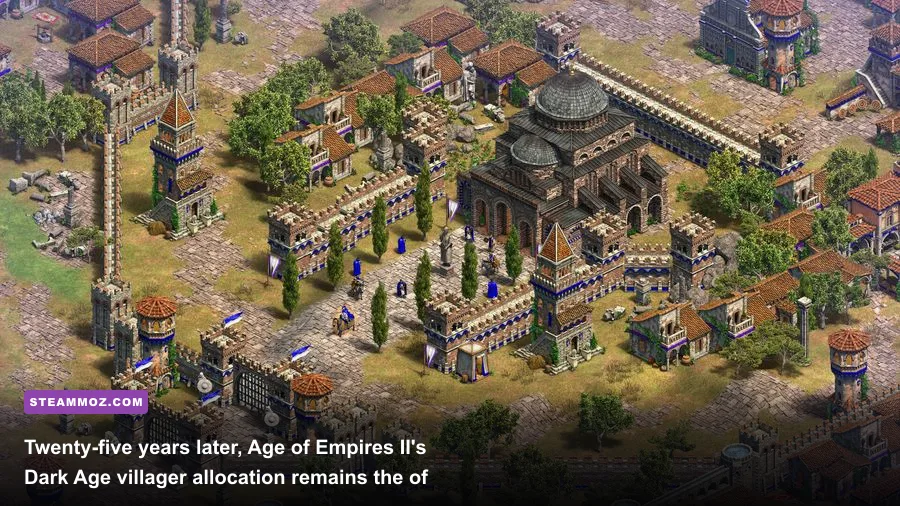
Few games survive 25 years with an expanding player base, but Age of Empires II: Definitive Edition isn't an ordinary game. Its economy operates on a ruthless flow model: managing 40+ villagers split between food, wood, gold, and stone while timing your Dark Age boar luring down to the second. A single mistake in your 21-pop Feudal Age build order leaves your woodline completely vulnerable to an opponent's Scout cavalry flush.
What keeps competitive players hooked is the micro-dance of unit counters. Dodging Mangonel boulders by splitting crossbow lines, quick-walling an exposed gap with palisades mid-raid, and calculating armor-penetration thresholds makes AoE2 as intensely technical as any modern esports title.
7. Supreme Commander: Forged Alliance
No RTS before or since has ever attempted the raw, ridiculous scale of Supreme Commander: Forged Alliance. While traditional RTS titles lock your camera to a 40-meter tactical patch, SupCom introduced the Strategic Zoom, allowing you to scroll from an individual engineer welding a radar dish all the way out to a full planetary theatre map in one smooth motion.
Its flow economy—where resources generate and consume continuously rather than pooling like cash—demands immense foresight. Battles aren't skirmishes; they are continental artillery bombardments, experimental spider-bot sieges, and nuclear intercept duels calculated with true physical ballistics. If an artillery shell arcs over a mountain, its trajectory physically checks against terrain polygons. Kept vibrant today via the community-maintained Forged Alliance Forever (FAF) client, it is an engineering marvel that has never been surpassed.
8. Company of Heroes 2
Relic Entertainment understood something crucial about tactical combat: real firefights are determined by suppression and line-of-sight, not arbitrary hitpoint pools. Company of Heroes 2 brought the TrueSight system to life, simulating realistic visibility cones based on walls, hedgerows, and vehicle hulls. You cannot shoot what your soldiers cannot physically see, turning urban ruins and rural forests into terrifying blind zones.
Directional armor calculations make tank engagements thrilling. Angling a Panzer IV's frontal plate can bounce high-velocity anti-tank rounds, while infantry equipped with PTRS rifles scramble to flank thin rear armor. Add dynamic weather where blizzards freeze troops and ice rivers shatter under mortar fire, and you get an adrenaline-fueled RTS that values tactical positioning over raw base-building speed.
B-Tier Innovators: Unique Mechanics That Redefined the Genre
Not every legendary strategy title needs massive armies or hundreds of APM. Some of the greatest games ever made stripped away the excess to deliver pure, concentrated tactical problem-solving.
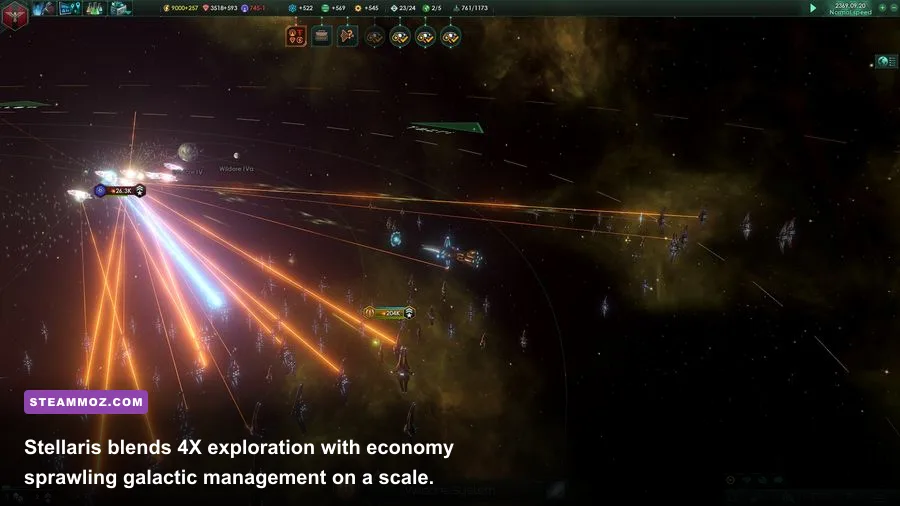
9. Stellaris
Paradox's grand sci-fi experiment takes the traditional 4X opening—explore, expand, exploit, exterminate—and morphs it into a massive simulation of galactic sociology. You don't just pick a faction; you engineer a species. You can run a hive-minded plant species that eats stars, a hyper-democratic coalition of synthetic humanoids, or a megacorporation running galactic slave-markets.
Navigating mid-game hyperlane networks and surviving apocalyptic endgame crises (like interdimensional invaders or rampaging AI fleets) tests your economic throughput to the limit. For commanders who enjoy tuning fleet loadouts and navigating vast deep-space maps, exploring space-based system upgrades parallels the thrill of tracking down elite ship modules in our EVERSPACE 2 secret locations and gear guide.
10. Into the Breach
Subset Games did the unthinkable with Into the Breach: they removed all randomness from tactical combat. There are no percentage-to-hit misses. No critical strikes. The alien Vek broadcast their exact intended attacks on an 8x8 grid, including which residential building they will crush on the next turn. Your job is not to out-damage them; your job is to manipulate the board like a grandmaster.
You use artillery mechs to knock enemies off course so their claws strike empty air, or hook an enemy into the line of fire of another alien's projectile. Your power grid doubles as your global health bar; if civilian cities take too much collateral damage, timeline collapse occurs and your squad jumps into an alternate reality to start over. It is pure, unfiltered deterministic chess with giant robots.
| Game / Engine | Performance Profile | CPU / Thread Bottleneck | Optimal System Tweak |
|---|---|---|---|
| Total War: Warhammer 3 (Warscape Engine) | Heavy GPU & CPU draw | Draw calls during 40v40 unit collisions | Cap VFX detail; lock 3D UI rendering |
| Stellaris (Clausewitz Engine) | CPU single-thread bound | Late-game pop job calculation checks | Reduce galaxy stars to 600; purge unused species |
| Supreme Commander: FA (Moho Engine) | Single-core simulation speed | Ballistics pathing for 1000+ units | Use FAForever client LUA performance patch |
| Civilization V (Firaxis LORE Engine) | Moderate RAM / CPU bound | Inter-turn AI decision evaluation | Enable Quick Combat and Quick Movement in UI |
When late-game turn simulations begin stuttering on older machines, fine-tuning your game profiles makes all the difference. Much like clearing render hiccups in tactical puzzle engines using Filament Marmalade Edition settings for higher FPS, dialling back physics clutter and background thread workloads prevents game-breaking slowdowns. If you encounter persistent memory bottlenecks on heavily modded setups, standard troubleshooting like the steps in our Elex PC fixes for crashes and FPS drops can help restore system stability before your next 10-hour campaign session.
What Makes a PC Strategy Game Immortal?
Graphics fade fast. A cutting-edge 3D model that looked revolutionary in 2012 will look dated today, but rock-solid strategy mechanics don't age. The reason games like StarCraft II, Age of Empires II, and Civilization V continue to see hundreds of thousands of daily players comes down to mechanical transparency, deterministic balance, and deep modding support.
PC remains the holy land for this genre because keyboards and mice offer the precise spatial inputs, hotkey configurations, and sub-pixel selection boxes that gamepads simply cannot replicate. When your entire tactical plan hinges on shifting an artillery cannon three meters to the left or queuing six production buildings within a two-second window, the hardware interface matters as much as your cerebral planning. Just as fixing control latency or camera stutter is vital when tackling precision puzzle games—as detailed in our EscapeVR basement low FPS fixes—having a responsive mouse and zero input lag is the baseline requirement for mastering high-level PC strategy.
Whether you're looking to climb the hyper-competitive 1v1 ladder in StarCraft II, engineer dynastic murders in Crusader Kings III, or carefully puzzle out a three-mech counter-offensive in Into the Breach, these ten titles represent the finest mental workouts PC gaming has ever offered. Clear your weekend schedule, brew a fresh pot of coffee, and get ready to utter the most dangerous phrase in gaming: just one more turn.