
When you aggregate millions of user reviews across Steam, Metacritic user scores, and decades of community forums, the verdict is definitive: the best PC games of all time are not merely visually dazzling spectacles, but mechanically transcendent masterworks that exploit everything unique to the platform. At the peak of player consensus stand Baldur's Gate 3, Half-Life 2, The Witcher 3: Wild Hunt, and Portal 2—titles that redefined emergent physics, narrative branching, and uncompromised player agency. PC gamers have historically rejected shallow cinematic corridors in favor of systems-heavy game design, high skill ceilings, granular input precision, and active modding ecosystems that keep communities thriving for decades.
Consensus S-Tier: The Masterpieces That Redefined PC Gaming
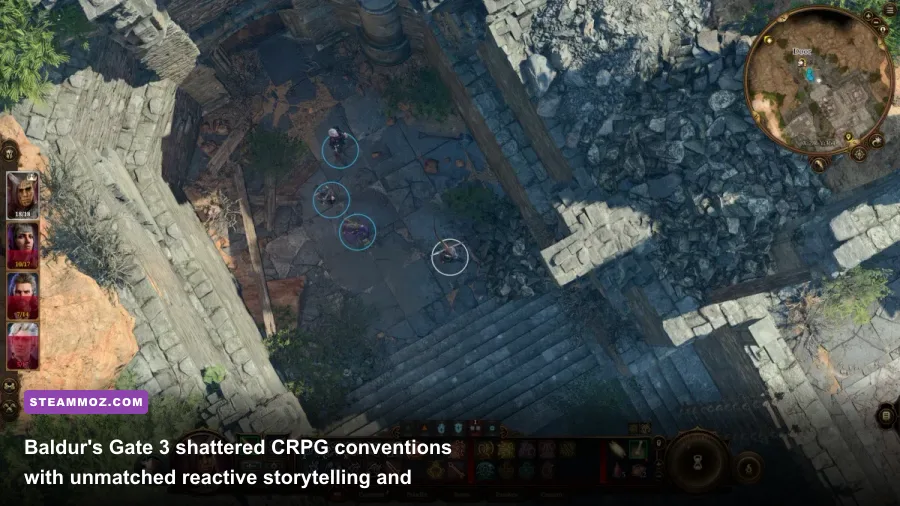
To claim the undisputed summit of PC gaming history, a title cannot merely be great for its release year; it must fundamentally transform game design. Baldur's Gate 3 achieved what the industry considered commercially impossible: launching a dense, uncompromising, turn-based CRPG based on the Dungeons & Dragons 5th Edition ruleset and dominating global charts. Larian Studios leveraged their proprietary Divinity 4.0 engine to construct a sandbox of terrifying complexity. Every spell, surface, elevation layer, and dialogue branch operates under systematic logic. Coat a chokepoint in grease, ignite it with a Firebolt, push a charging Minotaur into the Underdark abyss using an off-hand Bonus Action Shove, or talk an entire boss encounter into self-destruction via Charisma checks—the game bends to your creativity.
Much of its staying power stems from mechanical transparency. While casual players appreciate the cinematic delivery, hardcore enthusiasts obsess over buildcraft. Whether you are running an Open Hand Monk abusing the Tavern Brawler feat to add double your Strength modifier to attack and damage rolls, or stacking Spell Save DC through items like the Helm of Arcane Acuity to achieve an irreversible 100% hold rate on Raphael, the game respects mathematical mastery. You can examine the game's full feature set directly on the official Baldur's Gate 3 on Steam page, where it retains one of the highest positive review percentages in platform history.
Standing shoulder-to-shoulder with Larian's triumph is Valve's 2004 titan, Half-Life 2. It is virtually impossible to overstate how revolutionary the Source Engine was upon arrival. Before Gordon Freeman stepped into City 17, physics in first-person shooters were primarily decorative. Valve made Newtonian mechanics the core gameplay loop. The Zero Point Energy Field Manipulator—the Gravity Gun—did not just launch saw blades through zombies in the haunting corridors of Ravenholm; it transformed the entire environment into an interactive armory. Paired with peerless pacing that shifts seamlessly from tight corridor firefights to open-throttle hovercraft sprints across toxic canals, Half-Life 2 remains the quintessential showcase of wordless environmental storytelling and mechanical ingenuity. You can still inspect its technical milestones on the Half-Life 2 Store Page.
🎮 1bitHeart
Looking to experience this game? Grab your digital key directly on our store for $2.99.
View on Steammoz Store →Narrative Sovereignty: The Roleplaying Heavyweights

PC gaming has always been the promised land for narrative depth, where sprawling scripts and consequential moral ambiguity take precedence over linear cinematic rollercoasters. The Witcher 3: Wild Hunt demonstrated how to marry high-budget production with world-class writing. Built on REDengine 3, CD Projekt Red crafted a gritty, Slavonic dark-fantasy world devoid of easy black-and-white choices. The Bloody Baron questline ('Family Matters') remains legendary not because of flashy boss encounters, but because it tackled domestic trauma, grief, and desperation with raw emotional maturity.
Under the hood, the combat and character progression rewarded deep mechanical preparation. High-level play turns Geralt into an alchemical juggernaut. By combining the Acquired Tolerance and Heightened Tolerance skills, players could push toxicity thresholds past 240, running three concurrent Decoctions—such as Water Hag for a 50% damage boost at full health and Ekimmara for life-steal—while activating the Euphoria mutation from the Blood and Wine expansion to gain an absurd 210% scaling bonus to sword attack power and Sign intensity. You can read the sustained aggregate praise on the Metacritic User Consensus for The Witcher 3. Dissecting the best loadouts and stat scaling is a staple of PC gaming, much like analyzing classic weapon efficiency in our Far Cry 3: Blood Dragon weapons ranked breakdown.
Then there is Disco Elysium - The Final Cut, a game that discarded traditional combat entirely and produced the most intoxicating RPG of the modern era. Developed by ZA/UM, Disco Elysium functions as a forensic isometric psychological simulator where your own fragmented psyche serves as both party members and adversaries. Your 24 distinct internal skills—ranging from Inland Empire (imagination and gut premonitions) to Encyclopedia (compulsive trivia recitation) and Physical Instrument (brute machismo)—constantly chime into dialogue, bickering and lying to you. The game's Thought Cabinet functions as a cerebral inventory, where internalizing radical sociopolitical theories or bizarre psychological traits yields passive bonuses and unique dialogue flags. Passing a critical Red Check on a 2d6 roll under the bleak neon haze of Martinaise carries more kinetic tension than most conventional third-person shooters could ever dream of conjuring.
The Definitive Community Ranking Matrix
Ranking the greatest PC games of all time requires balancing raw critical legacy, community review sentiment, technical innovation, and ongoing replay value. Below is the consensus matrix evaluating the top 10 titles ever to grace the desktop platform:
| Consensus Rank & Game | Release Year | Community Approval | Core Engine / Architecture | Defining PC Gameplay Innovation |
|---|---|---|---|---|
| #1 Baldur's Gate 3 | 2023 | 96% Positive (500k+ Reviews) | Divinity 4.0 | Unrivaled narrative reactivity, emergent surface physics, and tactical D&D 5e adaptation. |
| #2 Half-Life 2 | 2004 | 97% Positive (150k+ Reviews) | Source Engine (Havok Physics) | Integration of rigid-body physical puzzle solving as an offensive combat weapon. |
| #3 The Witcher 3: Wild Hunt | 2015 | 96% Positive (700k+ Reviews) | REDengine 3 | Multi-layered, morally ambiguous quest architecture with intricate alchemy craft builds. |
| #4 Portal 2 | 2011 | 98% Positive (300k+ Reviews) | Source Engine | Spatial momentum puzzle engineering and peerless two-player cooperative synergy. |
| #5 Disco Elysium - The Final Cut | 2019 | 93% Positive (80k+ Reviews) | Unity (Custom Narrative Tools) | Replacing physical combat with 24 internal psychological voices and the Thought Cabinet. |
| #6 Elden Ring | 2022 | 92% Positive (600k+ Reviews) | FromSoftware Proprietary Engine | Flawless open-world discovery loop governed by strict poise-break combat mechanics. |
| #7 Fallout: New Vegas | 2010 | 96% Positive (160k+ Reviews) | Gamebryo | Complex faction rep systems, Damage Threshold mechanics, and extensive modding ceiling. |
| #8 Deus Ex (2000) | 2000 | 94% Positive (Classic Status) | Unreal Engine 1 | Pioneered the immersive sim genre: multi-path stealth, cybernetics, and computer hacking. |
| #9 DOOM Eternal | 2020 | 91% Positive (160k+ Reviews) | id Tech 7 | High-framerate combat resource loop: Chainsaw for ammo, Flame Belch for armor. |
| #10 Mass Effect 2 | 2010 | 95% Positive (Classic Status) | Unreal Engine 3 | Squad loyalty interplay culminating in the high-stakes, logically calculated Suicide Mission. |
System-Driven Immersion: When Mechanics Become Art

While some games rely on scripted events, PC gamers revere titles where systems interact organically. Consider Valve's Portal 2, widely regarded as the most mechanically flawless puzzle game in history. Building on the brilliant proof-of-concept of its predecessor, Portal 2 leveraged Source's momentum mechanics to introduce propulsion, repulsion, and conversion gels, turning spatial geometry into an intellectual obstacle course. Between GLaDOS's dry malice, Stephen Merchant's brilliant turn as Wheatley, and the community level-editor on the Valve Portal 2 Hub, it represents pure mechanical perfection.
On the opposite end of the spectrum sits Fallout: New Vegas. Obsidian Entertainment had a punishing 18-month development cycle, inherited the unstable Gamebryo engine, and yet produced an RPG so mechanically nuanced that Bethesda's own modern entries pale in comparison. New Vegas rejected the simple percentage-based damage reduction of its peers in favor of a dual-tier Damage Threshold (DT) and Damage Resistance (DR) system. If a Deathclaw possesses a DT of 15, firing 9mm rounds with base 12 damage means you barely tickle it; you need high single-shot alpha damage from a .308 Hunting Rifle or specialized armor-piercing hand-loaded rounds to punch through.
New Vegas also introduced an intricate multi-tier faction reputation system—tracking your Standing from Idolized down to Vilified across the NCR, Caesar's Legion, and local towns like Goodsprings. When players ran into the inevitable bugs of such an ambitious engine, the PC community stepped in with transformative community fixes like the 4GB Patcher, New Vegas Anti-Crash (NVAC), and Tick Fix. Resolving technical engine limits through player ingenuity is a proud tradition on PC, much like diagnosing stability in titles through our Elex PC crashes and FPS optimization manual or checking baseline specs in our Far Cry 2 PC specs guide.
We cannot discuss player agency without acknowledging Deus Ex (2000). Warren Spector and Harvey Smith established the rules of the 'immersive sim' that modern developers still chase today. When tasked with infiltrating the Statue of Liberty in the opening mission, JC Denton isn't given an invisible wall or an arbitrary cutscene: you can swim around the perimeter, stack crates to climb a back window, hack security turrets via computer terminals, pick locks using Multitools, or blow the front doors open with a GEP gun. The game never judges your approach; it simply establishes consistent physical rules and challenges you to exploit them.
Precision Combat and Mastery: The Skill-Ceiling Titans

The PC is also the premier platform for mechanical skill expression. From mouse input without artificial smoothing to high-refresh-rate panels running at 144Hz, 240Hz, or beyond, competitive gamers demand responsiveness. Elden Ring took FromSoftware's notoriously punishing combat model and unleashed it into the Lands Between. What makes Elden Ring rank so highly among PC enthusiasts is not just its awe-inspiring vistas, but the granularity of its combat mechanics.
Beneath the surface of every boss fight lies a hidden poise-damage calculation. A colossal weapon like the Giant-Crusher utilizing a fully charged heavy attack inflicts massive stance damage (upwards of 40 points per hit), allowing players to systematically stagger colossal threats like Starscourge Radahn or Malenia. PC players quickly embraced tools to uncap framerates and fine-tune graphics profiles—balancing volumetric effects, shadow cascades, and anti-aliasing to maintain a locked framerate. Ensuring smooth frame pacing in sprawling worlds is paramount, just as we break down performance profiles in our Far Cry 6 settings for maximum FPS and uncover dense secrets across uncharted maps in our Everspace 2 secret locations guide.
Meanwhile, DOOM Eternal turned the first-person shooter into an adrenaline-soaked game of high-speed mechanical chess. Running on id Software's blistering id Tech 7 engine, DOOM Eternal discarded the safe cover-shooter conventions that dominated the industry for over a decade. In their place, it introduced the 'fun zone': an unrelenting push-forward combat loop where every enemy encounter demands instant resource balancing.
Need ammunition? You must rev the Chainsaw on a fodder zombie. Bleeding out of armor? Ignite a pack of Imps with the Flame Belch and shatter them with a Super Shotgun blast. Desperately low on health? Stagger a Hell Knight to execute a violent Glory Kill. High-level PC play on Nightmare difficulty turns combat into an astonishing display of muscle memory: weapon-switching between the Precision Bolt rifle and Ballista in fractions of a second to animation-cancel cooldowns, double-dashing through mid-air, and swinging on Meathooks across battle arenas at 165 frames per second.
What Truly Makes a Game a 'PC Masterpiece'?
Examining this historic ranking reveals a clear common denominator: the games PC players hold dearest are those that respect the strengths of the platform. A true PC masterpiece is defined by three non-negotiable pillars:
- Total Mechanical Agency: Whether it is the branching dialogue trees of Disco Elysium, the emergent chemical interactions of Baldur's Gate 3, or the open infiltration routes of Deus Ex, PC gamers want their decisions to matter mathematically and narratively.
- Platform Scalability and Control Precision: A console game ported without raw mouse input, locked at 60 FPS, or suffering from shader compilation stuttering is swiftly penalized by the community. Masterpieces harness uncapped framerates, zero mouse acceleration, ultrawide resolutions, and rebindable control schemes.
- Modding Architecture and Preservation: Consoles rely on generational remasters; PC relies on community immortality. From the fan-made fixes that allow Vampire: The Masquerade - Bloodlines to run on modern Windows machines, to total conversions like Fallout: London or the endless custom maps of Portal 2, open software architecture ensures that the greatest games never die.
The PC platform remains the proving ground of the video game medium. While hardware generations come and go, graphics APIs evolve from DirectX to Vulkan, and graphics cards grow increasingly complex, the titles that endure at the very top of gamer-ranked lists share a singular virtue: they treat the player as an intelligent co-conspirator in an open, systemic sandbox.