Yes—Steam PC games are still worth playing in 2026, and the platform’s strongest argument isn’t cutting-edge graphics. It’s choice. For the price of one new release, you can build a library spanning Hades, Baldur’s Gate 3, Deep Rock Galactic, Stardew Valley, Cyberpunk 2077, and decades of PC classics, then play them at higher frame rates, with mods, ultrawide support, community fixes, and mouse-and-keyboard control. Steam isn’t perfect—store discovery is messy, live-service fatigue is real, and modern PC ports can launch in rough shape—but its value proposition is stronger than ever.
The honest answer depends on what you want from gaming. If you need every major release on day one with flawless optimization, Steam can be frustrating. If you care about ownership flexibility, performance tuning, backward compatibility, indie experimentation, and a gigantic backlog, it remains the best all-purpose gaming platform in 2026.
Why Steam’s Back Catalog Still Wins
Steam’s most underrated feature is time. A game doesn’t become irrelevant because it launched five or ten years ago; often, patches, DLC, mods, and cheaper hardware make it better. Portal 2 still delivers cleaner puzzle design than many newer releases. Left 4 Dead 2 remains a brilliant four-player co-op machine because its AI Director keeps encounters unpredictable. Terraria has received so much post-launch content that its progression curve can outlast a full-price 2026 blockbuster.
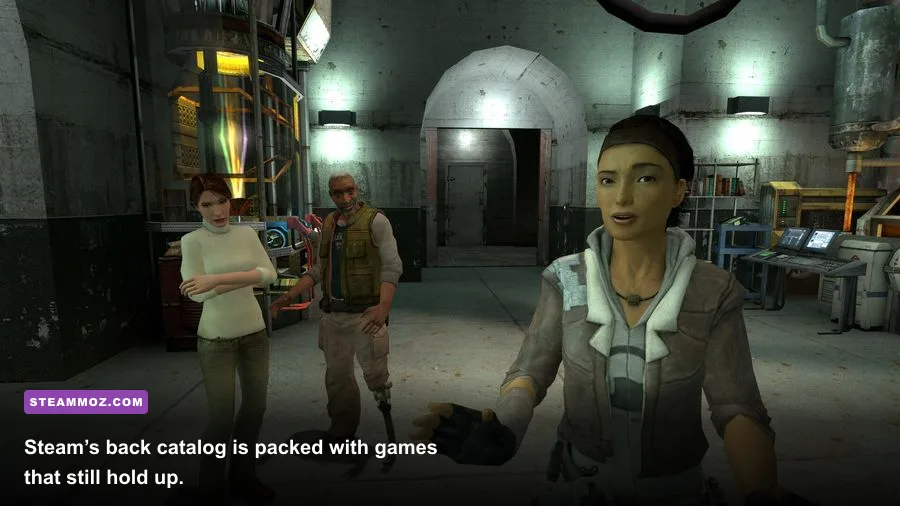
Valve’s own catalog demonstrates the advantage. Half-Life 2 runs effortlessly on modern systems, supports Steam Workshop content, and still teaches environmental storytelling through physics, pacing, and level design rather than map-marker overload. Counter-Strike 2 is free to start and continues to provide a precise competitive shooter loop, although its matchmaking experience and cosmetic economy won’t appeal to everyone.
Steam also preserves odd, specific games that consoles often lose during generation changes. You can jump from Vampire Survivors to Disco Elysium, from Euro Truck Simulator 2 to Warhammer 40,000: Darktide, without changing hardware or waiting for a remaster. That breadth is not just nostalgia. It means there’s nearly always a game suited to your available time, mood, and hardware.
| Game Type | Strong Steam Example | Why It Holds Up | Best Use Case |
|---|---|---|---|
| Classic single-player | Portal 2 | Sharp puzzles, stable performance, Workshop support | Short focused sessions |
| Replayable co-op | Deep Rock Galactic | Four classes, procedural caves, clear progression | Two-to-four-player nights |
| Indie roguelike | Hades | Fast combat, meaningful story runs, excellent controller feel | Repeatable 20–40 minute runs |
| Huge RPG | Baldur’s Gate 3 | Turn-based combat, reactive quests, extensive mod potential | Long-form weekend play |
For a useful reality check on older hardware, Steam’s official store search lets you filter by price, controller support, reviews, and operating system. That simple filtering is still more practical than chasing whatever game is currently trending.
Steam’s Best Games Are Not Always New Releases
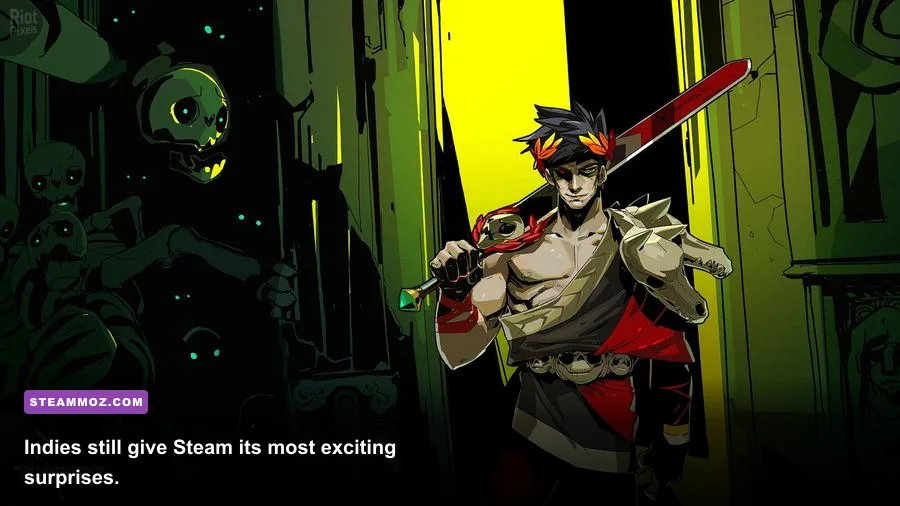
The biggest reason Steam remains worth playing is that its best experiences come from different eras. Hades turns repeated failure into narrative progress through Titan Blood upgrades, Mirror of Night talents, and weapon aspects. Balatro builds an entire strategy game around poker hands, then breaks its own rules with Jokers such as Blueprint, Brainstorm, and Photograph. Neither needs a gigantic open world to justify hundreds of hours.
That design variety is especially valuable in 2026, when many premium games are built around 60-hour checklists, seasonal currencies, and launch-week monetization. A compact title with a clear loop can feel more respectful of your time. Vampire Survivors asks you to move, position, and choose upgrades; it doesn’t ask you to clear a battle pass before the fun begins.
There are also modern games that justify the platform’s hardware demands. Cyberpunk 2077: Phantom Liberty is a showcase for ray-traced lighting, but it’s equally playable with rasterized settings and a sensible 60-fps target. Monster Hunter: World still has one of the strongest action-RPG progression loops on PC: learn a monster’s tells, craft a weapon from its parts, then return with a build that changes the matchup rather than simply raising an item level.
My candid ranking of Steam’s long-term value looks like this:
- S-Tier: Hades, Balatro, Slay the Spire, Stardew Valley, Portal 2, Deep Rock Galactic, Terraria, and Baldur’s Gate 3. These games offer either exceptional replayability or a campaign worth revisiting.
- A-Tier: Cyberpunk 2077, Elden Ring, Monster Hunter: World, Disco Elysium, Factorio, and The Witcher 3. Their value is enormous, though some demand more time, patience, or hardware tuning.
- B-Tier: Older annual sports games, abandoned live-service titles, and technically unstable ports. They can still be fun, but server health, licensing, or patch support creates real risk.
| Tier | Typical Value | What to Check | Verdict |
|---|---|---|---|
| S-Tier | Hundreds of quality hours | Usually positive recent reviews | Buy confidently during a sale |
| A-Tier | Excellent campaign or deep systems | Hardware and time commitment | Worth full attention, often discounted |
| B-Tier | Situational enjoyment | Servers, DLC, controller support | Research before buying |
Steam’s official refund policy also lowers the risk: generally, eligible games can be refunded within 14 days if you’ve played for less than two hours. That isn’t a substitute for research, but it’s a useful safety net against a bad port or a game that simply isn’t your thing.
Performance Is Still Steam’s Killer Feature

PC gaming’s advantage is control, not automatic perfection. A mid-range system can often deliver a better experience than a console if you target the right frame rate instead of blindly selecting Ultra. In a fast shooter such as Counter-Strike 2, stable frame pacing at 144 fps matters more than cinematic shadows. In Baldur’s Gate 3, a locked 60 fps is usually a smarter compromise than sacrificing image quality for 100 fps you barely notice during turn-based combat.
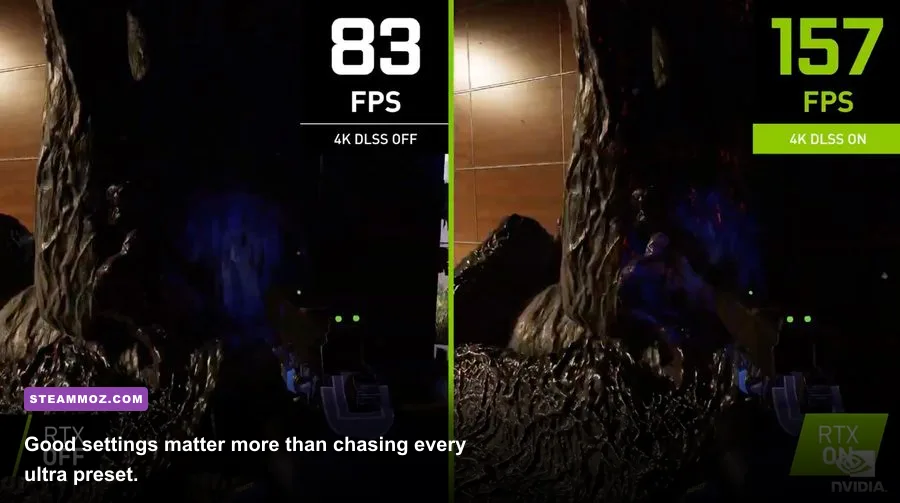
Upscaling technologies make the choice more interesting. DLSS is usually the first option to test on an Nvidia RTX card, while FSR supports a wider range of GPUs. Frame generation can make a single-player game feel smoother, but it doesn’t remove input latency and shouldn’t be treated as a replacement for a healthy base frame rate. If the game renders at 35 fps and invents extra frames, aiming for a genuine 60 fps baseline will usually feel better.
| Setting | Recommended Value | Typical FPS Impact | Visual Trade-Off |
|---|---|---|---|
| Ray tracing | Off or Medium | High, often 15–35% | Less accurate lighting and reflections |
| Shadow quality | Medium or High | Moderate, 5–12% | Softer or less detailed shadows |
| Volumetric fog | Medium | Moderate to high | Reduced atmospheric density |
| Texture quality | High if VRAM allows | Low GPU impact, high VRAM use | Sharper surfaces at a distance |
| DLSS or FSR | Quality at 1440p | Usually 15–35% gained | Slight reconstruction softness |
| Motion blur | Off | Negligible | Cleaner camera movement |
There’s a practical reason to keep Steam in the conversation: community patches can rescue games that publishers have abandoned. Before buying an older title, check recent reviews, the PC Gaming Wiki, controller compatibility, and whether its community fixes still work. Steamoz’s guides to ELEX performance fixes and Far Cry 6 settings show the difference between a game that is merely old and one that is still easy to maintain.
Steam Deck Changed What PC Ownership Feels Like
Steam Deck didn’t replace a desktop gaming PC, but it expanded Steam’s identity. A game library that once lived beside a monitor can now travel on a train, sit beside the television, or fill a 20-minute break. The OLED model’s 90Hz display, improved battery life, and 1280×800 resolution make older and well-optimized games particularly comfortable.
The trade-off is performance. A Steam Deck commonly targets 30 or 40 fps in demanding games, while lighter titles can reach 60 fps or higher. New releases with heavy shader compilation, aggressive CPU simulation, or poor Linux support may require lower settings and a locked frame rate. That’s not a failure of Steam; it’s a reminder that “PC” covers a huge range of hardware.
Proton has also made compatibility far less intimidating. Many Windows games run through Valve’s compatibility layer with little configuration, though anti-cheat systems, launchers, and unusual video codecs can still cause problems. Check the game’s current compatibility status rather than assuming a green badge tells the whole story. Multiplayer games can change their support after an update.
| Hardware Profile | Best Target | Ideal Game Types | Main Limitation |
|---|---|---|---|
| Steam Deck OLED | 30–40 fps at 800p | Indies, RPGs, older AAA games | New CPU-heavy releases |
| 1080p gaming PC | 60–144 fps | Shooters, esports, broad library | Limited ray-tracing headroom |
| 1440p desktop PC | 60–165 fps | Modern AAA and ultrawide play | Higher GPU cost |
| High-end 4K PC | 60–120 fps with upscaling | Visual showcase games | Diminishing value per frame |
Steam’s official Deck Verified page is a useful starting point, but community reports are often more revealing for games marked Playable. A title may technically launch while having tiny text, an awkward launcher, or controls that feel wrong without a mouse.
The Problems You Shouldn’t Ignore
Steam is worth playing on, not blindly trusting. Store discovery is crowded with shovelware, asset flips, early-access projects that never mature, and live-service games that can lose their player base overnight. A high user score helps, but always sort reviews by recent and read the negative comments for recurring complaints about crashes, stuttering, servers, or predatory progression.
Ownership is another complicated word. Most Steam purchases are licenses tied to your account, not permanent offline ownership in the traditional sense. Steam is remarkably resilient, but delisted games, third-party launchers, authentication requirements, and dead multiplayer servers can still affect access. Single-player games with offline modes, local saves, and active mod communities are safer long-term bets.
Modern PC ports also deserve skepticism. Shader compilation stutter, shader-cache issues, memory leaks, and shader traversal hitching can ruin a technically beautiful game. The solution isn’t always buying a faster GPU. Cap the frame rate, update drivers, verify files, disable overlays one at a time, and test a clean save. Steamoz’s crash and low-FPS troubleshooting guide covers the same diagnostic mindset, while our Everspace 2 FPS-first fix explains why stability should come before visual presets.
Finally, don’t confuse a huge backlog with good value. Buying ten games at 80% off is still wasteful if you only wanted one. Use your wishlist, wait for patches, and prioritize games with a clear reason to play them now. Steam’s official player charts can reveal what has staying power, but popularity shouldn’t override your taste.
So, Should You Still Play Steam Games in 2026?
Steam remains worth playing in 2026 because it serves nearly every kind of PC player at once. Competitive players get high-refresh performance and custom settings. RPG fans get enormous campaigns and mod support. Indie players get experimental mechanics that would never survive a blockbuster budget. Deck owners get a portable library, while desktop users can tune image quality, frame rate, input, and accessibility far beyond fixed console presets.
My recommendation is straightforward: keep playing Steam, but become a selective customer. Favor games with strong recent reviews, active developers, reliable offline functionality, and communities that still create mods or guides. Buy demanding releases after performance testing rather than launch-day hype. For older games, look for controller support and community fixes. For multiplayer titles, check server health before spending money.
The platform’s best years aren’t behind it because its value doesn’t depend on one blockbuster. It comes from the overlap of price, variety, technical freedom, and a library that keeps finding new audiences. In 2026, Steam is still the place where a five-dollar roguelike can steal your weekend, a ten-year-old co-op game can rescue a Friday night, and a carefully tuned PC can make a great game feel better than it ever did at launch.