
If you're searching for hidden gem PC games from 2022 you probably never heard of, start with NORCO, Citizen Sleeper, SIGNALIS, Pentiment, The Case of the Golden Idol, and Chained Echoes. They cover strange Southern Gothic adventure, tabletop-inspired sci-fi, survival horror, historical murder mystery, deduction, and classic JRPG combat—six games that rewarded curiosity far more than marketing budgets.
2022 was dominated by huge releases, but these smaller games were often more confident about their identity. None wastes time trying to be everything for everyone. Each has a sharp mechanical hook, a memorable setting, and enough personality to justify the occasional rough edge. Here’s what makes them worth installing now, who they suit, and where each one sits in this highly subjective hidden-gem ranking.
The six games ranked by originality and staying power

The ranking below isn’t a simple quality score. “Staying power” means how strongly a game’s ideas stick with you after the credits. A short game can rank above a 50-hour RPG if its atmosphere, structure, or decisions remain impossible to shake.
| Game | Core genre | Typical length | Best feature | Rank |
|---|---|---|---|---|
| NORCO | Point-and-click narrative adventure | 6–8 hours | Southern Gothic world-building | S-Tier |
| Citizen Sleeper | Dice-driven narrative RPG | 10–15 hours | Character-focused choices | S-Tier |
| SIGNALIS | Survival horror | 8–12 hours | Atmosphere and puzzle design | S-Tier |
| Pentiment | Historical detective RPG | 15–20 hours | Consequences across decades | A-Tier |
| The Case of the Golden Idol | Deduction puzzle game | 10–12 hours | Pure observation | A-Tier |
| Chained Echoes | Turn-based JRPG | 35–45 hours | Active Time Battle pacing | A-Tier |
My S-Tier picks are the games I’d recommend without a warning label. NORCO is deliberately slow, SIGNALIS can be cryptic to the point of irritation, and Citizen Sleeper is mostly menus and text—but those limitations are part of their design rather than evidence of missing content.
NORCO is the strangest point-and-click adventure here
NORCO, developed by Geography of Robots and published by Raw Fury, follows Kay as she returns to a polluted Louisiana town after her mother’s death. The central mystery involves Kay’s missing brother Blake, an oil company called Shield, and a surreal mechanical figure known as the Faceless Man. That setup sounds familiar on paper. The execution is anything but.
The game’s strongest trick is how it treats industrial infrastructure as folklore. Refineries, drainage canals, abandoned malls, and suburban homes are all rendered in dense pixel art, but they never feel like background decoration. The map becomes a diagram of environmental damage and inherited grief. Kay’s search is personal, while the town’s problems are generational.
Mechanically, NORCO is a classic point-and-click adventure with a few modern conveniences. You inspect hotspots, combine clues, revisit locations, and make dialogue choices, but the game rarely hides progress behind old-school moon logic. When a puzzle does become opaque, examine every item in Kay’s inventory and replay recent conversations before randomly clicking the scenery.
The optional “Mind Map” system is especially important. It’s not just a quest log: it tracks Kay’s emotional and investigative associations, opening short conversations and contextual details as you explore. Don’t rush past those nodes. Some of NORCO’s best writing is tucked into seemingly minor observations about local businesses, family rituals, and the people who stayed behind.
The drawback is that the finale leans harder into symbolism than resolution. If you want every mystery explained in a tidy paragraph, the last act may frustrate you. If you enjoy games that leave a little radioactive fog around their answers, this is one of 2022’s most distinctive adventures. See the game’s official Steam page for its complete feature list.
Citizen Sleeper turns survival into a daily dice roll
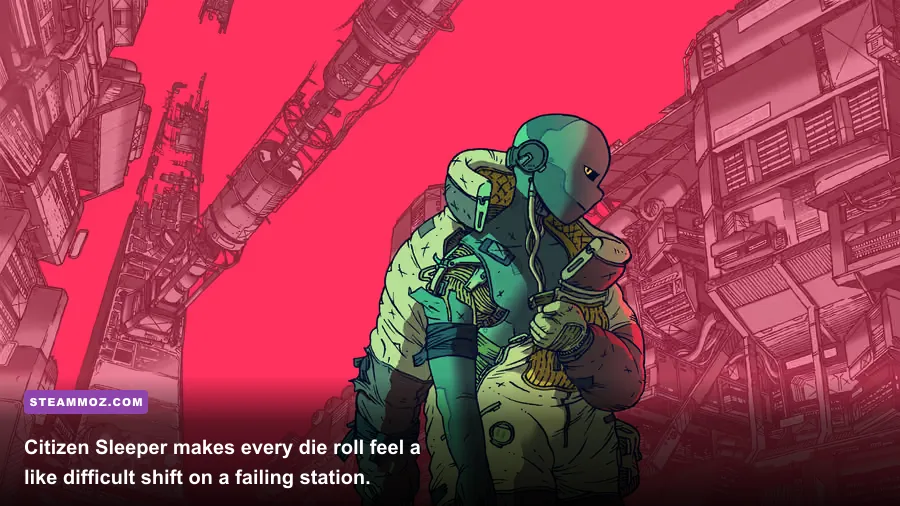
Citizen Sleeper casts you as a “Sleeper,” a synthetic worker whose digitized consciousness has escaped corporate ownership. You arrive on Erlin’s Eye, a damaged space station filled with independent workers, criminals, entrepreneurs, and people trying to avoid the corporation that technically owns your body.
The signature system is built around six-sided dice. At the start of each cycle, the game rolls your available dice, and you assign them to jobs, conversations, repairs, or risky actions. A high roll improves the odds of success, but even a low roll can be useful because many tasks reward partial progress rather than simply declaring failure.
Your condition is represented by a die-shaped health track. Let it deteriorate too far and you’ll lose access to your best actions. The fix is not grinding enemies—there are no traditional fights—but finding food, securing medicine, upgrading your Sleeper’s capabilities, and building relationships that unlock safer work. The game’s “class” choices, such as Extractor, Operator, and Machinist, change which action types you handle most efficiently.
Use the game’s clocks intelligently. A clock is a multi-step objective that advances through repeated actions, and several can expire as station events progress. The best strategy is to commit early to one or two personal goals, then use leftover cycles for profitable jobs. Chasing every available story thread at once can leave you underfunded and scrambling for stabilizers.
| Player type | Best starting approach | Priority | Main danger |
|---|---|---|---|
| Story-first player | Spend strong dice on conversations | Relationship clocks | Ignoring energy and health |
| Optimization-minded player | Build reliable work loops | Upgrades and stabilizers | Overcommitting to low-value jobs |
| Explorer | Open new station areas quickly | Interface and local contacts | Letting timed events expire |
What makes Citizen Sleeper special is that failure usually creates a new story instead of a reload screen. It’s closer to a tabletop campaign than a conventional RPG, and its compact structure makes a second playthrough meaningful. The official Steam listing includes the free post-launch content and current edition details.
SIGNALIS is survival horror with no wasted room
SIGNALIS stars Elster, a Replika technician searching for Ariane inside a hostile, collapsing facility. Its visual language recalls PlayStation-era survival horror, but the game’s cold industrial architecture, CRT-like interface, and dream logic make it feel more like a corrupted transmission than a nostalgia exercise.
Inventory pressure is the first major source of tension. Elster can carry only a limited number of items, so you’re constantly deciding whether a key item is worth occupying a slot that could hold ammunition, healing, or a weapon. The safest habit is to return to the nearest storage box whenever you collect a critical object. Hoarding every pistol round is less useful than carrying the tool needed for the next locked door.
Combat is about creating distance, not clearing rooms. The Handgun is dependable for ordinary enemies, while the Shotgun is best reserved for dangerous Replikas at close range. Flares can permanently neutralize downed enemies, but using them consumes a resource you may later wish you had. The game’s enemies telegraph attacks clearly enough to dodge, yet narrow corridors punish panic firing and greedy item pickups.
Puzzles are built around documents, audio logs, keypads, and visual associations. Write down unusual symbols and numbers rather than assuming the game will restate them. SIGNALIS also expects you to notice environmental repetition: a painting, phrase, or room layout may matter hours after you first see it. Its story is intentionally fragmented, so the answer isn’t always found in the most recent note.
This is the pick for players who miss survival horror that makes ammunition, save points, and hallway geometry feel dangerous. Its later sections become more abstract and its backtracking can test patience, but the atmosphere is exceptional. The official SIGNALIS Steam page is the best place to check current PC requirements.
Pentiment and Golden Idol make investigation the combat
Pentiment follows Andreas Maler, a journeyman artist living in the Bavarian town of Tassing during the 16th century. Developed by Obsidian Entertainment, it uses illustrated manuscript art, period typography, and a three-act structure to turn religious politics, class tension, and murder into one long historical argument.
Andreas’ background traits alter conversations and available deductions. Choosing a scholarly origin, for example, gives him different ways to interpret theology and classical references than a more practical upbringing. There isn’t a universally correct build. The fun comes from accepting that Andreas is informed in some areas and embarrassingly ignorant in others.
The critical advice is to stop treating Pentiment like a perfect-information detective game. You have limited time in each act, and pursuing one lead means abandoning another. Your accusations can be wrong, but the consequences echo through Tassing for years. That makes every decision feel heavier than a standard dialogue choice, especially when a character you dismissed later becomes central to the community’s future.
The Case of the Golden Idol is the sharper, more mechanical counterpart. Across a sequence of bizarre deaths in 18th-century England, you inspect frozen crime scenes, identify every person, and reconstruct the exact murder method. Entering a name or cause of death too early is usually pointless. First collect all visible clues, then connect repeated names, titles, weapons, and motives across cases.
The Golden Idol’s brilliant design is that it never highlights the important clue for you. A hat, posture, newspaper, or unusual adjective can be the difference between a correct solution and a wild guess. The game rewards a notebook and punishes clicking without reading. Its Steam page shows exactly how focused its deduction format is.
Chained Echoes is the hidden gem for classic JRPG fans
Chained Echoes is the biggest recommendation here: a 2022 RPG with roughly 35–45 hours of main-story content, pixel-art environments, airships, political factions, and giant Sky Armor machines. It deliberately borrows from Chrono Trigger, Xenogears, Final Fantasy VI, and Suikoden without becoming a museum piece.
Its most important battle mechanic is the Overdrive gauge. Actions move your party marker through green, yellow, and red zones. Staying in the green improves efficiency, while drifting into red makes enemies hit harder and your party perform worse. The solution isn’t simply “use your strongest attack.” Rotate skills to keep the gauge controlled, then exploit enemy weaknesses when your turn order is favorable.
Every character has a distinct tactical identity. Glenn works well as a durable physical attacker and debuffer, Lenne brings powerful elemental magic, Sienna excels at agility and critical-hit pressure, and Victor supports the party with healing and buffs. The reward board also encourages exploration by placing bonuses behind optional objectives, so backtracking has a mechanical purpose instead of being pure completionism.
Sky Armor battles change the rhythm rather than replacing the normal system. Machines have different equipment options and can handle threats that would overwhelm a human party, but they also make positioning and resource planning more important. Don’t save every consumable for an imaginary final emergency; the game gives you enough tools to handle difficult story encounters if you keep your equipment current.
| Game | Choose it if you want | Skip it if you dislike | Best first session |
|---|---|---|---|
| NORCO | Atmosphere and literary mystery | Ambiguous endings | One uninterrupted evening |
| Citizen Sleeper | Choices with tabletop structure | Text-heavy gameplay | Three to four cycles |
| SIGNALIS | Inventory-driven horror | Backtracking and cryptic lore | Headphones in a dark room |
| Pentiment | Historical drama and consequences | Slow-burn pacing | Read every conversation |
| Golden Idol | Hard deduction puzzles | Taking notes | Two cases at a time |
| Chained Echoes | Classic JRPG systems | Long campaigns | Explore side paths early |
These games also run comfortably on modest PCs, though SSD installation helps with load times and SIGNALIS benefits from a stable frame rate during combat. If your system struggles with older PC ports, Steamoz’s guides to ELEX crash fixes and Filament performance settings cover the same practical basics: update drivers, verify files, and avoid unnecessary overlays.
Which hidden gem should you play first?
Play NORCO first if you want a short, unforgettable narrative. Choose Citizen Sleeper for the most flexible role-playing and SIGNALIS for oppressive horror with genuine mechanical teeth. Pentiment is the strongest choice for history lovers, Golden Idol is ideal when you want your brain doing the fighting, and Chained Echoes is the clear pick for a substantial RPG campaign.
The common thread is confidence. These aren’t diluted versions of bigger games; they’re focused projects with very specific ideas about what games can do. That’s why they remain such strong answers to the search for hidden gem PC games from 2022 you probably never heard of. Start with one, ignore the storefront algorithm for an evening, and you may find the game you remember more clearly than the year’s biggest blockbuster.
For more overlooked discoveries, Steamoz’s guides to secret locations and hidden rewards and efficient progression are useful follow-ups when you’re ready to dig deeper into less obvious PC favorites.