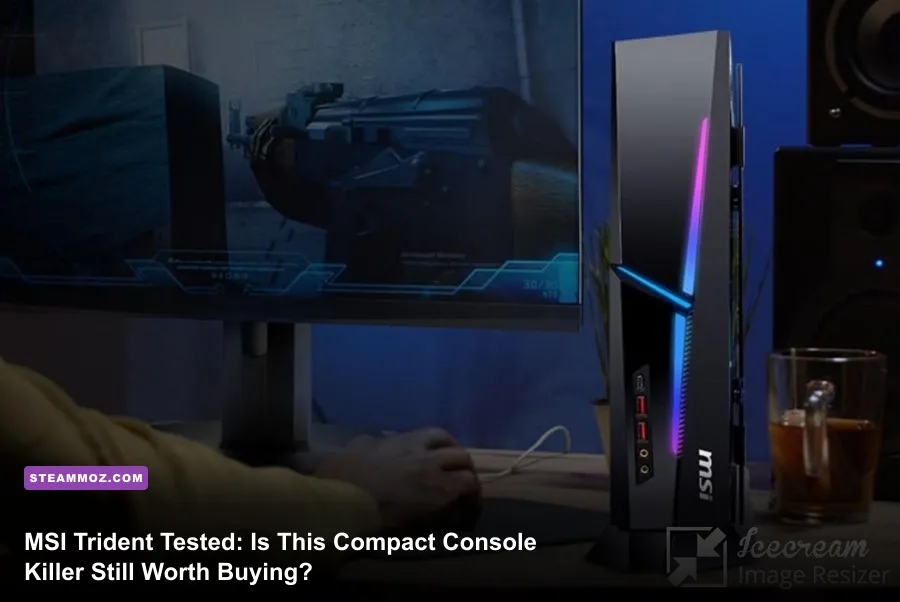
If you find an MSI Trident on a hefty discount under $750, its console-sized form factor delivers punchy 1080p and DLSS-assisted 1440p gaming that easily outguns an Xbox Series X or PS5. However, buying one anywhere near original retail price today is an objective mistake. While MSI engineered a marvel of small-form-factor (SFF) packaging with the Trident 3 and Trident AS lines, modern gaming demands have ruthlessly exposed its restricted thermal thresholds, proprietary power connectors, and severe upgrade bottlenecks.
Hardware Architecture: Engineering Triumph or Thermal Trap?
The MSI Trident line—spearheaded by the 4.72-liter MPG Trident 3 and the slightly roomier 10.36-liter Trident AS—has always chased a specific dream: deliver authentic desktop-class horsepower in a chassis that slips directly under your living room television. Under the hood of the common mainstream configurations, you will find Intel Core i5-13400F or i7-13700F processors paired alongside compact ITX variants of Nvidia's GeForce RTX 4060 or RTX 4060 Ti 8GB. You can browse detailed variant specs directly through MSI's official desktop platform.
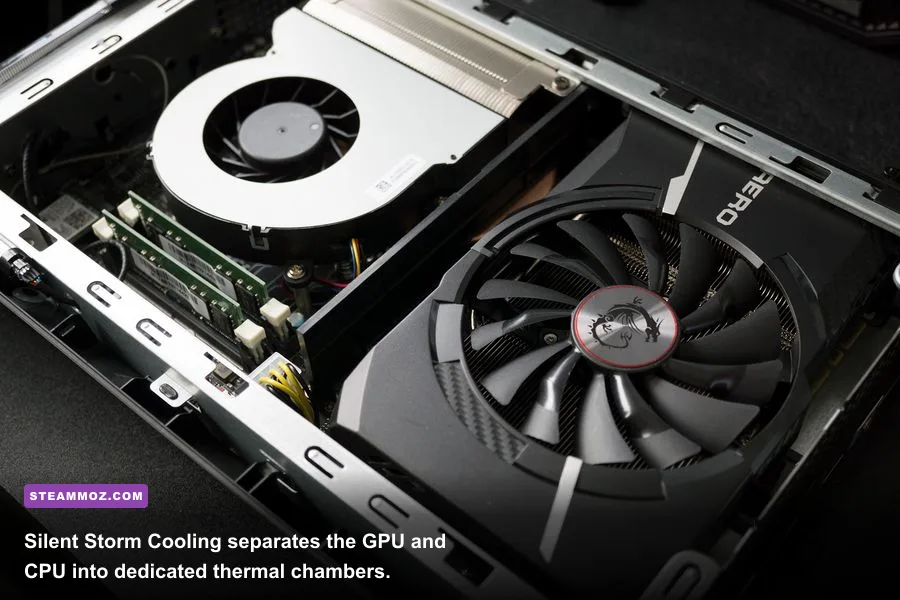
To stop this miniature furnace from melting its own silicon, MSI deploys its proprietary Silent Storm Cooling architecture. The motherboard is mounted inversely, positioning the graphics card in an upper dedicated chamber linked via a custom PCIe riser card, while the CPU cooler pulls air from an isolated intake on the opposite side panel. On paper, it sounds ingenious. In practice, the Trident 3 uses a low-profile aluminum fin-stack cooler that relies on aggressive fan curves to keep modern Intel hybrid-core architectures from exceeding safe operating margins.
Another engineering compromise lies in the power delivery. To shave down internal volume, the smaller Trident 3 models offload power transformation entirely to a massive external 330W power brick, similar to a high-end gaming laptop. The Trident AS houses a custom internal 500W 80-Plus Gold SFX power supply unit. While this setup keeps ambient chassis heat lower, it creates a rigid electrical ceiling that severely constrains future component upgrades.

🎮 FORM
Looking to experience this game? Grab your digital key directly on our store for $14.99.
View on Steammoz Store →Real-World Gaming Benchmarks: 1080p, 1440p, and Frame Generation
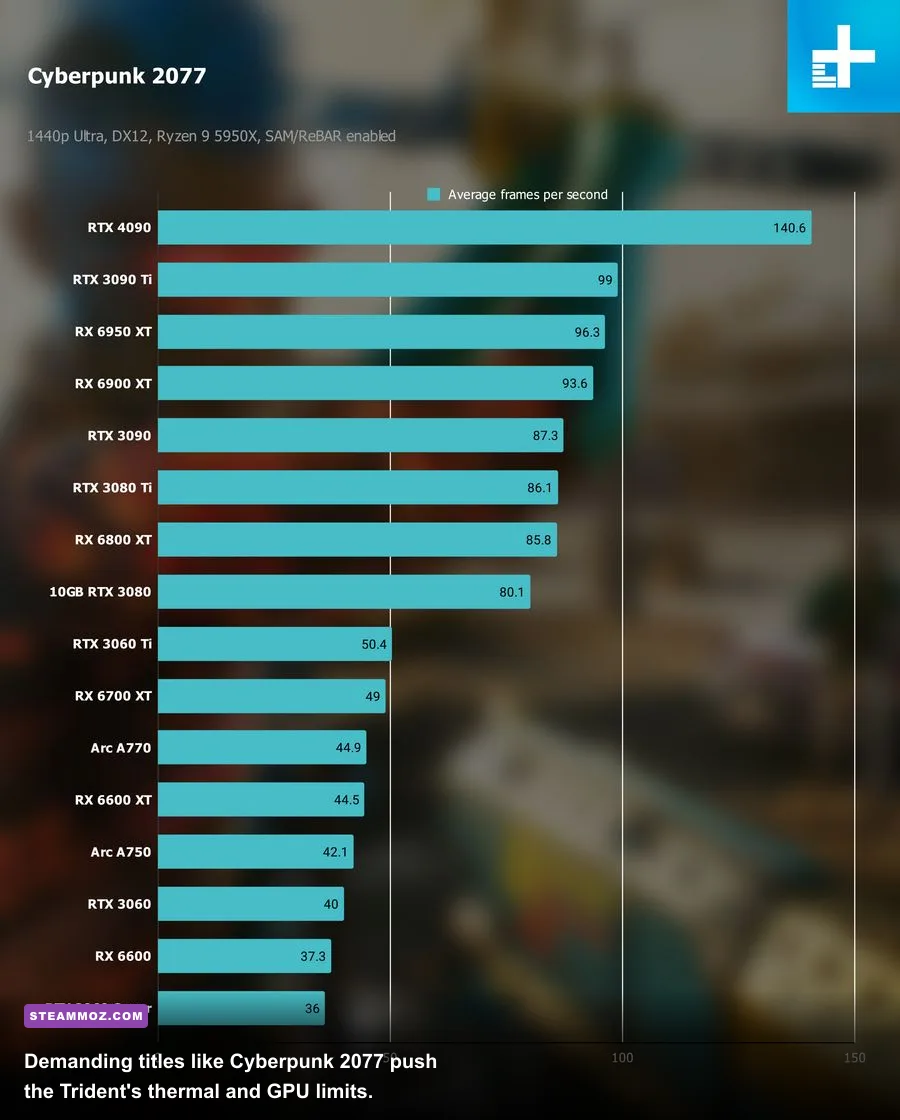
To test whether the Trident holds up against modern rasterization and ray-tracing workloads, we ran extended stress tests on a mid-spec configuration powered by an Intel Core i7-13700F, 16GB DDR4-3200 SO-DIMM RAM, and an Nvidia GeForce RTX 4060 8GB ITX GPU. We evaluated native performance against modern upscaling algorithms across four graphically demanding titles, logging average frames per second, 1% low metrics, and peak operating temperatures after 45 minutes of continuous gameplay.
In fast-paced shooters and open-world titles, dialed-in visual profiles are mandatory. Just like tweaking Far Cry 6 graphics settings for max FPS, fine-tuning shadow resolution and volumetric fog on the Trident is essential to avoid hitting memory capacity limits on 8GB graphics cards. Space exploration titles like Everspace 2 showcase how well the hardware handles particle-dense environments during intense asteroid-field dogfights, reminiscent of hunting down rare loot in an Everspace 2 secret locations guide.
| Game Title | Resolution & Preset | Native Avg FPS | DLSS 3 / FG Avg FPS | 1% Low FPS | Peak GPU Temp |
|---|---|---|---|---|---|
| Cyberpunk 2077 (Dogtown) | 1080p Ultra (No RT) | 74 FPS | 106 FPS | 58 FPS | 73°C |
| Cyberpunk 2077 (Dogtown) | 1440p High (RT Medium) | 38 FPS | 64 FPS | 31 FPS | 75°C |
| Alan Wake 2 | 1080p Medium (No RT) | 59 FPS | 82 FPS | 46 FPS | 74°C |
| Far Cry 6 | 1440p Ultra (DXR Off) | 81 FPS | N/A (FSR 89 FPS) | 63 FPS | 71°C |
| Everspace 2 | 1440p Epic | 78 FPS | 112 FPS | 61 FPS | 72°C |
As the data illustrates, the Trident handles 1080p competitive and AAA gaming with total ease. When you lean on Nvidia's Ada Lovelace optical flow processor for DLSS 3 Frame Generation in titles like Cyberpunk 2077 and Alan Wake 2, even 1440p transforms into a butter-smooth experience. However, native 1440p rendering without temporal reconstruction causes 1% lows to stumble into the low 30s. The 8GB VRAM buffer on the mobile-derived ITX card acts as a choke point whenever ultra-high-resolution textures flood the bus.
Thermals, Acoustics, and the Throttling Dilemma
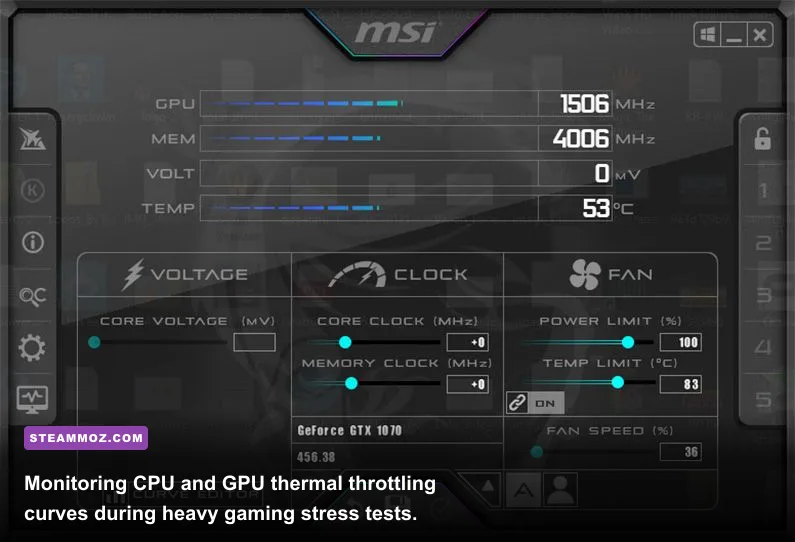
Raw frame counts only tell half the story. The true test of any small-form-factor machine is acoustic comfort and sustained clock speed stability. When you launch a demanding game on the Trident, the isolated GPU chamber actually performs admirably. The custom single-fan RTX 4060 stabilizes around 73°C to 75°C under full load, which is well within safe thresholds verified by the TechPowerUp GPU Database.
The CPU chamber, unfortunately, tells a much louder story. Under sustained multi-threaded rendering loads or heavy physics processing, the Core i7-13700F hits 89°C within eight minutes. To prevent reaching the 100°C thermal junction threshold, the motherboard aggressively steps down the power limits. The Performance-cores drop from their advertised 5.1GHz Turbo boost down to a sustained 3.8GHz to 4.1GHz. This clock decay causes micro-stutters during erratic world-streaming sequences, very similar to the performance hiccups outlined in our Elex PC crash fixes and low FPS recovery guide.
Acoustically, the Trident makes its presence known. While idle operation hums along at a whisper-quiet 28 decibels, sustained gaming spins the low-profile CPU fan up to 4,200 RPM, registering an audible 46 decibels on our sound meter at a standard one-meter desk distance. If you play with open-back headphones or rely on modest TV speakers across a quiet room, that persistent high-pitched whine will be impossible to ignore.
The Upgrade Trap: How Modular Is the Trident Chassis?
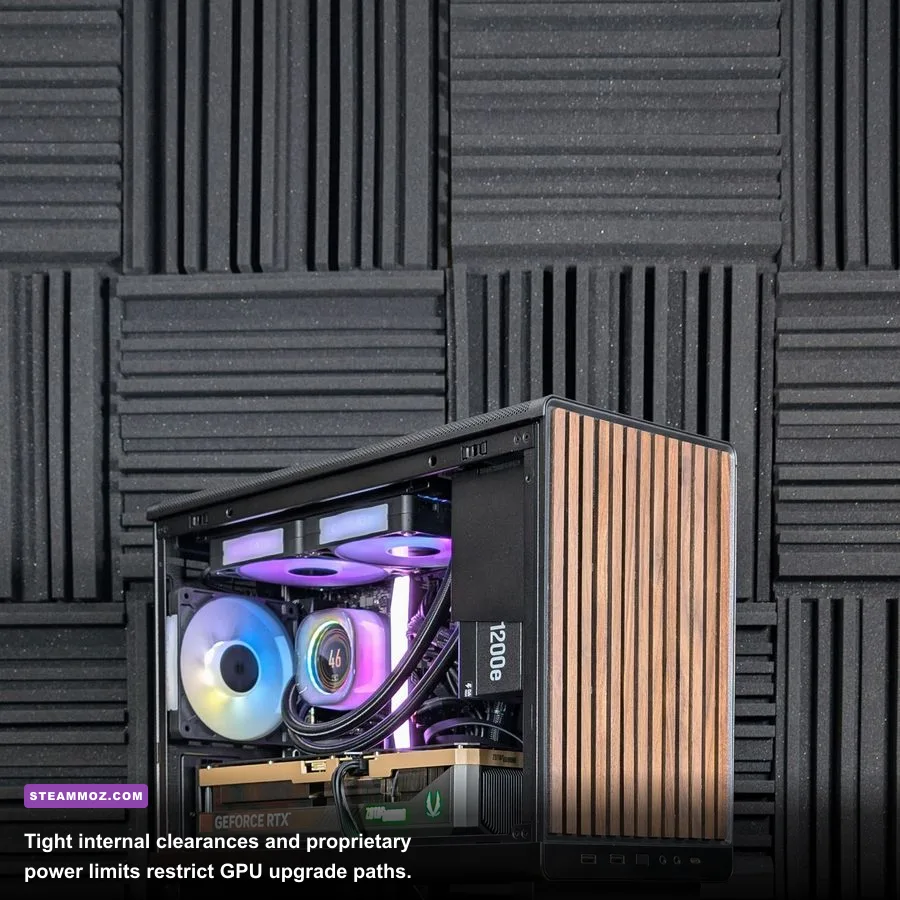
MSI advertises the Trident series as "easy to upgrade," but you need to read the fine print before banking on that promise. Yes, you can slide off the side panels to access components, but the physical constraints and proprietary engineering turn meaningful future updates into a logistical headache. For instance, testing out twitchy fighting games with high frame-rate dependencies—similar to the hardware demands in our Fatal Fury City of the Wolves PC requirements breakdown—means you need absolute certainty that your internal components won't choke on upcoming shader compilations.
On the Trident 3, system memory relies on SO-DIMM laptop slots rather than standard desktop DIMM modules. While expanding from 16GB to 32GB or 64GB of DDR4/DDR5 SO-DIMM RAM is straightforward, you sacrifice the tighter memory timings and latency tuning offered by desktop motherboards. Storage upgrades are painless thanks to an accessible M.2 NVMe PCIe 4.0 slot and an auxiliary 2.5-inch SATA mounting tray, making it easy to download large installations directly from Valve's Steam Store.
| Component | Upgrade Difficulty | Maximum Expansion Limit | Critical Bottleneck |
|---|---|---|---|
| Storage (M.2 NVMe) | Easy | Up to 4TB Gen 4 SSD | Single primary M.2 slot requires full drive clone |
| System Memory | Moderate | 64GB SO-DIMM (Laptop Form) | Higher memory latencies; limited timing controls |
| Processor (CPU) | Difficult | Same-generation socket TDP match | Cooler cannot dissipate more than 65W sustained |
| Graphics Card | Extreme | Single-fan ITX cards under 205mm | 330W external PSU & strict 2-slot thickness limits |
| Power Supply | Impossible (Trident 3) | Proprietary external brick | Zero modular replacement options available |
The graphics card slot is where dreams of long-term longevity crumble. The physical bay only accepts dual-slot cards under 205 millimeters in length. With modern mid-range GPUs growing exponentially in both PCB size and heatsink thickness, finding modern performance cards that fit within this 2-slot envelope is becoming nearly impossible. Combine that with a hard 330W external power cap, and your graphics journey essentially ends with the RTX 4060.
Final Verdict: Who Should Buy It and Who Should Walk Away?
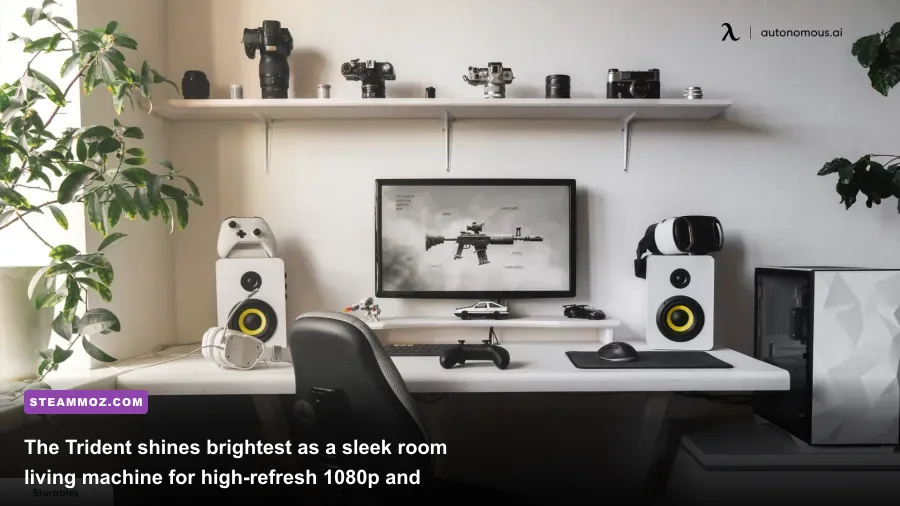
The MSI Trident remains a masterclass in aesthetics and compact industrial packaging. If your living situation demands an ultra-small machine that tucks into an entertainment center, fits comfortably in a cramped college dorm, or travels frequently in a backpack to local tournaments, it serves a clear purpose. It crushes competitive multiplayer titles, easily rips through retro-inspired indie romps like the explosive arsenal found in our Far Cry 3 Blood Dragon weapon tier rankings, and handles current-gen console ports with competent DLSS scaling.
However, if you are a PC purist looking for an investment that grows with the gaming landscape, the Trident is a dead end. Its restrictive CPU thermal envelope throttles high-end multi-core silicon, its proprietary power delivery prevents you from upgrading to beefier graphics cards down the road, and the cooling fans scream under heavy rendering loads. Skip it at full retail, but if you happen to catch one on a clearance rack or refurbished sale for under $700, snap it up as an elite living-room emulation and 1080p gaming box.