
The fastest way to “level” in Lara Croft and the Temple of Osiris is to stop looking for an XP bar that does not exist. The game has no conventional character levels or gold wallet. Progress comes from finishing tombs, collecting gems, opening treasure chests, completing red-skull challenges, and improving your equipment with better weapons, rings, and amulets. For efficient farming, replay short early and mid-game tombs, keep your score multiplier alive, grab every gem cluster, and spend your best gear on survivability before chasing maximum damage.
That distinction matters because plenty of old guides describe Temple of Osiris like a traditional action RPG. It isn't one. Lara Croft, Carter Bell, Isis, and Horus don't gain permanent XP levels in the Diablo sense, and there is no reliable “kill enemies for gold” loop. Your real wealth is the value of each run: gems, treasure, challenge rewards, and useful equipment. Once you understand that economy, the game becomes much easier to route efficiently.
This guide focuses on solo and four-player co-op, with practical farming routes, score mechanics, equipment priorities, and the mistakes that waste the most time. If your PC is struggling to keep the action smooth, Steamoz's guides for cleaner action-game runs and low-FPS troubleshooting are useful companions.
What “leveling and gold” really means here
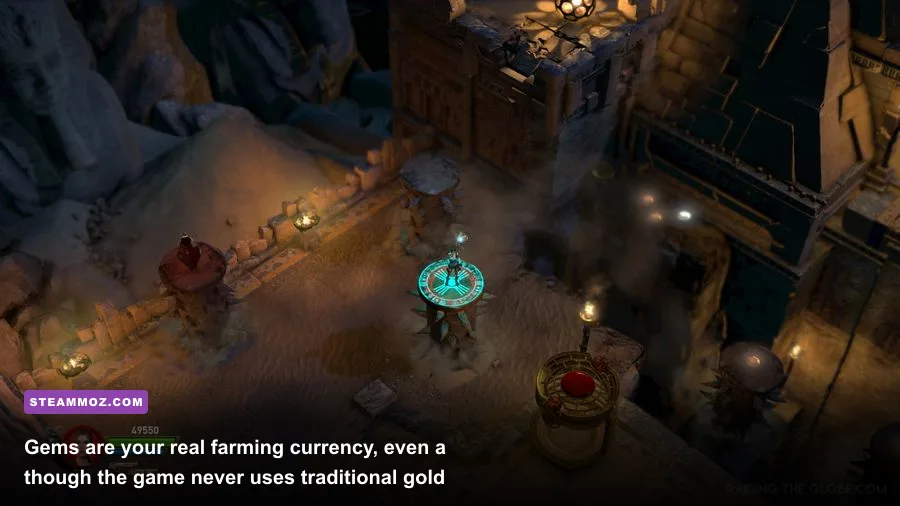
Temple of Osiris uses a score-and-equipment progression model rather than character XP. Every tomb is a compact obstacle course packed with breakable objects, enemies, traps, gems, red skulls, and optional objectives. Completing a level unlocks the next part of the campaign, while strong performance improves the rewards you take into later rooms.
The blue gems scattered through rooms are the safest source of score. Gold-colored treasure objects and chests are valuable because they often sit behind optional puzzles or dangerous routes, but they are not a spendable gold currency like the one in an RPG. Treat “gold farming” as treasure farming: maximize the gem total, collect chests, and replay the rooms where you can do that without burning lives.
The scoring system rewards momentum. Picking up gems in quick succession builds a multiplier, while taking too long, dying, or missing a pickup can break the chain. That means a dangerous detour is not automatically worthwhile. A route that collects 90 percent of the gems while preserving a multiplier can beat a messy route that grabs every item but repeatedly resets the chain.
| Progression Target | What You Actually Gain | Best Farming Method | Main Risk |
|---|---|---|---|
| Gems and score | Higher run value and stronger performance rewards | Fast pickups, breakables, and uninterrupted routes | Dropping the multiplier |
| Treasure chests | Equipment and valuable loot opportunities | Replay short tombs with known chest locations | Taking a slow route for a weak reward |
| Weapons | More reliable damage against tougher enemies | Open optional chests and replay reward-rich tombs | Using a weapon with poor handling |
| Rings and amulets | Build-defining bonuses and survivability | Compare every drop before discarding it | Chasing damage while ignoring defense |
| Red skulls | Challenge completion and extra scoring goals | Learn their exact route and repeat it cleanly | Forcing a skull during a risky run |
For a first clear, prioritize survival and route discovery. For a farm clear, prioritize speed and consistency. Those are different objectives, and mixing them is why many players feel as if the game is stingy with rewards.

🎮 LARA CROFT AND THE TEMPLE OF OSIRIS
Looking to experience this game? Grab your digital key directly on our store for $2.99.
View on Steammoz Store →The best early farming loop for solo players

Start by replaying the shortest tombs you have already completed instead of pushing into a new level while under-equipped. Early rooms are useful because their traps are readable, their enemy waves are manageable, and their gem paths can be memorized quickly. The exact best stage depends on which tombs you have unlocked and which chests you can reach, so judge a route by rewards per minute rather than by the stage's reputation.
Step 1: Pick a repeatable route
Choose a tomb that contains several connected gem lines, at least one chest, and no long mandatory elevator or cutscene section. Run it once at a relaxed pace and mark three things mentally: where the multiplier starts, where the route splits, and where a death is most likely. On the second attempt, ignore unnecessary combat and follow the safe gem line.
Step 2: Break objects while moving
Vases and destructible scenery are worth checking, but don't stop in the middle of a trap sequence just to shoot every pot. Fire while moving, use the dodge to cross open spaces, and return for a breakable only when the room is safe. A few missed objects are cheaper than losing a full multiplier to a careless spike or projectile.
Step 3: Separate chest runs from score runs
A chest run takes the safest path to loot. A score run commits to long gem chains and optional red-skull routes. Trying to do both on your first farming attempt usually creates a slow, fragile run. Build a reliable chest route first, then add challenge objectives after you know the room's hazards.
Step 4: Reset bad attempts early
If you die before collecting the central gem chain or lose the multiplier in the opening section, restart instead of limping through a poor run. This is especially effective in a short tomb. You are farming repeatable value, not proving that every attempt must reach the exit.
In solo play, Lara is the most natural farming choice because her movement and weapons feel familiar, but the character selection is less important than control comfort. Carter, Isis, and Horus each bring the same general adventure framework, while co-op changes puzzle interactions and the amount of chaos on screen. Players who enjoy route optimization may also appreciate Steamoz's fast farming principles in Indoorlands, although the actual progression systems are completely different.
Score multipliers, gems, and the gold-making route
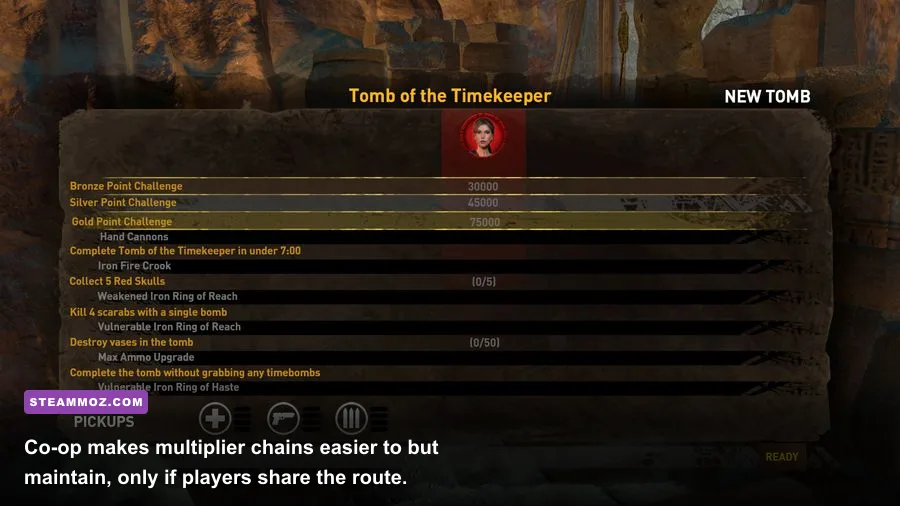
Your multiplier is the engine behind efficient farming. It grows when you collect gems in sequence and falls apart when the chain is interrupted. The best players don't simply sprint toward the next room; they plan movement so one pickup naturally leads into the next. Jumping, grappling, rolling, and shooting should all serve the route rather than happen randomly.
Keep your weapon aimed at the next threat while moving toward the next gem. Enemy kills are necessary, but most ordinary enemies are not worth stopping to fight if you can bypass them safely. Clear enemies that block a narrow corridor, guard a chest, or can knock you into a hazard. Ignore enemies that can be outrun without compromising the path.
Red skulls deserve their own approach. They are optional route challenges, and some are placed beside timed traps or difficult platforming. Don't add them to a farm loop until you can collect them without breaking your pace. A skull that takes 40 seconds and causes two deaths is not profitable just because it is technically collectible.
| Run Type | Primary Goal | Route Behavior | When to Use It |
|---|---|---|---|
| Safe chest run | Equipment and treasure | Take the shortest reliable path and skip risky skulls | When upgrading a weak loadout |
| Multiplier run | Maximum score and gem value | Chain pickups, avoid unnecessary stops, preserve momentum | When your route is fully memorized |
| Challenge run | Red skulls and optional objectives | Use practiced movement through trap-heavy sections | After the tomb feels comfortable |
| Co-op loot run | Chests and shared puzzle rewards | Assign players to switches, platforms, and combat lanes | With an organized group of two to four |
There is no meaningful reason to farm regular enemies for currency. If an enemy wave blocks you, eliminate it quickly with your strongest reliable weapon and move on. The time-efficient loop is always room completion plus pickups, not standing in one arena waiting for enemies to become profitable.
Weapons, rings, and amulets that speed up progression
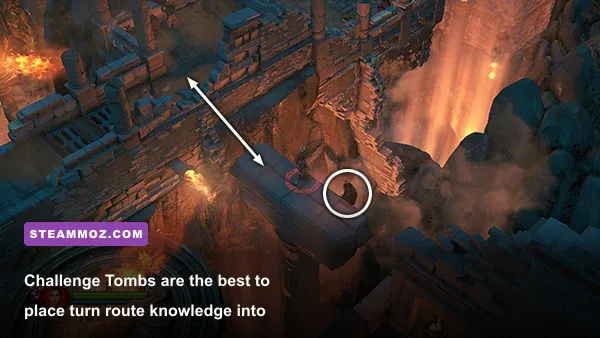
Equipment is where your practical “level” comes from. Damage helps, but raw damage is not the only stat that matters. A weapon that fires quickly, feels accurate, and lets you keep moving can outperform a heavier option that forces you to stand still. Tomb of Osiris is built around mobility, so your loadout should support clean movement through traps.
Use a dependable primary weapon for ordinary enemies and reserve your stronger option for shielded targets, large monsters, or crowded arenas. Don't waste your best ammunition or cooldown-equivalent resource on isolated weak enemies if a quick dodge and a few standard shots will do the job.
Rings and amulets deserve more attention than they usually receive. Defensive bonuses are fantastic during early farming because a single mistake can erase the time invested in a multiplier route. Once you can finish a tomb without losing health, shift toward damage or score-oriented bonuses that shorten combat and preserve momentum.
| Build Priority | Recommended Focus | Why It Works | Best Situation |
|---|---|---|---|
| Safe farmer | Health, damage reduction, reliable primary weapon | Protects the multiplier from one missed dodge | Learning a new tomb |
| Speed farmer | Fast weapon handling and damage bonuses | Shortens enemy encounters and keeps routes moving | Repeating familiar rooms |
| Challenge runner | Mobility and survivability | Helps with trap rooms and red-skull detours | Collecting optional objectives |
| Co-op support | Balanced defense and crowd control | Stabilizes chaotic rooms when players split up | Three- or four-player sessions |
Compare new loot immediately rather than assuming a higher rarity is automatically better. A modest damage upgrade with poor handling may slow your farming route, while a less glamorous defensive piece can prevent repeated deaths. Think in completed runs per hour, not in isolated item numbers.
Co-op farming without destroying the multiplier

Four-player co-op can produce excellent farming runs, but only when everyone understands the route. The game becomes noisier as players split across switches, grapple points, and enemy groups. One player racing ahead can trigger hazards while another is still collecting gems, breaking the chain and turning a fast run into a rescue mission.
Assign jobs before entering the tomb
Have one player lead the gem route, another handle switches and pressure plates, and the remaining players cover combat lanes. This is not a rigid class system; it is a simple way to stop four people from making the same decision at once. The lead player should call out when the group is skipping a chest or attempting a red skull.
Stay close during timed sections
Many co-op failures happen because players activate a mechanism before the group is ready. Wait for everyone at a gate, then trigger the sequence together. If a player falls or dies, stabilize the room before continuing. A few seconds spent regrouping is cheaper than losing the entire route's momentum.
Co-op also changes the value of combat. Extra players can clear enemy waves quickly, but friendly chaos makes trap deaths more likely. Avoid firing blindly near explosive objects or narrow platforms. Use voice chat or simple pings to call out skulls, chests, and unsafe jumps.
For PC players, hold a stable frame rate during crowded fights. Lower shadows and post-processing before dropping resolution, and cap the game to a frame rate your system can maintain. Consistent input is more useful than a higher but unstable peak. Steamoz's performance troubleshooting coverage explains the same general principle for another co-op action game.
Bosses, campaign progress, and the efficient endgame
Bosses are not the best place to farm ordinary treasure, but they are excellent tests of whether your equipment and movement habits are ready for later tombs. Read the telegraphs first. Large attacks usually announce themselves with a visible animation, a ground marker, or a clear projectile pattern. Dodge through open space, attack during recovery, and never stand still simply because the boss is briefly vulnerable.
Set, the central antagonist, is fought through spectacle-heavy encounters that emphasize positioning, hazards, and pattern recognition rather than a traditional health-bar grind. Don't burn a run trying to force damage during an unsafe phase. Survive the mechanic, then attack during the opening. That approach may feel slower, but it protects lives and lets you return to farming instead of repeating the entire encounter.
| Encounter Problem | Telegraph to Watch | Counter | Best Farming Lesson |
|---|---|---|---|
| Projectile wave | Visible launch animation and patterned shots | Move laterally, then counter during recovery | Don't panic-dodge before the pattern appears |
| Ground hazard | Marked floor or environmental animation | Move to a clean platform before attacking | Positioning beats greedy damage |
| Enemy swarm | Spawn cue and closing arena space | Clear the nearest threat and keep moving | Protect your route and multiplier |
| Timed mechanism | Activated switch or opening gate | Regroup before triggering it | Co-op coordination saves more time than speed |
Once the campaign is complete, rotate between your fastest chest route and your cleanest multiplier route. Use the first to search for better equipment and the second to practice score consistency. Add red skulls only when they fit naturally into the route. This two-loop system is more efficient than endlessly replaying a difficult tomb with poor survival odds.
Before changing your strategy, check the game's current storefront details on the official Steam page. For franchise information, the official Tomb Raider website and Crystal Dynamics are the safest sources.
The short version is simple: there is no conventional leveling grind and no enemy-gold farm to exploit. Build a safe route, preserve the multiplier, collect gems and chests, and upgrade toward the kind of run you are actually attempting. Temple of Osiris rewards clean movement far more than brute force, and once your route is practiced, the loot starts arriving quickly.