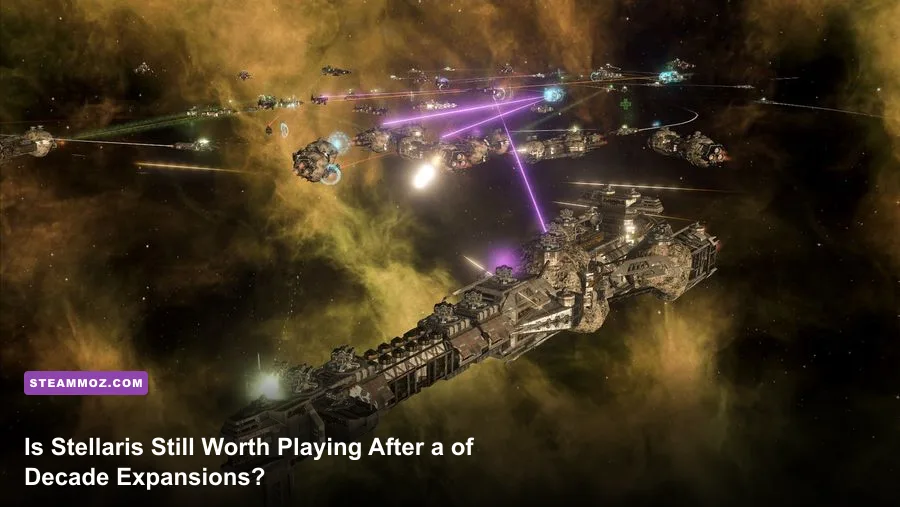
Yes, Stellaris is still worth playing, but with one massive caveat: it is no longer the game Paradox released in 2016. What started as a promising, slightly barren space 4X has mutated through ten years of continuous overhauls, custodial patches, and over twenty paid expansions into the most intricate sci-fi storytelling sandbox in PC gaming. Yet that sheer depth brings genuine hurdles—a steep financial barrier to entry, a brutal learning curve, and the infamous late-game simulation slowdown that still pushes modern CPUs to their absolute limits.
If you're wondering whether diving into this galactic behemoth today is a brilliant adventure or a total money pit, you need the unvarnished truth. The game has shed entire baseline systems, rebuilt its planetary economy twice, redefined how space combat works, and overhauled diplomatic federations. To make an informed call, you need to understand how the modern systems hold up, what the astronomical DLC catalog actually provides, and how to configure your galaxy so your rig doesn't drop to a crawl by year 2400.
The Metamorphosis: How a Clunky 2016 Map Painter Became a Sci-Fi Titan
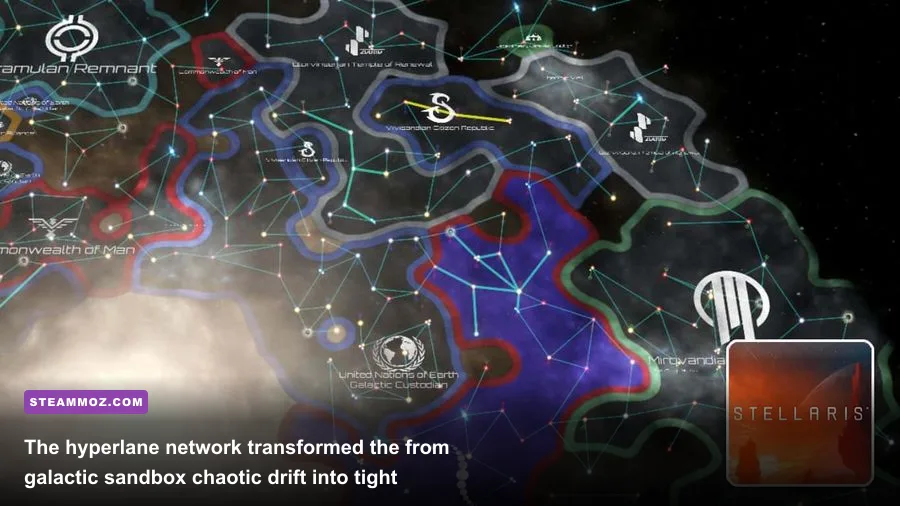
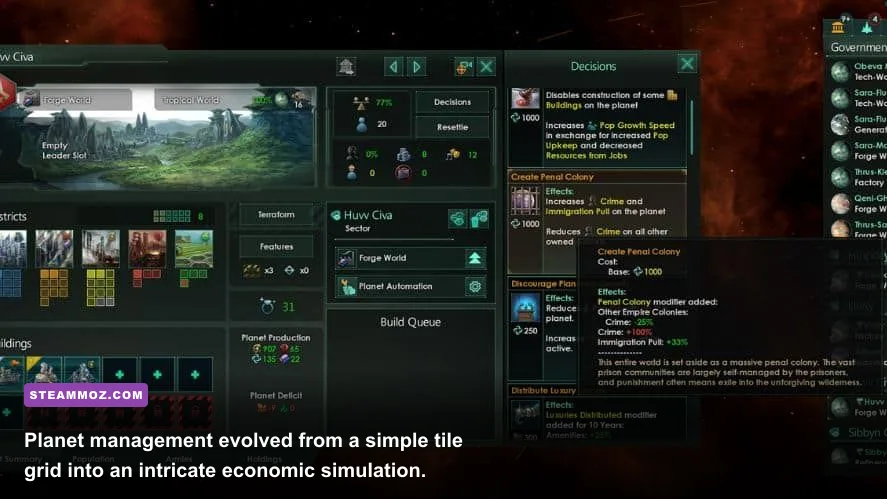
Booting up Stellaris today after a multi-year break feels like stepping onto an alien vessel. Back at launch, the game relied on a charming but rigid planetary tile system, three competing faster-than-light (FTL) drives that made border defense a logistical nightmare, and barebones diplomacy that rarely sparked emergent storytelling. Today, none of that original foundation survives. The transition to hyperlane-only navigation, followed by the complex Pop-job economy introduced in the 2.2 Megacorp era, transformed Stellaris from a standard 4X map-painter into an authentic grand strategy simulation.
The biggest reason the game still thrives is Paradox's dedicated "Custodian Team." Formed specifically to balance, refine, and modernize old content without charging players a dime, this team rescued Stellaris from the classic Paradox trap where ancient expansions rot while new ones pile on top. Older mechanics—like orbital habitats, ground combat leaders, ascension perks, and faction unity—routinely get full reworks alongside major DLC drops. The game plays with a fluidity and thematic coherence that makes modern runs feel distinct, whether you are running a fanatical purifier hive mind, an inward-perfectionist lithoid kingdom, or a corporate trade league bankrolling galactic elections.
Storytelling is where modern Stellaris utterly demolishes rival 4X titles like Galactic Civilizations or Endless Space 2. The archeology sites, astral rifts, and anomalous event chains turn early exploration into a captivating sci-fi novel. You aren't merely boosting raw mineral yields; you're deciphering the dying broadcast of an ancient precursor civilization, discovering your homeworld is caught inside an unstable time loop, or accidentally awakening an extradimensional horror inside a black hole. Much like optimizing resource extraction in Empires of the Undergrowth, mastering the early-game resource snowball in Stellaris requires striking an immediate balance between pure scientific curiosity and military deterrence.
The DLC Paywall: Navigating Paradox's Pricey Galaxy
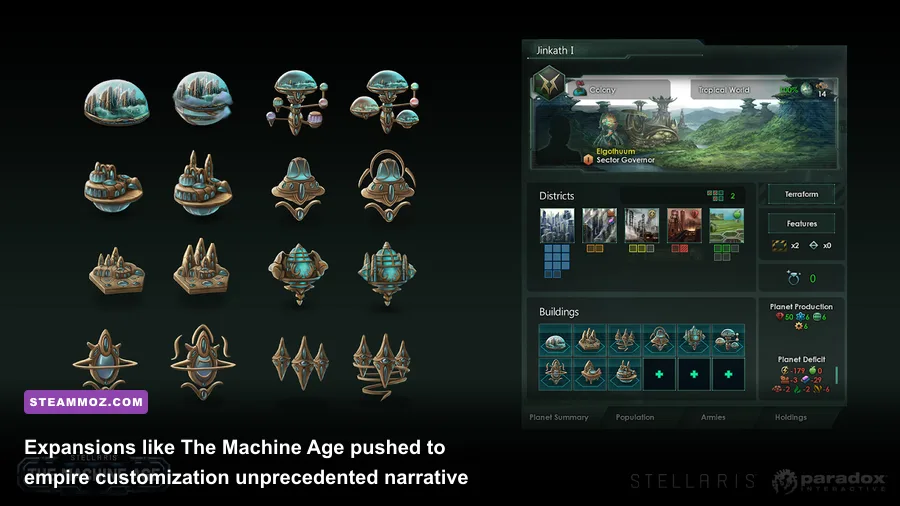
Let's address the elephant in the system: the complete Stellaris experience carries a staggering price tag if you buy every release piece by piece. Over twenty expansions, story packs, and species packs create an intimidating checkout cart for newcomers browsing the Stellaris Steam page. Fortunately, you do not need every pack to enjoy a top-tier campaign. The mechanical core of Stellaris is divided into distinct structural tiers, and understanding what each pack adds helps you skip filler content entirely.
For casual players or newcomers testing the waters, the monthly expansion subscription is by far the most sensible financial path. For the price of a takeout lunch, you get every mechanical expansion, narrative pack, and cosmetic asset unlocked instantly. However, if you prefer permanent ownership, picking up the base game during a major sale alongside two or three essential expansions gives you roughly 90% of the game's best strategic systems. The table below breaks down the essential expansions versus those you can safely put on the backburner.
| Expansion Name | Value Tier | Key Mechanical Additions | Strategic Verdict |
|---|---|---|---|
| Utopia | Essential (S-Tier) | Megastructures, Habitats, Ascension Paths, Hive Minds | Non-negotiable. Modern Stellaris doesn't feel complete without ring worlds, dyson spheres, and biological/psionic evolution. |
| Galactic Paragons | Essential (S-Tier) | Leader skill trees, Galactic Council, custom civic traits | Completely overhauls how admirals, scientists, and governors steer your empire. Essential for min-maxing and narrative depth. |
| The Machine Age | Essential (S-Tier) | Cybernetic/Synthetic ascensions, individualist machines, crisis paths | Paradox's finest modern expansion. Adds breathtaking late-game synthetic mechanics and terrifying megastructure options. |
| Federations | Recommended (A-Tier) | Galactic Community resolutions, specialized federations, Origins | Dramatically expands galactic diplomacy, giving non-military empires tools to conquer through soft power and sanction laws. |
| Overlord | Recommended (A-Tier) | Specialized vassals (Scholarium, Prospectorium), hyper relays, orbital rings | Makes empire subjugation intensely viable, eliminating the administrative headache of directly micromanaging 50 conquered planets. |
| Nemesis | Situational (B-Tier) | "Become the Crisis" path, Galactic Custodian, Espionage mechanics | Fun if you want to turn your empire into a galactic superweapon, but espionage remains underpowered and easily ignored. |
| Astral Planes | Situational (B-Tier) | Astral rift anomalies, alternate dimension relics, Astral actions | Packed with fantastic narrative writing and localized buffs, but adds very little to core strategic or competitive fleet gameplay. |
| Species Packs | Optional (C-Tier) | Unique species traits (Plantoids, Necroids, Toxoids, Aquatics) | Great flavor, but completely skippable unless a specific empire concept (like toxic subterranean scavengers) appeals to your playstyle. |
The Engine Bottleneck: Late-Game Lag and Simulation Overhead
No honest retrospective can ignore the performance question. Stellaris runs on Paradox's venerable Clausewitz Engine, paired with the Jomini sub-layer. While it looks visually clean and features jaw-dropping celestial skyboxes, the game's computational demands are punishing. The primary culprit isn't 3D rendering or graphical fidelity; it's the sheer mathematical weight of demographic simulation.
Every single day in the game's calendar, the CPU must calculate employment checks, ethics drift, living standard costs, trade value routing, and pop migration desires for tens of thousands of individual digital citizens spread across hundreds of star systems. By the time you reach year 2400, when colossal AI empires are juggling thousands of biological pops, the simulation speed can drop dramatically, turning days that once flew by in milliseconds into sluggish chugs. Just as we've seen when analyzing bottlenecks in hardware-intensive titles like Fatal Fury: City of the Wolves or sorting out configuration hitches in our Elex PC fixes guide, high single-core CPU clock speeds and low memory latency matter far more here than an expensive GPU.
Thankfully, the modern game gives you extensive control over these parameters right at the galaxy generation screen. You do not have to suffer through 10-second end-of-month freezes if you tune your game parameters intelligently before launching a campaign. Adjusting pop growth sliders and galaxy size yields massive gains without sacrificing strategic challenge.
| Galaxy Generation Setting | Default Setting | Performance-Optimized Value | Simulation Impact & Reason |
|---|---|---|---|
| Galaxy Size | Medium (600 Stars) | Small (400 Stars) or Medium | Reduces total empire count, pathfinding calculations, and trade network complexity by up to 40%. |
| Habitable Worlds Slider | 1.0x Scale | 0.25x – 0.5x Scale | Massive impact. Fewer planets means dramatically fewer total pops, forcing empires to value habitats and megastructures. |
| Growth Required Scaling | 1.5x Slider | 1.75x – 2.0x Slider | Imposes a soft ceiling on galactic population density, preventing uncontrolled pop explosion in the late 2300s. |
| Xeno-Compatibility | Enabled | Strictly Disabled | Critical. Prevents the AI from generating hundreds of hybrid cross-species templates that shatter CPU cache memory. |
| Hyperlane Density | 1.0x Scale | 0.75x – 0.8x Scale | Creates tactical military chokepoints while reducing AI pathfinding complexity during galaxy-wide fleet movements. |
Fine-tuning these sliders doesn't diminish the gameplay experience; in many ways, it actively improves it. Lowering habitable worlds makes terraforming candidates, orbital rings, and ring worlds genuinely valuable rather than redundant, while your day-to-day tick rate stays silky smooth even as fleets clash across every sector. If your machine struggles with frame drops across other demanding titles, tweaking systemic background tasks as outlined in our Far Cry 6 settings guide will free up vital system resources for heavy strategy sims.
Combat Meta and Fleet Warfare: Moving Beyond the Deathball
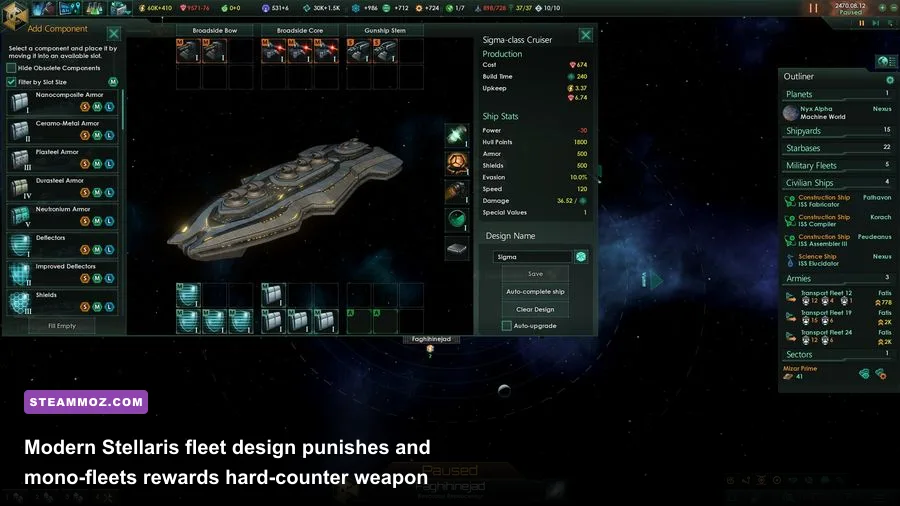
For years, Stellaris space combat suffered from a fatal flaw: the "corvette swarm" and the naked battleship mono-fleet. You stacked as many identical hulls as your naval capacity allowed, lumped them into a single terrifying stack, and marched across the galaxy. The game's 3.6 fleet combat overhaul permanently shattered that mindless loop, turning naval architecture into an engaging game of rock-paper-scissors that demands adaptive engineering.
Today, weapons operate under strict tactical roles governed by tracking, evasion, firing arcs, and armor/shield penetration. Small Corvettes boast base evasion caps reaching up to 90%, allowing them to dance around the sluggish tracking of colossal Tachyon Lances and Kinetic Artillery. Meanwhile, Cruisers serve as versatile combat chassis capable of carrying brawling torpedoes or backline strike craft hangars, and Frigates act as dedicated stealth ambuscade platforms. Much like evaluating gear synergies in our breakdown of Everspace deluxe upgrade weapons, balancing your ship modules between energy weaponry, kinetic shield-strippers, and point-defense screens makes the difference between dominating a sector and watching millions of alloys vaporize.
The introduction of the minimum firing range for long-distance spinal mount weapons also means your massive Battleships can be caught completely off guard. If an enemy fleet equipped with afterburners and short-range Devastator Torpedoes drops out of hyperspace right on top of your fleet anchor, your big guns cannot fire back. You are forced to build balanced fleets: screen destroyers to intercept hostile missiles, carrier cruisers to shred evasive swarms with strike craft, and titans to project command auras that disrupt hostile fire rates. Detailed fleet doctrine documentation on the official Stellaris Wiki underscores just how drastically defensive hull values and shield hardening components now influence modern fleet survival.
The Final Verdict: Who Should Play It Today?
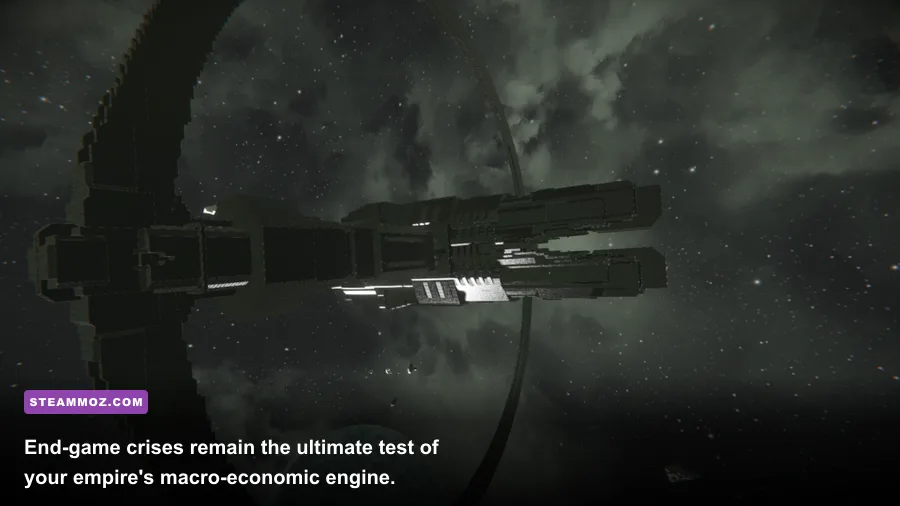
Ten years into its lifespan, Stellaris stands in a league of its own. It is not as mechanically uncompromising or spreadsheet-heavy as Distants Worlds 2, nor is it as board-game streamlined as Civilization VI. Instead, it occupies a golden midpoint: an awe-inspiring, endlessly replayable sci-fi roleplaying engine disguised as an empire builder. The narrative depth unlocked by modern civics, deep ascension trees, and unexpected galactic crises ensures that no two three-day campaigns ever play out the same way.
If you crave rigid tactical puzzles with instantaneous competitive balancing, the sprawling unpredictability and occasional AI diplomatic quirks will occasionally frustrate you. But if you want to guide a primitive pre-FTL species into a cybernetic hive mind that captures stellar energy to build automated megastructures, fight off an ancient awakened fallen empire, and outmaneuver bureaucratic rivals in a cutthroat galactic senate, Stellaris has no equal on the market.
Grab the base game on sale, test the waters with the Paradox subscription pass or the Utopia expansion, and drop your galaxy slider's habitable worlds down to half. Set your hyperlanes, pick an Origin that sparks your imagination, and prepare to lose entire weekends to the stars. According to updates directly from the developers at Paradox Interactive, the Custodian initiative isn't slowing down anytime soon—making right now the most refined, feature-complete moment in the game's entire history to claim your corner of the galaxy.