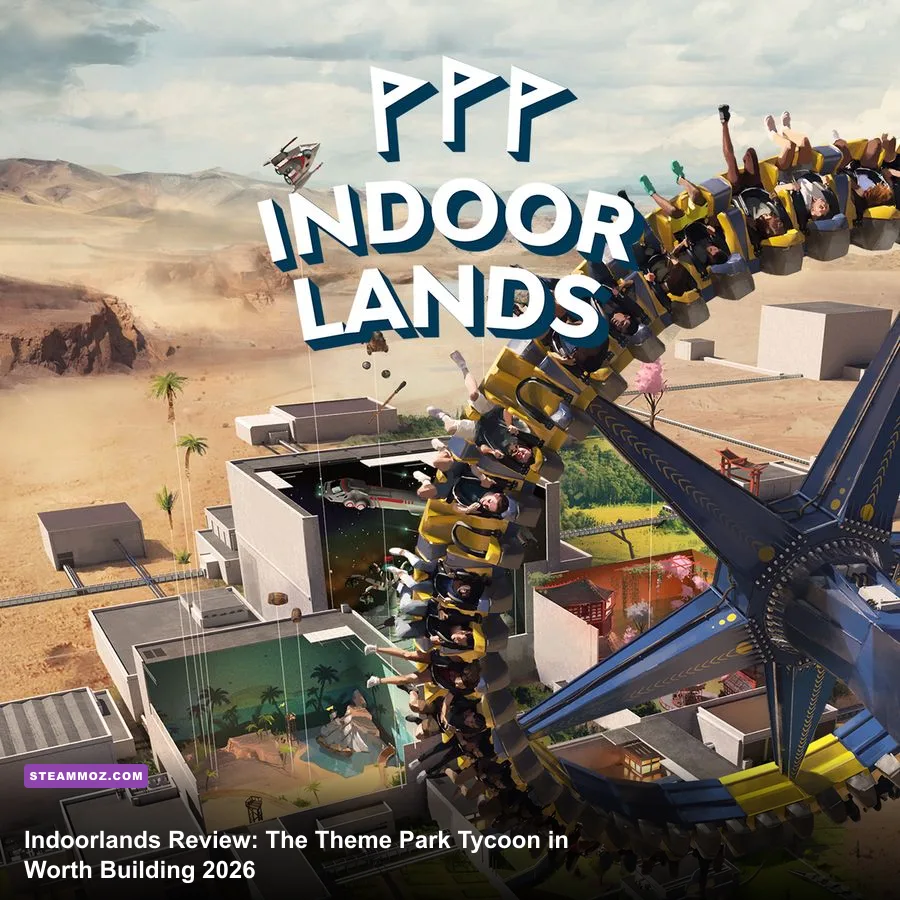
Indoorlands is worth playing in 2026 if you want a relaxed, creatively focused theme-park builder rather than a brutally detailed business simulator. Its biggest strengths are the satisfying park-building toolkit, indoor setting, flexible ride placement, and approachable management loop. Its weaker side is the lack of the deep economic pressure, staff simulation, and presentation polish found in heavier tycoon games. For roughly the price of a casual management game, it remains an easy recommendation for builders—but cautious buyers should check the current Steam update history before jumping in.
That distinction matters. Indoorlands is not trying to be Planet Coaster with the difficulty turned down. It is closer to a compact, friendly park sandbox where you design an enclosed attraction center, unlock new options, keep visitors happy, and gradually turn an empty building into a profitable destination. The indoor premise also gives it a useful identity: weather is not constantly interrupting operations, and you can think in terms of themed halls, corridors, food courts, and activity zones instead of a traditional outdoor park.
What Indoorlands actually is in 2026
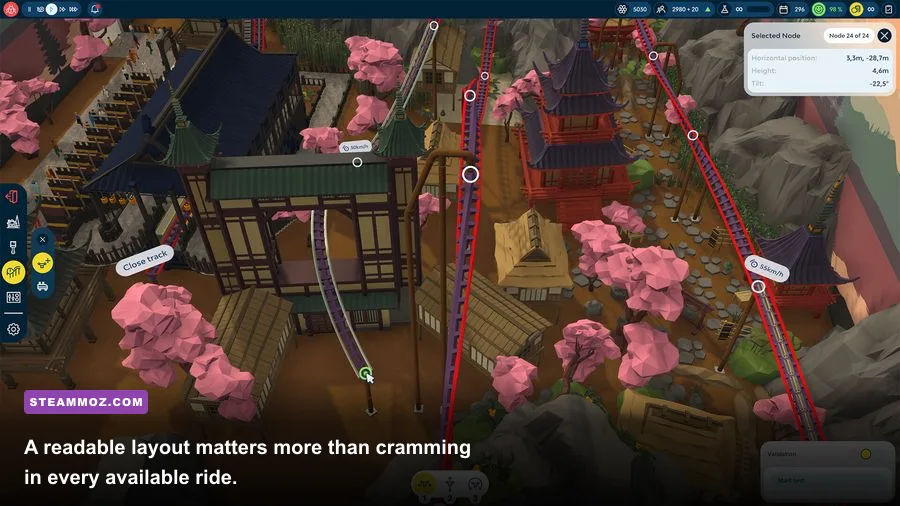
Indoorlands comes from German developer Pixelsplit and focuses on building an amusement park inside a large indoor venue. You place rides and attractions, connect them with paths, add scenery and facilities, hire the people needed to keep the venue running, and respond to what guests want. The game is available on Steam, where the store page is also the best place to check the latest build, Early Access status, and current system requirements.
The central loop is pleasingly clear:
- Build a ride or attraction to create a reason for guests to visit.
- Lay out paths, entrances, queues, toilets, food, and other support facilities.
- Watch guest thoughts, finances, and operational problems.
- Unlock more construction and decoration options.
- Rework the park when congestion, costs, or unhappy visitors expose a bad decision.
That final step is where the game earns its keep. A park that looks attractive on paper can still fail because guests walk too far, queues block the main route, facilities are badly distributed, or the entrance zone becomes a noisy wall of attractions. Indoorlands gives you enough feedback to diagnose those issues without burying the answer under dozens of spreadsheets.
The game is best approached as a creative management sandbox. If you enjoy watching a layout evolve, taking screenshots, and moving a ride three tiles because the sightline feels wrong, you will find a lot to like. If you need complex supply chains, staff schedules, research trees with meaningful trade-offs, or an economy that can collapse after one bad loan, the experience may feel lightweight.
Campaign, challenges, and sandbox
The structured modes give new players a reason to learn the systems in stages. Campaign-style objectives are useful because they push you toward specific construction and financial goals instead of leaving you alone with a giant empty floor. Challenge scenarios add a little more direction, while sandbox is the obvious long-term home for players who care most about design.
Sandbox is especially important in 2026 because it reveals the game's real audience. You can experiment with a compact family zone, divide the venue into themed rooms, create a coaster-centered hall, or build a food-and-leisure complex that prioritizes atmosphere over maximum income. The absence of outdoor weather means your visual identity comes from architecture, flooring, lighting, ride placement, and decoration rather than terrain sculpting.
| Mode | Best For | What It Teaches | Long-Term Appeal |
|---|---|---|---|
| Campaign | New players | Core construction and guest management | Moderate |
| Challenges | Players who want objectives | Budget control and targeted park design | Moderate |
| Sandbox | Creative builders | Layout planning and visual experimentation | High |

🎮 Indoorlands
Looking to experience this game? Grab your digital key directly on our store for $4.74.
View on Steammoz Store →Building a park that does not collapse into congestion
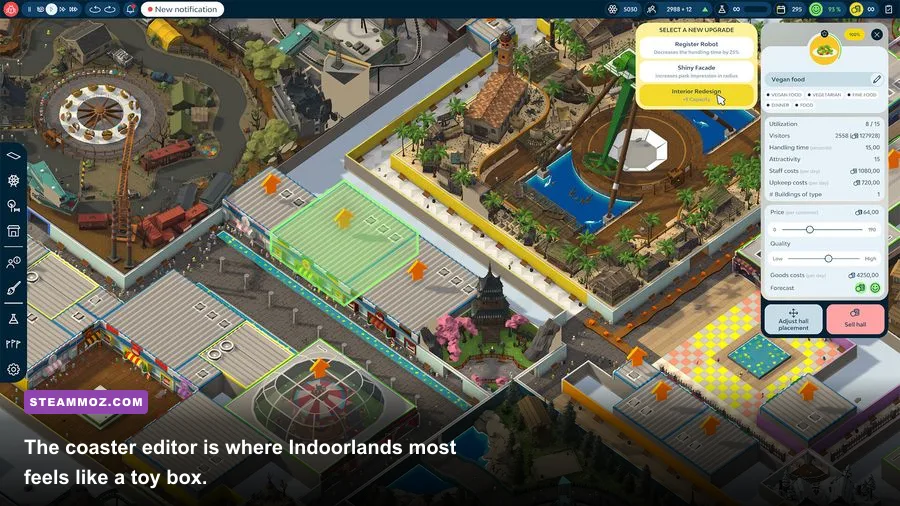
Indoorlands looks simple until your first successful park becomes busy. Early construction rewards compactness, but copying that approach later creates traffic jams. My strongest advice is to design the venue in zones from the beginning: an entrance and information area, a family attraction section, a higher-intensity ride section, and a service-heavy food and restroom area. You do not need to fill every zone immediately. Empty space is far cheaper than rebuilding a mature park.
Start with a central spine wide enough to handle two-way movement, then branch into short loops. A dead-end queue or attraction can work, but a dead-end public corridor tends to create awkward foot traffic. Put high-demand rides away from the entrance so visitors spread through the building. Place food and restrooms near the middle of a zone rather than clustering every facility at the front gate.
Queues deserve special attention. A ride with excellent appeal can still underperform if its queue entrance points directly into a main walkway. Leave a buffer between the ride entrance and the public route, then give the queue enough room to grow without sealing off nearby shops. When you upgrade or replace a ride, check that the new footprint has not swallowed a path connection.
Indoorlands also rewards visual discipline. Repeating one decoration set throughout the building is faster, but themed clusters make the park feel intentional. Use a consistent color and flooring scheme for each zone, then reserve distinctive landmarks for the entrance and major rides. Guests may care about practical needs, but you will care about whether the park looks like a place you designed rather than a warehouse full of objects.
A reliable early-game layout
Build one dependable attraction first, then add a second attraction before expanding the footprint. Pair rides with a nearby toilet and food option, but avoid placing five facilities beside the entrance. Keep a modest cash reserve for staff, maintenance, and corrective construction. The temptation to spend every available dollar on another attraction is strong; it is also how a promising park becomes an expensive traffic problem.
| Park Area | Recommended Contents | Common Mistake | Better Approach |
|---|---|---|---|
| Entrance | Information, first attraction, basic path | Building every facility here | Use it as a welcome zone, not a warehouse |
| Family zone | Accessible attractions, food, toilets | Making the route too long | Keep needs within a short walking loop |
| Thrill zone | Larger rides and generous queues | Blocking the main corridor | Use a branch route and leave expansion space |
| Service zone | Staff support and operational facilities | Hiding access behind attractions | Leave clean back-of-house routes |
For comparison, players coming from more demanding builders may appreciate our PC settings guide, but Indoorlands generally asks more from your planning instincts than from your hardware. The park itself is the puzzle.
How deep are the management systems?
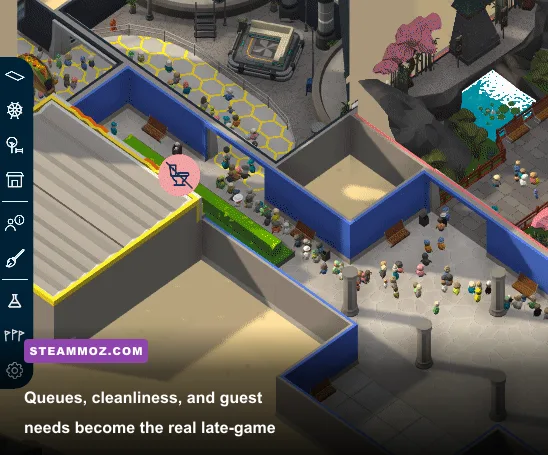
The management layer is enjoyable, although it is not relentlessly sophisticated. You are balancing construction cost, attraction appeal, guest satisfaction, operating expenses, queue length, and the practical flow of people. Those systems interact enough to create problems worth solving, but they rarely produce the kind of crisis that forces a complete strategic rethink.
Guest feedback is your most useful instrument. Do not treat an unhappy thought as a single isolated complaint. Several guests asking for food usually means your food coverage is poor, your prices are too aggressive, or the closest facility is hidden behind a long queue. Repeated complaints about walking distance point to a layout issue, not a reason to scatter random decorations around the map.
Staffing works best when you think in coverage rather than headcount. Add workers where a service problem actually appears, then watch whether the issue moves or disappears. Over-hiring early consumes money that should be paying for new attractions; under-hiring creates a park that looks successful while operational quality quietly falls behind.
The progression curve is gentle. Unlocks give you reasons to continue expanding, but the game rarely demands a carefully optimized order. That is good for first-time tycoon players and less exciting for veterans who want a technology tree full of painful choices. Indoorlands wants you to ask, “What would look good here?” before asking, “What gives the highest return per minute?”
Where the simulation falls short
The biggest weakness is consequence. In a deeper business simulator, a poor layout can create a debt spiral, staff revolt, or long-term reputation damage. Indoorlands more often lets you repair the mistake through patience and rearrangement. That lowers frustration, but it also lowers tension.
There is no shame in that design choice. Many players bounce off tycoon games because the simulation punishes experimentation before they understand the interface. Indoorlands is more welcoming. Just know what you are buying: a readable management game with creative freedom, not an exhaustive economic model.
If you want a more survival-focused management challenge, Steamoz's Aliens vs. Predator survival tips cover a very different kind of pressure. Indoorlands is much more forgiving and considerably less stressful.
Performance, graphics, and the best PC settings
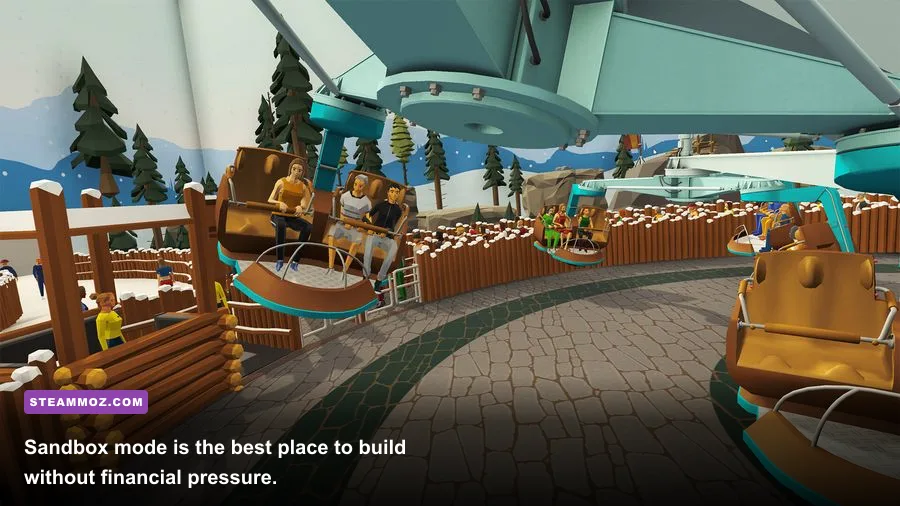
Indoorlands is not a showcase for cutting-edge rendering. Its stylized 3D presentation is clean and readable, which is exactly what a management game needs when a venue fills with rides, visitors, staff, props, and path networks. Performance will still vary with park size and camera position, so do not judge the game solely from a tiny starting venue.
On a modern gaming PC, the sensible approach is to begin at the default preset, cap the frame rate to your monitor, and lower shadows or effects only if a large park begins to stutter. A locked 60 frames per second is preferable to chasing a higher number while the camera moves through a crowded attraction hall. Management games benefit from stable scrolling and responsive zoom more than they benefit from maximum reflections.
| Setting or Profile | Recommended Value | Performance Impact | Visual Trade-Off |
|---|---|---|---|
| Resolution | Native monitor resolution | Medium | Best interface clarity |
| Texture quality | High if VRAM allows | Low to medium | Keeps rides and decorations crisp |
| Shadows | Medium | Medium to high in large parks | Less depth around buildings and rides |
| Effects | High initially | Medium | Lower values reduce visual sparkle |
| Frame-rate cap | 60 FPS | Reduces spikes | Smoother, more consistent camera movement |
| V-Sync | Use if tearing appears | Small latency cost | Cleaner scrolling |
Before buying, compare your machine with the official Steam requirements, because storefront specifications can change as builds are updated. Also check whether your save files and mods are compatible after a major patch. Players troubleshooting other PC games can find useful context in our PC crash and low-FPS fixes, though those solutions are not Indoorlands-specific.
Is Indoorlands worth playing in 2026?
Yes—provided you want a calm, accessible theme-park builder and accept its limited simulation depth. Indoorlands is at its best when you are shaping spaces: turning a blank hall into a colorful family venue, separating attractions into coherent districts, solving a queue that has swallowed the main path, and watching visitors use a layout that once existed only in your head.
It is less compelling if you want an unforgiving tycoon career. The financial layer does not consistently create enough pressure, and the progression can feel more like a gentle checklist than a hard-fought business climb. Veterans of Planet Coaster or Parkitect may also miss more advanced guest behavior, stronger scenario design, and a deeper sense that every construction decision could ruin the company.
| Player Type | Verdict | Why |
|---|---|---|
| Creative builder | Strong buy | Flexible layouts and a relaxed sandbox loop |
| New tycoon player | Buy | Readable systems and forgiving progression |
| Hardcore simulator fan | Wait for a sale | Economic and staff depth may feel thin |
| Coaster specialist | Try with expectations managed | Building is fun, but the whole game is not only about coasters |
| Performance-focused laptop player | Check requirements first | Large parks can be more demanding than the opening hour suggests |
My final score for 2026 is 7.5/10. That number reflects a game with a clear personality, an inviting construction loop, and enough management to keep a park alive, but not enough systemic depth to become the definitive modern theme-park simulator. It is a particularly good fit for short evening sessions because you can accomplish something tangible in under an hour: add a ride, rebuild a queue, fix a service gap, or finish a themed room.
Buy Indoorlands if the phrase “I want to design an indoor amusement park” already sounds fun. Skip it if you are searching for a punishing economy simulator or a giant, feature-heavy replacement for every other park builder. In 2026, it remains a charming and worthwhile niche game—not flawless, not endlessly deep, but still surprisingly good at making one more layout adjustment feel impossible to resist.
For more management-game recommendations, our Ash of Gods review takes a similarly candid look at whether an older PC title still earns your time.