
Yes, Halo Infinite is still worth playing on PC in 2026—especially if you want a free arena shooter with exceptional gunplay, a healthy custom-game scene, and one of the best movement systems in modern multiplayer. The catch is that it isn't the complete Halo comeback many players expected at launch. Its campaign remains a gorgeous but uneven open world, its live-service history left scars, and the experience depends heavily on whether you prefer ranked precision, social chaos, Forge creations, or solo PvE.
That distinction matters. Infinite is no longer something you play because you're waiting for the “real” Halo to arrive. After years of updates, playlist changes, new maps, Forge support, Firefight, and balance tuning, it has become a sharper, broader game in its own right. It still has rough edges, but the moment-to-moment combat is strong enough to carry a surprising amount of baggage.
The short answer depends on what you want from Halo
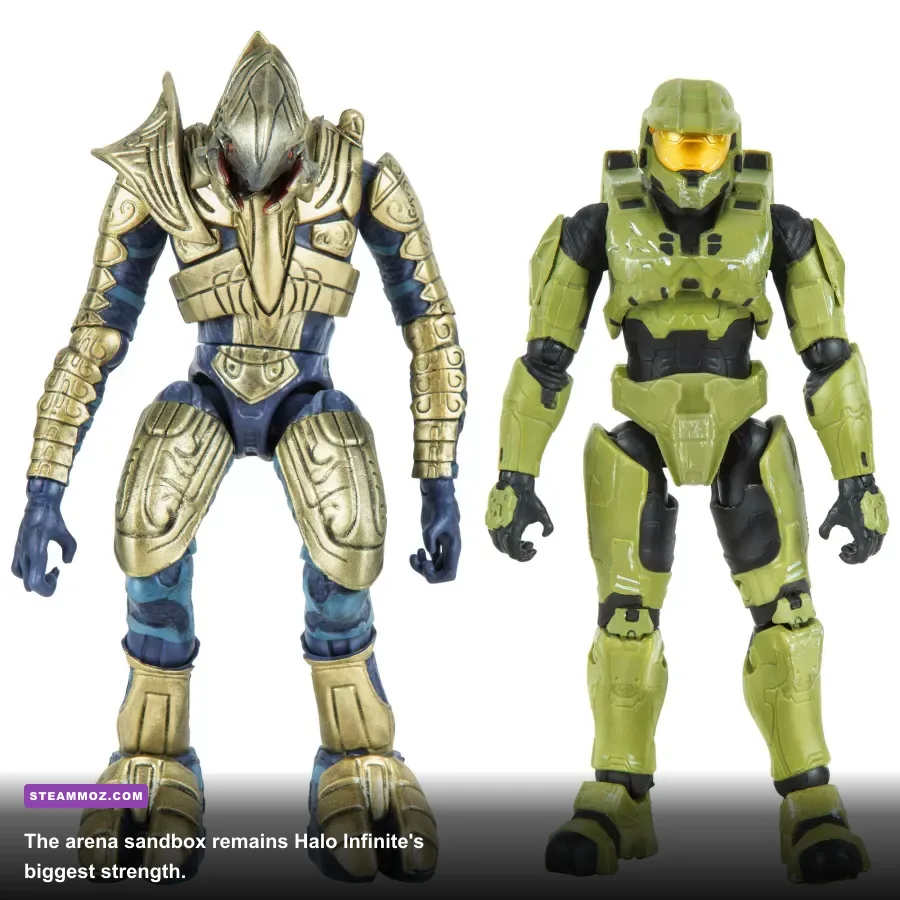
For competitive players, the answer is an easy yes. Halo Infinite's 4v4 arena combat rewards aim, positioning, shield management, grenade timing, and weapon control without turning every gunfight into a twitchy instant-kill exchange. The core loop—strip shields with sustained fire, land a headshot, then exploit the dropped weapon or power position—still feels distinct from Call of Duty, Valorant, and XDefiant.
For casual players, the answer is more qualified. Social playlists are fun when the teams are reasonably balanced, but matchmaking quality, connection consistency, and occasional playlist repetition can determine whether a session lasts twenty minutes or three hours. The free-to-play structure also means the multiplayer battle pass and cosmetic economy are always visible, even though core gameplay content is available without buying a premium pass.
For campaign fans, Infinite is worth a discounted purchase rather than an automatic full-price recommendation. The first few hours are excellent: Master Chief's grapple-powered movement opens up combat encounters, the Banished feel heavier and more aggressive than standard Covenant enemies, and Zeta Halo has enough verticality to make every firefight feel more physical. Later, the open-world loop leans too hard on familiar outposts, collectibles, and repetitive objectives.
| Player Type | 2026 Verdict | Why |
|---|---|---|
| Ranked FPS player | Sí, strongly recommended | Precise sandbox, demanding map control, excellent 4v4 fundamentals |
| Casual multiplayer player | Recommended | Free access, varied playlists, but matchmaking quality can fluctuate |
| Solo campaign fan | Recommended on sale | Great encounters and mobility, weaker open-world repetition |
| Forge creator | Strongly recommended | Deep tools and a large library of community-made maps |
| Competitive esports hopeful | Recommended with reservations | High skill ceiling, but population and event activity vary by region |
The smart entry point is the official Steam version of Halo Infinite. Multiplayer is free, while the campaign is sold separately or included through selected Xbox and PC Game Pass plans. Before buying the campaign, check current licensing and subscription terms on the official Xbox Halo Infinite page.
Infinite's gunplay is still the main event
Halo Infinite succeeds because its weapons don't just have different damage values; they create different decisions. The MA40 Assault Rifle is forgiving at close and medium range, but its bloom and slower kill time make it a poor substitute for a precision weapon across long sightlines. The BR75 Battle Rifle is the workhorse: controlled three-round bursts, reliable headshots, and enough range to contest most lanes when you pace your shots.
The VK78 Commando sits between those roles. Its automatic fire can shred at medium range, but holding the trigger too long causes recoil and accuracy problems. Burst it around the head and upper chest, especially when an opponent's shields are already damaged. The MK50 Sidekick remains lethal in practiced hands, but its small magazine punishes panic firing. A clean body-shot string followed by a final headshot can win a duel that the Assault Rifle would lose.
Power weapons are intentionally situational. The S7 Sniper Rifle rewards disciplined angles and headshots, while the Stalker Rifle offers a more forgiving energy-weapon alternative but overheats if you treat it like a normal marksman rifle. The Needler is devastating when enough crystalline needles track into a target, yet it loses value when enemies strafe behind cover. The Energy Sword and Gravity Hammer dominate close quarters, but their effectiveness depends on radar information and movement timing rather than simple possession.
| Weapon | Best Range | Core Strength | Main Weakness |
|---|---|---|---|
| BR75 Battle Rifle | Medium to long | Reliable precision bursts and headshots | Requires aim discipline under pressure |
| MA40 Assault Rifle | Close to medium | Fast shield pressure and easy handling | Weakens sharply at long range |
| VK78 Commando | Medium | Flexible automatic precision fire | Recoil punishes full-auto spraying |
| MK50 Sidekick | Close to medium | Fast time-to-kill with accurate shots | Small magazine and demanding recoil |
| Needler | Close to medium | Tracking needles can trigger a supercombine | Weak against cover and fast lateral movement |
| Energy Sword | Close | Threatens instant melee-range kills | Predictable without a lunge angle or escape plan |
The melee system is equally important. A normal melee attack deals heavy finishing damage after shields break, while the Mangler's old close-range dominance has been curtailed by balance changes over the game's lifespan. Don't burn grenades randomly, either. Plasma Grenades are excellent for forcing a player away from cover, Frag Grenades bounce around corners, and Dynamo Grenades can disrupt vehicles and grouped enemies.
That interaction between equipment, weapons, and movement is why Infinite still feels satisfying after the novelty wears off. The official Halo Waypoint hub remains the best place to check current news, patch notes, and sandbox changes before returning to ranked play.
The campaign is spectacular in combat, repetitive between fights
Infinite's campaign puts Master Chief, the Weapon, and the Pilot Echo 216 on Zeta Halo after the Banished defeat the UNSC Infinity. That setup gives the story a more intimate tone than Halo 5, with the Chief rebuilding trust with his AI companion while uncovering what happened to Cortana and the ring's defenders. The character work is more focused than the previous game, even when the wider plot still feels like it is repairing continuity damage.
The campaign's best feature is the Grappleshot. Upgrades let you shorten its cooldown, and that changes both exploration and combat. You can yank yourself to a ledge, steal a weapon from a Banished guard, pull an explosive coil into a group, and immediately grapple away from a Brute's hammer swing. The Drop Wall provides temporary cover, the Threat Seeker helps identify hidden enemies, and the Thruster gives Chief a short evasive burst. Upgrade choices matter because Spartan Cores are limited early on.
Prioritize Grappleshot upgrades if you enjoy exploration and aggressive encounters. A stronger Grappleshot improves cooldown and traversal, while additional Thruster upgrades make higher-difficulty fights less punishing. The Shield Core is the safest investment for Heroic and Legendary players, but it won't rescue you from bad positioning against a Brute Chieftain or a charging Hunter.
Open-world content is where the campaign loses momentum. Clearing a Forward Operating Base unlocks fast travel and reveals nearby activities, but many objectives repeat the same basic rhythm: approach a Banished position, eliminate guards, destroy equipment, and claim a reward. High-value targets are more interesting because their altered weapons change the encounter. Infiltrating strongholds and rescuing Marines can still produce excellent combat stories, but the map doesn't evolve enough to make every icon feel essential.
| Campaign Activity | Reward | Value in 2026 | Best Approach |
|---|---|---|---|
| Forward Operating Base | Fast travel and operational support | High | Capture early to improve map movement |
| Banished Outpost | Valor, weapons, and story flavor | Medium to high | Use Grappleshot angles instead of attacking the front gate |
| High-Value Target | Unique named weapon | High | Scout the arena and remove ranged threats first |
| Spartan Core | Equipment upgrades | High | Collect enough for Grappleshot and Shield Core upgrades |
| Audio Log | World-building and backstory | Optional | Collect naturally rather than sweeping every icon |
There is no reason to force yourself through every collectible. The strongest campaign experience comes from following the main missions, capturing useful FOBs, completing a few high-value targets, and letting exploration happen naturally. Players who want a completionist checklist may enjoy the density; everyone else should treat the open world as a combat playground, not a second job.
Forge and Firefight rescued the long-term multiplayer loop
Forge is the clearest reason Halo Infinite remains relevant beyond its original launch window. The toolset allows creators to build maps, script encounters, alter object behavior, and assemble modes that feel far removed from standard arena matches. It isn't just a room editor. A well-made Forge map can change sightlines, weapon economies, objective flow, and the entire pace of a match.
That community content matters because it softens the limitations of the official rotation. If you dislike playing the same familiar arena maps, Forge browser content can provide infection variants, race courses, survival scenarios, social hubs, and experimental objective modes. Quality is inconsistent, naturally, but the best creations demonstrate exactly why Halo's sandbox remains so adaptable.
Firefight adds a more direct PvE answer. Fighting Banished waves around an objective gives weapons such as the Hydra, Sentinel Beam, and Needler room to behave differently than they do in competitive arena. The King of the Hill structure keeps teams moving, while enemy composition forces you to prioritize Jackal shields, Elite energy weapons, Brute power weapons, and Hunter pressure instead of simply farming the weakest targets.
Firefight is especially good for returning players who don't want the stress of ranked matchmaking. It teaches map routes, weapon pickups, and enemy behavior while still demanding communication. The best teams rotate before the hill becomes untenable, save equipment for dangerous waves, and avoid wasting power weapons on Grunts when a Hunter pair is about to enter the zone.
PC performance is good, but your settings matter
Halo Infinite scales reasonably well on modern gaming PCs, though its open-world campaign is heavier than a compact arena map. The official minimum target lists a Ryzen 5 1600 or Core i5-4440, 8GB of RAM, and a Radeon RX 570 or GeForce GTX 1050 Ti with 4GB of VRAM. For a smoother 1080p experience, 16GB of system memory and a six-core processor are much more sensible targets.
Don't confuse a high average frame rate with a good competitive setup. Infinite feels best when frame pacing is stable and your minimums don't collapse during explosions, vehicle fights, or crowded campaign spaces. Set a frame-rate limit slightly below your monitor's refresh rate if your system produces uneven frametimes. On a 144Hz display, a locked 120 or 141 FPS can feel better than a wildly fluctuating 160-220 FPS.
| Setting or Hardware | Recommended Value | FPS Impact | Visual Note |
|---|---|---|---|
| Resolution scale | 100%; lower to 90% if needed | Very high | Primary performance lever, but lower values soften distant targets |
| Texture quality | High with 8GB VRAM; Medium with 4GB | Medium | Controls surface detail and VRAM pressure |
| Shadow quality | Medium | Medium to high | Medium preserves useful depth without heavy cost |
| Volumetric fog | Low or Medium | Medium | Low improves clarity in large outdoor spaces |
| Geometry quality | High | Medium | Improves distant structures and terrain definition |
| Effects quality | Medium | Medium | Reduces explosion and particle spikes |
| Async compute | Test On first | System-dependent | Can improve GPU utilization, but benchmark your own PC |
| Minimum frame rate | Disabled for uncapped play | Variable | Dynamic scaling can blur the image during heavy scenes |
On a GTX 1660 Super or RX 5600 XT-class GPU, 1080p Medium-to-High settings are a practical starting point. An RTX 3060 or RX 6700 XT can target high-refresh 1080p or solid 1440p with sensible compromises. Ray tracing is not a reason to buy Infinite, and competitive players should favor visibility and consistency over cinematic shadows.
If Infinite crashes or stutters, start with driver updates, shader compilation patience, overlays, and texture-quality reductions rather than immediately reinstalling. Our broader guide to PC crash and FPS fixes covers the same troubleshooting principles, while the higher-FPS settings guide is useful for understanding which options usually cost the most frames.
Should you play ranked, social, or custom games?
Start with social playlists for a few sessions. They give you space to learn weapon spawns, equipment locations, map geometry, and the rhythm of shield breaks without the full pressure of a rating system. Once you understand when to disengage, how to preserve a power weapon, and how to convert a numerical advantage, ranked becomes far less frustrating.
Ranked arena generally emphasizes a tighter ruleset and precision weapons, making the BR75 and Sidekick fundamentals especially important. The biggest mistake new players make is chasing kills into open space. Halo rewards living through the first engagement, recharging shields, and returning with a teammate. A two-player collapse is usually more valuable than a heroic solo push that leaves your team in a three-on-four.
Learn the difference between damage and progress. Shooting an enemy's shields is useful only if your team can capitalize on the break. If the target escapes around a corner, you may have spent ammunition without gaining map control. Call out shield damage, watch the kill feed, and rotate toward the next objective before the other team gets there.
| Mode | Best For | Skill Priority | Common Mistake |
|---|---|---|---|
| Social Arena | Learning maps and sandbox interactions | Weapon familiarity and movement | Ignoring power-weapon timers |
| Ranked Arena | Competitive improvement | Team spacing, accuracy, objective timing | Taking isolated fights |
| Big Team Battle | Vehicle combat and chaotic matches | Spawn awareness and anti-vehicle tools | Walking into open lanes alone |
| Firefight | Cooperative PvE | Target priority and hill rotation | Wasting equipment on minor enemies |
| Forge Browser | Novelty and community content | Adaptability | Judging the entire mode by one poor map |
Big Team Battle is still the place for players who want the loudest version of Halo. The Warthog, Ghost, Wraith, and Scorpion create memorable momentum swings, but vehicles are not invincible. The Hydra, Skewer, Plasma Grenades, and coordinated rifle fire can remove them quickly. Use terrain, don't park in predictable sightlines, and remember that a vehicle's value is measured by pressure and positioning, not just kills.
The verdict: worth installing, not worth romanticizing
Halo Infinite PC is worth playing in 2026 because the actual shooting remains outstanding. Its weapons have personality, its movement creates constant tactical choices, and its free multiplayer entry point makes trying the game almost risk-free. Forge and Firefight give it more staying power than the launch version had, while custom maps can make the game feel fresh long after the official playlist novelty fades.
But the honest retrospective has to include the compromises. The campaign's open-world structure is less varied than its combat. Live-service updates cannot erase the slow start or every community frustration. Matchmaking can be inconsistent, and players seeking a dense story campaign with the variety of Halo 3 may finish Zeta Halo wishing it had more bespoke missions and fewer repeated tasks.
My recommendation is simple. Install the free multiplayer if you miss classic Halo gunfights, then spend your first week sampling Social Arena, Big Team Battle, Firefight, and Forge rather than judging the game from one playlist. Buy the campaign when it is discounted or access it through a suitable subscription. Use a stable frame-rate cap, learn the BR75, protect your life during objective fights, and don't treat every map icon as mandatory.
Infinite isn't the flawless Halo revival it promised to be. It is something more complicated and, in 2026, arguably more useful: a technically impressive sandbox that finally has enough modes and community support to justify returning. If you want an FPS built around shield breaks, precision headshots, movement, and controlled chaos, Halo Infinite still earns a place on your PC.
For more performance-focused PC coverage, see our guides to max-FPS graphics settings and crash and low-FPS troubleshooting. They won't fix a bad ranked teammate, but they can at least make sure your own PC isn't the weakest link.