
Triple-A racing is currently trapped in a predictable loop of bloated open-world checklists and live-service treadmills, but the sharpest handling models and most intoxicating speed in the medium belong to titles that rarely crack mainstream headlines. If you want uncompromising physics, inventive drift mechanics, and tracks designed to test raw spatial awareness rather than your patience with microtransactions, you need to dig into the indie and double-A scene. From twin-stick slide mechanics that completely reinvent steering to zero-gravity anti-grav ships running on hyper-responsive physics engines, these five overlooked racing games deliver mechanical highs that outclass the biggest names in the genre.
Inertial Drift: Re-Inventing Cornering With Twin-Stick Drift Controls
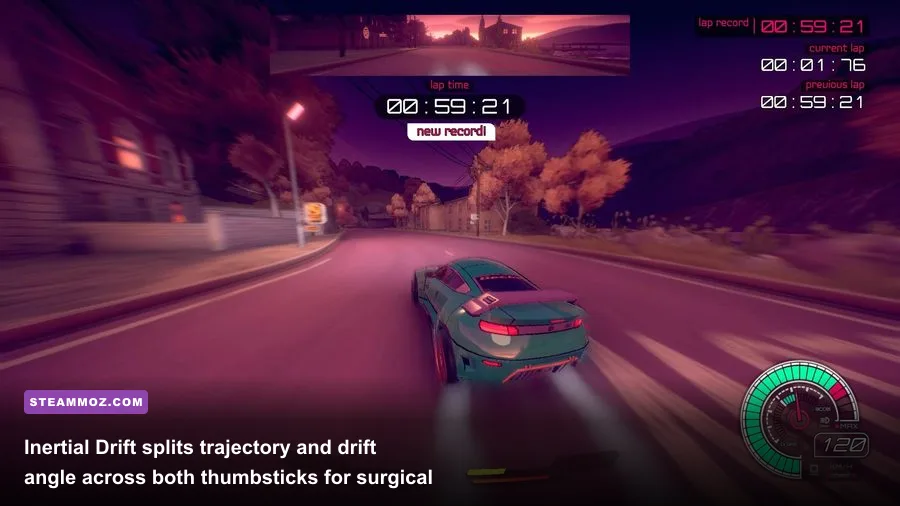
Arcade racing has relied on the same fundamental drift logic for decades: tap the brake, yank the wheel, counter-steer, and watch an invisible rail carry you through the bend. Inertial Drift throws that entire convention into the incinerator by introducing a dedicated twin-stick control layout. Your left thumbstick directs the vehicle's forward trajectory and steering angle, while the right thumbstick directly dictates the lateral drift angle. This total decoupling of steering and drift pitch gives you continuous, analogue authority over how far out your rear axle steps mid-corner.
The brilliance of this setup is how it eliminates the digital feel of standard arcade sliding. In cars like the entry-level Coda Gecko, drifting is gentle, predictable, and heavily governed by front-end grip, making it easy to master the hairpins of Lake Hill. Shift into the Haro Vulcan or the unforgiving Dragon Silvia, however, and the game morphs into an intense tightrope walk. The right stick becomes a hair-trigger blade: throw it too far into the stops on Lakeside Loop, and your rear quarter panel will immediately scrape the barrier, shedding 40 km/h of vital exit momentum. Much like dialing in high-performance profiles in tactical PC configurations for smooth frame execution, mastering Inertial Drift requires hyper-attentive inputs where micro-corrections dictate your survival.
What elevates the game beyond a mere mechanical gimmick is how its 16 distinct vehicles behave like specialized combatants in a fighting game roster. Some chassis demand that you stay pegged on the throttle while micro-flicking the right stick; others require aggressive pre-braking to compress the front suspension before you dare pivot the rear end. Wrapped in a striking cel-shaded 90s anime aesthetic that evokes heavy nostalgic memories reminiscent of iconic neon retro styling, Inertial Drift represents the rarest achievement in the racing genre: a control scheme that forces you to build entirely new neuromuscular pathways.
Distance: Atmospheric Survival Platforming Disguised as an Arcade Racer
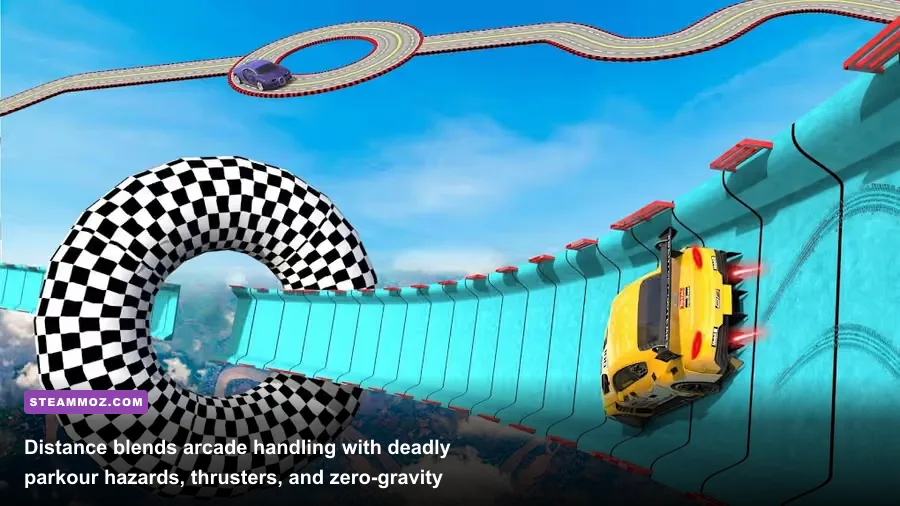
Most racing games treat tracks as passive ribbons of asphalt. Refract Studios’ Distance treats its courses as hostile, sentient murder chambers. Born as the spiritual successor to the legendary student project Nitronic Rush, Distance blends blisteringly fast arcade driving with parkour mechanics, thrusters, and zero-gravity surface transitions. Your car doesn't just navigate asphalt; it jumps, rotates along pitch and roll axes in mid-air, pops out aerodynamic wings to glide across cavernous chasms, and drives upside down on the underside of ruined synthwave megastructures.
The sheer tactical depth of Distance lies in its boost-and-heat economy. Boost is infinite, but overheating your reactor core causes your vehicle to instantly detonate. Surviving brutal campaign sectors like Cataclysm or The Factory demands continuous environmental thermal management. You must vent heat by executing clean barrel rolls during long aerial drops, scraping down cooling strips along vertical corridors, or cutting your thrusters moments before a laser gate slices your chassis in half. Even when you do get clipped, the modular damage engine doesn't automatically trigger a game-over screen; lose both right-side wheels to a swinging plasma blade, and you must rapidly counter-steer on two wheels using thruster bursts to stabilize your trajectory toward the next repair checkpoint.
The game plays with scale and terror in ways traditional motorsport titles never dare to dream. As neon spires crumble into dynamic obstacle mazes synced to an ominous electronic soundtrack, Distance delivers the same white-knuckle spatial problem solving you would expect when hunting for well-guarded structural secrets in deep-space environments. It is an aggressive, biomechanical nightmare of a racer where split-second reaction times and spatial awareness trump basic apex hunting.
BallisticNG: Pure High-Speed Zero-G Precision Built for Purists

When major publishers abandoned the futuristic combat racing space, indie studio Neognosis stepped into the void and constructed BallisticNG. While marketed on the surface as an affectionate love letter to the original 32-bit PlayStation era of WipEout, BallisticNG has quietly evolved into the absolute definitive anti-gravity simulation engine on the market, operating with mechanical fidelity that outclasses even its historic inspirations.
The secret lies within the simulation physics. Unlike modern arcade floaters that glue the ship to a spline, BallisticNG simulates raw electromagnetic repulsion, vehicle mass, downforce, and dynamic airbrake drag. Approaching a blind chicane on tracks like Nova Split or Cassandra at Phantom-class speeds (surpassing 800 km/h) requires dual airbrake feathering on both analog triggers. Yanking the left airbrake creates drag on the port wing, pitching the ship's nose down into the banking while maintaining engine thrust; botch your pitch axis input over a jump crest, and your hull will catch upward air pressure, stalling in mid-air and slamming unceremoniously into the circuit ceiling.
The game also features a fully customizable physics selector. You can race using the authentic 2159 handling ruleset, which preserves the floaty, high-momentum slide of the original 1995 classics, or switch to the 2280 ruleset, an ultra-sharp, high-grip model that demands surgical micro-adjustments on high-end controllers. Much like setting up competitive low-latency monitors or fine-tuning rendering targets as you would when optimizing system settings for locked high frame rates, BallisticNG rewards players who treat velocity as a calculated science. Factor in native VR support, robust custom ship importing, and an astonishing track roster, and you have an anti-gravity masterpiece hiding in plain sight.
Circuit Superstars: Motorsport Strategy Disguised as a Cute Top-Down Racer
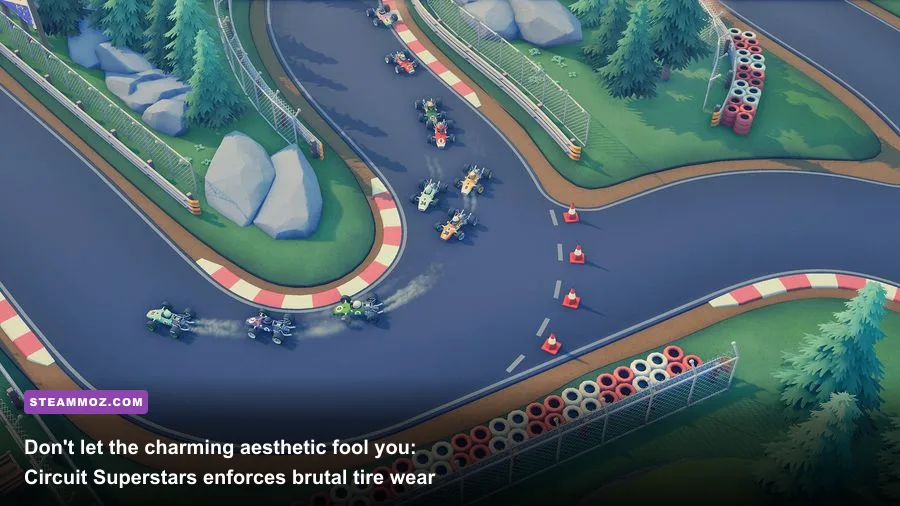
Do not let the miniature, vibrant dioramas fool you: Circuit Superstars is a hardcore simulation racer cloaked in top-down arcade attire. Developed by Original Fire Games—a team founded by actual motorsport competitors—this title features a tire-wear, fuel-consumption, and weight-transfer simulation engine that rivals the complexity of Assetto Corsa or iRacing, compressed into a tactile, overhead perspective.
Every single vehicle category—from 1960s GP vintage single-seaters to thundering Euro Trucks and modern Apex GT cars—possesses a remarkably complex handling signature. In the GP vintage cars, thin cross-ply tires and featherlight chassis mean aggressive trail-braking will instantly send the back end looping around on entry into Siena’s tight chicanes. To go fast, you must smoothly load the outside suspension, balance the car on the edge of slip angle, and roll on the throttle with delicate analog moderation. If your telemetry hits too high of a slip angle across sustained corners, you will cook your rubber compound, permanently dropping grip for the remainder of the stint.
This dynamic introduces genuine pit lane warfare into five-minute races. In a 20-lap endurance session around Maple Ridge, running soft compounds will net you blazing sector times for five laps, after which your tires fall off a dramatic performance cliff, costing you 1.8 seconds per lap. Hard compounds let you run long, but leave you utterly vulnerable to dives on cold out-laps. When you finally pull into the pit box, the game switches to a nerve-wracking semi-manual stop where you must balance repairing structural chassis damage against taking on precisely metered liters of fuel. It provides all the tactical sweat of an endurance racing pit wall without the six-hour time commitment.
Art of Rally: Scandinavian Flicks and Pure Handling Discipline
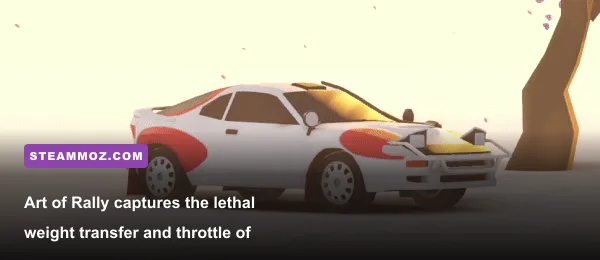
Rally driving is fundamentally about manipulating inertia: pitching hundreds of kilograms of steel sideways so that your tires scrub off excess speed while pointing your engine torque straight down the next straightaway. Developed by Funselektor Labs, Art of Rally distills this dangerous kinetic dance into its purest form. Viewed from an elevated, panoramic chase camera, you are stripped of intrusive cockpit gauges and left with nothing but engine audio, elevation cues, and the tactile balance of your vehicle’s tires against variable surfaces.
The handling model here is remarkably authentic and utterly merciless. The game takes you on a historical journey through the golden eras of off-road racing, culminating in the lethal, fire-breathing monsters of Group B. Piloting the Turbo 16 or the Hammerhead through the dense gravel forests of Finland requires flawless mastery of the Scandinavian flick. You must brake hard in a straight line, steer slightly away from the turn to swing the car’s rear mass outward, then snap the steering back into the apex while matting the gas to shift the mechanical differential's power forward. If you get your entry angle wrong by even five degrees, you will spear violently into a cluster of pine trees, taking terminal steering rack damage.
Surface transitions dictate your entire racing approach. The moment your tires roll off dry tarmac onto loose gravel, your braking distances double, demanding that you brake an entire telephone pole earlier than your instincts suggest. Wet asphalt cuts lateral traction in half, turning fast sweeping bends in Germany into terrifying moments of hydroplaning. Just as unoptimized hardware pipelines can introduce erratic micro-stutters during high-speed calculations, as detailed in our guide on resolving erratic system frame pacing and stability dips, Art of Rally exposes every millimeter of instability in your driving line. It is serene, minimalist art disguising a hardcore driving sim that demands absolute discipline.
Under-the-Radar Racer Benchmark: Physics Depth, Skill Ceilings, and System Demands
To help you decide which of these unconventional driving experiences matches your mechanical preferences, setup requirements, and hardware configuration, we have broken down their simulation cores and technological demands below. Whether you are hunting for an instant arcade fix on an entry-level handheld or a blistering zero-latency sim loop on an enthusiast display, each of these hidden gems occupies a unique tactical niche.
| Game Title | Sub-Genre Focus | Signature Gameplay Mechanic | Physics Model Complexity | Recommended Controller Setup |
|---|---|---|---|---|
| Inertial Drift | Arcade Twin-Stick Drift | Decoupled Steering / Slide Sticks | Medium (Bespoke per car) | Standard Dual-Stick Gamepad |
| Distance | Survival Platform Racer | Mid-Air Pitch/Roll & Jet Boosting | Arcade / Action Hybrid | Gamepad with Digital Bumpers |
| BallisticNG | Anti-Gravity Sim / Combat | True Magnetic Repulsion & Airbrakes | Extreme (Simulated aero drag) | Analog Trigger Gamepad or Flight Stick |
| Circuit Superstars | Top-Down Sim-Cade | Tire Heat, Wear, & Fuel Degradation | High (Full tire friction curves) | Precision Analog Gamepad / Wheel |
| Art of Rally | Isometric Historic Rally | Weight Transfer & Differential Locking | Very High (Raw momentum rally) | Gamepad with Haptic Triggers / Wheel |
Performance optimization in racing titles is critical; missed frames translate directly into blown apexes and ruined lap times. Fortunately, these indie developers built their engines with hyper-lean pipelines that scale across a massive range of hardware while maintaining razor-sharp frame pacing. Below are the hardware realities, physics engine tick rates, and optimal tuning targets for getting the most out of each racer.
| Game Title | Engine / Physics Rate | Target Framerate | Minimum GPU Baseline | Pro Tuning Tip |
|---|---|---|---|---|
| Inertial Drift | Unreal Engine / 60Hz Physics | 120+ FPS | GTX 960 / RX 560 | Disable Motion Blur; map drift stick deadzones to zero. |
| Distance | Custom Unity / 100Hz Internal | 144 FPS | GTX 760 / HD 7870 | Cap framerate to monitor refresh to prevent boost jump desync. |
| BallisticNG | Custom Unity / Up to 240Hz | 240+ FPS / VR Ready | Intel HD 4000 (Toasters welcome) | Enable 2280 Physics Mode and map Airbrakes to LT/RT axes. |
| Circuit Superstars | Unity / 120Hz Physics Tick | 60–120 FPS | GTX 660 / R7 370 | Lock camera zoom to Dynamic Close to track tire slip visually. |
| Art of Rally | Unity / Multi-surface Vector | 60–144 FPS | GTX 1060 / RX 580 | Lower Foliage Density one notch to stabilize heavy forest FPS. |
Triple-A racing may hold the keys to official manufacturer licenses and multi-million-dollar marketing machines, but these five indie masterworks prove that mechanical inventiveness and razor-sharp physics modeling matter far more than hyper-detailed car rosters. Whether you are wrestling with the hair-trigger weight distribution of an 80s Group B rally monster or dialing in lateral angles on a neon mountain pass, these hidden gems deliver the pure, unadulterated thrill of speed that modern blockbusters have spent years forgetting.