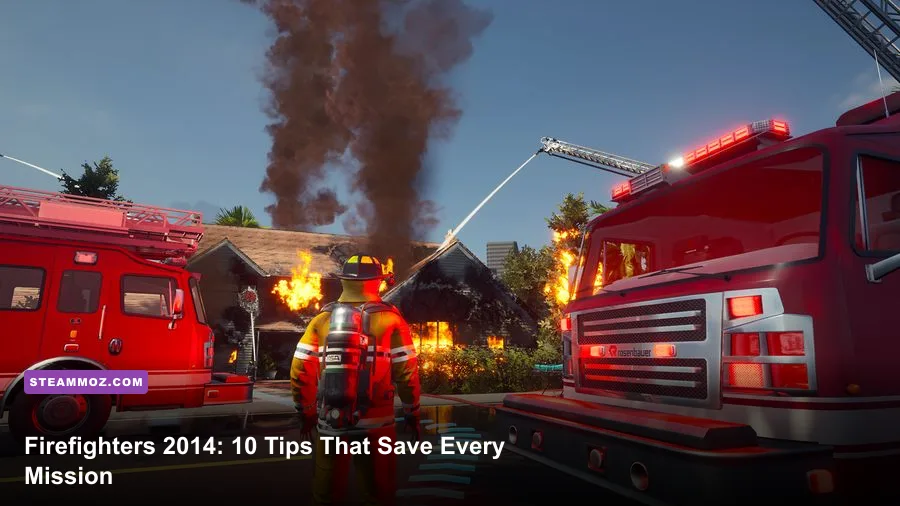
The ten best Firefighters 2014 tips are simple: pause before committing, assign every crew member a job, keep a hose line supporting interior work, search systematically, and treat vehicle positioning as part of the solution. Firefighters 2014 - The Simulation is less about sprinting toward the biggest flame than controlling a messy emergency. Fires spread, visibility collapses, civilians can be easy to miss, and a badly placed truck can waste more time than a slow extinguisher ever will. The advice below focuses on the habits that make early missions manageable without pretending this older simulation is more sophisticated than it is.
The game does not present a modern skill tree or a deep statistics screen, so new players should think in terms of roles, tools, access, and timing. Every action should answer one question: does this make the next rescue, suppression, or search step safer and faster?
1. Read the scene before touching the controls
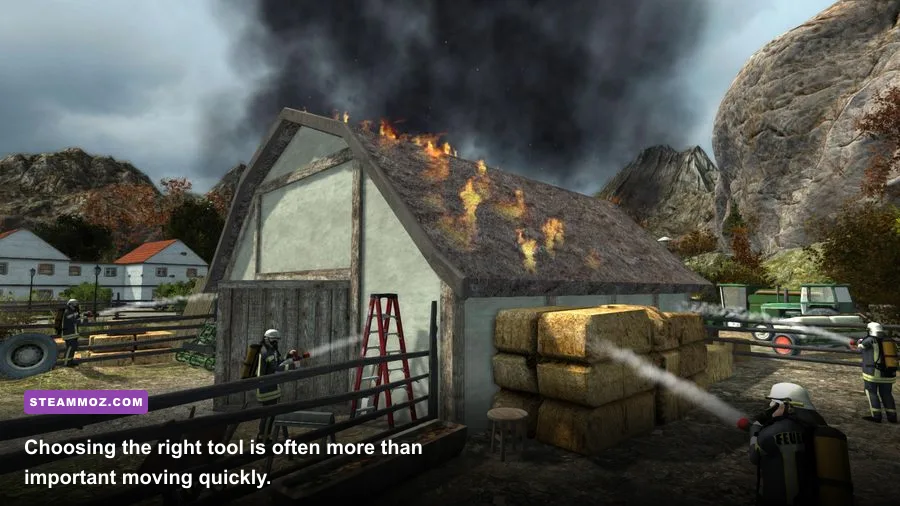
Your first thirty seconds are reconnaissance, not dead time. Stop the vehicle, rotate the camera around the incident, and identify the building's main entrance, side access, visible windows, parked obstacles, and the likely route to civilians. Firefighters 2014 often gives you enough visual information to establish a workable plan before the first tool is selected.
Look for the source of the heaviest smoke rather than automatically targeting the largest visible flame. Flames on the exterior may be drawing attention away from a deeper room or upper-floor problem. Also check whether a vehicle, wall, fence, or piece of street furniture is blocking the shortest approach. If your firefighter cannot reach the interaction point, repeatedly clicking the same location will not fix the route.
A useful opening sequence is consistent across missions: place the truck where the crew can still reach the building, send one firefighter toward the nearest access point, prepare suppression equipment, and reserve another crew member for search or rescue. This is the same kind of deliberate opening that makes other tactical games work; Steamoz's run-saving beginner habits apply surprisingly well here.
🎮 Firefighters 2014 - The Simulation Game
Looking to experience this game? Grab your digital key directly on our store for $4.99.
View on Steammoz Store →2. Match the tool to the problem
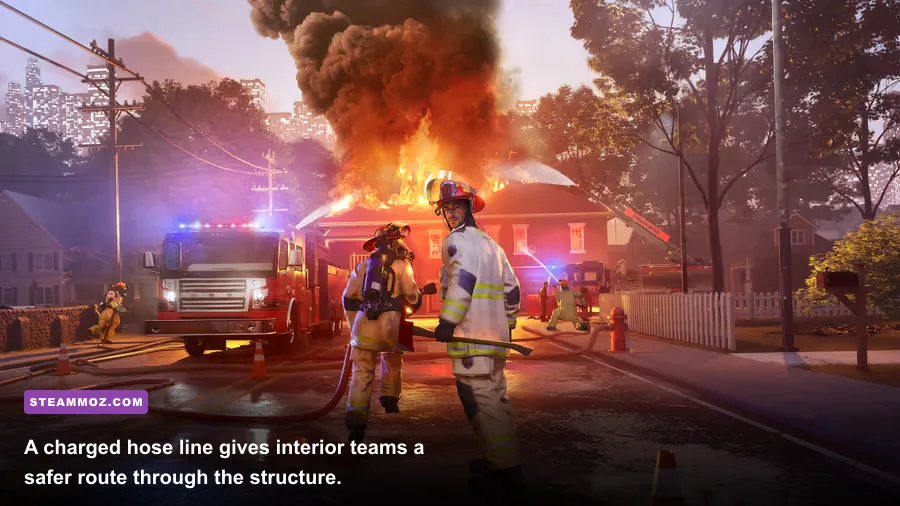
Do not treat the extinguisher, hose, axe, and other equipment as interchangeable buttons. The extinguisher is the fast answer for a small, localized flame. It is useful when a firefighter must clear a narrow area or finish a pocket of fire without setting up a full attack. It becomes inefficient when used against a broad room or a fire that is still being fed from another direction.
The hose is your main suppression tool for serious incidents. Use it when the burning area is large, when flames are blocking access, or when an interior route needs to remain controlled while another firefighter searches. The axe is primarily an access tool: doors, obstacles, and blocked routes can turn a rescue into a wasted minute if you insist on approaching from the wrong side. If a mission gives you a cutting tool for a specific obstruction, save it for that obstruction instead of carrying it into every encounter.
| Situation | Best first tool | Why it works | Common mistake |
|---|---|---|---|
| Small isolated flame | Extinguisher | Quick deployment and precise control | Using a hose and losing setup time |
| Large room or exterior spread | Hose | Better sustained suppression | Trying to solve the whole fire with an extinguisher |
| Blocked doorway or obstacle | Axe or assigned access tool | Opens the route needed for progress | Ordering a firefighter to walk through an impassable route |
| Unknown interior area | Search-focused crew member | Finds civilians and hazards while suppression continues | Sending every firefighter to the same flame |
Switch equipment with a purpose. If the active objective changes from suppression to rescue, stop staring at the fire and move the correct firefighter into position. The game rewards task completion, not impressive-looking spray effects.
3. Build a two-person response instead of a traffic jam
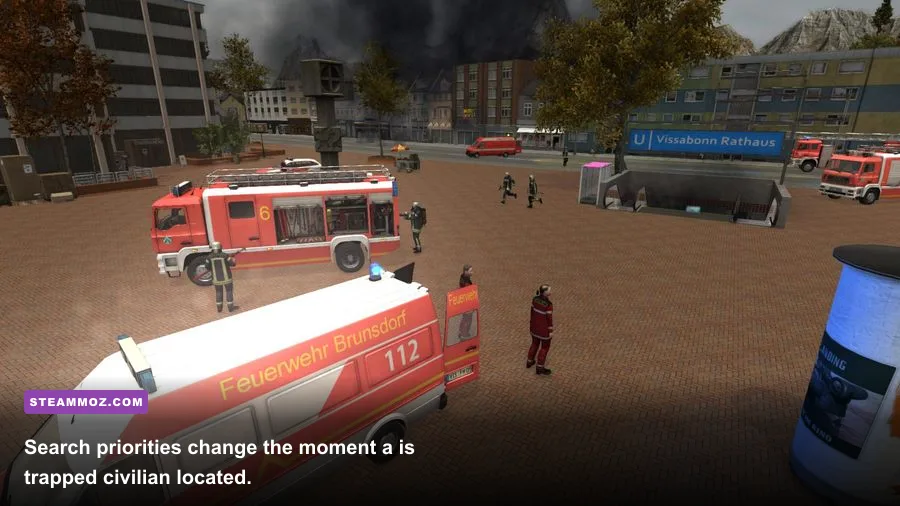
The fastest crew is not four firefighters standing shoulder to shoulder. Split the response into a suppression pair and a search or access pair whenever the mission allows it. One firefighter controls the immediate danger while the other advances toward the objective. This prevents the classic beginner failure where three crew members queue behind one character and contribute nothing.
Keep the jobs concrete. A hose operator should suppress the route or the fire front. A second firefighter should search rooms, clear access, locate civilians, or finish isolated hotspots. If a third crew member is available, use that person as a flexible reserve who can take over a tool, handle a nearby flare-up, or complete an interaction the main pair cannot reach.
Spacing matters. Leave enough room for characters to turn, approach doors, and interact with objects. Tight clusters create pathfinding problems, especially around the fire truck and building entrances. If a firefighter stops unexpectedly, move the destination a few steps away and issue the order again instead of assuming the mission is bugged.
Think of the squad as a moving chain. The hose operator protects the front, the searcher creates information, and the reserve fixes whatever the first plan missed. That structure is far more reliable than micromanaging every character simultaneously.
4. Establish the hose line before making a deep entry
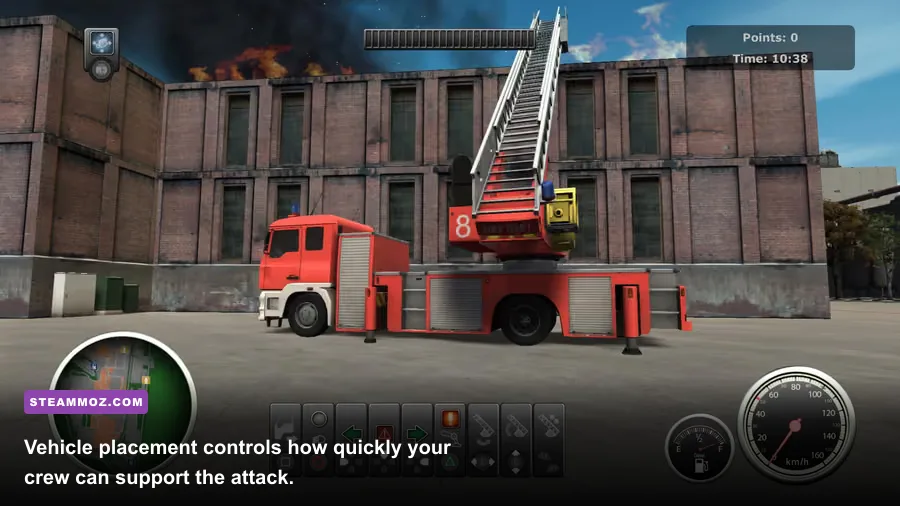
Interior work is where impatient players lose control. Before sending a firefighter deep into a burning structure, establish suppression from a position that covers the entry route. You want the path behind the firefighter to remain usable, not a corridor that becomes dangerous while attention is focused on a room farther inside.
Use short advances. Suppress the visible fire, move to the next safe interaction point, pause, and reassess. Do not walk past an active flame simply because the objective marker is farther away. If the route branches, deal with the branch closest to your team first. A cleared entrance gives you a fallback route and makes later rescues much less chaotic.
The hose is also useful defensively. You do not always need to stand directly beside the hottest flame. Position the operator so the stream can control the area ahead while leaving enough space for another firefighter to pass. If the game camera makes the stream difficult to judge, zoom or rotate before issuing a long movement command; a bad angle can make an apparently clear route look safe when it is not.
Firefighters 2014 is not a hardcore heat-model simulator, but it still communicates danger through spread, smoke, blocked access, and interrupted movement. Play around those signals. When the screen becomes visually confusing, retreat to the last cleared area and rebuild the approach rather than pushing deeper.
5. Search in a repeatable pattern
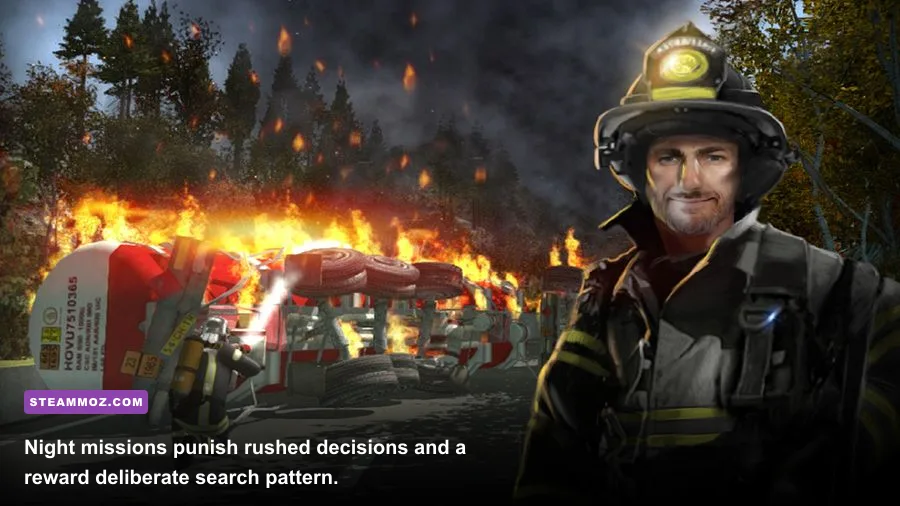
Random searching feels active but produces missed rooms. Start at the entrance, sweep one side of the structure, then return through the center before checking the opposite side. Clear each accessible room or interaction point once, and keep track of doors, stairways, and dead ends. This simple pattern prevents you from circling the same hallway while an unchecked room remains behind you.
Search only after the immediate fire front is controlled. A civilian marker or rescue objective is valuable, but a firefighter trapped behind an expanding flame helps nobody. When a civilian is found, change the crew's priority instantly: one character should handle the rescue interaction while another protects the route out. Do not abandon suppression entirely unless the fire is already contained.
For multi-room buildings, divide the structure into zones. Mark the entrance zone, the nearest interior zone, and the far zone mentally. Complete each zone before moving onward. This is especially useful in smoke-heavy missions where identical corridors make visual memory unreliable.
Night scenes and industrial areas deserve slower searches. Emergency lighting can make objects look like open routes, while machinery, containers, and narrow passages can hide the actual interaction point. Rotate the camera and approach from a different angle when a civilian or objective seems to be present but will not trigger.
6. Rescue civilians before chasing perfect suppression
Fire control is important, but a mission with a trapped civilian should not become a purity test about extinguishing every flame first. Once the nearest route is reasonably controlled, commit one firefighter to the rescue. The second firefighter keeps the corridor usable and deals with any flame that threatens the extraction path.
Approach civilians from the safest available side. If the direct route is blocked, clear access first rather than forcing repeated movement commands. After the rescue interaction begins, resist the urge to drag the same firefighter back toward the largest fire. The rescue itself is the priority, and abandoning the civilian can cost more than leaving a small hotspot for a few seconds.
When several civilians are involved, handle the closest viable rescue first. That reduces the distance your crew must travel through a changing scene. After each evacuation, pause for a quick reassessment: check whether the entry remains open, whether the next target is accessible, and whether the hose operator needs to reposition.
7. Park the fire truck like a piece of equipment
The truck is not just decoration or a spawn point. Its position determines the practical shape of your response. Park close enough to reduce walking time, but not so close that the vehicle blocks the entrance, a side route, or the space needed for firefighters to turn around. A slightly offset position is usually better than placing the front bumper directly against the building.
Before unloading the crew, inspect the approach from the truck to the incident. If a wall, hedge, vehicle, or corner funnels everyone through a single narrow gap, move the truck. Repositioning early is cheap; discovering that the hose operator cannot reach the fire after the structure has spread is expensive.
Use the road and open ground as your staging area. Keep one clear path between the vehicle and the building for extraction. If the mission includes several incident points, avoid parking in the middle of the route between them. The best placement supports the current objective without creating a second navigation problem.
| Truck position | Useful when | Advantage | Risk |
|---|---|---|---|
| Offset near the main entrance | Single-building response | Short crew travel and clear access | Can block the entrance if parked too tightly |
| Side of the structure | Side-door or long-building missions | Improves access to a second route | May lengthen the return path |
| Open road staging point | Multiple objectives | Preserves movement around the scene | Longer walk to the first fire |
8. Treat objectives as a checklist, not a suggestion
Firefighters 2014 missions can feel complete when the main blaze is out, yet the actual objective may still require a search, a rescue, an interaction, or a specific area to be cleared. Read the objective text again after every major event. If progress has stopped, assume something remains undone before assuming the game has failed to register your work.
Common causes of stalled progress include one small flame behind an object, a civilian in a side room, an unopened route, or a firefighter who has been assigned to the wrong interaction. Walk the perimeter and revisit rooms methodically. Do not restart immediately; a two-minute inspection often finds what frantic movement misses.
Use the mission's wording to decide how aggressively to play. A suppression-focused objective allows you to prioritize the fire front. A rescue-focused objective demands earlier search work. A clearance objective usually rewards a careful perimeter sweep after the obvious flames disappear.
9. Fix pathfinding before it wastes the mission
When a firefighter freezes, walks in circles, or refuses an order, cancel the command and issue a shorter one. Target a nearby piece of open ground first, then the doorway, then the final interaction point. Long commands across smoke-filled interiors are more likely to collide with objects or route through an inaccessible gap.
Keep characters from occupying the same doorway. Move the first firefighter through, wait for the route to open, and then send the next. If a tool interaction will not trigger, change the camera angle and approach from the front or side rather than repeatedly clicking the object from behind another character.
Save or restart only after testing a local correction. Older simulation games can have awkward collision and animation behavior, but many apparent problems are simply crowded navigation. The same mindset used in troubleshooting awkward simulation performance helps here: isolate one problem, change one variable, and test again.
10. Use a stable control and graphics setup
Firefighters 2014 is an older PC title, so maximum settings are rarely the key to better play. A stable frame rate and readable scene matter more than extra visual effects. Start with the game's native resolution, then lower shadows, reflections, and post-processing if the camera stutters around smoke or emergency lighting. Keep texture quality high if your system can handle it, because readable surfaces make doors and obstacles easier to identify.
Use a moderate camera sensitivity and avoid constant rapid rotation. Smooth camera movement makes it easier to identify a route, while excessive sensitivity turns building interiors into visual noise. If the game offers windowed or borderless modes, test them when fullscreen causes input or alt-tab problems. For older hardware, the best profile is the one that keeps navigation responsive during the busiest fire effects.
| Setting area | Recommended starting point | Performance impact | Gameplay reason |
|---|---|---|---|
| Resolution | Native monitor resolution | High if reduced | Preserves readable doors and objectives |
| Shadows | Medium | Medium to high | Reduces smoke-scene hitching with limited clarity loss |
| Reflections and effects | Medium or low | Medium | Improves stability around emergency lights and fire |
| Textures | High where VRAM allows | Low to medium | Keeps environmental details easier to read |
| Display mode | Fullscreen first; borderless if needed | System-dependent | Helps resolve focus and input issues |
For a second opinion on tuning older PC games, Steamoz's Darklands settings guide and Cricket Through the Ages performance guide explain the same practical principle: prioritize consistency over a screenshot-friendly preset.
The dependable beginner routine
Put the ten tips together and every mission gets a repeatable opening. First, read the scene and park the vehicle without blocking access. Second, select the tool that matches the immediate problem. Third, establish a hose-supported route before deep entry. Fourth, split the crew between suppression, search, and access. Fifth, sweep rooms in a pattern and rescue civilians as soon as the route is controlled.
After that, revisit the objective list, solve pathfinding problems with short commands, and adjust graphics only when performance interferes with camera control. Firefighters 2014 becomes much less frustrating once you stop treating it like an action game. The winning rhythm is slower than a sprint, but it is also far more efficient: observe, stage, suppress, search, extract, and confirm.
For the official product details, check the game's Steam store page and the publisher's official Aerosoft site. And if you enjoy systems-heavy games where careful planning beats frantic inputs, Steamoz's Edge of Sanity settings advice is worth bookmarking too.