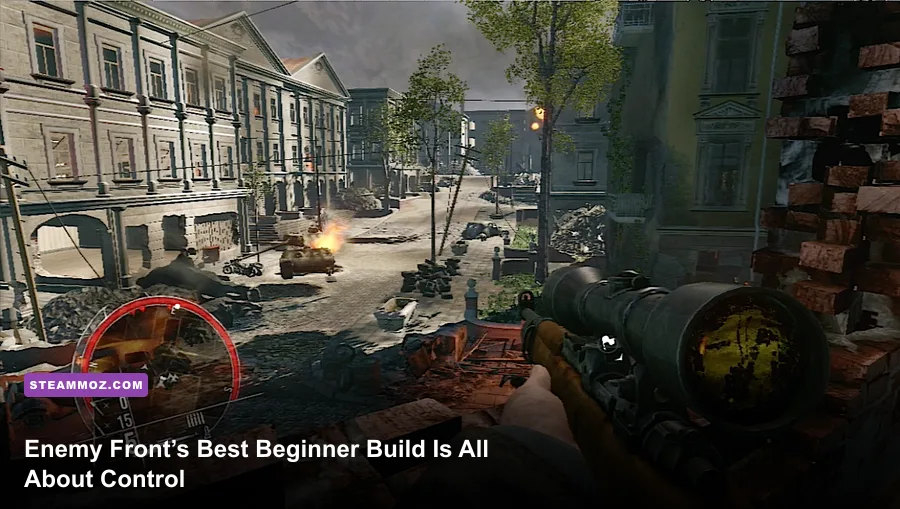
The best beginner build in Enemy Front is a flexible control loadout: carry the MP40 for close-range clearing, use the Kar98k when sightlines open up, keep a silenced pistol for stealth takedowns, and save grenades for groups behind cover. The game has no RPG skill tree, weapon-stat scaling, or permanent class build, so your real “build” is the weapon combination, difficulty habits, and route discipline you use from the first mission onward.
That distinction matters. Enemy Front is a linear World War II shooter built around Robert Hawkins, an American war correspondent pulled into resistance operations across occupied Europe. Weapons are picked up from the environment, and the strongest loadout can change between checkpoints. Think of this guide as a starting combat system rather than a character sheet: a reliable way to make the campaign’s stealth sections, open firefights, and vehicle-heavy encounters feel manageable.
The Best Starting Loadout for New Players
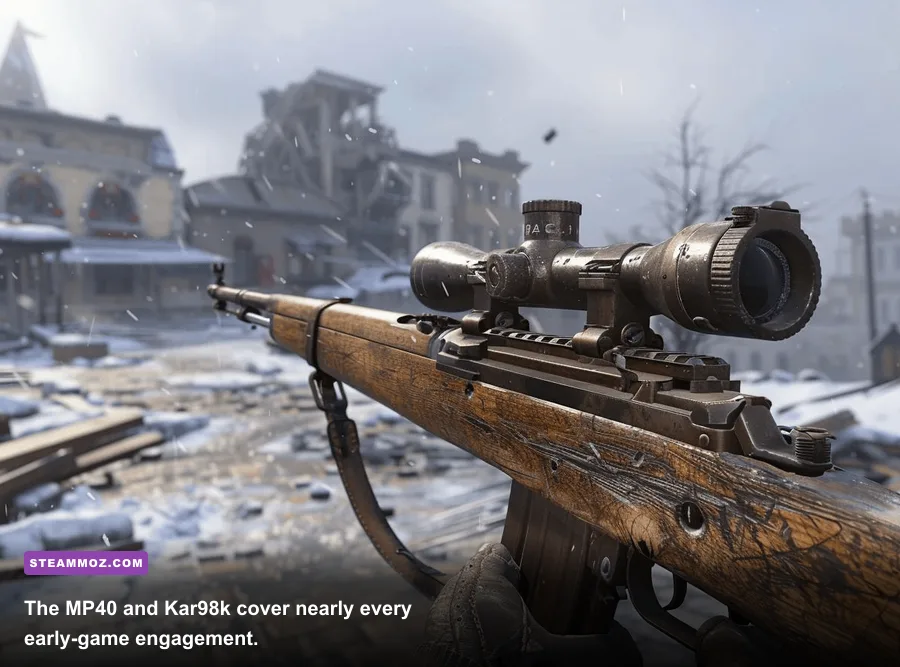
Start with the MP40 as your default weapon whenever the game offers it. Its compact profile and fast handling make it much easier to control inside buildings, trenches, and narrow village streets than a full-sized rifle. The trade-off is obvious: the MP40 loses effectiveness at long range, and its magazine disappears quickly if you hold the trigger through every encounter.
Pair it with the Kar98k. The bolt-action rifle is slower, but it rewards deliberate headshots and gives you a clean answer to German soldiers posted in windows, towers, and distant sandbag positions. You don't need to carry the rifle constantly. Swap to it before crossing an open field, then return to the MP40 when the fight collapses into close quarters.
Your secondary weapon should be a silenced pistol whenever one is available. The suppressed sidearm is not a substitute for the MP40; it is an opening tool. Use it to remove an isolated guard, trigger a stealth sequence, or finish a wounded enemy without advertising your position. If the game forces a different sidearm, conserve its ammunition and prioritize the primary weapon dropped by nearby enemies.
| Slot | Recommended Weapon | Best Range | Why Beginners Should Use It |
|---|---|---|---|
| Primary | MP40 | Close to medium | Fast handling and dependable room-clearing power |
| Long-range swap | Kar98k | Medium to long | Accurate single shots against exposed targets |
| Secondary | Silenced pistol | Close | Quiet takedowns and low-risk stealth openings |
| Explosive | Hand grenade | Grouped enemies | Flushes soldiers from trenches and hard cover |
For a deeper look at how the campaign’s guns compare, use Steamoz’s Enemy Front weapon tier list. The important beginner takeaway is simple: don't chase the biggest-looking weapon. Choose the gun that matches the next piece of terrain.
Why not start with the MG42?
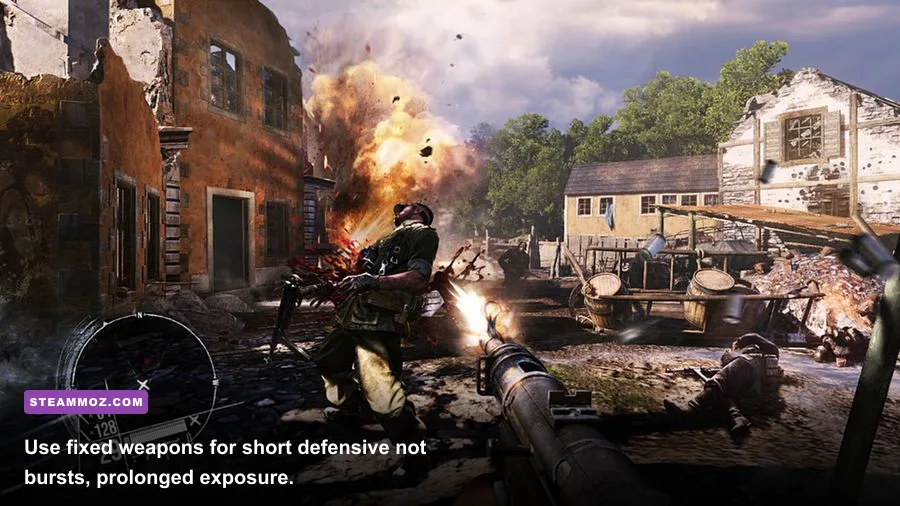
The MG42 is devastating when mounted or used from a prepared position, but it is a poor default weapon for learning the campaign. Its recoil and handling punish movement, and carrying it encourages you to stand in the same place while enemies flank you. Use mounted MG42s during defense objectives, fire in short bursts, and leave the position as soon as the game gives you room to move.

🎮 Enemy Front
Looking to experience this game? Grab your digital key directly on our store for $1.99.
View on Steammoz Store →Skill Priorities Without a Skill Tree
Enemy Front doesn't let you spend points on health, reload speed, stealth, or weapon damage. That means your “skill priorities” are behavioral: improve the habits that produce the biggest survival gains. First, learn enemy awareness. German infantry usually reveal their positions through muzzle flashes, shouted warnings, movement in windows, and the red directional damage indicator. Don't sprint toward the last place you saw a muzzle flash. Reacquire the angle, identify cover, and then return fire.
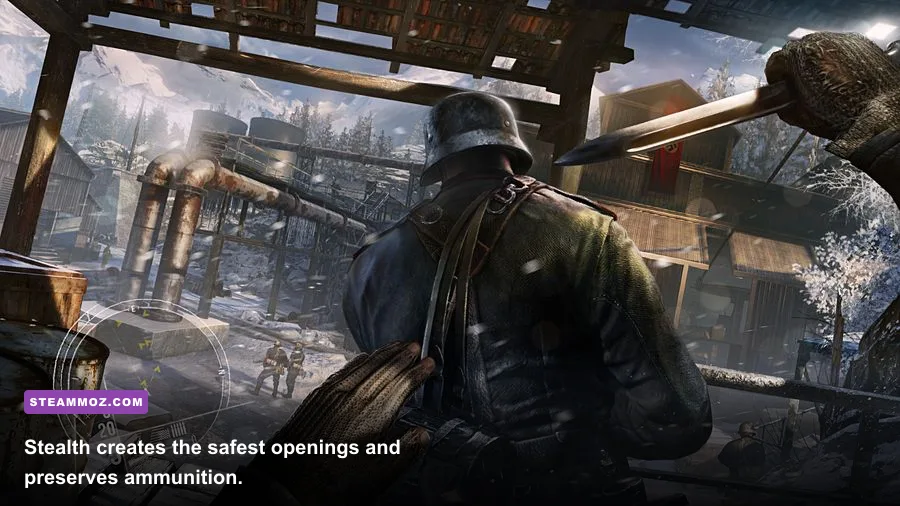
Second, prioritize stealth whenever the mission permits it. Crouch behind low cover, watch patrol routes, and use the silenced pistol on isolated targets. A quiet opening can remove two or three enemies before the main firefight begins. More importantly, it lets you reach a better position instead of fighting the entire encounter from the doorway where the game spawned you.
Third, treat health as a resource rather than a reset button. Health recovery is limited by the campaign’s checkpoint design, and taking several small hits while crossing between cover quickly turns into a failed push. Peek from the side of cover, fire two or three rounds, duck back, and change your angle. The AI is much easier to handle when you make it search for you.
| Priority | Habit to Practice | Combat Benefit | Common Beginner Mistake |
|---|---|---|---|
| 1 | Use cover before firing | Reduces chip damage during peeks | Standing in the open to finish a target |
| 2 | Open with stealth | Removes guards before alarms and reinforcements | Firing the MP40 at the first visible enemy |
| 3 | Swap range-appropriate weapons | Improves accuracy and ammunition efficiency | Spraying at distant silhouettes |
| 4 | Relocate after loud bursts | Stops enemies from pre-aiming your cover | Repeeking the same window repeatedly |
For a more general stealth-and-positioning mindset, Steamoz’s new-player tips for Dragon’s Dogma are obviously aimed at a different genre, but the principle carries over: spend your attention on the next safe option, not on recovering from the last mistake.
Your Combat Rotation for Every Encounter
Use this five-step rotation whenever you enter a new combat space. Start by stopping at the threshold. Enemy Front often places an immediate threat just beyond a doorway, ridge, or courtyard entrance, and sprinting through the trigger point can activate several firing positions at once.
- Scout the space. Look for windows, mounted guns, explosive objects, patrols, and the next piece of hard cover.
- Remove the isolated target. Use the silenced pistol or a careful Kar98k shot if the target is outside alert range.
- Move to hard cover. Sandbags, stone walls, vehicles, and large crates are safer than thin wooden fences or foliage.
- Use the MP40 in controlled bursts. Fire roughly four to six rounds, release the trigger, and reset your aim before the next burst.
- Advance only after the nearest firing angle is quiet. Reload behind cover, collect ammunition, and repeat the process.
Grenades fit between steps three and four. Throw one when two or more enemies are committed to a trench, bunker entrance, or room. Don't waste explosives on a lone soldier standing beside open ground. The grenade's value comes from forcing a group out of cover while you control the exit.
When enemies rush, backpedal toward your previous cover instead of trying to win a point-blank duel in the open. The MP40 handles this panic moment well, but your goal is still to create distance. If a soldier reaches melee range, a short burst to the chest is safer than attempting a slow precision shot.
How to handle mounted guns and armor
Mounted MG42 sections are about timing, not damage racing. Identify the gunner's firing arc, move between cover during the pause, and use a grenade if the position is protected by nearby infantry. Vehicle encounters usually reward patience and the anti-armor weapon the level places nearby. Don't burn every grenade on regular infantry immediately before an objective that clearly signals a tank or armored-car threat.
Mission Progression and Weapon Swaps
Your loadout will change because Enemy Front distributes weapons through missions rather than locking you into a permanent inventory. Early environments teach the MP40-and-rifle rhythm: clear a building, take a distant shot, then push through a courtyard. Later resistance operations add more open terrain, fortified positions, explosives, and defensive sequences where the best weapon is the one already positioned near the objective.
Keep at least one weapon with a healthy ammunition supply. A powerful gun with five rounds left is not a build; it is a temporary opportunity. After a firefight, check bodies and weapon pickups before moving through the next checkpoint. If you are carrying an MP40 with low ammunition, swapping to a common German rifle is better than stubbornly saving the last magazine for an imaginary boss fight. The campaign has no conventional RPG boss roster, so ammunition management matters more than hoarding.
| Encounter Type | Preferred Weapon | Position | Win Condition |
|---|---|---|---|
| Village interiors | MP40 and pistol | Doorframe or interior cover | Clear rooms without overextending |
| Open fields | Kar98k, then MP40 | Stone wall or trench | Pick off distant threats before advancing |
| Fortified trench | MP40 and grenades | Flank side of cover | Flush defenders, then push quickly |
| MG42 defense | Mounted MG42 | Prepared emplacement | Use bursts and watch the flanks |
| Armor objective | Placed anti-armor weapon | Hard cover near the objective | Attack during safe movement windows |
The official Enemy Front Steam page confirms the game’s campaign and multiplayer focus, while the CI Games Enemy Front page provides the original developer information. Check the Steam community discussions if you run into older PC-specific issues, but don't expect modern balance patches to turn the campaign into a progression-driven shooter.
PC Settings That Make the Build Feel Better
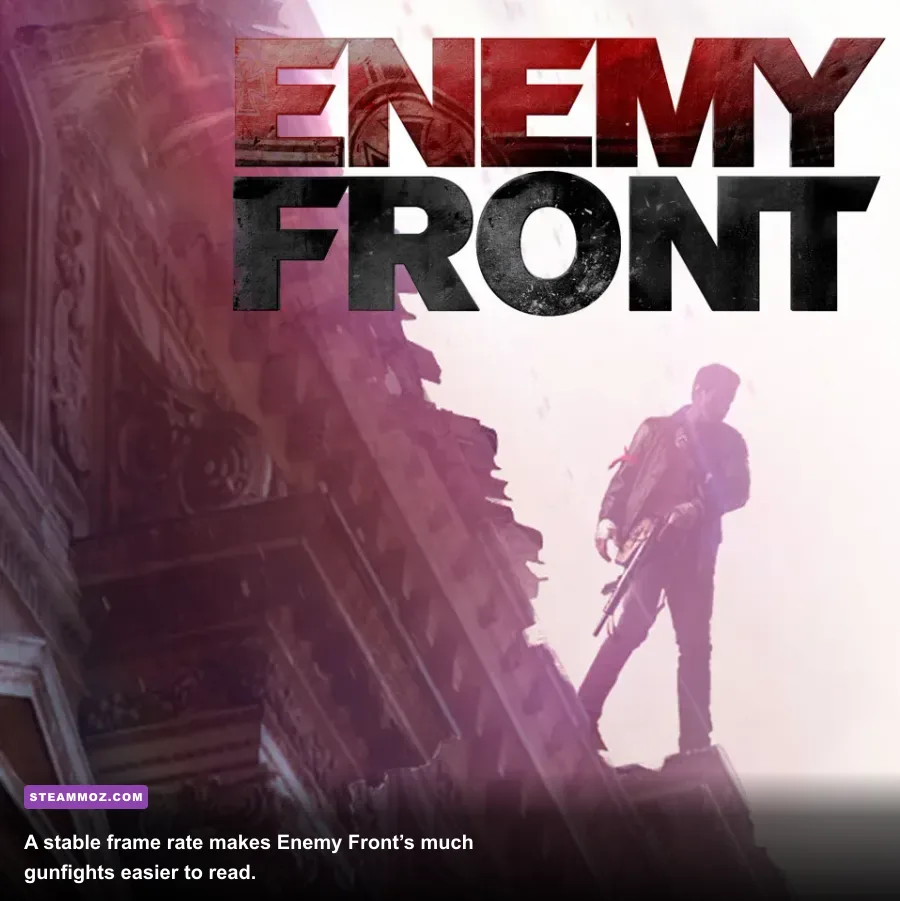
A stable frame rate helps more than chasing ultra-quality textures. Enemy Front is an older PC release, so most modern systems can target 60 FPS, but inconsistent frame pacing can make MP40 bursts feel strangely slippery. Start at 1080p, use the highest texture quality your GPU memory comfortably supports, and reduce shadows first if performance dips during outdoor firefights.
| Setting | Recommended Value | FPS Impact | Visual Trade-Off |
|---|---|---|---|
| Resolution | 1920×1080 | High if increased | Best clarity-to-performance baseline |
| Texture quality | High | Low to medium | Keeps weapons and environments sharper |
| Shadow quality | Medium | Medium to high | Small loss in shadow detail, useful FPS gain |
| Anti-aliasing | Medium or High | Medium | Reduces jagged rifle sights and geometry |
| Effects quality | Medium | Medium | Less smoke and explosion detail |
| V-sync | Off if tearing is acceptable | Latency benefit | May introduce screen tearing |
If you want more PC optimization ideas, Steamoz’s guides to reducing stutters in Ghost Recon Breakpoint and fixing crashes and low FPS in Final Vendetta cover the same practical priorities: stable frame pacing, sensible resolution, and avoiding settings that add visual cost without helping readability.
Once you have the MP40, Kar98k, silenced pistol, and grenade rhythm down, the campaign becomes far less chaotic. Scout first, open quietly, fight from hard cover, burst instead of spraying, and swap weapons whenever the terrain changes. That is the real beginner build for Enemy Front: not a permanent class, but a disciplined toolkit that keeps every encounter under your control.