Drone Swarm is worth playing in 2026 if you want a focused, unusual sci-fi strategy game—not if you're expecting a traditional RTS. Stillalive Studios' 2021 release remains one of the most inventive space-combat experiments on Steam, built around controlling a swarm of up to 32,000 drones instead of selecting individual units. Its campaign delivers clever tactical puzzles, a memorable survival premise, and battles that feel completely different from conventional fleet games. The catch is equally clear: the story is light, the mission structure becomes repetitive, and the interface occasionally struggles to communicate what your swarm is doing.
That makes this a recommendation with conditions. At a deep discount, Drone Swarm is an easy buy for fans of tactical experimentation, roguelite-style upgrades, and sci-fi systems that ask you to think spatially. At full price, its relatively short campaign and uneven difficulty make the decision less automatic. After several years of patches and a mature PC ecosystem, however, the core game is still refreshingly original.
What makes Drone Swarm different from other RTS games?
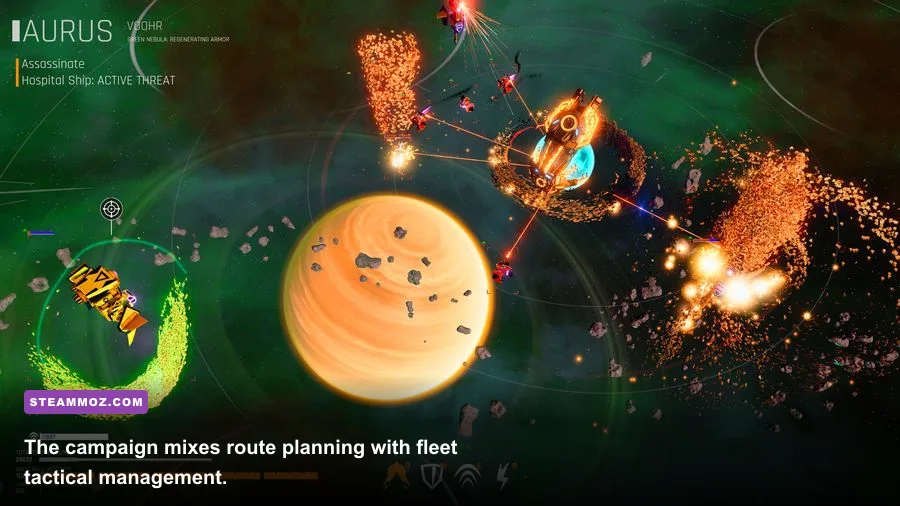
Drone Swarm puts you in command of the Noah, a gigantic spacecraft carrying the last remnants of humanity after Earth has been destroyed. The ship's name is more than a story reference: it is your base, objective, and most important vulnerability. Instead of building a conventional fleet, you direct a cloud of autonomous drones around the Noah. The swarm attacks, blocks incoming fire, gathers resources, and creates temporary formations in real time.
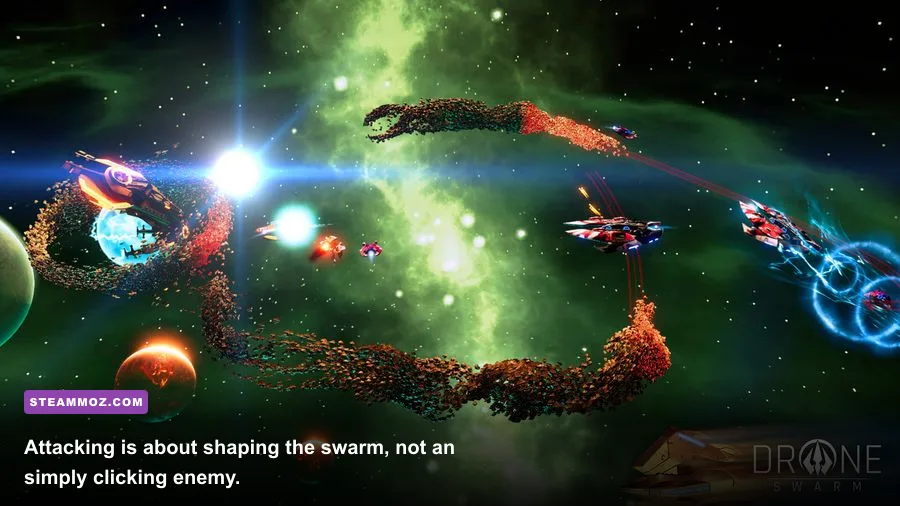
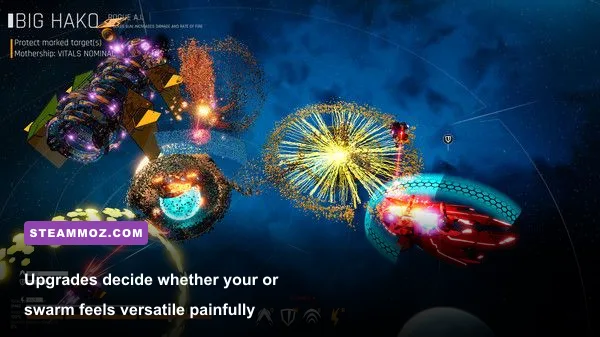
The headline figure is up to 32,000 drones, but the number isn't there just for spectacle. The game treats the swarm as a flexible mass. You can stretch it into a long shield, compress it around the Noah, split it into attacking groups, or send it toward a distant target while keeping a defensive pocket near the ship. The best moments come when one shape solves several problems at once: a broad crescent absorbs a projectile wave, then folds inward to surround an exposed enemy.
This is closer to controlling a physical material than commanding soldiers. Drones have travel time, formations have coverage limits, and every movement creates an opening somewhere else. A scattered swarm may reach an enemy faster, but it won't stop incoming fire as reliably. A dense formation offers protection, yet it can waste time crossing the battlefield. You are constantly balancing distance, density, damage, and the Noah's safety.
The combat also includes tactical controls that let you pause or slow the action while issuing orders. That feature is essential rather than decorative. Enemy attacks often arrive in readable waves, and the game expects you to pause, identify the threat, reshape the swarm, and resume before the Noah takes a catastrophic hit. It feels closer to solving a moving puzzle than winning an APM contest.
The campaign has a strong hook but a modest scope
The campaign follows the Noah's journey through hostile space while survivors search for a new home. The setup gives every encounter a clear purpose, and the ship's survival creates immediate pressure. Still, the narrative mostly exists to connect battles and upgrades. Character interactions are functional, not the reason to play, and players looking for a rich space opera should keep their expectations in check.
That modest scope is part of why Drone Swarm remains approachable. You won't spend hours learning diplomacy trees, production chains, or a dozen competing factions. The game gives you one strange tool and keeps asking how creatively you can use it.

🎮 Drone Swarm
Looking to experience this game? Grab your digital key directly on our store for $4.99.
View on Steammoz Store →How Drone Swarm combat works in practice
Every engagement revolves around three jobs: protect the Noah, damage the enemy, and preserve enough drones to respond to the next threat. Those jobs overlap, but they aren't interchangeable. If you send the whole swarm forward to attack, a fast projectile can bypass your formation and hit the ship. If you keep everything wrapped around the Noah, you may fail objectives that require destroying enemies quickly.
The most reliable habit is to maintain a defensive reserve. Don't treat every available drone as attack power. Keep part of the swarm between the Noah and the most dangerous firing lane, then move the rest toward the current target. This reserve gives you room to react when a battle introduces a second enemy, a new projectile pattern, or an objective timer.
Enemy telegraphs are readable once you stop watching the damage numbers and start watching the battlefield. Large projectiles and beam attacks usually reward early repositioning; trying to dodge at the last second often leaves the Noah partially exposed. The swarm's size can make movement look slower than it really is, so issue orders before the threat reaches the edge of your formation.
Formation geometry matters more than simply having a larger cloud. A wide arc is useful against attacks arriving from one direction because it creates a screen without completely abandoning your objective. A compact shell is better when threats surround the Noah. A narrow spear lets you concentrate damage on a fragile target, but it should never be left unattended while enemies are firing from another angle.
| Combat situation | Best swarm shape | Main risk | Practical response |
|---|---|---|---|
| Single enemy firing from range | Wide forward arc | Side exposure | Keep a small reserve behind the Noah |
| Multiple enemies around the ship | Compact defensive shell | Low offensive reach | Stabilize first, then peel off an attack group |
| Fast target crossing the map | Narrow spear | Weak protection | Attack only when the route is safe |
| Heavy projectile wave | Broad interception wall | Formation arrives too late | Pause early and move before the volley closes in |
The game is at its best when it forces trade-offs rather than simply spawning tougher enemies. You might be able to destroy a target, but only by leaving the Noah exposed for several seconds. That decision-making is the reason Drone Swarm still feels fresh in 2026.
Upgrades and progression determine your real power
Drone Swarm's progression system gives the campaign its strategic backbone. Between battles, you select improvements that shape how the swarm behaves. Some choices make the drones more aggressive, others improve survivability or mobility, and several unlock specialized tools that change how you approach encounters. The important point is that an upgrade isn't valuable in isolation; it needs to match the way you already control space.
A defensive upgrade is especially valuable early because mistakes are expensive while you are still learning enemy patterns. More resilient drones give you time to reposition, and that extra breathing room is often worth more than a small increase in damage. Once you can consistently protect the Noah, offensive upgrades become more attractive because they shorten dangerous engagements.
Mobility is easy to underestimate. A swarm that reaches a threat one second earlier can intercept a projectile, finish an objective, or escape a bad angle before the Noah is punished. Mobility upgrades won't produce dramatic damage numbers, but they improve almost every decision you make. If your battles feel slow and reactive, movement-focused improvements usually address the real problem.
Don't build for one perfect scenario. A damage-heavy setup can feel incredible in an open arena, then collapse when enemies attack from two directions. Likewise, a fortress-style defensive build may survive comfortably but fail missions with aggressive time pressure. The strongest general-purpose approach mixes durability, movement, and one reliable damage tool.
| Build direction | Priority | Strength | Weakness | Best for |
|---|---|---|---|---|
| Balanced swarm | Durability, movement, damage | Handles unfamiliar missions | Never maximizes one stat | First campaign playthrough |
| Defensive shell | Survivability and coverage | Excellent Noah protection | Slow objective completion | Projectile-heavy encounters |
| Strike swarm | Damage and mobility | Deletes priority targets quickly | Punishing when surrounded | Confident players and short fights |
| Control-focused swarm | Formation flexibility and utility | Solves awkward battle layouts | Requires precise timing | Players who enjoy tactical experimentation |
There isn't one mandatory meta build, which is good news for replay value. The downside is that some upgrades feel much stronger than others in a blind run, and the game doesn't always explain their long-term value clearly. Read each improvement as a change to your toolkit, not just a bigger number.
Where Drone Swarm starts to show its age
The swarm concept is excellent, but the campaign doesn't always provide enough variety to support it. Many encounters repeat familiar patterns: reach a location, survive waves, destroy targets, or escort the Noah through danger. The tactical situations change, yet the underlying rhythm can become predictable after several hours.
That repetition is most noticeable when the game asks you to fight multiple similar battles before offering a meaningful upgrade. Drone Swarm rarely becomes bad, but its momentum dips. A more generous stream of new enemy behaviors or more dramatic mission modifiers could have made the later campaign feel less like a sequence of variations.
The interface is another mixed success. It is clean enough to understand the basics, and the pause controls prevent battles from becoming visual noise. However, a swarm of thousands of units is inherently difficult to read. When several objectives, enemy shots, and formation orders overlap, it can be hard to tell whether your drones are attacking, blocking, traveling, or simply caught behind the Noah.
Camera movement and selection also take practice. You need to develop the habit of looking at the whole combat space rather than fixating on the current target. New players often lose because they win the local exchange while ignoring a threat approaching from the opposite side. That isn't entirely a flaw—the game wants you to think globally—but clearer threat prioritization would make the learning curve feel fairer.
Story presentation is similarly serviceable. The premise is compelling, yet the characters and dialogue rarely match the scale of the disaster. If you arrive hoping for the emotional weight of a major narrative RPG, you'll leave disappointed. If you treat the story as a reason to keep moving through increasingly difficult tactical puzzles, it does its job.
For a broader look at getting older PC games running smoothly, our guides to Kholat graphics settings and Kujlevka performance tweaks cover the same kind of practical optimization thinking.
Performance and the best PC settings in 2026
Drone Swarm is not a modern hardware stress test, but its huge number of moving drones can make crowded battles feel heavier than quiet exploration. The game generally runs well on current PCs, and the visual style remains attractive at high settings. The biggest performance cost comes from the swarm itself and the effects layered over large encounters, not from cinematic texture detail.
Start with the game's native resolution and adjust effects before lowering textures. Dropping texture quality can make the Noah and battlefield look noticeably flatter, while reducing shadows or post-processing usually costs less visually. If your frame rate dips only when the swarm fills the screen, lower effects quality first and cap the frame rate to a stable target.
| Setting | Recommended value | Performance impact | Visual trade-off |
|---|---|---|---|
| Resolution | Native monitor resolution | Highest overall impact | Keep native unless the GPU struggles |
| Textures | High | Low to medium | Preserves ship and interface clarity |
| Shadows | Medium | Medium | Good first reduction for crowded battles |
| Effects and particles | Medium or High | Medium to high | Lower this if swarm-heavy fights stutter |
| Anti-aliasing | High or native option | Low to medium | Helps keep drone edges readable |
| Frame-rate cap | Stable monitor target | Improves consistency | Use stability over an erratic peak |
On a gaming laptop, a locked 60 frames per second is a sensible target. Strategy games don't demand the same latency as competitive shooters, and a stable frame rate makes the swarm easier to read than a fluctuating 90-to-45 FPS range. If you use a high-refresh display, raise the cap only after checking a late-campaign battle rather than an empty map.
For comparison, our Just Cause 3 settings guide explains why effects and post-processing are often better targets than texture quality. The same principle applies here, even though Drone Swarm's workload is much more tactical than open-world.
Is Drone Swarm worth playing in 2026?
Yes—provided you want a compact, systems-driven strategy game and understand what it isn't. Drone Swarm isn't a replacement for Homeworld, Stellaris, or a traditional base-building RTS. There is no sprawling economy, no giant tech tree, and no multiplayer scene carrying the game forward. What it offers instead is a distinctive campaign about directing one enormous, reactive weapon around a vulnerable ship.
The value proposition is strongest for players who enjoy pausing to solve tactical problems. If the idea of turning a cloud of drones into a shield, spear, net, or emergency retreat sounds exciting, the game delivers that fantasy better than almost anything else on PC. Its best battles create the satisfying feeling that you won through geometry and timing rather than superior statistics.
It is a weaker recommendation if repetition quickly kills your enthusiasm, or if you need character-driven storytelling to stay invested. The campaign's rough edges are visible, particularly in mission variety and communication. You may finish wishing there were ten more enemy types, a deeper narrative, or a more flexible endgame.
| Player type | Verdict | Why |
|---|---|---|
| Tactical strategy fan | Strong buy on sale | The swarm mechanics are genuinely unusual and rewarding |
| Traditional RTS player | Try before buying | No base building, economy, or conventional unit roster |
| Sci-fi story enthusiast | Buy cautiously | The premise is stronger than the character writing |
| Short-session PC gamer | Good fit | Pause-based battles make progress easy to manage |
| Replayability hunter | Mixed | Build variety helps, but the campaign structure repeats |
Before buying, check the official Drone Swarm Steam page for the current price, system requirements, and player feedback. You can also visit Stillalive Studios' official site for the developer's other projects and support information. If you want more unusual strategy recommendations, our roundup of games like Iratus is a good next stop.
Steamoz verdict: Drone Swarm is a clever, flawed, and still worthwhile strategy game. Its 32,000-drone hook isn't a marketing gimmick; it creates a combat language built around shape, coverage, and timing. The campaign could use more variety, but nothing else quite reproduces the thrill of moving an entire battlefield-sized organism around a fragile spaceship. In 2026, play it for the mechanics, buy it during a sale, and give yourself time to learn how the swarm wants to move.