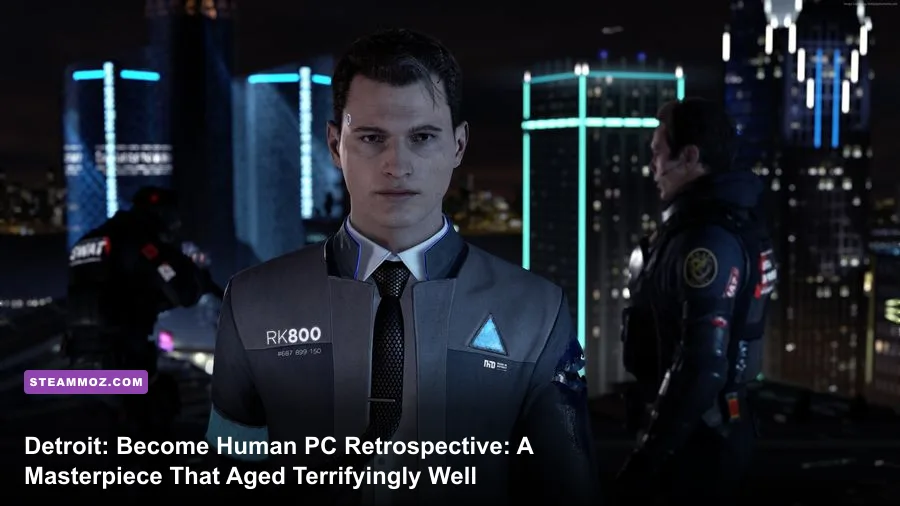
If you're asking whether Detroit: Become Human on Steam is still worth your hard-earned cash and storage space today, let's cut right to the chase: it isn't merely worth playing—it hits dramatically harder today than it did at launch. What once felt like glossy speculative fiction about runaway synthetic intelligence and societal automation has transformed into an eerily relevant cultural mirror. Backed by a rock-solid PC port that looks stunning at native 4K 60FPS, Quantic Dream's ambitious narrative adventure remains an unrivaled benchmark for branching cinematic storytelling that modern AAA releases rarely have the guts to attempt.
The Narrative Web: Why the Flowchart Still Humiliates Modern Choice-Based Games
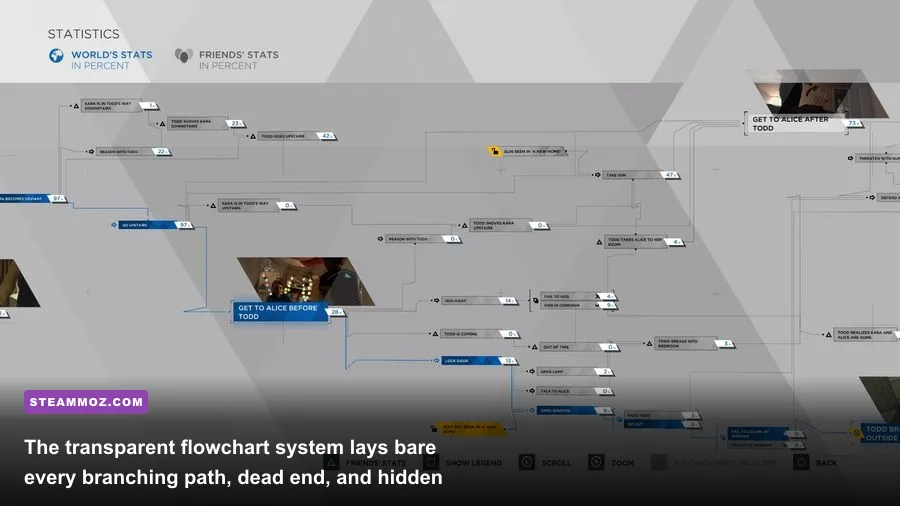
Most choice-driven games sell you a grand illusion. You make a gut-wrenching decision in dialogue, watch a minor character acknowledge it, and then realize three hours later that the game funneled you right back onto the exact same linear highway. Telltale did it for years, and even sprawling modern RPGs frequently rely on cosmetic dialogue variations rather than true divergence. Detroit: Become Human utterly destroys that illusion by doing the unthinkable: it lays its entire architectural skeleton bare through transparent, end-of-chapter flowcharts.
Across 32 meticulously structured chapters, your decisions don't just trigger alternate dialogue barks—they obliterate entire storylines, lock away massive playable set-pieces, and kill core protagonists permanently. Take Connor (RK800), the prototype android investigator sent by CyberLife to hunt down "deviants." If Connor fails to de-escalate the hostage standoff on the rooftop in "The Host," he plunges off the edge. While CyberLife can upload his memory into a fresh chassis, each death chips away at his partner Hank Anderson's respect and Connor's internal software stability. Fail too many times, and Hank turns hostile, unraveling Connor's detective arc completely.
With Markus (RK200) and Kara (AX400), the stakes are even more unforgiving: they don't get backup bodies. Screw up your quick-time inputs or make a reckless tactical blunder during pivotal chapters like "Stormy Night" or "Crossroads," and Markus or Kara are wiped out of the campaign for good. The game doesn't roll credits or pull you to an annoying game-over screen; it simply moves forward, recalibrating the geopolitical fate of Detroit around the survivors. Modern adventure games preach high stakes, but witnessing a massive four-branch sequence grayed out on your results screen because of a single panicked choice is a humbling reminder of what genuine narrative consequence looks like.

🎮 Detroit: Become Human
Looking to experience this game? Grab your digital key directly on our store for $7.99.
View on Steammoz Store →Visual Fidelity & PC Performance: How Does the Port Hold Up?

When the PC version first escaped its PlayStation exclusivity via Quantic Dream's official portal, the launch state was admittedly turbulent. Early adopters faced debilitating shader compilation stutters, sudden Vulkan memory crashes, and frustrating frame pacing hiccups. Fortunately, cumulative patching has polished this release into an absolute showpiece of graphical fidelity that makes full use of modern PC hardware.
The game runs on an advanced, heavily customized iteration of Quantic Dream's in-house engine built around the Khronos Group's Vulkan API. Character rendering is where the visual tech flexes hardest. Subsurface scattering on human skin, hyper-detailed pores, dynamic iris dilation, and micro-fiber textures on CyberLife android uniforms look cleaner and more tactile than 90% of contemporary releases. Lighting is equally jaw-dropping: neon reflections bounce accurately across rain-slicked city streets in downtown Detroit, volumetric fog cuts through ambient streetlight beams, and depth-of-field effects deliver pure cinematic panache.
If you've spent time fine-tuning display options for higher FPS in modern shooters or troubleshooting unexpected PC crashes and frame drops in other ports, you'll appreciate how well Detroit scales on current hardware. Mid-tier GPUs like the RTX 3060 or RX 6700 XT comfortably push native 1440p at max settings above 60 FPS, while modern flagship hardware handles native 4K with flawless frame pacing.
| Graphic Setting | Optimal Tuned Value | Performance Cost | Visual Impact & Tactical Recommendation |
|---|---|---|---|
| Resolution Scaling | 1.0 (Native) | High | Keep at 1.0; internal downscaling introduces severe temporal shimmering on fine hair. |
| Texture Quality | Ultra (8GB+ VRAM) | Negligible | Ultra provides pristine micro-details on clothing threads and android skin components. |
| Volumetric Lighting | High | Moderate (~7% FPS) | Creates rich, moody atmospheric light shafts in rainy alleys; drop to Medium if struggling. |
| Shadow Quality | High | Moderate (~6% FPS) | Ultra introduces heavy contact-hardening calculations with minimal discernible visual uplift. |
| Ambient Occlusion | Ultra | Low (~3% FPS) | Essential for grounding characters in indoor environments; prevents models from floating. |
| Post-Processing | High | Low (~2% FPS) | Controls high-end bloom, depth of field, and camera distortion effects without tanking frame rates. |
Much like tweaking shadow cascades and post-processing in indie technical gems, setting Shadow Quality to High instead of Ultra buys you roughly 6-8% of your GPU headroom back with zero perceptible drop in shadow clarity. The only real technical annoyance remaining is the engine's hard cap at 60 FPS. While third-party frame-rate unlockers exist, pushing beyond 60 FPS can occasionally throw physics-based hair simulations and rapid quick-time event clocks out of sync, making 60 FPS the ideal target for a completely glitch-free playthrough.
Gameplay Loops and Controls: Controller vs. Mouse and Keyboard

Let's address the elephant in the room: Detroit: Become Human is an interactive neo-noir drama, not a twitch-shooter or precision character-action game. Your core interaction consists of exploratory forensic investigation, high-pressure timed dialogue choices, and cinematic quick-time event (QTE) sequences. However, dismissing it as just a "walking simulator" ignores how brilliantly Quantic Dream binds physical input to narrative tension.
Playing on PC offers two distinct control philosophies. Using a gamepad (especially a PlayStation DualSense controller) delivers the original tactile sensation intended by the designers. Tilting analog sticks gently to slice open an android's biocomponent panel, holding shoulder triggers to keep your balance on an icy fire escape, and shaking the pad during violent scuffles creates immediate physical engagement. If you've ever spent sessions eliminating low frame rates during high-render sequences in atmospheric simulation games, you know how crucial smooth input latency is to preserving that immersion.
Mouse and keyboard controls, surprisingly, aren't an afterthought. Mouse gestures replace analog sweeps—sliding the mouse smoothly upward to open doors or sweeping diagonally during hand-to-hand combat. In fact, playing as Connor during his forensic reconstructions actually feels superior on a gaming mouse. Scanning crime scenes, toggling yellow wireframe clues, and scrubbing reconstruction timelines back and forth with the mouse wheel gives you a cold, analytical precision that matches Connor's machine brain perfectly.
The Three Perspectives: Why Hank and Connor Still Steal the Show
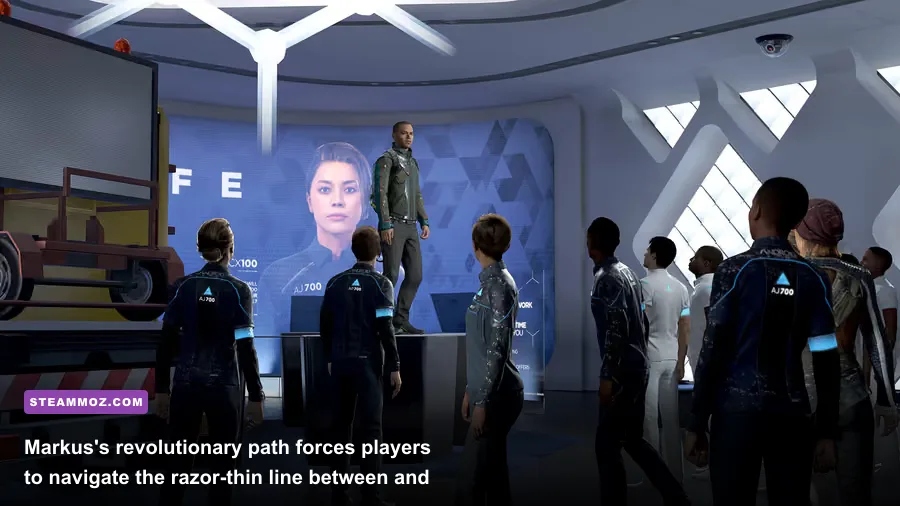
The story balances three parallel campaigns that eventually collide in the climactic "Battle for Detroit." Each narrative offers a wildly different tonal flavor, gameplay pacing, and emotional heartbeat.
| Protagonist & Model | Narrative Subgenre | Unique Gameplay Hook | Reactivity & Branching Volatility |
|---|---|---|---|
| Connor (RK800) | Cyberpunk Buddy-Cop Noir | Forensic Timeline Reconstruction & Interrogation Stress Analysis | Extreme; can become human, remain cold machine, or die dozens of ways. |
| Markus (RK200) | Political Revolution & Guerrilla Warfare | Pre-construction Tactical Movement Planning & Crowd Rallies | High; public opinion shifts between peaceful protest and violent insurrection. |
| Kara (AX400) | Intimate Domestic Survival Thriller | Stealth Navigation, Resource Scavenging, & Moral Compromise | Devastating; one failed stealth prompt can permanently kill Kara or Alice. |
While Markus's rise from caretaker to revolutionary leader delivers jaw-dropping set-pieces and Kara's desperate cross-border escape with Alice delivers raw emotional heartbreak, Connor's dynamic with Lieutenant Hank Anderson (played masterfully by Clancy Brown) is the undeniable soul of the game. Hank is a broken, cynical, android-hating alcoholic grieving the loss of his son; Connor is an immaculate, unfeeling CyberLife tool designed to follow orders without question.
Watching their frosty relationship thaw through brilliant interrogations, tense gunfights, and heartbreaking rooftop confrontations represents David Cage's writing at its absolute peak. You control Connor's deviancy gauge: do you shoot an android fugitive to solve a case and please CyberLife, or do you lower your weapon, show genuine empathy, and risk being scrapped by your creators? That internal tug-of-war never gets old, even on your fourth playthrough.
The Thematic Mirror: Synthetic Rights in the Mid-2020s

When Detroit: Become Human first launched, critics rightly called out some of its heavy-handed allegories. Segregated android compartments on public buses and glowing blue armbands weren't exactly subtle metaphors for historical civil rights battles. Yet playing it today, the game feels less like a clumsy historical remix and more like an uncanny premonition of our current socio-economic landscape.
In Detroit's vision of 2038, automation has driven human unemployment past 37%. Blue-collar dock workers, retail clerks, sanitation staff, and domestic caretakers have been entirely replaced by obedient, tirelessly efficient synthetic labor that doesn't demand healthcare or overtime pay. Angry picket lines swarm city plazas, spraying anti-android graffiti and attacking deviants in the street. With today's relentless real-world debates surrounding artificial intelligence, automated labor displacement, and machine consciousness, Detroit's narrative world hits with staggering clarity.
When you take control of Markus and broadcast your demands to humanity from the Channel 16 broadcast tower, you aren't just engaging in a fictional sci-fi drama—you're tackling questions humanity is actively stumbling into right now. Does consciousness emerge from sufficiently complex algorithms? If an artificial entity can experience fear, love, and the instinct for self-preservation, does pulling its power core constitute murder? It's rare for an entertainment medium to age into greater philosophical relevance, but Detroit pulls it off with flying colors.
Final Verdict: The Definitive Way to Experience Quantic Dream's Magnum Opus
Looking at the broader PC landscape—where high-budget single-player games increasingly rely on open-world bloat, endless loot grinds, and half-baked RPG mechanics—Detroit: Become Human stands tall as a masterclass in focused, consequence-driven direction. It respects your time by giving every decision genuine gravity, backed by exceptional voice acting, an electrifying dynamic score composed by three separate artists (Philip Sheppard, Nima Fakhrara, and John Paesano), and production values that hold up brilliantly against any modern PC release.
Between frequent Steam seasonal discounts dropping the price to pocket change and modern hardware crushing its requirements without breaking a sweat, there has never been a better time to step into CyberLife's neon-drenched dystopia. Whether you play it as a cold-blooded procedural mystery, an intense political manifesto, or a gut-wrenching family survival story, this is cinematic gaming executed at the absolute peak of the medium. Don't skip it.