Destroyer: The U-Boat Hunter does not hide a traditional collectible trail of secret locations. There are no confirmed secret rooms, buried caches, collectible cards, or off-map treasure islands waiting to be discovered. The game's hidden rewards are tied to mission objectives, successful submarine hunts, optional convoy tasks, clean tactical execution, and Steam achievements. This guide maps out where the game's real secrets are found, how to trigger them, and which supposed “secret locations” are actually sonar contacts or mission events.
That distinction matters. Exploring the tactical map at random won't uncover a secret island, and sailing beyond a convoy marker doesn't unlock a bonus chest. Destroyer: The U-Boat Hunter is a station-management combat simulator, not an open-world naval game. Its rewards are deliberately buried inside mission logic: an unidentified contact that must be classified, a transport that must survive, a U-boat that only surfaces after you force it to spend its battery, or an achievement earned by completing a difficult task without wasting ammunition.
The advice below is based on the game's core campaign and combat systems. For patch notes, current mission availability, and any newly added objectives, check the official Steam page and the Iron Wolf Studio website before treating a community rumor as fact.
Are There Really Secret Locations?
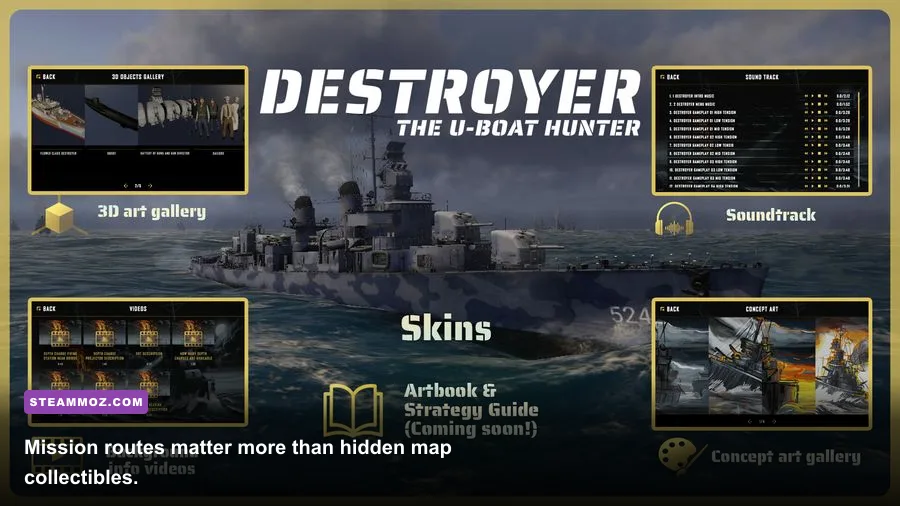
The short answer is no—not in the conventional sense. The campaign's operational maps contain convoy lanes, patrol areas, approach vectors, and scripted or semi-scripted submarine encounter zones. They aren't designed as free-roaming maps with hidden landmarks. A mission may place a U-boat outside the most obvious search arc, but that is a tactical contact problem rather than a collectible location.
What players often call a “secret location” is usually one of four things. First, a submarine can sit outside the initial sonar sweep, forcing you to widen the search pattern. Second, an underwater contact may be classified incorrectly as a false echo until you compare bearing, range, and movement. Third, an optional mission condition can appear only after the primary convoy objective is safe. Finally, an achievement can reward a particular method of engagement rather than a geographic discovery.
| What Players Call a Secret | What It Actually Is | How to Reveal It | Reward Type |
|---|---|---|---|
| Hidden U-boat zone | Contact outside the first search arc | Use expanding sonar sectors and hydrophone checks | Kill credit, mission score |
| Secret convoy objective | Optional protection or detection task | Read the briefing and watch the objective panel | Bonus completion progress |
| Buried reward | Achievement condition | Complete a specific tactical action | Steam achievement |
| Invisible island | Navigation or map boundary | Not discoverable; it is not content | None |
Before every sortie, pause and read the complete briefing instead of rushing to the action stations. The briefing tells you which vessels matter, where the convoy is expected to travel, and whether the mission is about escort, interception, or submarine destruction. Those details define the real “secret route.” If the convoy is the mission's protected asset, chasing a distant contact can fail the objective even when you score a U-boat kill.

🎮 Destroyer: The U-Boat Hunter
Looking to experience this game? Grab your digital key directly on our store for $14.99.
View on Steammoz Store →Where the Hidden Contacts Actually Spawn
There is no universal coordinate list because contact placement depends on mission setup, difficulty, and the tactical situation. Still, hidden submarines consistently become easier to find when you search the areas a real commander would prioritize: the convoy's projected path, the blind side of your escort formation, and the water behind or ahead of the transport group where a U-boat can set up an attack run.
Start with the last known bearing, then avoid charging straight toward the contact. A destroyer that races through the area creates noise, changes the geometry of the search, and can pass directly over a submarine before the crew obtains a useful solution. Set a predictable course, reduce unnecessary speed when listening, and let the sonar operator build a stable picture.
When a contact disappears, don't assume the game has moved it to a secret location. A submerged U-boat can change depth, turn away, and exploit the way sound travels through the water. Mark the last bearing and range, then search in a widening fan rather than making random circles. Hydrophone information is especially valuable when active sonar is unavailable or when you need to approach without announcing your exact position.
The reliable search pattern
- Record the first bearing. Note whether the contact is ahead, abeam, or astern of the destroyer.
- Classify before attacking. Check whether the echo behaves like a submarine rather than a transient or surface contact.
- Build a search fan. Sweep one side of the last known position, then the other, instead of looping over the same water.
- Use speed deliberately. High speed helps close distance but makes quiet tracking and precise final positioning harder.
- Predict the escape route. A U-boat avoiding a destroyer usually creates a better search position behind its turn than at its original contact point.
| Contact Situation | Best Station | Common Mistake | Correct Response |
|---|---|---|---|
| Weak or intermittent echo | ASDIC and hydrophone | Firing at the first blip | Confirm bearing consistency over multiple sweeps |
| Contact vanishes after a turn | Hydrophone | Searching the old location | Search beyond the turn along the likely escape vector |
| U-boat near convoy lane | Escort screen | Chasing without protecting transports | Keep the convoy between the threat and the objective |
| Surface or periscope sighting | Gunnery and torpedo defense | Overcommitting to depth charges | Use the weapon matching the submarine's current state |
This is also why a “secret spot” video can seem convincing while failing in your mission. The creator may have found a contact after a specific convoy movement, while your formation and timing produce a different solution. Treat the location as a tactical clue, not a fixed collectible coordinate.
Hidden Rewards From Sonar and Weapon Mastery
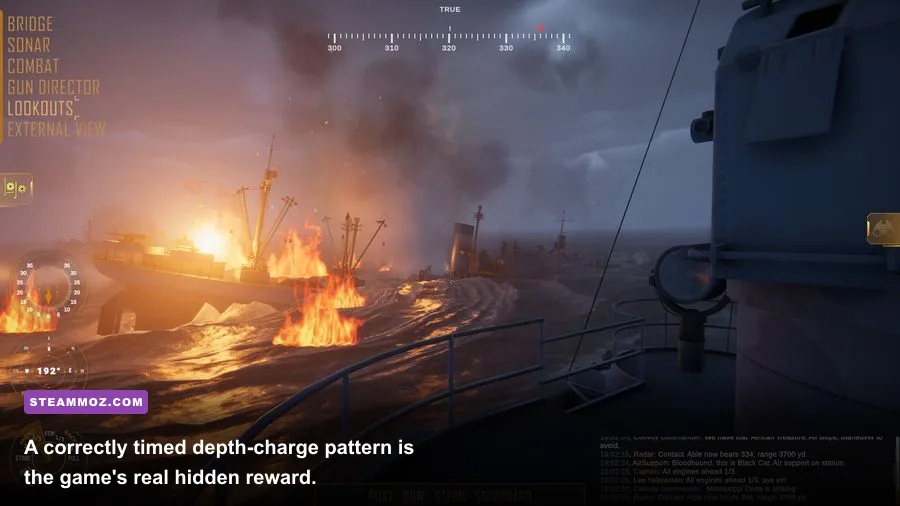
The best hidden rewards come from learning what each station can reveal. ASDIC gives you an active underwater search, but it also exposes the destroyer's presence. Hydrophones are slower and less immediately precise, yet they let you listen for movement while preserving uncertainty. Radar and visual lookout information matter when a U-boat surfaces, uses its periscope, or launches an attack. Switching stations at the right moment is more valuable than memorizing a map.
Depth charges are not a magic button. The attack depends on the submarine's estimated position, depth, heading, and your own speed. Dropping too early produces a harmless splash behind the target; dropping too late sends the pattern over the submarine's previous location. Use the contact solution to place the run across the U-boat's projected path, not directly on the last visible mark.
Hedgehog-style forward attacks are strongest when you have a reliable bearing and a controlled closing angle. They reward patience because the projectiles need a good solution before release. Conventional depth charges are more forgiving when the submarine is already astern or when you have only a rough estimate of depth. The hidden skill check is knowing when not to fire.
| Tool or Station | Best Use | Reward-Linked Skill | Failure Risk |
|---|---|---|---|
| ASDIC | Confirming an underwater contact | Maintaining a stable attack solution | Alerting the U-boat and losing contact |
| Hydrophone | Quiet tracking and reacquisition | Finding a submerged target without rushing | Misreading noise as a confirmed target |
| Radar | Surface contacts and approach awareness | Detecting threats before visual range | Ignoring underwater contacts while watching it |
| Depth charges | Astern attacks and uncertain solutions | Correct timing and depth estimation | Wasting a pattern behind the target |
| Forward anti-submarine weapon | Close, confirmed submerged target | Precision attack from a controlled approach | Firing with a poor bearing solution |
| Main guns | Surface targets and emergency defense | Protecting the convoy without abandoning formation | Using them as a substitute for anti-submarine weapons |
For a deeper look at performance tuning in demanding PC games, Steamoz's Kholat graphics settings guide and Kujlevka smooth-FPS guide cover the same frame-time priorities that help here: stable delivery is more useful than a flashy but inconsistent frame rate.
Mission Objectives That Unlock the Real Rewards

Destroyer: The U-Boat Hunter's meaningful unlocks are attached to mission completion and performance rather than exploration. Protecting the required ships, locating the submarine, surviving the engagement, and using the correct station all contribute to a successful sortie. Some rewards are visible immediately as mission progress; others are best understood as Steam achievement conditions.
Don't abandon the operation the moment the first U-boat is damaged. Check the objective panel. A wounded submarine may still threaten the convoy, and a mission can require more than one contact. Likewise, don't chase a fleeing target beyond the area if doing so exposes the transports. The game is testing command judgment, not just your ability to produce an explosion.
A clean reward-focused run
- Read every objective. Separate the primary condition from optional tasks before ordering the ship into the search area.
- Keep the formation intact. A destroyer that wanders too far can win the duel and still lose the mission.
- Confirm the target. Use multiple sonar readings and hydrophone information before spending limited attack opportunities.
- Attack on a forecast position. Depth charges should meet the submarine where it will be, not where it was.
- Recheck the sea after the attack. A damaged U-boat may dive, turn, or attempt another attack run.
- Finish the extraction or escort phase. The final safe convoy state is part of the reward condition.
| Objective Type | Priority | Best Tactic | What You Earn |
|---|---|---|---|
| Protect convoy vessels | Critical | Stay between threat and transports | Mission completion and progression |
| Find an unidentified contact | High | Use controlled sonar and hydrophone sweeps | Detection progress or optional credit |
| Destroy a U-boat | High | Match weapon to depth and bearing | Combat credit and possible achievement progress |
| Preserve ammunition or ship integrity | Situational | Fire only with a usable solution | Higher-quality mission performance |
| Complete the operation | Critical | Remain alive and follow the end-state objective | Campaign progression |
Achievement hunters should use the game's official Steam statistics page as the final authority. Achievement names and requirements can change, and community lists sometimes combine planned content with released content. If an achievement seems to demand a hidden coordinate, check whether the wording actually describes a weapon, survival, escort, or detection action.
Rumors, Bugs, and What Not to Waste Time On
Several common “secret location” claims are simply misunderstandings. Sailing to the extreme edge of the operational map does not reveal a developer room. Circling an island or heading toward an empty radar mark does not unlock a cache. Repeating a mission while firing every weapon at random is not a reliable way to trigger hidden content. These actions cost time, ammunition, and convoy safety without providing a reward.
There is also a difference between a hidden mechanic and a bug. If the sonar display freezes, a contact fails to update, or a mission objective refuses to complete after the stated conditions are met, record the mission, difficulty, and reproduction steps. Then compare the issue with current reports on the official Steam discussion hub. A broken objective can look exactly like a secret trigger when it is really a state-tracking problem.
For PC stability, keep the game at a frame rate your system can hold consistently and avoid background overlays while testing a suspected mission issue. Steamoz's max-FPS settings breakdown explains why frame-time consistency matters in demanding combat games, while the PC fixes guide for Koa and the Five Pirates of Mara is useful when separating software problems from game design.
The practical verdict is simple: there are no confirmed collectible secret locations to sweep in Destroyer: The U-Boat Hunter. The hidden rewards are earned by finding contacts efficiently, preserving the convoy, selecting the right anti-submarine weapon, and completing mission-specific conditions. Treat each map as a tactical puzzle rather than a treasure hunt. Once you stop searching for imaginary islands and start tracking the submarine's likely path, the game's most satisfying secrets become much easier to uncover—and your mission results improve immediately.