
Death Howl Deluxe Edition is worth playing in 2026 if you want a compact, story-led roguelite where positioning matters as much as card quality. The base game delivers the meaningful experience: a mournful journey through a Nordic-inspired spirit world, grid-based encounters, deckbuilding, exploration, and a surprisingly personal story about grief. The Deluxe Edition is harder to recommend at full price unless you care about the digital soundtrack and artbook, but the game itself remains an excellent pick for players who prefer thoughtful turns over frantic combat.
That distinction matters. This isn't a huge live-service RPG with hundreds of hours of seasonal content, and it isn't trying to be another Slay the Spire clone with a new coat of paint. Death Howl is a focused single-player adventure built around Ro, a grieving protagonist who enters a dangerous realm of spirits while trying to understand loss. Its best ideas are tightly connected: the bleak setting makes the story land, the grid makes every card more interesting, and the short-run structure keeps failure from becoming exhausting.
For the latest platform details, screenshots, and edition contents, check the official Death Howl Steam page. After spending time with the full release, here's the honest answer for 2026: buy the standard edition if you're primarily here for the game, and choose Deluxe during a sale if you want the complete audiovisual package.
Death Howl's combat is the reason to stay

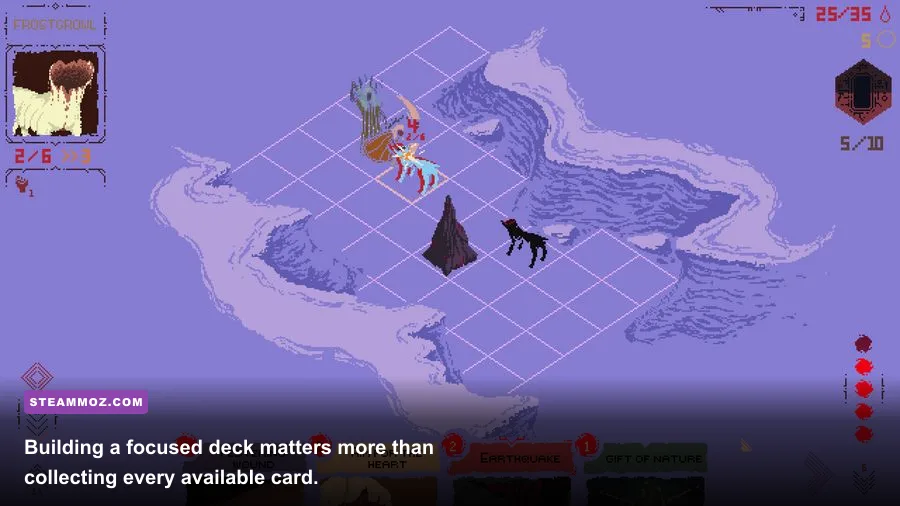
Death Howl's combat takes place on a tile-based arena, and that single decision gives its card system considerably more bite. A damage card isn't just a number in your hand. You need to consider range, line of attack, enemy movement, safe tiles, and whether spending energy now leaves you exposed during the next enemy turn. A strong-looking play can be completely wrong if it strands Ro beside a hostile spirit.
That makes the game feel closer to a compact tactical RPG than a conventional card battler. You draw cards, spend resources, move across the battlefield, and respond to visible threats. Enemies telegraph their intentions clearly enough that defeats usually feel understandable. If an opponent is about to occupy a tile or launch a directional strike, the puzzle becomes finding a route that preserves your next turn rather than simply maximizing immediate damage.
The most important habit is to stop treating movement as a leftover action. Movement is part of your damage plan. A carefully chosen tile can create distance, open a line for a ranged card, deny an enemy's preferred approach, or let you finish a target without walking into the attack zone of another. Players coming from traditional deckbuilders often waste early turns attacking from poor positions. Death Howl quickly teaches you that a mediocre card played from safety is often better than a powerful card that creates a fatal counterattack.
Cards also gain value from context. A defensive effect can buy time for a high-damage turn, while a movement effect can be the key to making a narrow attack work. You won't always assemble a flashy infinite combo. Instead, the satisfying moments come from turning an awkward hand into a clean sequence: shift to a safe tile, create distance, strike the exposed enemy, then end the turn outside the next telegraphed attack.
| Combat Element | What It Changes | Best Player Habit | Common Mistake |
|---|---|---|---|
| Grid position | Controls range, safety, and attack routes | Plan the enemy turn before spending your last card | Moving only after all attacks are used |
| Card energy | Limits how much you can do in one turn | Keep enough resources for an escape or defense | Emptying the resource bar for small damage |
| Enemy telegraphs | Reveal the next major threat | Prioritize enemies that restrict your movement | Focusing the lowest-health target automatically |
| Deck size | Determines consistency and draw quality | Remove weak cards when the opportunity appears | Adding every new card because it looks useful |
The result is deliberate rather than explosive. If you want constant screen-filling effects, Death Howl may feel restrained. If you enjoy reading a battlefield and winning because you saw the trap two turns early, its combat has real staying power.

🎮 Death Howl Deluxe Edition
Looking to experience this game? Grab your digital key directly on our store for $16.35.
View on Steammoz Store →Deckbuilding rewards focus instead of greed
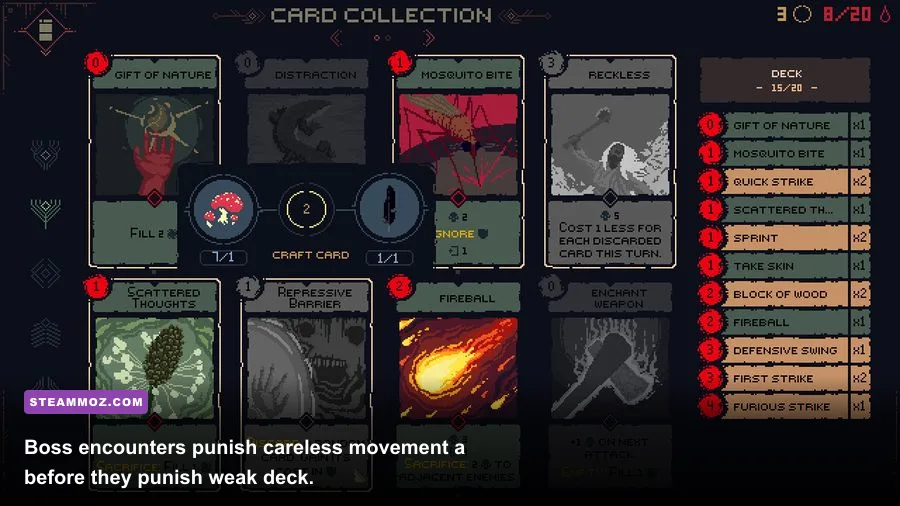
The deckbuilding is strongest when you approach it as a consistency problem. New cards are tempting, especially after a difficult encounter, but a bloated deck makes your best tools harder to find. Death Howl rewards a compact plan: decide whether your current run is leaning toward direct damage, control, defense, mobility, or a hybrid that genuinely supports two of those ideas. A pile of individually decent cards is not the same thing as a functioning deck.
That advice is especially important early on. Your first few rewards should solve an immediate weakness rather than chase a perfect late-game build. If Ro is regularly cornered, prioritize cards that improve positioning or reduce incoming pressure. If enemies survive long enough to surround you, look for reliable damage and effects that punish clustered targets. The game is generous enough to let you experiment, but not so generous that every card choice becomes irrelevant.
There is also a satisfying tension between permanent progression and run-based progress. You learn more about the available card pool and encounters with each attempt, but knowledge alone won't rescue a sloppy turn. That balance keeps failure useful. You can come away from a lost run with a better understanding of a card interaction, a dangerous enemy pattern, or the point at which your deck needs to stop adding new pieces.
My preferred approach is to value repeatability over theoretical ceiling. A card that works in most hands is more valuable than a spectacular effect that requires three specific conditions. Keep your deck lean, avoid redundant effects unless they are central to the build, and don't mistake rarity for compatibility. When a reward doesn't support your plan, passing on it is often the correct decision.
| Build Direction | Priority | Strong Situation | Risk |
|---|---|---|---|
| Direct damage | Reliable attacks and safe range | Single targets and short encounters | Running out of defense when enemies close in |
| Control and mobility | Movement, spacing, and enemy manipulation | Dense arenas with several threats | Taking too long to finish durable enemies |
| Defensive attrition | Protection and dependable counterattacks | Bosses and predictable attack patterns | Losing tempo against swarms |
| Hybrid setup | Two compatible effects with minimal filler | Long runs with varied encounter types | Becoming mediocre at both jobs |
Players who enjoy deckbuilders for their decision-making will find plenty to chew on. Players who mainly want to unlock a broken build and steamroll every encounter may find the experience less immediately rewarding. Death Howl's best runs feel earned because the game keeps asking whether your current deck actually works on the board in front of you.
The story gives the roguelite structure a pulse
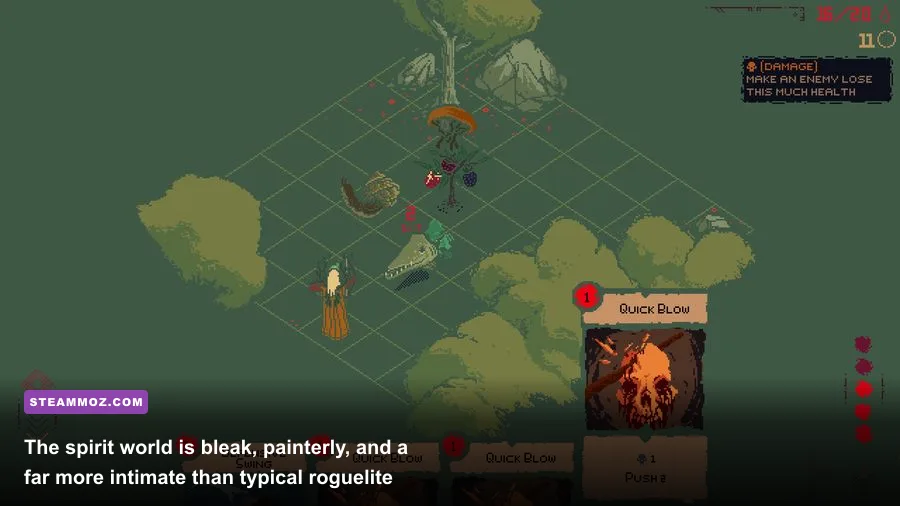
Death Howl's narrative is not decorative wallpaper behind the mechanics. Ro's grief gives the journey a clear emotional direction, and the spirit-world setting lets the developers explore memory, absence, and acceptance without turning the game into a conventional fantasy epic. Its visual language is grounded in a harsh, mythic Stone Age atmosphere: weathered landscapes, unnatural spirits, and environments that feel like emotional spaces as much as physical locations.
The writing works best when it stays quiet. Death Howl doesn't need Ro to deliver a dramatic speech after every battle. Small pieces of context, environmental details, and the rhythm of returning to the world after a failed attempt do more work than constant exposition. The bleakness can be heavy, but it gives the otherwise abstract run structure a reason to exist.
That atmosphere is also why the Deluxe Edition's extras have more value here than they would in a disposable arcade roguelite. A digital soundtrack and artbook won't add new mechanics, but they extend the mood beyond the campaign. The music is a major part of the game's identity, particularly during exploration and story beats where the sparse presentation leaves room for the score to carry tension.
Still, don't buy Deluxe expecting a large expansion. The edition is fundamentally a presentation upgrade, not a separate campaign or a major gameplay package. If you never open digital bonus material and usually listen to games with your own playlist, the standard release is the smarter purchase. The core story, combat, and exploration are not locked behind the premium edition.
For comparison, readers who enjoy games with strong atmosphere and focused progression may also like Steamoz's coverage of Everspace 2's hidden locations, though Death Howl is much smaller and more deliberately paced. The shared appeal is the feeling that exploration is revealing character rather than simply filling a checklist.
Performance, length, and value in 2026
Death Howl is a relatively modest PC game, and that works in its favor. Its painterly 2D presentation and contained arenas don't demand a high-end graphics card, while the turn-based structure means you aren't making frame-perfect inputs during combat. On a modern gaming PC, the sensible target is a locked 60 frames per second at 1080p. Higher refresh rates are welcome for navigation, but they don't transform the tactical experience.
Use the game's native resolution first, then adjust effects quality if your system struggles. The biggest practical gain will come from reducing post-processing or environmental effects rather than aggressively lowering texture detail. Because the battlefield is visually readable by design, a stable frame rate and clear enemy telegraphs matter more than chasing a few extra pixels.
| Profile | Resolution and Preset | Expected Result | Who It Suits |
|---|---|---|---|
| Entry-level | 1080p, Low to Medium | Stable 60 FPS on supported hardware | Older laptops and integrated-graphics systems that meet Steam's minimum |
| Balanced | 1080p, High | Locked 60 FPS with stronger visual detail | Most mainstream gaming PCs |
| High-refresh | 1440p, High, effects trimmed if needed | Fluid exploration with modest gains in combat feel | Mid-range GPUs and 120Hz-plus displays |
| Battery-friendly | 720p or 900p, Medium, 30 or 40 FPS cap | Lower power draw and fan noise | Steam Deck and portable play |
The Steam listing's baseline requirements are approachable, but portable performance depends more on the device's power profile than on raw GPU strength. A 30 FPS cap is perfectly comfortable for the turn-based battles, while a 40 FPS cap is a nice middle ground if your handheld can maintain it without excessive battery drain. Disable unnecessary overlays if you see hitching, and give the game a clean restart after changing major display settings.
As for length, Death Howl is best understood as a focused campaign with replayable runs, not an endless hobby game. Your first playthrough will take longer because you'll be learning the card pool and enemy behavior. Later attempts move faster, but the appeal depends on whether you enjoy refining decisions after failure. The game offers enough replay value for a deckbuilder, yet it doesn't pretend that every player will spend hundreds of hours inside it.
That makes the value question straightforward. At a discount, the standard edition is an easy recommendation for fans of tactical roguelites. At full price, it depends on how much you value the story and presentation. Deluxe earns its premium only when the soundtrack and artbook matter to you. For broader PC optimization advice, Steamoz's ELEX PC fixes and Far Cry 6 graphics settings guide cover more demanding games, but the same principle applies here: stable performance beats a flashy preset.
Who should buy the Deluxe Edition?

Death Howl Deluxe Edition is an excellent fit for players who want a serious, self-contained deckbuilder with a strong emotional center. It suits fans of grid tactics, turn-based combat, card experimentation, and indie games that trust silence and atmosphere. The combat has enough tactical friction to reward mastery, while the story gives each run more meaning than a random collection of rooms and rewards.
It is less suitable if you need fast action, extensive character classes, online co-op, or a huge post-game ecosystem. The game doesn't bury its mechanics under a mountain of content. That focus is a strength, but it also means the experience can feel narrow if you expect a live-service time sink or a sprawling RPG with dozens of equipment slots.
My final recommendation is to buy the standard edition first if you're uncertain. The Deluxe upgrade makes sense for players who finish the game and want to support the developer, collect the digital extras, or keep the soundtrack. If the price gap is small during a Steam sale, Deluxe becomes the obvious version. Otherwise, the base game contains the part that matters most: the carefully tuned combination of cards, positioning, enemy telegraphs, and grief-soaked exploration.
| Player Type | Recommendation | Why |
|---|---|---|
| Tactical deckbuilder fan | Buy | The grid makes familiar card decisions more spatial and deliberate |
| Story-first indie player | Buy on sale | The atmosphere is strong, but the campaign is focused rather than enormous |
| Digital soundtrack collector | Buy Deluxe | The bonus material complements the game's strongest artistic feature |
| Action-game fan | Try before buying | Combat is thoughtful and turn-based, not fast or reflex-driven |
| Hundreds-of-hours roguelite player | Wait for a discount | Replayability depends on enjoying refinement, not endless content |
Death Howl doesn't reinvent deckbuilding, but it understands exactly what its version needs to be. The grid gives every card a physical consequence, the story gives every failed run emotional context, and the restrained presentation keeps the experience memorable instead of noisy. In 2026, that combination still feels distinctive.
Verdict: Death Howl is worth playing, and the Deluxe Edition is worth choosing when the soundtrack, artbook, and sale price line up. Buy it for the thoughtful combat and mournful world; skip it only if you need constant action or a limitless endgame.
For more focused PC recommendations, see Steamoz's Empires of the Undergrowth leveling guide. You can also follow the developer through The Outer Zone's official website and check the game's official Steam community hub for updates, player discussions, and current edition information.